Our readers keep the lights on and my smoothie glass nicely filled. As an Amazon Associate, I earn from qualifying purchases.
Specs are compiled from manufacturer listings and verified buyer reviews and can change over time — please confirm the key details on the product page before buying.
A compact monocular lets you see the details you’d otherwise miss. The heron around the bend, the setlist on a distant stage, the trail marker half-hidden in the brush — they are all within reach if you have the right glass in your pocket. Most pocket telescopes sacrifice either image clarity or portability. The best compact monocular fits in your jacket and delivers a sharp, steady view instantly.
I’m Mohammad Maruf — the founder and writer behind WellFizz. This guide is built by comparing the manufacturers’ published specifications and the patterns across verified customer reviews, so you get each pick’s real strengths and trade-offs instead of marketing spin.
Whether you are hiking a ridge or scanning the skyline at a concert, picking the right compact monocular depends on matching the magnification and lens size to your most common use — and ignoring the hype around numbers you will never need handheld.
Our Picks at a Glance


How To Choose The Best Compact Monocular
A compact monocular is simpler than binoculars, but there are a few numbers that separate a genuinely useful tool from a frustrating toy. Here is what to look for.
Magnification and Objective Lens Size
You will see a product described as “8×32” or “10×25.” The first number is the magnification — how many times closer an object appears. The second is the objective lens diameter in millimeters. A larger objective lens lets in more light, which directly translates to a brighter image in low-light conditions like dusk or heavy shade. An 8×32 is the most versatile all-rounder for a compact monocular; the 8x is steady enough to hold by hand without a tripod, and the 32mm lens gathers enough light for most conditions. A 10×25 offers more reach but a dimmer view and more image shake.
Lens Coatings and Prism Type
The coating on the lens controls how much light passes through to your eye. “Fully multi-coated” means every lens surface has multiple anti-reflective layers — this is the standard you want for a crisp, bright image without glare. The prism is the internal glass that corrects the image orientation. BAK-4 is a high-density barium crown glass that produces a sharper, rounder image with better edge definition, while cheaper BK-7 glass often gives a slightly clipped or dimmer view.
Field of View and Eye Relief
Field of view (FOV) is measured in feet at 1,000 yards — a higher number means you see a wider panorama without having to sweep the monocular around. This matters a lot for tracking birds in flight or scanning a landscape. Eye relief is the distance your eye can be from the eyepiece while still seeing the full image. If you wear glasses, you need at least 15mm of eye relief. A twist-up eyecup lets you adjust that distance precisely for glasses or bare eyes.
Quick Comparison
| Model | Best For | Magnification | Objective Lens (mm) | Weight (oz) | Amazon |
|---|---|---|---|---|---|
| Nocs Provisions Zoom Tube 8×32★ Best Overall | All-round clarity and build quality | 8x | 32mm | 9.5 | Amazon |
| Vortex Solo Monocular 8×36Top Performer | Unconditional lifetime warranty | 8x | 36mm | — | Amazon |
| Nocs Provisions Field Tube 10×32Premium Pick | High magnification with great glass | 10x | 32mm | 8.09 | Amazon |
| Maven CM.1 8x32mm | Premium optics in a pocketable frame | 8x | 32mm | 8.7 | Amazon |
| Olimt 8×32 Monocular Telescope | Value packed with premium coatings | 8x | 32mm | 8 | Amazon |
| Jizmo 8×25 High Definition Monocular | Close-focus detail work | 8x | 25mm | 5.6 | Amazon |
| URBANCOAST 8×32 Mini Monocular | Ultra-rugged all-weather use | 8x | 32mm | 9.9 | Amazon |
| OLIMT 10×25 Monocular Telescope | Shirt-pocket 10x magnification | 10x | 25mm | 5.8 | Amazon |
| Barska Blackhawk 10×25 Monocular | Budget entry-level waterproof | 10x | 25mm | 0.15 Pounds | Amazon |
In‑Depth Reviews
1. Nocs Provisions Zoom Tube 8×32 Monocular
Our pick — over 4.5★ from 400+ verified ratings; the strongest balance of quality and price.
A pocket companion that makes you want to look at everything twice.
This is the monocular that owners describe as their favorite new tool — and it is easy to see why. The 8×32 configuration with a Swiss-designed Bak4p prism delivers a field of view of 384 feet at 1,000 yards, which means you can scan a hillside or a stadium without feeling like you are peering through a straw. The fully multi-coated optics produce a crisp, bright image that keeps color accurate right to the edge of the lens. It weighs 9.5 oz and measures 5.5 by 2.5 inches, so it slides easily into a backpack pocket, though a few note it is not a true jeans-pocket fit.
The build quality is where this one stands out from the pack. The patented Rugged Wave Grip actually feels secure in a wet hand, and the IPX4 water resistance means a sudden rain shower will not end your session. There is a 1/4-inch tripod thread built into the frame for when you want a steady view, and a multi-stop twist-up eyecup that makes it genuinely comfortable for eyeglass wearers. The “No-Matter-What” Lifetime Warranty removes the worry about a drop on the trail. What wins people over is the overall quality — over 40 owners cite it as the top reason to buy — and the clarity, which 37 separate buyers praise.
For the money, you get a monocular that rivals optics at twice its price. It even accommodates smartphone photography: just line up your phone camera to the eyepiece and capture the scene. As owners put it: “a monocular (5.5×2.5 in, 9-10 oz) with 4X microscope attachment — excellent for birding and fossil work.” The only real trade-off is the size; it is compact for what it is, but not micro. If you want something that disappears into a coin pocket, look at the Jizmo 8×25 below. But for anyone who wants the best overall balance of clarity, brightness, and durability, this is the one.
What owners applaud
- Exceptional clarity and brightness from fully multi-coated optics.
- Rugged Wave Grip feels secure even in wet conditions.
- Built-in tripod mount adds versatility for steady long-viewing.
- Lifetime warranty inspires real confidence on the trail.
Who should think twice
- Fits a backpack or jacket pocket easily, but some find it a bit bulky for tight jeans pockets.
- No included neck lanyard — you may want to add your own.
Reach for this if: you want a do-everything compact monocular with excellent glass, a lifetime warranty, and a secure grip for hiking, birding, and travel.
Look elsewhere if: your top priority is absolute minimum size and weight for a coin pocket — the Jizmo 8×25 is lighter and smaller.
2. Vortex Solo Monocular 8×36
Buy this when you want to stop worrying and just look.
Vortex has built a reputation on its unconditional lifetime VIP warranty — if it breaks, they repair or replace it, no questions asked, no receipt needed. That promise alone pushes the Solo 8×36 ahead of many competitors for anyone who plans to use their monocular hard in the field. The 36mm objective lens is larger than the standard 32mm found on most compact units, which means it gathers noticeably more light in dawn, dusk, or deep shade. The fully multi-coated lenses deliver the clarity that owners cite as the number one reason to buy — with 95 separate mentions, it is the most praised feature across the entire category.
It is not the smallest option here. At 4.9 inches tall and with a fairly bulky utility clip, it does not slide into a shirt pocket as easily as the Olimt or Jizmo. Owners note that one-handed focusing is unrealistic due to a stiff focus wheel and the clip design. But that stiffness also means the focus stays where you set it, and the rubber armor makes it extremely durable. The adjustable eyecup works for glasses wearers, and the field of view is generous enough for scanning. If you compare it to the Nocs Zoom Tube above, the Vortex has better low-light performance thanks to the larger 36mm objective, but it is bulkier and harder to operate one-handed.
For around the same price as the Nocs, you get a 36mm objective that out-gathers the 32mm competition, plus a warranty that is essentially forever. The downsides are real: it is not truly pocketable for most people, and the focusing requires two hands. But if your priority is durability and low-light brightness, and you can live with a little extra heft, this is a fantastic choice.
Standout strengths
- Larger 36mm objective lens provides a noticeably brighter image in low light.
- Unconditional, transferable lifetime warranty — best in the industry.
- Rubber armor and nitrogen-purged build are extremely rugged and waterproof.
Honest limitations
- Bulky design and heavy clip mean it is not a true pocket carry.
- Focus wheel is stiff, making one-handed operation difficult.
Best for: the user who wants the absolute best warranty and the brightest view in low light, and does not mind a larger unit that rides on a belt clip.
Not for: anyone who needs a micro-sized monocular that disappears into a jeans pocket or jacket liner.
3. Nocs Provisions Field Tube 10×32 Waterproof Monocular
More reach, same superb build, now fully submersible.
The Field Tube takes everything that makes the Zoom Tube great and pushes it further. The 10x magnification gives you a tighter view than the 8x Zoom Tube, which is ideal for spotting details on distant mountain ridges, identifying waterfowl across a marsh, or checking targets at the range. The 32mm objective still pulls in plenty of light, though the exit pupil diameter of 3.28 mm is smaller than the Zoom Tube’s 4 mm, making it slightly less forgiving in low light. The field of view is 333 feet at 1,000 yards — narrower than the 8x version, as expected, but still wide enough for practical use.
Where this monocular really shines is its waterproofing. The IPX7 rating means it can be submerged in up to three feet of water for 30 minutes without damage, and the nitrogen sealing prevents internal fogging. The oversized focus wheel is precise and allows adjustments from 9.3 feet to infinity, and the multi-stop twist-up eyecup makes it comfortable for glasses wearers. It weighs just 8.09 oz — lighter than the 8x Zoom Tube — and the patented Wave Grip is as secure as ever. Owners praise the optical quality and the one-handed operation, which they note is actually easier than the Vortex Solo. The clarity rating, however, is mixed — a few owners find it slightly less sharp than they expected at 10x, which is a common trade-off for higher magnification in a compact format.
If you frequently need to see farther and are willing to accept a slightly narrower field of view and stricter stability requirements, the Field Tube is an excellent step up from the Zoom Tube. The lifetime warranty applies here too.
Why it stands out
- 10x magnification gives meaningful extra reach for birding and range spotting.
- IPX7 waterproof and fogproof — survives total submersion.
- Oversized focus wheel is precise and easy to operate one-handed.
The trade-offs
- Higher magnification means more image shake when hand-held.
- Field of view is narrower than the 8x version.
Buy it for: situations where you need 10x reach in a fully waterproof, one-handed package — ideal for kayaking, coastal hikes, and long-range observation.
skip it if: you mostly scan wide landscapes or have trouble keeping a 10x steady; the 8x Zoom Tube is more forgiving.
4. Maven CM.1 8x32mm Monocular

The optical purist’s pocket companion, if you can tolerate the stiff focus ring.
Maven is known for high-end optics at direct-to-consumer prices, and the CM.1 8×32 delivers exactly that philosophy in a palm-sized package. The premium glass and fully multi-coated lenses produce edge-to-edge clarity that owners consistently rate as excellent — it is the most praised aspect by a wide margin. The field of view is a generous 393 feet at 1,000 yards, which is wider than the Nocs Zoom Tube and gives you a genuinely expansive panorama. It weighs 8.7 oz and fits easily into a jacket pocket, making it one of the more portable premium options.
The elephant in the room is the focus ring. It is very stiff — noticeably tighter than any other monocular in this guide. Some owners appreciate that it prevents accidental adjustment, but others find it difficult to use for quick birding or tracking moving subjects. The eye relief adjustment is also loose, which can be frustrating. This is a monocular best suited for static observation: scanning a canyon, studying architecture, or watching a distant animal that is not moving fast. If you compare it to the Olimt 8×32 below, the Maven has superior glass clarity and a wider field of view, but the Olimt’s focus ring is far smoother for active use. The lack of a 1/4-inch tripod socket is another omission that puzzles owners given the price point.
Maven backs it with an unconditional life-time warranty — same as Vortex. For the buyer who values optical purity above all else and does not mind a stiff focus ring, the CM.1 is a worthy investment. For anyone who needs quick, reactive focusing, the Nocs or Olimt is a better fit.
What you are paying for
- Premium glass with exceptional edge-to-edge clarity and minimal chromatic aberration.
- Wide 393-foot field of view at 1,000 yards — excellent for landscape scanning.
- Compact and lightweight at 8.7 oz; fits easily in a chest pocket.
The catch
- Focus ring is very stiff, making it difficult for rapid focus adjustments.
- No tripod mount socket, which limits extended viewing stability.
Choose this if: you are a static observer — landscape scanning, architecture, or stationary wildlife — and want the absolute best glass clarity in a compact form.
Pass on it if: you need to focus quickly on moving subjects like birds in flight or sports; the stiff ring will frustrate you.
5. Olimt 8×32 Monocular Telescope Mini Pocket

High-end coatings at a mid-range price that outperform the cost.
At first glance, the Olimt 8×32 looks like another no-name monocular. Then you read the spec sheet and realize it packs fully multi-coated extra-low dispersion lenses and BAK-4 prisms with both phase and dielectric coatings — the same optical treatments found in enthusiast-level binoculars. That combination delivers an image that owners describe as exceptionally clear with high color reproduction and low distortion. The field of view is an impressive 397 feet at 1,000 yards and beats both the Nocs Zoom Tube (384 feet) and the Maven CM.1 (393 feet).
It weighs 8 oz and measures 4.17 by 1.49 inches, making it genuinely pocketable. The all-metal body is IPX7 waterproof, so it can survive an accidental drop in a stream. The large focus wheel is smooth and easy to operate one-handed. Owners consistently cite the quality and image quality as the top reasons to buy. The only recurring note is a slightly short depth of field, meaning you have to be precise with the focus in cluttered landscapes. Compared to the Nocs Zoom Tube, the Olimt is narrower and lighter, and offers a slightly wider field of view for a lower price, though the Nocs wins on build feel and warranty length.
For the price, this is the strongest value proposition in the list. You get optical coatings normally reserved for premium-tier products, a wide field of view, and a durable waterproof body. The downsides are minor: no lifetime warranty and a slightly short depth of field. But for most hikers and day-trippers, this is an absolute steal.
Why it wins on value
- Phase and dielectric coatings on BAK-4 prisms — rare at this price point.
- Widest field of view in the 8×32 category at 397 feet.
- IPX7 waterproof, metal body, and smooth focus wheel.
Minor trade-offs
- Short depth of field requires careful focusing in cluttered scenes.
- No lifetime warranty, unlike the Vortex or Maven options.
Best for: budget-conscious buyers who refuse to compromise on optical coatings — this gives you premium glass treatments for a fraction of the price.
Less ideal for: anyone who wants a no-questions-asked lifetime warranty; this is a consumer product, not a heirloom.
6. Jizmo 8×25 High Definition Monocular Telescope

The one that focuses on things right in front of your nose.
Most monoculars refuse to focus on anything closer than 8 to 10 feet. The Jizmo 8×25 will lock onto a subject just one foot away. That makes it a genuine curiosity: it is both a telescope and a de facto field microscope. It is perfect for inspecting a spider’s web, reading the date on a coin at a museum exhibit, or examining a flower petal up close. The exit pupil diameter is 3.13 mm — smaller than the 8×32 options — which means it is less bright in low light, but for daytime close-up work, that is rarely an issue.
It is genuinely tiny. At 5.6 oz and roughly the size of a deck of cards, it slips into a coin pocket or a small pouch without any bulge. The 16mm eye relief works well with glasses, and the twist-up eyecup is adjustable. The field of view is 342 feet at 1,000 yards — a bit narrower than the 8×32 options, but still serviceable. The close focus capability is the headline feature. One owner described it as “a microscope you can get up to 7 in close.” The drawbacks are the lack of waterproofing and the absence of included lens caps, which some owners noted as an oversight.
If your primary need is to see distant objects clearly, a 32mm objective will serve you better with its brighter image. But if you are a naturalist, a rock collector, or someone who loves examining small details up close, this monocular fills a niche that nothing else on this list touches.
Its unique appeal
- class-leading close focus of just 1 foot — works as a field microscope.
- Extremely light and compact at 5.6 oz; true pocket carry.
- Sharp image with no chromatic aberration at 8x magnification.
What it lacks
- Not waterproof — avoid heavy rain or submersion.
- No lens caps included; you may need to buy aftermarket ones.
Grab this for: close-up nature observation, insect watching, and museum or gallery visits where standard monoculars cannot focus near enough.
Think twice if: you prioritize low-light performance or waterproofing — the 8×32 models are better suited for dim conditions and wet weather.
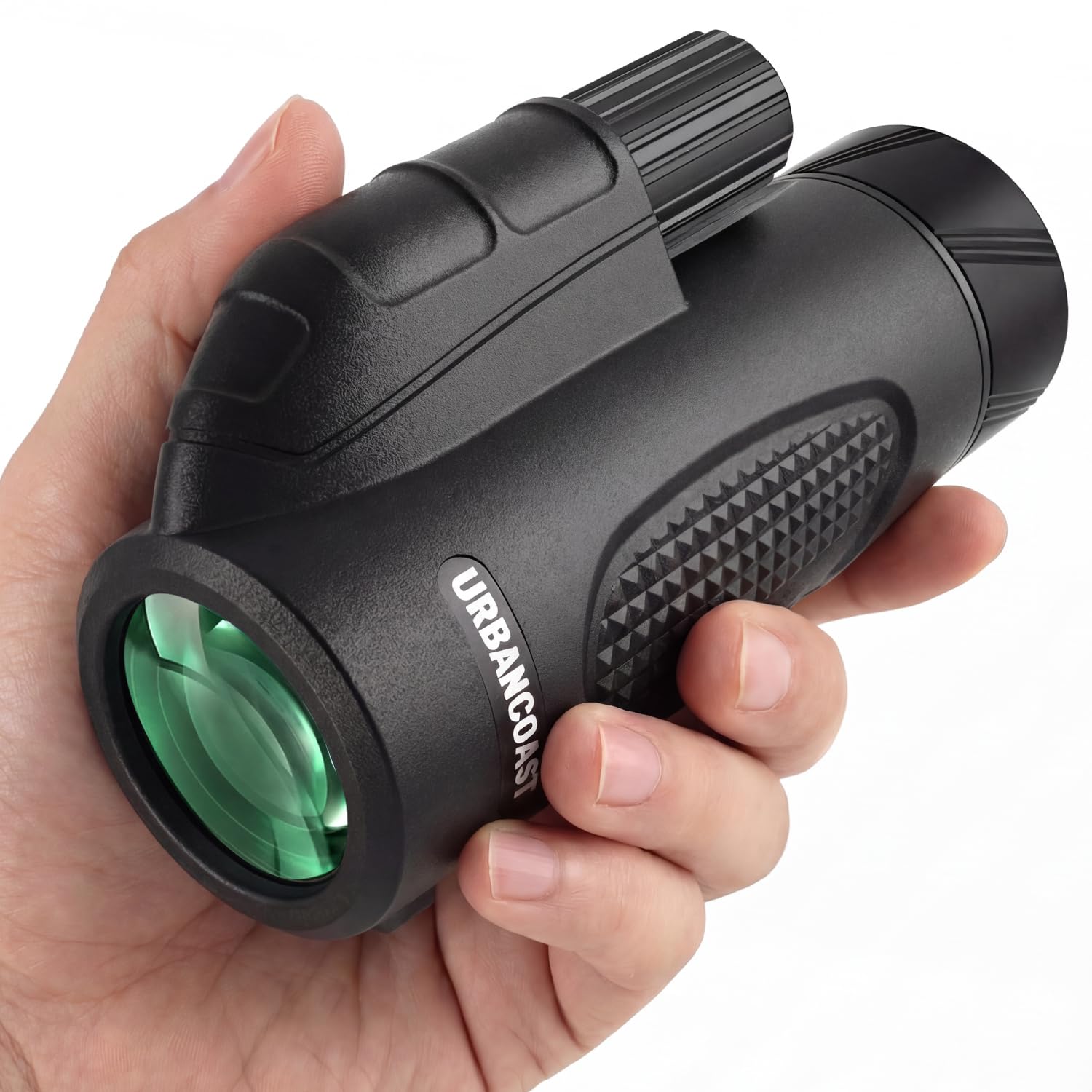
7. URBANCOAST 8×32 Mini Monocular Telescope
Built to shrug off a dunk, a drop, and a deep freeze.
When the weather turns hostile, the URBANCOAST 8×32 is the monocular that keeps working. Its IP67 rating means it is fully dust-tight and can survive immersion in up to one meter of water for 30 minutes — a step beyond the IPX7 rating on some competitors. The operating range of -4°F to 149°F means it will function in a snowstorm or a desert summer without fogging up internally. The fully multi-coated optics and BAK-4 prism deliver a bright, sharp image with a field of view of 315 feet at 1,000 yards. The image quality and ease of use are the features owners praise most.
It is a bit heavier than some alternatives at 9.9 oz, and the 5.2-inch length is noticeable in a jacket pocket. However, the non-slip grip and large focus wheel make it very easy to operate with one hand, even with gloves on. The twist-up eyecup offers comfortable viewing with or without glasses. The image quality is reported to be excellent edge-to-edge, with one owner stating it is “clearer and simpler to use than my other more expensive monocular.” It is IP67-rated to survive the worst conditions, making it a rugged all-rounder for camping, kayaking, and winter hiking.
If you compare it to the Olimt 8×32, the URBANCOAST has a higher ingress protection rating (IP67 vs IPX7) and a wider operating temperature range, making it better for extreme environments. It is heavier and longer, but feels more sturdy in the hand. For the vast majority of users who will not be submerging their monocular, the smaller and lighter Olimt is a better daily carry. But for the dedicated outdoor adventurer, this is a tank.
Built for extremes
- IP67 waterproof and dustproof — survives full immersion and dust storms.
- Operates from -4°F to 149°F; no fogging or freezing issues.
- Excellent edge-to-edge image quality with BAK-4 prism and FMC optics.
Practical trade-offs
- Heavier and longer than many pocket monoculars at 9.9 oz and 5.2 inches.
- Field of view is narrower than the category leaders (315 ft vs 384+).
Ideal for: serious outdoor adventurers, kayakers, winter campers, or anyone who expects their gear to survive a river crossing or a snowstorm.
pass on it if: you need an ultra-light, ultra-compact daily carry — the Olimt or Jizmo will serve you better in town.
8. OLIMT 10×25 Monocular Telescope
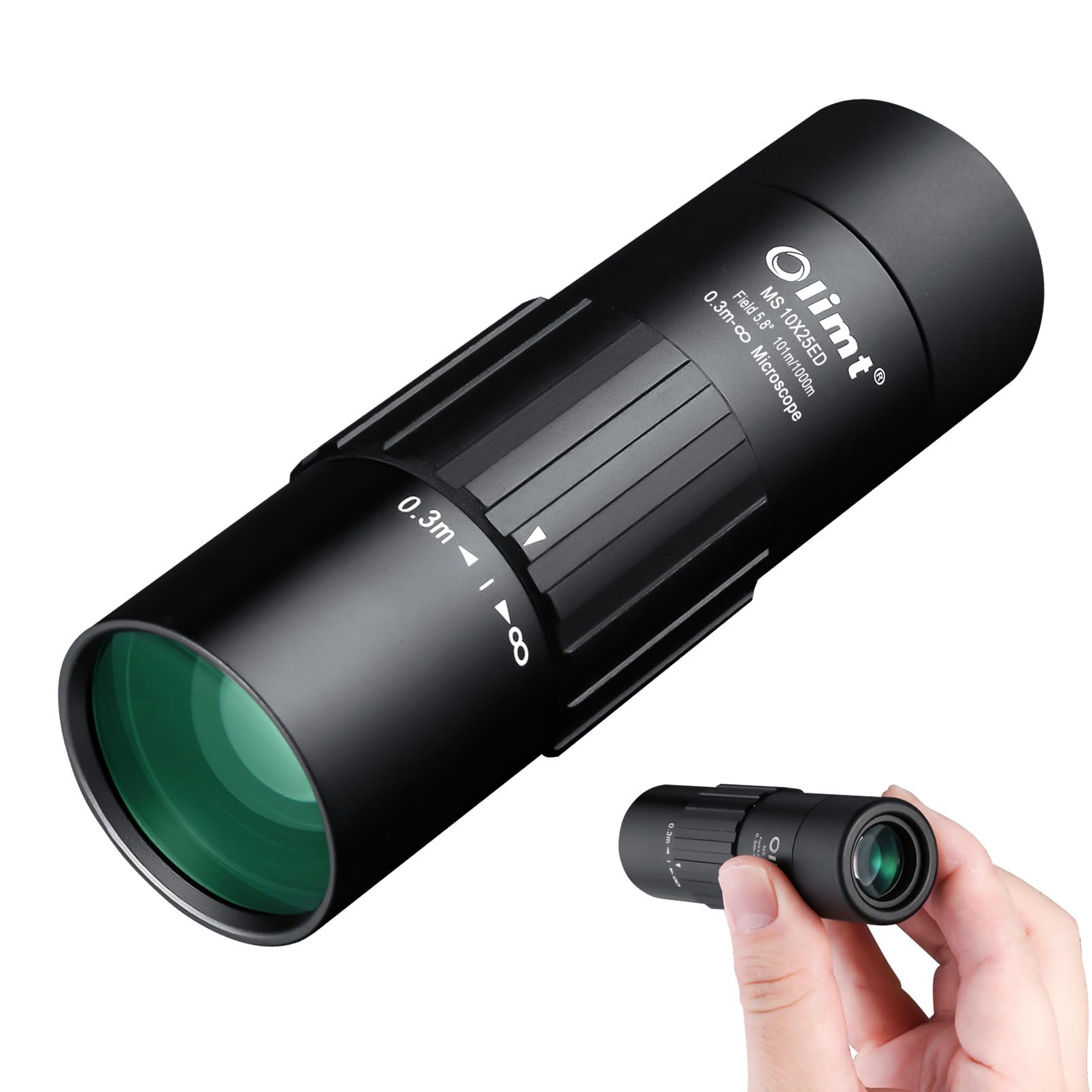
A 10x that actually fits in your shirt pocket without weighing you down.
Getting 10x magnification into a truly compact package is an optical challenge. The OLIMT 10×25 meets it with ED (extra-low dispersion) glass and fully multi-coated lenses to minimize chromatic aberration — the purple fringing that plagues cheaper high-magnification optics. The result is a sharp, clear image at 10x that fits into a package measuring just 3.8 by 1.2 by 1.2 inches and weighing 5.8 oz. It truly slips into a shirt pocket, which is rare for a 10x monocular. The close focus of 0.98 feet means you can also examine nearby objects in detail, giving it a dual personality similar to the Jizmo 8×25.
The trade-off for that pocketable size is a smaller 25mm objective lens and a 2.5 mm exit pupil. The image will be noticeably dimmer in low light compared to the 8×32 models. The narrow field of view (303 feet at 1,000 yards) also means it struggles with moving subjects — one owner noted it is not good for following a bird in flight. The IPX7 waterproofing gives you confidence in rain, and the aluminum body feels sturdy. The focus ring has a long travel distance, which allows precise adjustment but takes a moment to learn. Some owners found the included weather caps poorly designed.
If you need 10x reach and pocketability above all else, this is your best bet at this price point. But be honest about your needs: if you primarily scan wide landscapes or watch wildlife at dawn and dusk, an 8×32 like the Nocs Zoom Tube will give you a brighter, more forgiving view.
Where it excels
- True shirt-pocket size at 5.8 oz — the lightest 10x in this guide.
- ED glass delivers sharp images with minimal color fringing.
- Close focus under 1 foot adds macro capability.
Where it falls short
- Dim and narrow view in low light compared to 8×32 options.
- Narrow field of view makes tracking moving subjects difficult.
Best for: daytime hikers or travelers who want maximum magnification in the smallest possible package and can live with a dimmer view.
Avoid if: you shoot in low light, need to track fast-moving birds, or want a forgiving field of view.
9. Barska Blackhawk 10×25 Waterproof Monocular
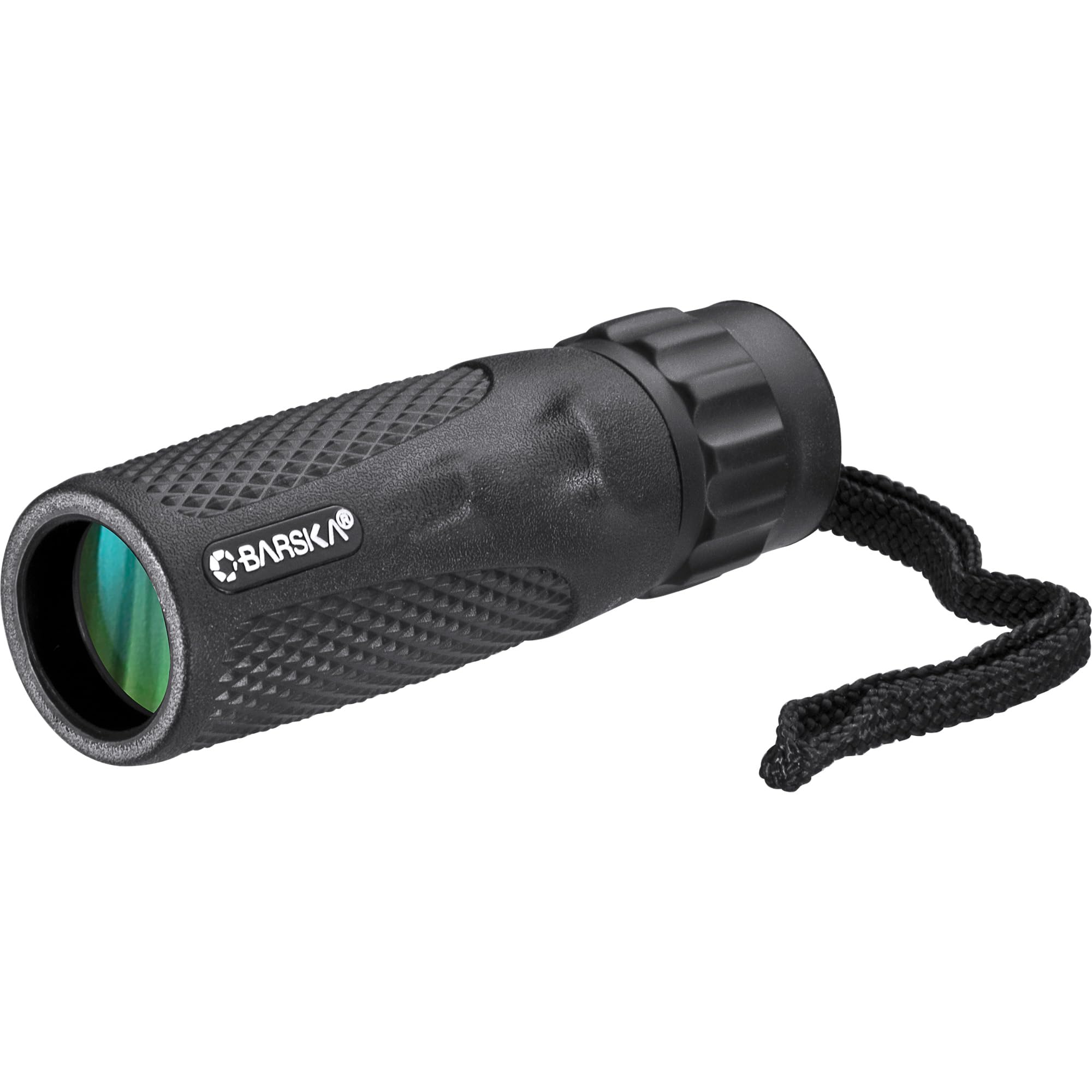
The affordable entry point that proves you don’t have to spend big to see clearly.
If you are new to monoculars or just need a spare to toss in a glove box, the Barska Blackhawk 10×25 will do the job without a painful investment. It is nitrogen purged and O-ring sealed, making it 100% waterproof and fogproof — a feature that is genuinely impressive at this price point. The multi-coated lenses and BAK-4 roof prism produce an image that is clear and bright enough for daytime use, and the diamond-textured rubber grip is comfortable and secure. The field of view is 303 feet at 1,000 yards, which is typical for a 10x compact. It also weighs just 0.15 pounds — lighter than any other monocular in this guide — though many owners note it feels slightly larger than expected for a “compact”.
The optics are not going to rival the Maven or even the Nocs; owners note the image is noticeably less sharp and bright than a Vortex. The eye relief can be fiddly: if you do not hold it at exactly the right distance, the image is hard to see. The included lens covers are not attached, which is a minor annoyance. The rubber coating is durable and the carrying case provides some protection. For short-range spotting at a sporting event or a quick look at a trail marker, it works well. For prolonged birding or low-light use, it will leave you wanting more clarity and brightness.
At nearly a third of the price of the Nocs Zoom Tube, the Barska is a true budget pickup. It is the lightest option here at just 0.15 pounds, though it is not as small as the OLIMT 10×25. The honest truth is that the OLIMT 10×25 offers better glass and a smaller form factor for a modest step up in spend. The Barska is for the buyer who wants functional waterproof optics at the lowest possible price and is not fussy about premium clarity.
What you get for the price
- Nitrogen-purged 100% waterproof and fogproof construction — rare at this budget.
- Extremely light at 0.15 pounds; comfortable to carry all day.
- Diamond-textured rubber grip provides a secure hold in wet conditions.
Where corners are cut
- Image clarity and brightness are noticeably lower than mid-range options.
- Eye relief is finicky — requires precise positioning for a clear view.
- Slightly larger than some “compact” buyers expect.
Choose this if: you need a functional, waterproof monocular for occasional use and want to spend as little as possible — great for a car kit or a child’s first optic.
Pass if: you plan to use it regularly for birding, wildlife, or any low-light scenario; the image quality will frustrate you versus the Olimt or Nocs options.
Understanding the Specs
Magnification and Objective Lens
The two numbers on a monocular — for example, 8×32 — tell you everything about its personality. The first number (8x) means an object appears eight times closer than it does with your naked eye. The second number (32) is the diameter of the front lens in millimeters. A larger objective lens gathers more light, which directly translates to a brighter image in low light. An 8×32 is the most versatile balance for a compact monocular: steady enough to hold by hand, bright enough for dawn and dusk. A 10×25 gives you more reach but a smaller lens, which means less light and more image shake.
Field of View (FOV)
Field of view is measured in feet at 1,000 yards — how wide a scene you can see at that distance. A higher number means you see more without moving the monocular. This is critical for tracking birds in flight, scanning a hillside, or following sports action. A compact monocular with a 380+ foot FOV is considered wide and forgiving. A 300-foot FOV is narrower and requires more sweeping to follow a moving subject. If you tend to watch stationary subjects (architecture, distant wildlife), FOV matters less. If you track moving things, prioritize a wider FOV.
Exit Pupil and Eye Relief
The exit pupil is the circle of light that exits the eyepiece; you calculate it by dividing the objective lens diameter by the magnification (a 32mm lens divided by 8x equals a 4 mm exit pupil). A larger exit pupil (3-4 mm) gives you a brighter, more forgiving view, especially in low light. A smaller exit pupil (2.5 mm or less) means you need to align your eye precisely, and the image will be dimmer in twilight. Eye relief is the distance your eye can be from the eyepiece while still seeing the full image. If you wear glasses, you need at least 15 mm of eye relief. A twist-up eyecup lets you adjust this distance precisely.
Lens Coatings and Prism Quality
Lens coatings control how much light passes through the glass instead of reflecting off it. “Fully multi-coated” means every glass surface has multiple layers of anti-reflective coating, resulting in the brightest, clearest image. Look for “Fully Multi-Coated” on the spec sheet; “Multi-Coated” or “Coated” are lower tiers. The prism is the internal glass that corrects the image orientation. BAK-4 is high-density barium crown glass that produces a sharper, rounder image. BK-7 glass is cheaper and can produce a slightly clipped or dimmer image. Most quality compact monoculars in this guide use BAK-4 prisms.
FAQ
What does 8×32 mean on a compact monocular?
Is 10x magnification too shaky for handheld use?
Can I use a compact monocular with eyeglasses?
What is the difference between BAK-4 and BK-7 prisms?
How important is waterproofing in a compact monocular?
What is a good field of view for a compact monocular?
Can I take photos through a compact monocular with my phone?
How do I attach a compact monocular to a tripod?
Which is better for bird watching, 8x or 10x?
What does “fully multi-coated” mean and why does it matter?
Final Thoughts: The Verdict
If you want one dependable pick, the compact monocular winner is the Nocs Provisions Zoom Tube 8×32 because it delivers the ideal 8×32 balance of clarity, brightness, and build quality with the confidence of a lifetime warranty. If you want the absolute best low-light performance and a warranty that covers everything, grab the Vortex Solo Monocular 8×36. And for the best value — premium optical coatings at a mid-range price — the Olimt 8×32 Monocular is the one to reach for.
How We Picked
We do not accept paid placement. Every pick is matched to a real buyer and a real use-case; we do not hands-on test units.
Sources & Methodology
Specifications: manufacturer listings and product documentation. Review insights: verified customer reviews, as of July 2026. Pricing: not shown on this page (it changes often); check the current price via the retailer link.
As an Amazon Associate, WellFizz earns from qualifying purchases. This does not affect which products we feature.
Related Guides

Mo Maruf
I created WellFizz to bridge the gap between vague wellness advice and actionable solutions. My mission is simple: to decode the research and give you practical tools you can actually use.
Beyond the data, I am a passionate traveler. I believe that stepping away from the screen to explore new environments is essential for mental clarity and physical vitality.