Our readers keep the lights on and my smoothie glass nicely filled. As an Amazon Associate, I earn from qualifying purchases.
Specs are compiled from manufacturer listings and verified buyer reviews and can change over time — please confirm the key details on the product page before buying.
Compact hunting binoculars live in a world of trade-offs. Shrink the body and you usually kill the light-gathering ability that makes dawn and dusk viewing possible. But a good compact pair — built with the right prism design and lens coatings — lets you glass a ridge top for a half hour without the heavy neck ache of a full-size set. The seven picks here all fit the brief: small enough to stash in a jacket or pack pocket, bright enough to extend useful shooting light.
I’m Mohammad Maruf — the founder and writer behind WellFizz. This guide is built by comparing the manufacturers’ published specifications and the patterns across verified customer reviews, so you get each pick’s real strengths and trade-offs instead of marketing spin.
These are the best compact hunting binoculars tested by thousands of real owners, covering everything from sub- values that punch way above their weight to premium pocket-sized glass that rivals full-size optics.
Our Picks at a Glance


How To Choose The Best Compact Hunting Binoculars
Picking the right pair is about matching the numbers on the spec sheet to the real-world conditions you hunt in. A binocular that is sharp in the store can look muddy at last light. Here are the three specs that separate a field-worthy compact from a frustrating one.
Exit Pupil — The Brightness Calculator
Take the objective lens diameter (the big number, in mm) and divide it by the magnification. That gives you the exit pupil — the circle of light your eye actually sees. Anything below 2.5 mm gets noticeably dim as the sun drops. For hunting at dawn or dusk, you want at least 3 mm, and ideally closer to 4 mm if you can manage it in a compact package.
Field of View — How Much Woods You See
Measured in feet at 1,000 yards, field of view (FOV) tells you the width of the scene. A wider FOV helps you track a running deer or scan a tree line quickly. Compact binoculars often trade FOV for size, so anything over 300 feet at 1,000 yards is strong for a small set. Below 280 feet and you will find yourself hunting for the subject instead of watching it.
Lens Coatings — The Reason Cheap Glass Fails
Every lens surface reflects some light. Coatings reduce that reflection. Fully multi-coated optics apply multiple layers to every glass surface, which boosts light transmission and cuts glare. That directly translates to a brighter, clearer image in low light. If you see just “coated” or “multi-coated” on a spec sheet, the cheapest lens treatment is likely used — fine for daytime, disappointing at dusk.
Quick Comparison
| Model | Best For | Magnification / Objective | Eye Relief | Field of View (ft @ 1000 yds) | Amazon |
|---|---|---|---|---|---|
| Leupold BX-1 Rogue 10×25★ Best Overall | Low-light hunting from a stand | 10x25mm | 15 mm | 294 ft | Amazon |
| Nocs Provisions Standard Issue 10×25Wide View Pick | Wide-view travel and birding | 10x25mm | 10 mm | 315 ft | Amazon |
| Vortex Vanquish 10×26 | All-around compact performance | 10x26mm | 16 mm | 294 ft | Amazon |
| Bushnell Powerview 10×42 Bone Collector | Maximum low-light at a budget price | 10x42mm | 17.5 mm | 293 ft | Amazon |
| Nikon Trailblazer 10×25 | Pocket-sized preparedness | 10x25mm | 6.3 mm | — | Amazon |
| Nocs Provisions Field Issue 8×42 | Full-size brightness in a mid-size body | 8x42mm | 20.4 mm | 394 ft | Amazon |
| ZEISS Terra ED 8×25 | Premium pocket glass for the discerning hunter | 8x25mm | 16 mm | 315 ft | Amazon |
In‑Depth Reviews
1. Leupold BX-1 Rogue Binoculars, 10x25mm (59225)
Our pick — over 4.5★ from 750+ verified ratings; the strongest balance of quality and price.
The deer-stand companion that keeps glassing long after the sun drops below the tree line.
Leupold used an inverted Porro prism design — instead of the straight-through roof prism most compacts use, this prism layout lets the body stay incredibly slim while keeping the light path wide. The result is a 10×25 that does not feel like a compromise. Buyers consistently report that it delivers extended visible time during last shooting hours, and that real-world edge comes from Leupold’s Advanced Optical System, which cuts glare in harsh light.
What owners praise most is the clarity — it is the single most-mentioned aspect across hundreds of reviews. The rubber armor coating gives a positive grip even with wet hands, and the extension eyecups block ambient light well enough to keep you locked on a target. At 15 mm of eye relief, it clears enough distance for eyeglass wearers to use it comfortably, though it falls a millimeter short of the Vortex Vanquish’s 16 mm eye relief.
The trade-off is the inverted Porro design’s physical geometry — it is waterproof and fogproof, but the body shape is slightly less pocketable than a true roof prism. An occasional owner mentions the adjustability of the eye cups can feel a little stiff at first. For the price, though, the optical performance is tough to top, and Leupold’s legendary customer care backs it fully.
Edge in the field: The glare reduction means you keep glassing when other compacts have already fogged up or washed out. It is the best value-for-money pick on this list and the one most hunters actually reach for from a stand.
Grab these for: Low-light hunting from a fixed position where every extra minute of visible light matters. The clarity at 82 mentions by owners is the leading story here.
Think twice if: You need a truly flat pocket-binocular that folds down to nothing — the inverted Porro body is compact but not ultra-slim.
2. Nocs Provisions Standard Issue 10×25 Binoculars
The color-splash optic that gives you the widest view in a 10×25 body.
Nocs Provisions set out to make binoculars that look good and perform better, and the Standard Issue 10×25 delivers exactly that. Its field of view is 315 feet at 1,000 yards — noticeably wider than the Leupold BX-1 Rogue’s 294 feet, making it easier to track fast-moving birds or scan open ridges without constantly readjusting. The fully multi-coated optics are paired with a Swiss-designed BAK4 prism (high-density glass that produces a rounder, brighter exit pupil than cheaper BK7 glass), and owners say the clarity and “true 10x magnification” make it punch well above its weight.
What stands out most here is the ergonomic package. The Rugged Wave Grip design covers every surface in a textured silicone rubber that feels secure even with gloves. The multi-stop twist-up eyecup has three distinct positions — critical for eyeglass wearers. At 10 mm, the eye relief is shorter than most others here, so non-eyeglass users get the most out of it. It is IPX7 rated (submersible in three feet of water for 30 minutes without damage), and the nitrogen filling prevents internal fogging.
The catch is the eye relief: at 10 mm compared to the Leupold’s 15 mm or the Vortex’s 16 mm, glasses wearers may struggle to see the full field. One owner noted the field of view felt a bit narrow for their needs, though that contradicts the wider spec. A few also mention the included strap runs short, but the lifetime “No-Matter-What” warranty balances the minor quibbles.
Best for travel: Lightweight at 11.85 oz and pocketable, this is behind-the-seat and daypack-ready gear. The image quality is the second most-praised aspect at 17 mentions.
Reach for it if: You want the widest field of view in a compact 10×25 for scanning open terrain, and you do not wear glasses full time.
Look elsewhere if: You need long eye relief for prescription eyewear during all-day wear.
3. Vortex Vanquish Reverse Porro Prism Binoculars 10×26

The lightest Vortex in the lineup that still earns the lifetime warranty.
Vortex built the Vanquish around a reverse Porro prism system with a slightly larger 26 mm objective lens — 4% bigger than the Leupold’s 25 mm — which gives it a meaningful edge in light-gathering. That extra millimeter means an exit pupil of 2.6 mm compared to the Nocs Standard Issue’s 2.4 mm, so the image stays brighter as shadows lengthen. Owners describe the view as “crisp” and note it replaced older budget binoculars that failed past 50 yards. The fully multi-coated lenses (multiple anti-reflective layers on every air-to-glass surface) are responsible for that clarity, boosting light transmission and resolution.
At 16 mm, the eye relief is the joint best in the compact 10x category here (tied with the Zeiss Terra ED for 8x), and the twist-and-lock eyecups let you dial in the exact distance for your eyes. The rubber armor covers the full body for a non-slip grip, and the nitrogen-purged, O-ring sealed construction means you will never see internal fog. The field of view is 294 feet at 1,000 yards — comparable to the Leupold but narrower than the Nocs Standard Issue’s 315 feet.
The most-discussed trade-off across owner feedback is the focus wheel: it works smoothly but some find it slightly too coarse for fine adjustments at long range. That is a small price for the confidence the VIP warranty provides — it is unconditional, unlimited, and fully transferable. Vortex will repair or replace it for life, no questions asked.
Crowd-Pleasers
- Largest exit pupil in the compact category (2.6 mm) for brighter low-light views.
- 16 mm eye relief beats the Leupold and Nocs for glasses-wearers.
- Lifetime VIP warranty is class-leading — covers any damage, no receipt needed.
Reality Check
- Focus knob could use finer threading for precision at distance.
- Field of view (294 ft) is narrower than the Nocs Standard Issue (315 ft).
Take it hunting if: You want the best light-gathering in a pocketable 10x binocular with a warranty you will never outlast.
Skip it for:Ultra-wide scanning — the Nocs Standard Issue gives you a bigger picture.
4. Bushnell Powerview 10×42 Bone Collector Binoculars

The budget alternative that brings full-size objective power in a 5.5-inch body.
Bushnell’s Bone Collector line has an advantage most compacts simply cannot match: a 42 mm objective lens in a body just 5.5 inches long. That gives it an exit pupil of 4.2 mm — by far the largest on this list — which translates to noticeably brighter images in low light compared to any 25 mm or 26 mm competitor. The multi-coated optics draw in enough light that a hunter can spot a doe moving through brush well past sunset.
At 22 oz, it is heavier than the others here (the Nocs Standard Issue is 11.85 oz, the Leupold is even lighter). But that weight buys you 17.5 mm of eye relief — the most of any pick here — so eyeglass wearers get the full field of view without pressing lenses into glass. The diamond-cut grip texture on the focus wheel and body helps when wearing gloves, and the Realtree Edge camo finish breaks up the outline against trees.
Clarity drew the most mentions from owners, but it splits evenly between those who call it “crisp” and those who find it softer than premium glass — this is a mixed aspect, not a pure strength. Durability also draws mixed feedback; some buyers report it holds up to years of field use, while others note the plastic enclosure is less forgiving than aluminum-bodied competitors. For the price, the optical performance is undeniable for hunting applications that demand low-light reach.
The real edge: 4.2 mm exit pupil in a sub-6-inch body is unique. Nothing in the compact price tier comes close to this low-light ability.
Choose this if: Your priority is low-light brightness and you do not mind a bit of extra weight (22 oz) to get it.
Pass on it if: You need true pocket portability — the 42 mm objective bulks it up beyond jacket-pocket size.
5. Nikon Trailblazer 10x25mm Binoculars (8218)
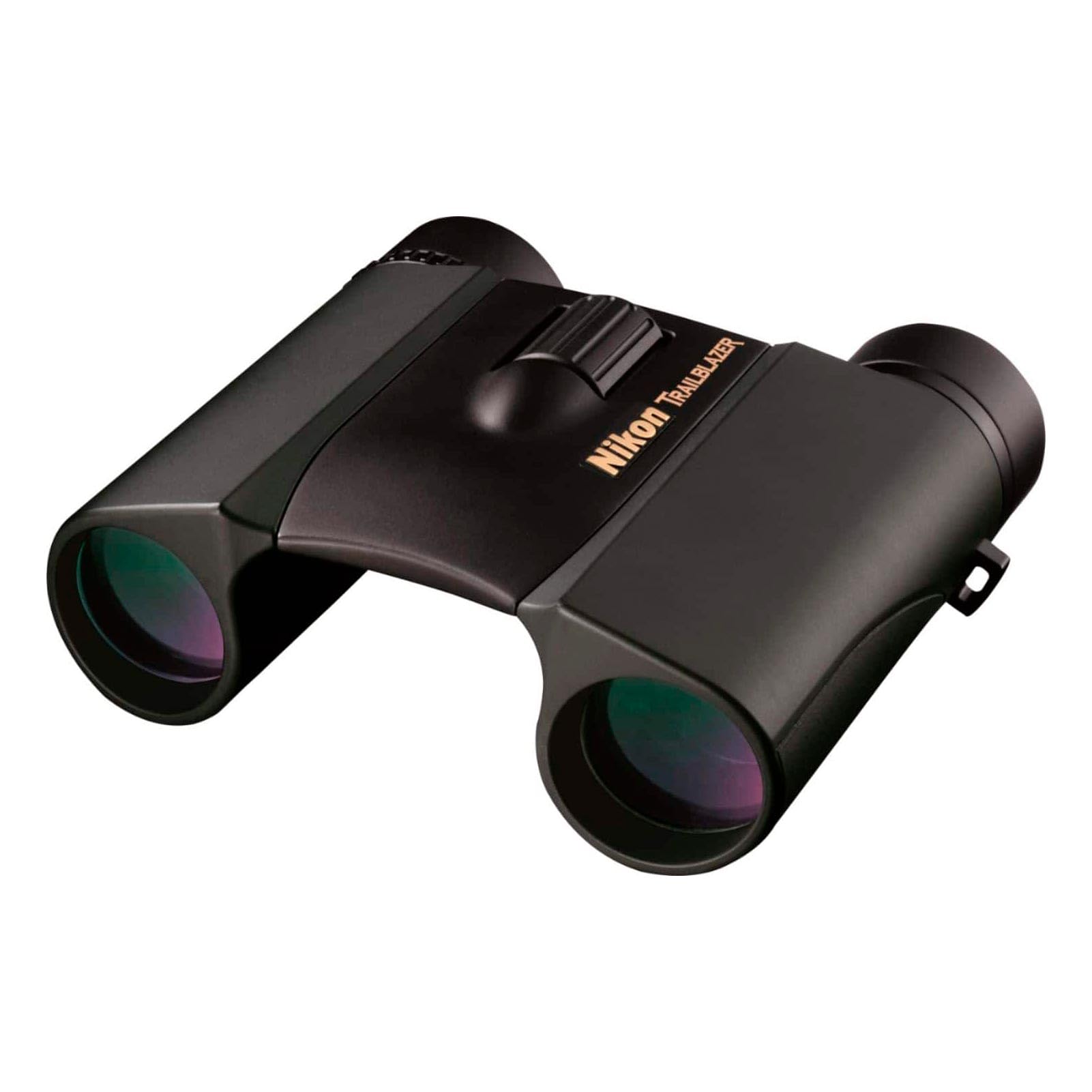
The fold-flat pocket binocular that disappears into a shirt pocket until you need it.
Nikon’s Trailblazer uses a roof prism design with a folding hinge, so it compresses into a package that genuinely fits in a shirt pocket. At 9.9 oz, it is the lightest binocular on this list after the Zeiss Terra ED. The fully multi-coated lenses deliver crisp, high-contrast views with good depth of field, and owners describe the image quality as nearly matching higher-tier Nikon Monarch models in a fraction of the size.
The catch is eye relief: at just 6.3 mm, it is the shortest on this list by a wide margin. Anyone who wears glasses will find the view cramped and will need to press the eyepieces directly against their lenses. For non-eyeglass users, the view is excellent — bright, sharp, and color-accurate. The focus knob is smooth and precise, and the nitrogen-filled and O-ring sealed construction makes it fully waterproof and fogproof.
A few owners mention that the lens caps are easy to lose and that the storage pouch requires the binoculars to be fully folded. The loose eyecup has been a minor recurring note, though some owners fixed it with a small screw. For the weight and pocketability, the optical quality is tough to beat at the price — but the short eye relief is a real limitation for eyeglass wearers.
Why It Works
- 9.9 oz and folds flat — truly pocket-sized for everyday carry.
- Fully multi-coated lenses deliver crisp, high-contrast images.
- Nitrogen-filled and O-ring sealed for all-weather reliability.
Know This
- 6.3 mm eye relief is the shortest here — not suitable for glasses wearers.
- Eyecups can feel loose; lens caps are easy to misplace.
Best for: Hikers, backpackers, and hunters who wear contacts and want a binocular that lives in a pocket until needed.
Not for: Glasses-wearers at all — the 6.3 mm eye relief is a dealbreaker.
6. Nocs Provisions Field Issue Compact 8×42 Waterproof Binoculars
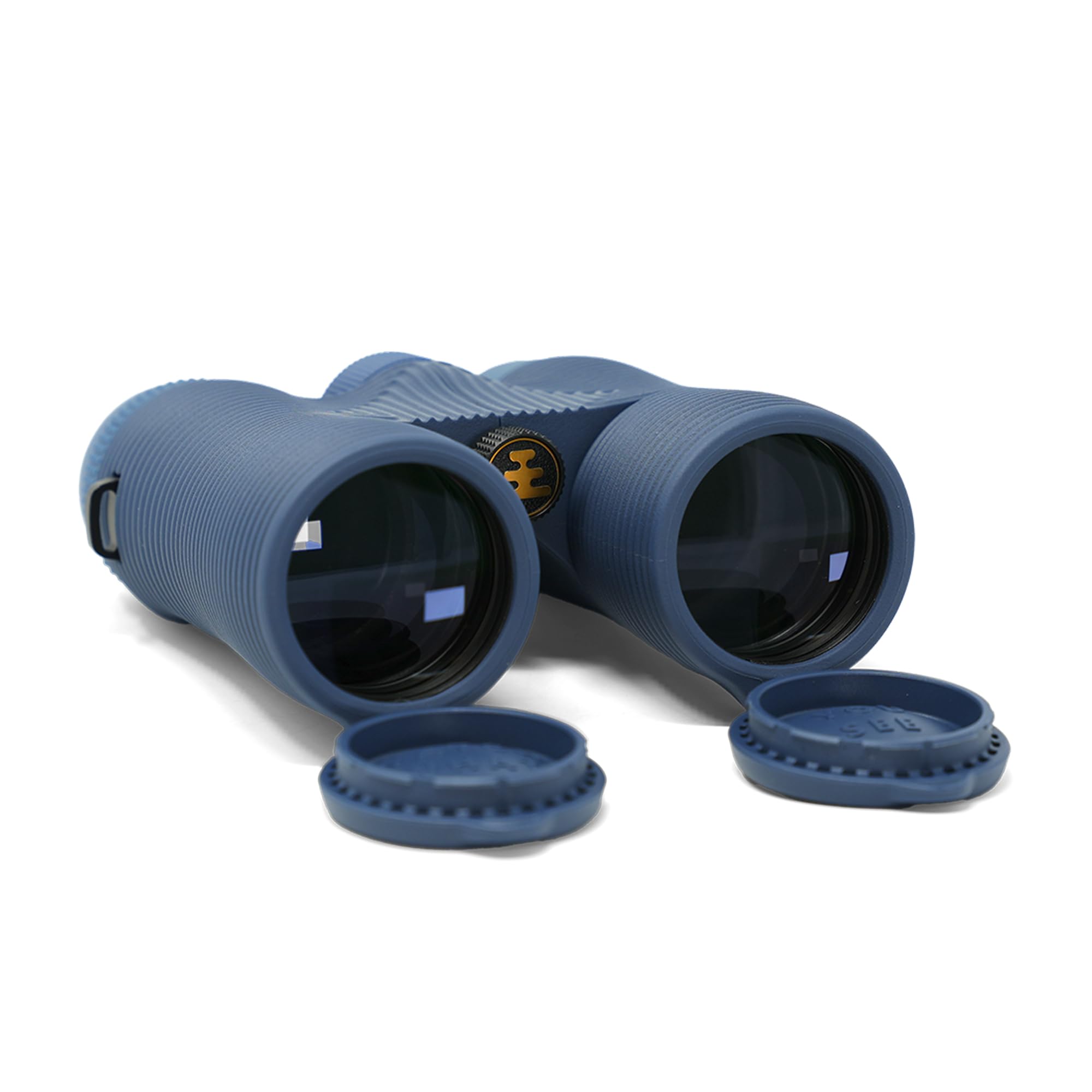
The 8×42 that squeezes full-size brightness into a mid-size body without the weight penalty.
At 1.3 lb, the Field Issue 8×42 sits at the heavier end of this list, but it brings a 5.4 mm exit pupil — the biggest of any pick here. That means it gathers more light than any 10×25 or 10×26 compact, making it the best option for hunting in deep timber or on overcast days. The 8x magnification provides a wider, steadier field of view — 394 feet at 1,000 yards — than any 10x pick, which makes a real difference when tracking running game or scanning a hillside.
The eye relief is an impressive 20.4 mm, so glasses wearers get the entire field of view without compromise. The multi-stop twist-up eyecups provide custom positions, and the Rugged Wave Grip makes the body feel secure even when wet. It is IPX7 rated (submersible up to 1 meter for 30 minutes), and it is fogproof thanks to nitrogen-filled chambers. The oversized focus wheel allows smooth adjustments from 6.6 feet to infinity.
Quality is the most-praised aspect by a wide margin, with owners calling it “excellent value” and praising the lightweight feel for an 8×42. The only recurring note is that the included case and strap feel a bit basic for the price point. For hunters who want the light-gathering of a full-size optic in a more packable build, this fits a balance that compacts cannot reach.
The thing everyone loves: “Beautiful field of view for birding” and easy focus that works even with glasses. The quality is the leading story at 30 owner mentions.
Choose it if: You want maximum low-light performance in a mid-size body that fits in a daypack, and you wear glasses.
skip it if: You need a true pocket binocular — this is mid-size, not compact, and weighs 1.3 lb.
7. ZEISS Terra ED Pocket Binoculars 8×25

The pocket Zeiss that puts 88% light transmission into a magnesium chassis.
ZEISS brings its legendary SCHOTT ED glass (Extra-low Dispersion glass that reduces color fringing around edges) to the compact format, and the result is an 8×25 that delivers 88% light transmission. The hydrophobic multi-coating and ZEISS T* coating (a proprietary anti-reflective coating) work together to produce brilliant, high-contrast images even in twilight and rain. At 315 feet, the field of view matches the Nocs Standard Issue for width, but the image clarity and color accuracy are a step above — the ED glass controls chromatic aberration (color blurring at high-contrast edges) that blurs edges on cheaper lenses.
The build is exceptional. The chassis is reinforced magnesium with glass-fiber reinforcement, making it both light and nearly indestructible. The LotuTec coating on the outer lenses repels water and dirt, so rain beads up and rolls off instead of smearing the view. The large focus wheel falls naturally under your index finger, and it takes just 1.25 turns to go from close focus to infinity — faster than most compacts. At 16 mm, the eye relief is generous for an 8×25 and works well with glasses.
The most-discussed issue across owners is the focus wheel — several note it is too tight straight from the start, though it typically loosens with use. The 3.1 mm exit pupil is adequate for general hunting but limits low-light performance compared to the 4.2 mm Bushnell or 5.4 mm Nocs Field Issue. For the price, you are paying for Zeiss glass and build quality that owners say performs within 95% of the Swarovski CL 8×25 at about a third of the cost.
The Zeiss Advantage
- SCHOTT ED glass and T* coatings deliver industry-leading clarity and color accuracy.
- LotuTec coating sheds water instantly for all-weather usability.
- Magnesium chassis with glass-fiber reinforcement is incredibly durable.
Honest Caveats
- Focus wheel can be stiff when new — requires a break-in period.
- 3.1 mm exit pupil limits low-light reach compared to larger objective binoculars.
Splurge on this if: You prioritize absolute optical purity and build quality in a pocket-sized binocular and want a lifetime companion.
Reconsider if: Your primary hunting is at dawn/dusk — a 42 mm objective (like the Bushnell or Nocs Field Issue) will give you more usable light.
Understanding the Specs
Eye Relief
Eye relief is the distance between your eye and the eyepiece lens where you can still see the full field of view. If you wear glasses, you need at least 14-15 mm so you do not have to smash your lenses against the glass. Shorter eye relief (below 12 mm) means you need to hold the binoculars close to your eye, which creates issues for spectacle wearers. The Leupold BX-1 Rogue and Vortex Vanquish both hit 15-16 mm, which is the balance for compact hunting binoculars. The Nikon Trailblazer’s 6.3 mm is the lowest here — glasses-wearers should look elsewhere.
Field of View
Field of view (FOV) tells you how wide a scene you can see at 1,000 yards. A wider field makes it easier to spot and track moving game. The Nocs Standard Issue and ZEISS Terra ED both offer 315 feet — the widest among the truly compact picks. The Leupold and Vortex sit at 294 feet, which is perfectly usable but means you will move the binoculars slightly more to scan. For comparison, the Nocs Field Issue 8×42 offers a massive 394 feet, but that comes in a larger, heavier body.
FAQ
Will a 10×25 binocular be bright enough for hunting at dawn?
What is the difference between Porro prism and roof prism binoculars?
What does fully multi-coated mean and why does it matter?
How do I know if a compact binocular will fit my hands?
Is a 10x magnification too shaky for handheld use in a compact binocular?
What is the BAK4 prism and why does it matter for hunting?
How important is waterproofing and fogproofing for hunting binoculars?
Can I use compact binoculars while wearing prescription glasses?
Final Thoughts: The Verdict
For most hunters, the best compact hunting binoculars are the Leupold BX-1 Rogue 10×25 because it balances exceptional low-light clarity with a compact, rubber-armored body backed by a legendary warranty — and it is the clear crowd favorite across hundreds of owner reviews. If you want the widest field of view in a truly pocketable design, grab the Nocs Provisions Standard Issue 10×25. And for maximum low-light performance at a budget-friendly price, the Bushnell Powerview 10×42 Bone Collector is the one to reach for when dawn and dusk are where the action happens.
How We Picked
We do not accept paid placement. Every pick is matched to a real buyer and a real use-case; we do not hands-on test units.
Sources & Methodology
Specifications: manufacturer listings and product documentation. Review insights: verified customer reviews, as of July 2026. Pricing: not shown on this page (it changes often); check the current price via the retailer link.
As an Amazon Associate, WellFizz earns from qualifying purchases. This does not affect which products we feature.
Related Guides

Mo Maruf
I created WellFizz to bridge the gap between vague wellness advice and actionable solutions. My mission is simple: to decode the research and give you practical tools you can actually use.
Beyond the data, I am a passionate traveler. I believe that stepping away from the screen to explore new environments is essential for mental clarity and physical vitality.