You do not need a spare room to build real strength at home. If you have put off buying a home gym because your apartment, garage, or corner will not fit a full power-rack setup, the machines below are designed to solve that problem without forcing you to downgrade your workouts or your living space.
I’m Mohammad Maruf — the co-founder and writer behind WellFizz. This guide is built by comparing the manufacturers’ published specifications and the patterns across verified customer reviews, so you get each pick’s real strengths and trade-offs instead of marketing spin.
A good compact home gym needs serious weight capacity and exercise variety in a tiny footprint. This guide breaks down the seven best options to help you find the right compact home gym for your space and budget.
How To Choose The Best Compact Home Gym
Every compact home gym is a trade-off between footprint, stability, and exercise variety. Before you pick one, focus on four things that make or break the experience in a small space.
Measure Your Ceiling Height First
A surprising number of compact home gyms require you to perform exercises overhead, like lat pulldowns or pull-ups. If you have standard 8-foot ceilings, you have about 21 inches of clearance above a machine that stands under 63 inches tall, which is plenty for most movements. But if your gym is in a basement with 7-foot ceilings, that same machine could leave you hunched over or unable to do certain exercises. Always measure your actual ceiling height and compare it to the machine’s height plus your own height during overhead movements.
Weight Capacity vs. Actual Use
The maximum weight recommendation on the spec sheet tells you the absolute limit the frame can hold before failing, but your day-to-day working weight will be much lower. A rack rated for 1,000 pounds will feel rock-solid at 300 pounds, while a budget machine rated for 110 pounds might wobble at half that load. If you plan to lift heavy, look for a frame built with thick steel (at least 14-gauge or 2mm) and a capacity that is at least double your heaviest lift.
Pulley Ratio Explained in Plain English
A 1:1 pulley system means the weight you load is exactly what you feel — load 50 pounds on the stack and you lift 50 pounds. A 2:1 system means the weight is split in half — load 50 pounds and you only feel 25 pounds. Many budget cable machines use 2:1 systems to keep the weight stack small and affordable, but this makes it harder to gauge your actual progress. For strength training, a 1:1 ratio is almost always better because every pound you add is real.
The Real Footprint: Deployed vs. Stored
Manufacturers often advertise the “folded size” of their machines because it sounds impressive — a tiny 3 square feet. But you will not train while the rack is folded. You need to know the fully deployed footprint, and whether that fits in your workout area without blocking doors or furniture. A machine that expands to 12 square feet might still be fine if you can push it against the wall between sets, but a machine that stays at 9 square feet the whole time might block your hallway.
Quick Comparison
On smaller screens, swipe sideways to see the full table.
| Model | Category | Best For | Key Spec | Amazon |
|---|---|---|---|---|
| Mikolo Folding Squat Rack | Premium Wall-Mount | Full-body workouts with dual cable crossover | 1,000 lbs capacity; folds to 3 sq ft | Amazon |
| Mikolo Smith Machine Power Cage | Premium Smith Machine | Guided bar path and heavy lifting | 1:1 pulley; 13.2 sq ft footprint | Amazon |
| Goimu WM3-V4 Folding Squat Rack | Premium Wall-Mount | Versatility with dual independent pulleys | 2,000 lbs capacity; 15 pulley heights | Amazon |
| JELENS FS01 Folding Squat Rack | Mid-Range Wall-Mount | Serious squats and pull-ups on a budget | 1,100 lbs static load; folds to 2.08 sq ft | Amazon |
| TOUSAINS CR63 Cable Machine | Mid-Range Cable Machine | Apartment-friendly cable and rowing | 330 lbs capacity; folds to 2.92 sq ft | Amazon |
| EVO Gym Portable Home Gym | Budget Portable | Travel-friendly strength training | 400 lbs max resistance; fits in backpack | Amazon |
| Total Flex Compact Home Gym | Budget All-in-One | Light-to-moderate home workouts | 7 resistance levels; foldable bench | Amazon |
In‑Depth Reviews
1. Mikolo Folding Squat Rack (WR00)
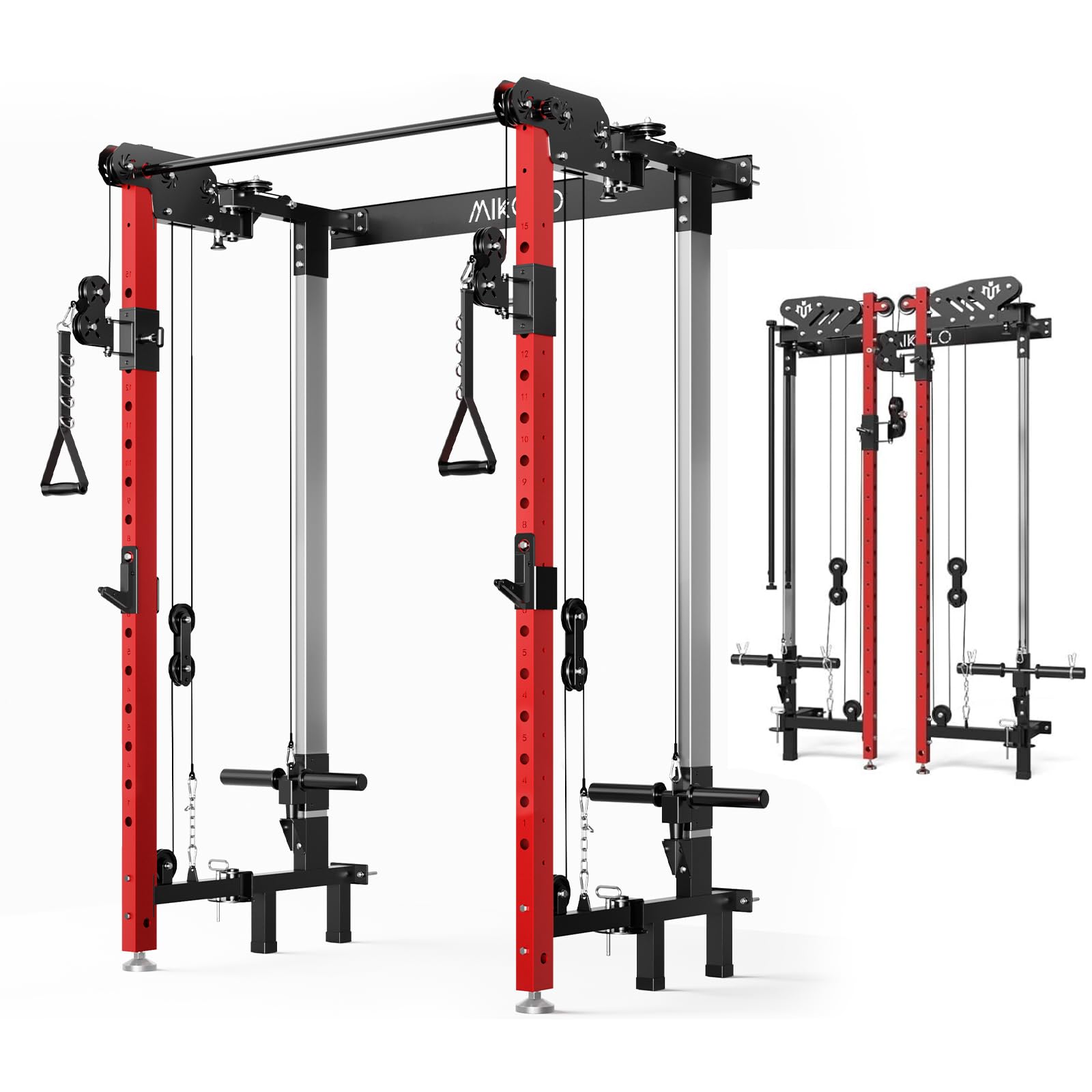
At 3 square feet folded, the Mikolo WR00 is the top pick for anyone who needs a full power rack, cable crossover, and lat pulldown but must still park a car in the garage afterward.
The dual independent pulley system uses a true 1:1 ratio, meaning every pound you load is exactly the weight you lift — supersets and drop sets are easy without recalculating. The frame is built from 2×2 inch 14-gauge steel and holds a maximum weight of 1,000 pounds, so it feels stable even during heavy squats.
Assembly takes about 2.5 to 3 hours, and you will need lag bolts for wooden studs since the kit only includes concrete anchors. Some cable carriages have a slight stickiness at first, but it improves with even weight distribution. For the space savings and cable versatility, this rack delivers commercial-grade functionality in an apartment-friendly footprint.
Why it’s great
- Dual 1:1 pulleys for true weight feel
- Folds to 3 sq ft — fits in a closet
- Sturdy 14-gauge steel frame rated for 1,000 lbs
- Five adjustable modes for every exercise type
Good to know
- Assembly takes 2.5+ hours for two people
- Mounting hardware only for concrete; wooden studs need separate lag bolts
- Cable carriages can stick with uneven weight
- Pull-up bar is thin but solid
2. Mikolo Smith Machine Home Gym Power Cage
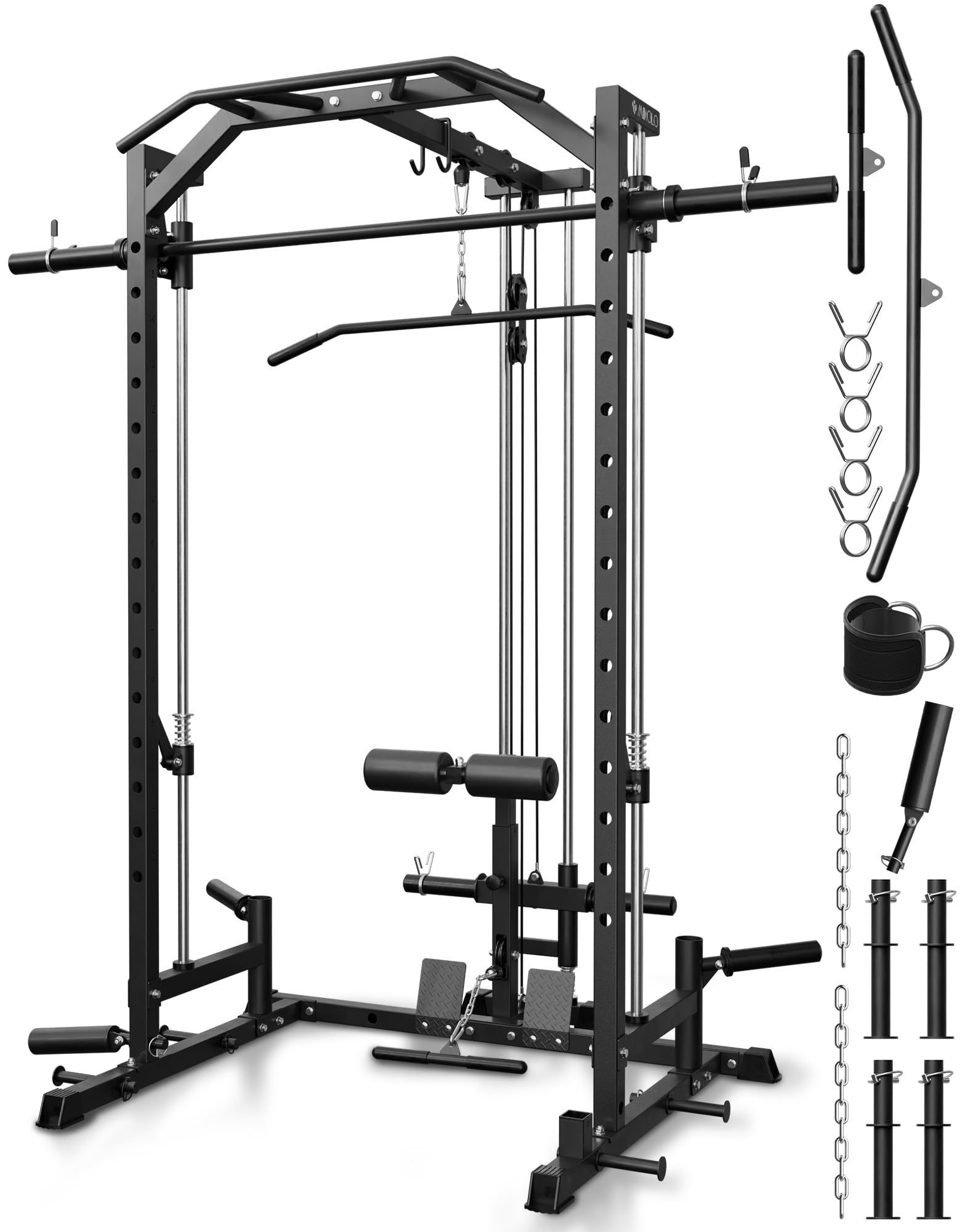
Where the folding Mikolo WR00 wins on space, this Smith machine wins on guided stability. It takes up 13.2 square feet on the floor (52 x 46 inches), larger than the folding rack but still compact enough for a garage or basement corner. The steel frame is 2mm thick, giving it a feel the manufacturer calls “earthquake-proof.”
The 1:1 pulley ratio means your lat pulldowns and seated rows are honest — load 150 pounds, feel 150 pounds. The Smith machine glides smoothly and quietly, and reviewers praise it for “perfect alignment, no missing hardware.” It comes with eight free attachments including a landmine and ankle straps, so you can do 10+ exercises right out of the box without buying extra gear.
The catch: to switch exercises, say from lat pulldown to low row, you have to unscrew the cable anchor from the weight stack and reattach it, which breaks your workout flow. Assembly takes two people around 4 hours. Choose this over the top pick if you prioritize guided bar stability and a 1:1 cable system over a folding frame.
Where it shines
- True 1:1 pulley for accurate weight load
- 2mm thick steel frame rated for 1,000+ lbs
- Smith machine and lat pulldown in one unit
- 8 free attachments included
Worth noting
- Requires changing cable anchor to switch exercise type
- 13.2 sq ft footprint — bigger than folding racks
- Assembly takes ~4 hours with two people
- Instructions are not very detailed
3. Goimu WM3-V4 Folding Squat Rack

The Goimu WM3-V4 is for someone who needs a home gym that folds away into a 4.3-square-foot footprint but still offers enough space for two people to train simultaneously on the dual independent pulley system when fully deployed to 12.3 square feet. Its 2,000-pound static weight rating is the highest on this list.
Reviewers call the rack “very solid” and report it handles heavy loads like 225 pounds safely, though they note a slight side-to-side give when fully open. The cable system runs smoothly after applying the included silicone grease, but some users found the pulley resistance high and recommended adding ball bearings for smoother movement. The 15 adjustable pulley heights let you set cables from floor level to overhead, covering nearly every cable exercise found in a commercial gym.
Assembly requires two people and takes about 3 hours, with the biggest complaint being poor picture instructions. For the price, you get a folding rack with dual independent cables that rivals machines costing significantly more.
What stands out
- 2,000 lbs capacity — highest on this list
- Dual independent pulleys for partner training
- 15 adjustable pulley heights for full cable variety
- Collapses to 4.3 sq ft for tight storage
The trade-offs
- Assembly instructions are poor (IKEA-style pictures)
- Pulley system can be resistant; may need ball bearings
- Pull-up bar doesn’t always stay locked
- 5 ft bar is tricky for heavy lifts; 7 ft bar recommended
4. JELENS FS01 Folding Squat Rack
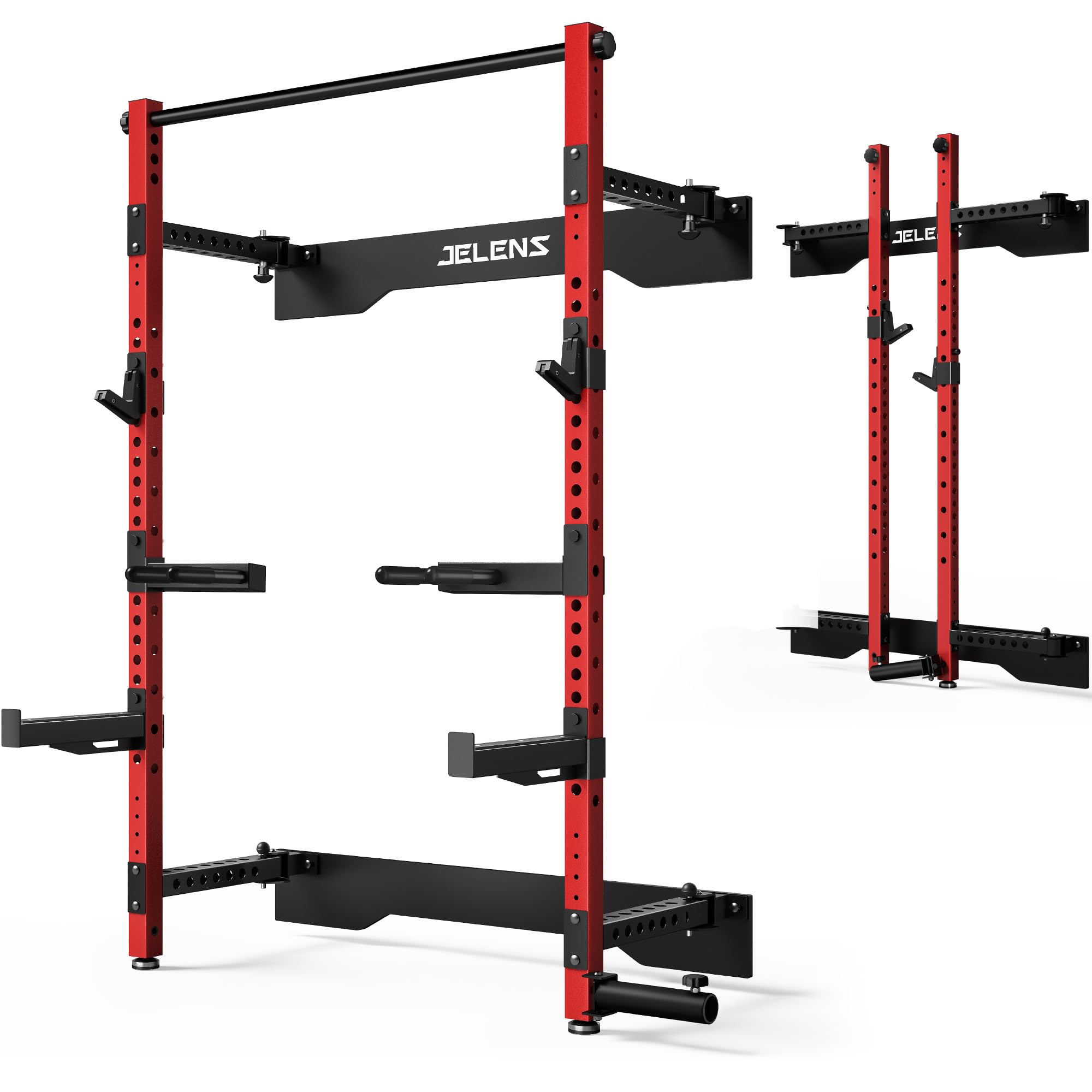
The single most important number for a wall-mounted rack is the static load rating, and the JELENS FS01 claims a weight capacity of 1,100 pounds. That makes it one of the strongest options for serious squats and bench presses when you factor in the 86.22-inch height, which fits taller users well. It folds flat to just 2.08 square feet (folded: 50.7 x 5.9 x 86.2 inches), so it barely protrudes from the wall when not in use.
The downside: this is a pure power rack — no built-in cable system, no lat pulldown, no Smith machine. You get J-hooks, safety bars, a pull-up bar, and a landmine attachment. Buyers report it is “sturdy, great value” and “stable for heavy lifts,” but they also point out that the J-cups could be a weak point over time and that you absolutely need to use a stringer (a wooden board bolted to the wall studs) before mounting.
If your goal is purely barbell training — squats, deadlifts, bench press, pull-ups — and you want the smallest possible footprint, the JELENS FS01 gives you a rock-solid foundation without paying for features you will not use, making its price-to-value read as strong for dedicated lifters who prioritize raw capacity over versatility.
The upsides
- 1,100 lbs static load for heavy barbell training
- Folded depth is only 5.9 inches from wall
- Includes J-hooks, safety bars, pull-up bar, landmine
- Sturdy 2×2 inch steel frame for stability
Keep in mind
- No cable system or lat pulldown included
- Must use a stringer for safe wall mounting
- J-cups are a potential long-term durability concern
- Wall mounting instructions could be clearer
5. TOUSAINS Cable Machine CR63
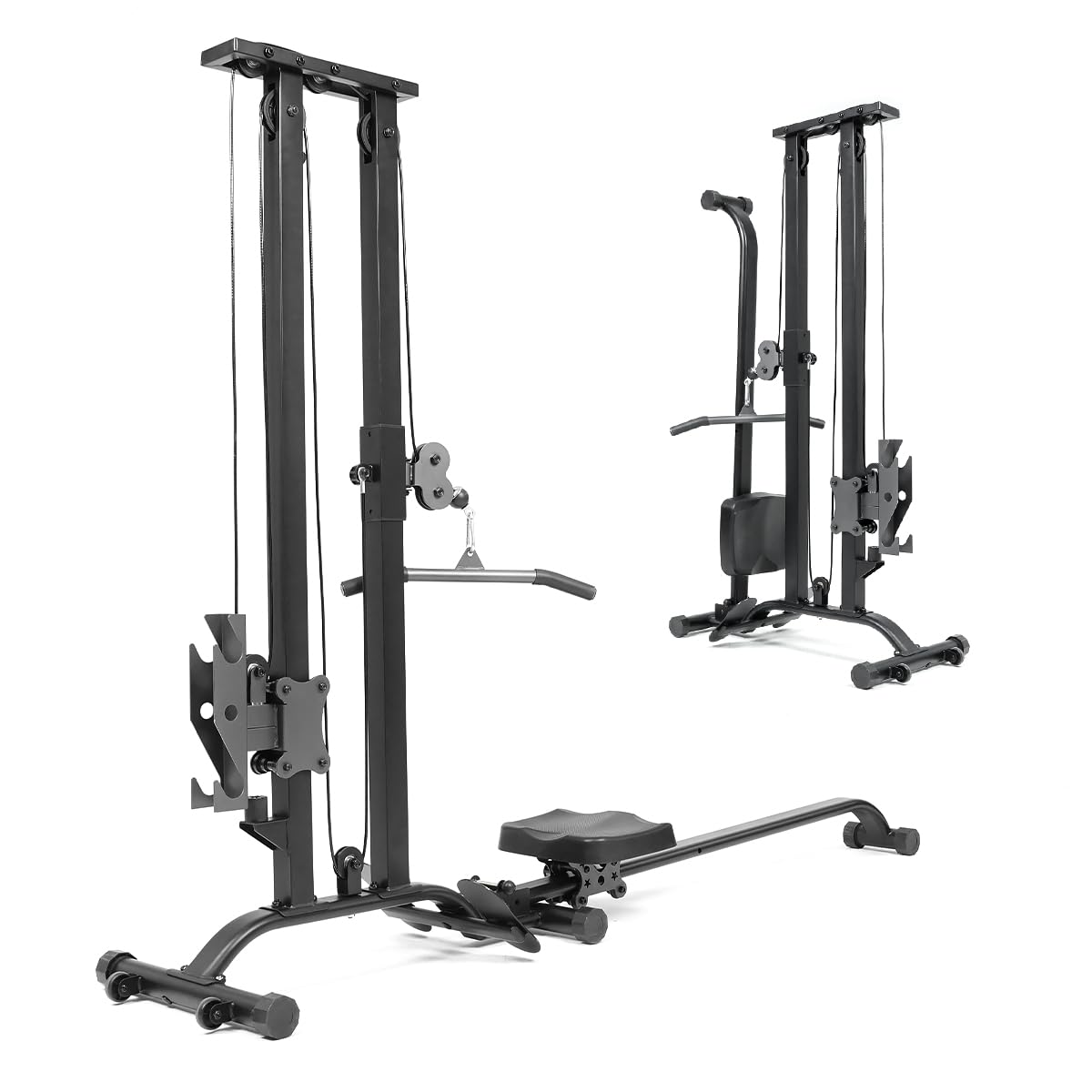
At this lower price you get a 2-in-1 machine that switches between a cable crossover and a rowing machine in about 3 seconds via a quick-change cable system, folding to the size of a suitcase (2.92 square feet) at just 12.4 inches wide. The fully deployed footprint is 7.12 square feet, smaller than a yoga mat, according to the manufacturer.
The cable machine supports up to 330 pounds of resistance by loading two dumbbells simultaneously (most competitors only allow one). The frame stands at 62.99 inches tall, fitting comfortably under standard 7-foot ceilings with 21 inches of headroom for overhead lat pulldowns. Reviewers highlight the “small footprint, uses adjustable weights, freestanding, good price” as the winning combination, and many note that assembly takes about 30 minutes with pre-placed screws.
The main limitation: no included rowing seat — you sit on the floor for rowing exercises, which some users find uncomfortable. The machine is also lightweight at 50.7 pounds, making it easy to move but also meaning heavier users might feel wobble during intense cable work. For an apartment dweller wanting cable exercises and rowing cardio without dedicating a room, the CR63 is a clever space-saving solution.
Why we’d pick it
- Ultra-slim 12.4 inch width for hallways
- 2-in-1 cable machine and rower in one unit
- 30-minute assembly with pre-placed screws
- Fits under 7 ft ceilings with 21 inches clearance
A few caveats
- No rowing seat included — you sit on the floor
- Lightweight frame (50.7 lbs) can feel less stable
- Assembly instructions are very poor
- Max 330 lbs capacity limits heavy lifters
6. EVO Gym Portable Home Gym
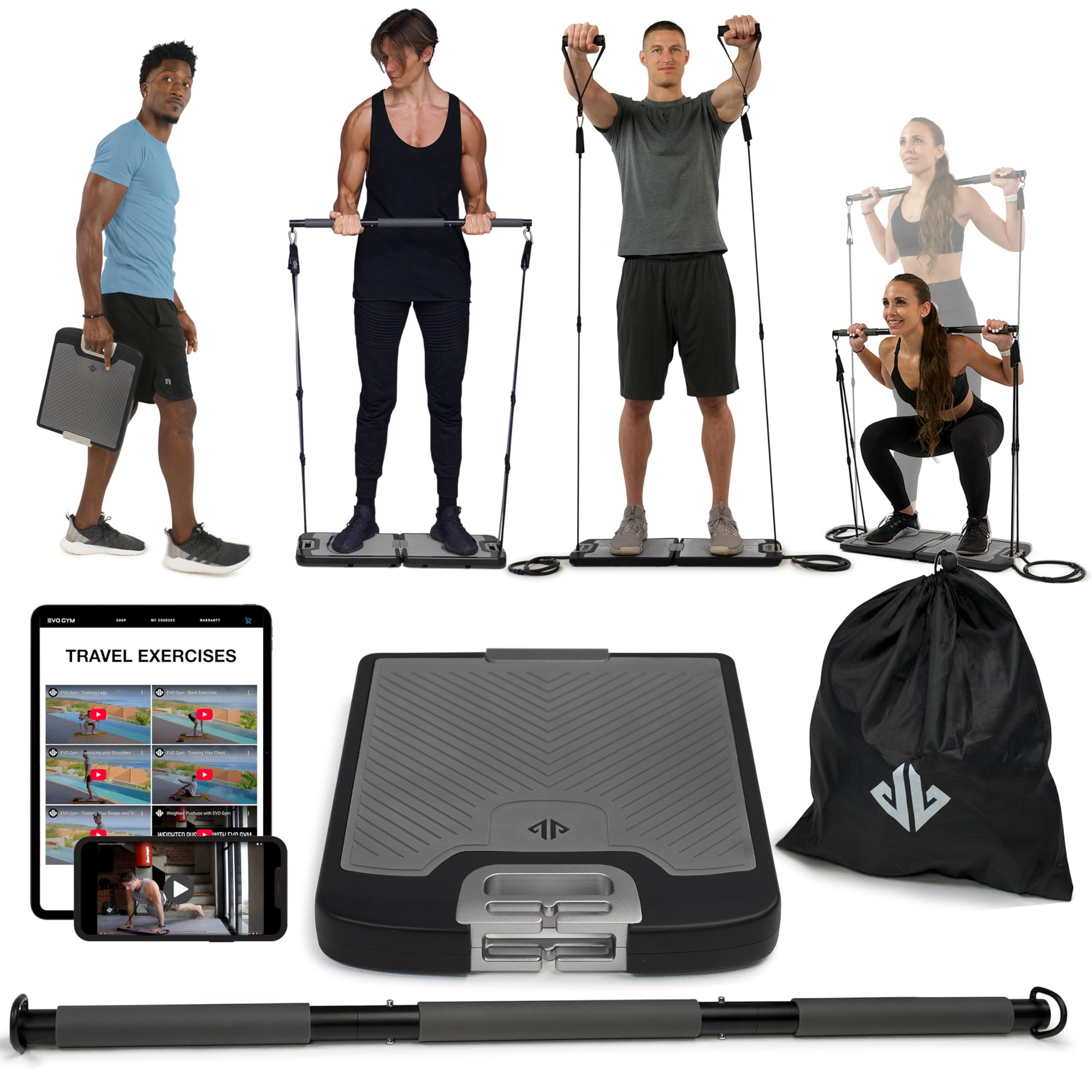
The EVO Gym is for travelers, van-lifers, or anyone needing a full strength workout in a bag small enough for carry-on luggage. It packs 10 resistance bands (two 10 lb, two 20 lb, two 30 lb, and four 50 lb) into a base that folds flat and slides under a bed. With an extra pair of 50 lb bands, you can reach a maximum of 400 pounds of resistance — 21% higher than the TOUSAINS CR63’s 330-pound limit.
You do not need to anchor it to a wall or door for most exercises; the wide base platform is reinforced with aircraft-grade aluminum and stays put during squats, deadlifts, and overhead presses. Owners mention the progressive overload via band notches is excellent for performing squats, deadlifts, bench presses, cable flies, and hundreds of other movements. One reviewer noted they used it for 3 months with noticeable results and that the company replaced a broken band despite user error.
The honest limit: bands cannot perfectly replicate the feeling of free weights or a cable stack — deadlifts and chest presses are “suboptimal but workable with creativity,” as one reviewer put it. Also, the base lacks a latch to keep it closed when folded. But if your primary constraint is that the gym needs to disappear into a closet or backpack between sessions, the EVO Gym delivers 400 pounds of progressive resistance in a truly portable package.
Strong points
- 400 lbs max resistance — highest on this list
- Folds flat; fits under a bed or in a backpack
- 10 bands with precise notches for progressive overload
- Sturdy aluminum base stays put during exercises
Before you buy
- Bands feel different from cable stacks or free weights
- Base has no latch to keep it closed when folded
- Some exercises (deadlifts, chest presses) require creativity
- Bands can shift out of alignment during use
7. Total Flex Compact Home Gym

The Total Flex is a foldable adjustable bench with resistance bands and a leg extension attachment. At 24 kilograms (about 53 pounds), it is heavier than the EVO Gym but lighter than any steel rack, and it arrives almost fully assembled. You can carry it from room to room with a built-in handle or fold it up and slide it against a wall. In terms of price and value, it sits in the middle of the field — more affordable than the premium steel rack options but pricier than the simplest band-only systems, offering a balance of bench features and portability.
You get 20 bench positions controlled by a letter-and-number system, plus three levels of color-coded resistance bands that provide 7 adjustable levels of smooth two-way resistance. The included components (foot plate, ankle straps, handle grips, headrest, leg extension with three bungee cords) let you do over 50 exercises. One reviewer says they started at 249 pounds and dropped to 209 pounds using this machine in their apartment.
The one clear reason to choose it over the EVO Gym is the adjustable bench — the Total Flex gives you a real decline/incline bench setup that bands alone cannot match. But it tops out at 300 pounds of resistance (compared to EVO’s 400 pounds), and several reviewers mention that the company’s online workout videos are useful but a written PDF exercise chart is missing from the box. It is for someone who wants a compact, bench-based resistance system for moderate strength training in a very small apartment.
What we like
- 20 adjustable bench positions for varied angles
- Almost fully assembled out of the box
- Foldable with carry handle for room-to-room portability
- 7 resistance levels suitable for beginners to intermediate
The downsides
- Max 300 lbs resistance limits heavy lifters
- No written exercise chart included — online videos only
- Too light for serious bodybuilding or powerlifting
- Customer support is hard to reach
Understanding the Specs
Ceiling Height Compatibility
This is the most overlooked spec in the compact home gym category. Most folding power racks and cable machines stand between 60 and 86 inches tall. If you have 8-foot ceilings (96 inches), you have plenty of clearance. But if you have 7-foot basement ceilings (84 inches), a rack like the JELENS FS01 at 86.22 inches simply will not fit. Always measure your ceiling height and subtract the machine’s height from it — you need at least 10-12 inches of clearance above your head during overhead exercises like lat pulldowns or pull-ups.
Pulley Ratio: 1:1 vs 2:1
The pulley ratio tells you whether the weight you load is the weight you actually lift. A 1:1 ratio means direct transfer — load 100 pounds on the stack, feel 100 pounds in your hands. A 2:1 ratio doubles the cable travel distance and halves the resistance — load 100 pounds, feel only 50 pounds. Budget machines often use 2:1 to keep the weight stack small, but this makes it harder to track your actual strength gains. For an honest workout, stick with 1:1 pulley systems if your budget allows.
Weight Capacity: Static vs Dynamic Load
Wall-mounted and folding racks usually list a “static load” rating — the maximum weight the rack can hold when nothing is moving. This is different from a “dynamic load” rating, which accounts for the shock of dropping weight during a failed rep. A rack rated for 1,100 pounds static load is safe for 300-pound squats because the weight is stable. But if you plan to drop 300 pounds of barbell from overhead, look for a rack with at least 1,000 pounds static rating to absorb the shock safely. Never confuse the two ratings.
Footprint: Deployed vs Stored
Every folding compact home gym has two numbers: the size when open for training and the size when folded for storage. The stored size is what manufacturers advertise in big bold numbers, but the deployed footprint is what actually matters for your daily workout space. A rack that folds to 3 square feet but expands to 12 square feet will block a hallway for the entire workout. Measure your training zone (the area where you place the rack when open) separately from your storage zone, and make sure both fit your actual room layout.
FAQ
Do I need to bolt a folding squat rack to the wall?
Can a compact cable machine replace a full-size gym cable crossover?
How much weight can I really lift on a 1,000-pound rated rack?
Resistance bands vs cable stacks: which feels more like a real gym?
Final Thoughts: The Verdict
For most people trying to fit serious strength training into a small apartment or crowded garage, the overall winner for a compact home gym is the Mikolo Folding Squat Rack (WR00) because it combines a 1,000-pound-rated power rack with dual 1:1 pulley cables in a frame that folds to just 3 square feet. If you want a guided Smith machine path for safer heavy lifting without sacrificing the 1:1 cable feel, grab the Mikolo Smith Machine Power Cage. And for pure portability that fits in a backpack and hits 400 pounds of resistance, the standout is the EVO Gym Portable Home Gym at this size.

Mo Maruf
I created WellFizz to bridge the gap between vague wellness advice and actionable solutions. My mission is simple: to decode the research and give you practical tools you can actually use.
Beyond the data, I am a passionate traveler. I believe that stepping away from the screen to explore new environments is essential for mental clarity and physical vitality.