Our readers keep the lights on and my smoothie glass nicely filled. As an Amazon Associate, I earn from qualifying purchases.
Specs are compiled from manufacturer listings and verified buyer reviews and can change over time — please confirm the key details on the product page before buying.
You want a camera small enough to slip into a jacket pocket, simple enough to hand to a friend without explaining a thing, and smart enough to give every picture real character. The trouble is that vintage SLRs are bulky, single-use cameras get expensive fast, and the wrong compact just sits on a shelf. Here are the five best picks right now — from a half-frame workhorse that doubles your film to a digital compact that rivals full-frame quality.
I’m Mohammad Maruf — the founder and writer behind WellFizz. This guide is built by comparing the manufacturers’ published specifications and the patterns across verified customer reviews, so you get each pick’s real strengths and trade-offs instead of marketing spin.
Whether you are loading your first roll or upgrading from a phone, these recommendations cover every budget and style of shooting. The right compact film camera should feel like a natural extension of your hand — not a burden in your bag.
Our Picks at a Glance

How To Choose The Best Compact Film Camera
A compact film camera is a simple purchase, but a few key decisions separate a keeper from a camera that sits on a shelf. Focus on these three areas first.
Half-frame vs Full-frame: The shot-count trade-off
A standard 35mm camera exposes one full 24x36mm frame per click. A half-frame camera (like the Kodak EKTAR H35N or the Pentax 17) splits each frame in half, so you get 72 shots from a 36-exposure roll instead of 36. The trade-off is smaller negatives, which means less detail when you enlarge prints — but for social media scans and 4×6 prints, the difference is barely visible.
Auto-everything vs Manual control
True point-and-shoot cameras handle focus, exposure, and flash for you. Other models, like the Pentax 17, offer manual ISO settings from 50–3200 or zone-focus rings that let you decide whether the subject at 2 meters or infinity is sharp. If you want to learn the craft, a camera with manual control is a better teacher. If you just want to shoot without thinking, go auto.
Lens quality and built-in flash
Glass lenses produce sharper, more contrasty images than plastic ones. Look for a coated lens if you want to minimize flare. A built-in flash is standard on most compact film cameras, but reliability varies widely — some buyers report flashes failing after a few rolls. If flash is critical for your indoor or night shooting, check that the reviews on your model do not flag it as a weak point.
Quick Comparison
| Model | Best For | Format | Lens | Focus System | Amazon |
|---|---|---|---|---|---|
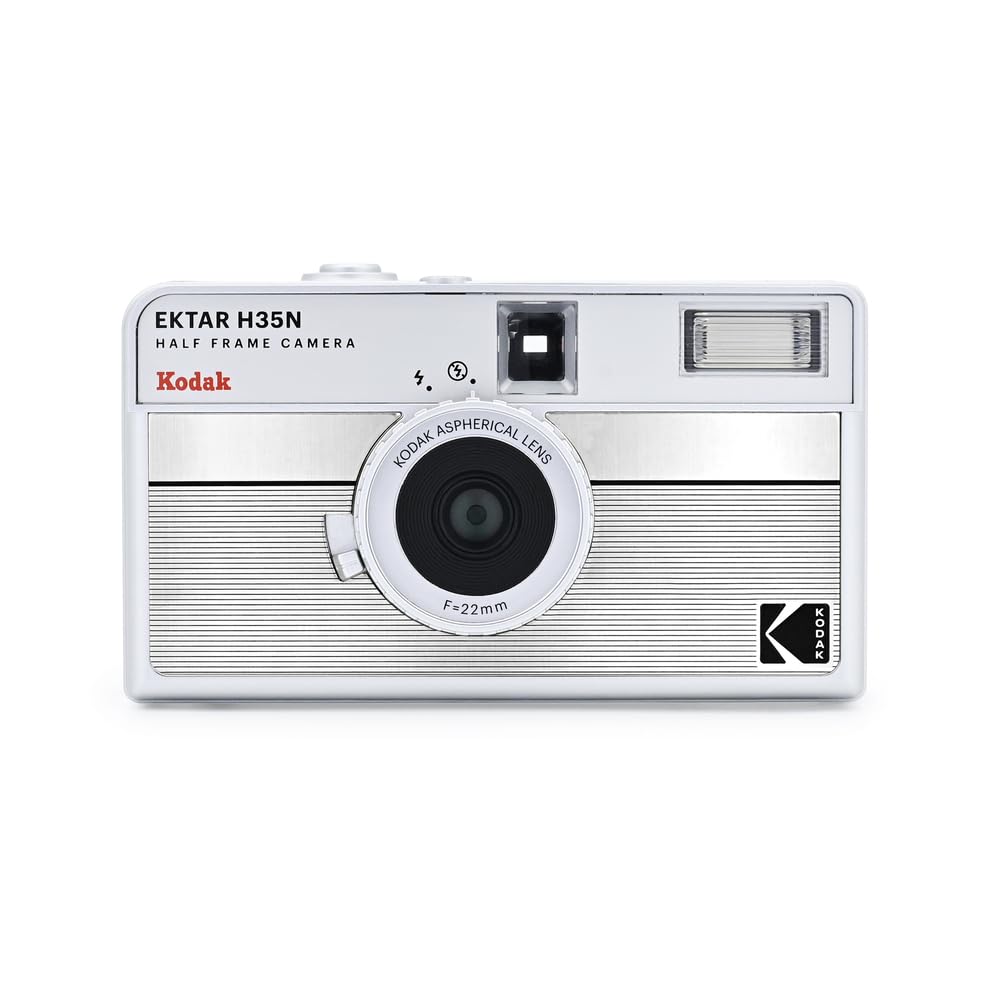
| Kodak EKTAR H35N (standalone)★ Best Overall | Budget-friendly half-frame starter | Half-frame 35mm | 22mm f/11 coated glass | Focus-free (fixed) | Amazon |
| Kodak EKTAR H35N bundleBest Bundle | New shooter with film included | Half-frame 35mm | 22mm f/11 coated glass | Focus-free (fixed) | Amazon |
| Pentax 17 Kit | Premium half-frame with full manual control | Half-frame 35mm | 25mm f/3.5 HD coated | 6-zone | Amazon |
| Ricoh GR IIIx HDF | Pocketable digital with film-like character | Digital (APS-C) | 26.1mm f/2.8 (40mm equiv.) | Contrast-detect AF | Amazon |
In‑Depth Reviews
1. Kodak EKTAR H35N Half Frame Film Camera (Standalone)
Our pick — over 4★ from 650+ verified ratings; the strongest balance of quality and price.
The Kodak EKTAR H35N gives you 72 shots per roll and a proven toughness that survived 12 assignments as a wildland firefighter.
You get 72 shots out of a single 36-exposure roll of 35mm film because the camera uses half-frame format — it splits each full frame in half, so you capture a whole trip without reloading. The 22mm f/11 coated glass lens is fixed-focus, which means it is always sharp from a few feet to infinity; there is zero learning curve, you just point and press the shutter button.
A built-in star filter switches on to turn streetlights and candles into four-beam flares, and the bulb function (a long-exposure mode) lets you capture light trails at night if you mount it to a tripod. The flash runs on one AAA battery. Owners mention taking this camera through 20 states, 11 countries, and 12 assignments as a wildland firefighter — the flash eventually gave out, but the body kept shooting. The crowd rating is 4.4 out of 5 stars across more than 600 owners, with quality and appearance as the two most-praised aspects.
The honest trade-off is the plastic build — it is not a metal tank. The film advance wheel can feel stiff on some units, and flash reliability draws mixed feedback in the reviews. This is a camera built for fun and travel, not for archival-grade darkroom prints. But as owners put it: “go take some pictures with yours.”
What owners love
- Half-frame gives you 72 shots per roll — twice the mileage from every film purchase
- Focus-free lens with built-in star filter makes creative shooting easy
- Proven toughness: survived a round-the-world trip plus firefighting work
The fine print
- Plastic body — treat it with care; drops can crack the shell
- Flash reliability is inconsistent; a few owners had theirs quit mid-trip
- Film, AAA battery, cable release, and tripod are sold separately
Your go-to travel companion if: you want the most shots per roll in the smallest package and you are okay with a rough-and-tumble plastic body that has proven itself in the field.
Think twice if: you need a metal housing, a flash you can bet your night shots on, or a camera that feels premium in the hand.
2. Kodak EKTAR H35N Half Frame Film Camera Bundle with Kodak Ultramax 400
You get the same rugged half-frame camera with a roll of Kodak Ultramax 400 film, so you start shooting as soon as the box arrives.
This bundle is functionally identical to the standalone H35N above — same 22mm f/11 coated glass lens, same half-frame 72-shot format, same star filter and bulb mode — but it includes one roll of Kodak Ultramax 400 (24 exposures, which becomes 48 half-frame shots). The camera body itself weighs 200 grams versus the 110-gram standalone, a difference driven entirely by the bundled packaging and film. At 4.33 x 1.77 x 2.56 inches, it still vanishes into a jacket pocket.
The crowd rating of 4.3 across more than 400 owners echoes the standalone’s story: ease of use and appearance are the top positives. One first-time buyer described it as “very useful when traveling and learning film … easy to set up, use, and carry.” The camera is fully mechanical — the only electrical component is the flash, powered by a AAA battery. You must manually wind the film after each shot to avoid double exposures, a small ritual that some owners find meditative.
The recurring negative is the flash — it tops the complaint list. A number of customers note it failing after a few rolls or even after two days. The bundle also includes the same plastic construction, so this is not a camera you want to drop on concrete. The built-in tripod hole makes up for the lack of image stabilization once you mount it on a mini tripod for night shots.
What owners love
- Film is included — one less thing to buy before your first outing
- Beginner-friendly design: load, wind, point, and shoot
- Fully mechanical operation means no battery drain except for the flash
The fine print
- Flash reliability is the most-discussed drawback; many owners found it inconsistent
- The plastic shell is not built for heavy abuse
- Instructions for loading film are poor — you will want a quick YouTube video
Best for beginners who want a one-box solution: the bundle saves you a trip to a camera store and the 48-shot half-frame format is ideal for learning the basics without burning through film.
Skip this if you already own film stock: buy the standalone H35N instead and put the savings toward a second roll.
3. Pentax 17 Half-Frame Compact Film Camera Kit

The Pentax 17 is the most serious camera here — it gives you six zone distances and manual ISO from 50 to 3200, which the fixed-focus H35N simply cannot match.
This is the most serious film camera on the list. The Pentax 17 runs on a 25mm f/3.5 lens with an advanced HD coating that reduces flare and improves contrast — a measurable step above the fixed-focus H35N. The zone-focus system has six distinct zones from 0.25 meters to infinity, so you can pre-focus for street photography or landscape work with genuine precision. A manual ISO range of 50–3200 and exposure compensation of ±2 EV give you creative control that no other camera in this list offers.
It is still a half-frame camera — 72 shots per 36-exposure roll — but the larger f/3.5 aperture lets in significantly more light than the H35N’s f/11, which means better results in dim conditions. The kit bundles three rolls of Kodak Gold 200 film, a CR2 3V battery, a lens cap, a wrist strap, and a microfiber cleaning cloth. The electronically controlled central shutter coordinates with six shooting modes, making this adaptable to everything from quick snapshots to careful long-exposure work on a tripod.
The crowd rating is 4.4 stars across 20+ ratings. Owners describe the lens as “sharp for half-frame” and note that the camera balances sophistication with simplicity. One critical review flag an occasional shutter malfunction — note if you are unlucky with unit quality. Another reviewer points buyers to the Kodak Snapic as a capable budget alternative. If you are ready to invest in a camera that teaches you the craft and rewards deliberate shooting, this is the one.
A real creative tool: The Pentax 17 is not a toy — it is a precision half-frame camera with manual controls and a sharp coated lens. Best for hobbyists who want to learn exposure and focus discipline.
Choose this if you want to grow into film photography: the six-zone focus and manual ISO range are genuine learning tools that a fixed-focus camera cannot provide.
Think twice if you just want a simple point-and-shoot: the price point is much higher, and the learning curve is steeper — an EKTAR H35N or Snapic A1 will serve you better for casual shooting.
4. Ricoh GR IIIx HDF Camera

The Ricoh GR IIIx HDF is a pocket digital camera with a 24.2MP APS-C sensor — the same sensor size used in professional DSLRs — plus a toggle-able filter that mimics the look of film.
This is the only digital camera on the list, and it earns its place by delivering the soul of film photography in a package that fits in a jeans watch pocket. The GR IIIx HDF features a 24.2MP APS-C size CMOS sensor (the same sensor size you get in most professional DSLRs) paired with a 26.1mm f/2.8 GR lens that gives a 40mm equivalent field of view (the classic documentary photographer’s focal length). The Highlight Diffusion Filter (HDF) diffuses highlights to create a soft, dreamy quality reminiscent of film, and you can turn it on and off with a dedicated Fn button.
The contrast-detect autofocus has 150 points, the aperture goes to f/2.8, the aspect ratio is 3:2, and the camera connects to your smartphone via Wi-Fi. It shoots at a bit depth of 8-bit and uses SD memory. USB charging, fast startup, and full customizability make it a genuine everyday carry camera. Reviewers point out preferring it over the Leica Q, Fuji X100V, and Canon G1X mk iii, calling the image quality “fantastic” and the portability “class-leading for the size.” The crowd rating is 4.4 stars across 45+ ratings, with camera quality and portability being the top aspects praised.
The trade-off is the lack of a built-in flash, and one owner notes the camera cannot focus on very close objects. A minor quality issue — a front fascia pop-off — was reported on one unit due to an aftermarket part. At this price point, the GR IIIx HDF is a serious investment. It is not a film camera, but it produces the kind of characterful, high-contrast images that film shooters chase, without the cost and hassle of film development.
The film-like digital alternative: A pocket-sized 24MP APS-C camera with a twitchable HDF filter that mimics film’s highlight diffusion. A worthy sidekick or main camera for shooters who want digital convenience with analogue soul.
Perfect for the photographer who wants one pocketable camera that does everything: it beats every film compact on image quality and versatility, and the HDF filter adds a unique creative tool.
Not for you if you insist on real film: no loading, no developing, no grain — the GR IIIx is a digital tool that mimics film, not a film camera.
Understanding the Specs
Half-frame vs Full-frame 35mm
A half-frame camera exposes each 35mm frame vertically, taking two pictures in the space of one normal frame. You get 72 shots from a 36-exposure roll, which saves on film cost and keeps you shooting longer between reloads. The cost is a smaller negative, which means less resolution for large enlargements — but for 4×6 prints and digital scans, the difference is negligible.
Zone-focus systems explained
A zone-focus camera has a limited set of focus distances — typically 2–6 zones — marked on the lens barrel. You rotate the ring to the appropriate zone (portrait, group, landscape) before shooting. It is faster than manual focusing and much simpler than autofocus, which is why it is common on modern compact film cameras. The more zones, the more precise you can be.
FAQ
Will a half-frame camera fit standard 35mm film?
Do I need to buy batteries for a compact film camera?
Which film speed works best for these cameras?
How do I load film into a half-frame camera?
Can I use these cameras indoors without a flash?
How durable are these plastic-bodied cameras?
What is the Highlight Diffusion Filter (HDF) on the Ricoh GR IIIx?
Is the Ricoh GR IIIx worth it over a film camera?
Final Thoughts: The Verdict
If you want one dependable pick, the compact film camera winner is the Kodak EKTAR H35N because it delivers the most shots per roll at the lowest weight, with proven real-world toughness and a built-in star filter for creative fun. If you want full-frame auto-everything with a glass lens and a 2-zone focus, grab the KODAK Snapic A1. And for serious hobbyists ready to invest in manual control and superior optics, the Pentax 17 Kit is the pick that will grow with your skills.
How We Picked
We do not accept paid placement. Every pick is matched to a real buyer and a real use-case; we do not hands-on test units.
Sources & Methodology
Specifications: manufacturer listings and product documentation. Review insights: verified customer reviews, as of July 2026. Pricing: not shown on this page (it changes often); check the current price via the retailer link.
As an Amazon Associate, WellFizz earns from qualifying purchases. This does not affect which products we feature.
Related Guides

Mo Maruf
I created WellFizz to bridge the gap between vague wellness advice and actionable solutions. My mission is simple: to decode the research and give you practical tools you can actually use.
Beyond the data, I am a passionate traveler. I believe that stepping away from the screen to explore new environments is essential for mental clarity and physical vitality.