Our readers keep the lights on and my smoothie glass nicely filled. As an Amazon Associate, I earn from qualifying purchases.
Specs are compiled from manufacturer listings and verified buyer reviews and can change over time — please confirm the key details on the product page before buying.
Finding a compact camera under $200 that actually takes sharp photos and smooth video instead of blurry, disappointing shots is tougher than it looks. You want something small enough to toss in a bag, simple enough to hand to a beginner, but with real features like decent zoom, autofocus that works, and video that doesn’t look like it was shot in 2010. This guide identifies the best performers under $200 by comparing specs and verified reviews.
I’m Mohammad Maruf — the founder and writer behind WellFizz. This guide is built by comparing the manufacturers’ published specifications and the patterns across verified customer reviews, so you get each pick’s real strengths and trade-offs instead of marketing spin.
The best compact camera under $200 delivers a surprisingly capable blend of high-resolution stills, usable video, and thoughtful extras like WiFi sharing or a flip screen without crossing into toy-camera territory.
Our Picks at a Glance


How To Choose The Best Compact Camera Under $200
In this price range, you are balancing raw specs like megapixels and zoom against real-world usability. The cameras here fall into two camps: solid point-and-shoots with optical zoom from a trusted brand, or higher-spec digital-zoom models packed with features like WiFi and flip screens. Understanding each spec’s real-world impact simplifies your decision.
Optical Zoom vs. Digital Zoom
Optical zoom uses the camera’s lens to physically magnify the image, keeping it sharp and clear. Digital zoom simply crops into the picture and enlarges the pixels, which makes everything look grainy. For a compact camera under $200, a model with 4X or 5X optical zoom (like the Kodak FZ55 or FZ45) will give you much cleaner close-ups than a camera relying on 16X or 18X digital zoom alone.
Megapixels and Image Quality
A 16MP sensor on a reputable brand like Kodak usually produces more natural, reliable colors than an “88MP interpolated” sensor on a lesser-known brand. Interpolation is a software trick that adds pixels to a lower-resolution image, making the file bigger but not actually sharper. Stick with honest 16MP for consistent everyday photos; the higher interpolated numbers are only appealing if you plan to heavily crop or enlarge prints.
Autofocus and Stabilization
Fast autofocus (AF) and image stabilization stop your photos from coming out blurry, especially indoors or in low light. Look for models that specify “fast autofocus” or “autofocus lock,” as some budget cameras use a fixed focus that struggles with subjects closer than a few feet. Optical Image Stabilization (OIS) on the lens is more effective than electronic anti-shake, which just processes the video.
Quick Comparison
| Model | Best For | Megapixels | Optical Zoom | Video Resolution | Amazon |
|---|---|---|---|---|---|
| Notoldpine 5K Camera★ Best Overall | Best Value Vlogging Cam | 80MP | — | 5K | Amazon |
| LOUM 8K CameraSelfie Special | Best for Selfies/Vlogging | 88MP | — | 8K | Amazon |
| Kodak PIXPRO FZ55 (Standalone)Best Budget Point-and-Shoot | Best Budget Point-and-Shoot | 16MP | 5X | 1080p Full HD | Amazon |
| Minolta 48MP Camera | Compact Travel Companion | 48MP | — | 4K | Amazon |
| Kodak PIXPRO FZ45 | Reliable Entry-Level Option | 16MP | 4X | 1080p Full HD | Amazon |
| Minolta MND20 | Cheapest Fun Compact | 44MP | — | 2.7K | Amazon |
In‑Depth Reviews
1. Kodak PIXPRO FZ55 16MP Digital Point & Shoot Camera, Bundle with 32GB SD Card, Protective Case, and Hi-Speed Card Reader (Blac-product-meta”>
5K Video270° Flip Screen
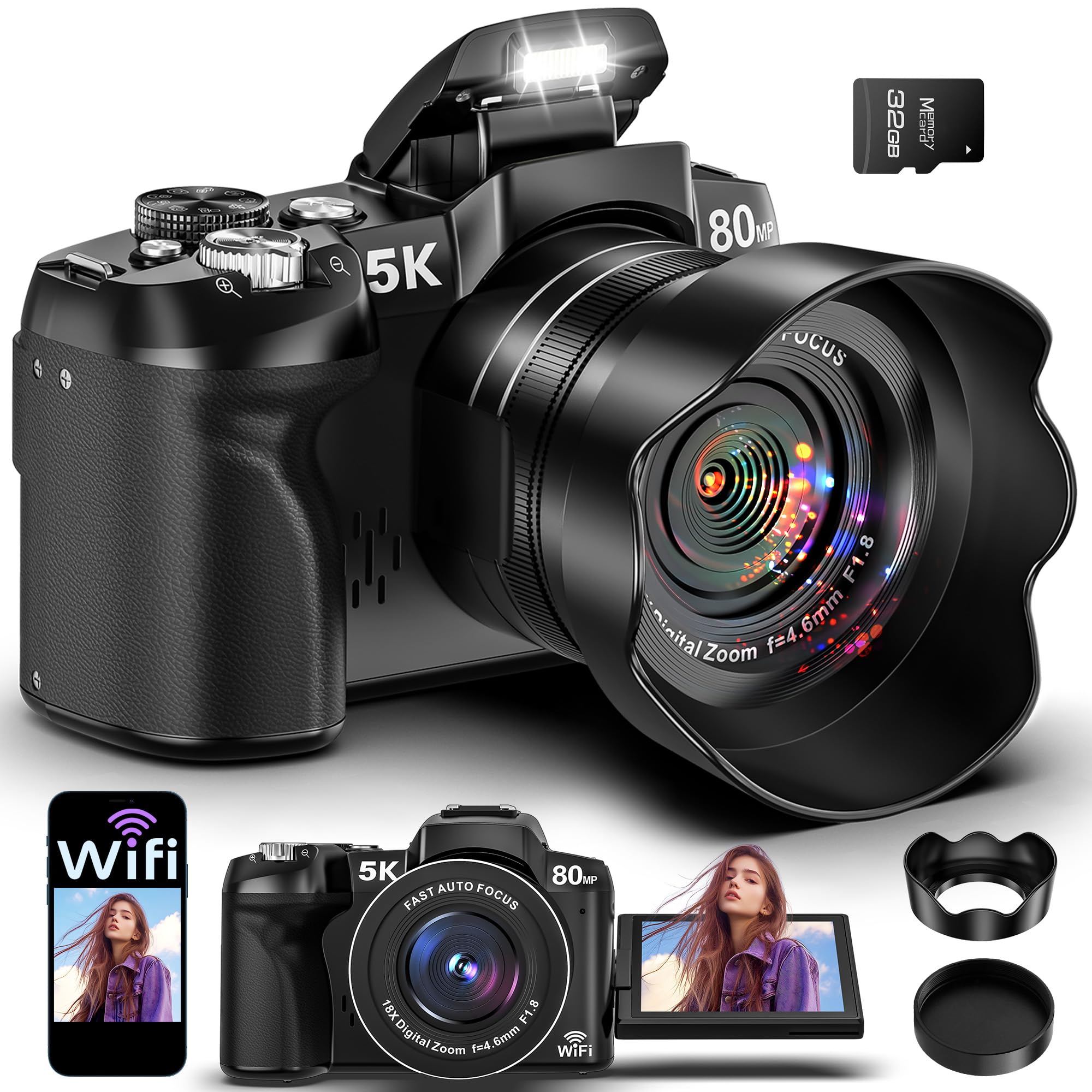
A vlogger’s wishlist of specs — flip screen, WiFi, and 5K video — at a price that shocks you.
Customers note “sharp, vibrant 80MP photos; smooth 5K video; 270° flip screen for selfies/vlogging; fast autofocus; built-in WiFi; lightweight; includes memory card and lens hood; 18X zoom; excellent value for beginners.” That single review captures why this camera punches way above its entry-level price. The F1.8 aperture lets in more light than the LOUM’s F2.0, giving you better performance in dim conditions and a slight edge in background blur.
The 3-inch flip screen rotates a full 270 degrees, making it perfect for solo YouTube creators or group selfies where you need to see the frame. The built-in WiFi lets you transfer shots to your phone without digging for a cable. It records over 120 minutes on a single charge, and the 32GB card it ships with means you can start filming immediately. The 30 creative filters, including vintage and sketch modes, give your videos a unique look without editing software.
The “18X zoom” is digital, not optical, so close-ups lose clarity. Unlike the Kodak FZ55’s 5X optical zoom, this model will show grain the more you zoom in. It is a trade-off of creative features for raw zoom quality.
Why You Will Love It
- 5K video (3x the resolution of the Minolta MND20’s 2.7K) for crisp, detailed footage.
- Fast autofocus locks onto subjects within 6.56 ft for sharp results.
- Complete kit with 32GB card, lens hood, and pouch included.
One Honest Limitation
- Digital zoom only — close-ups lose clarity compared to any optical-zoom Kodak.
The call: This is the best value pick for any beginner or vlogger who prioritizes video quality, a flip screen, and WiFi over pure optical zoom.
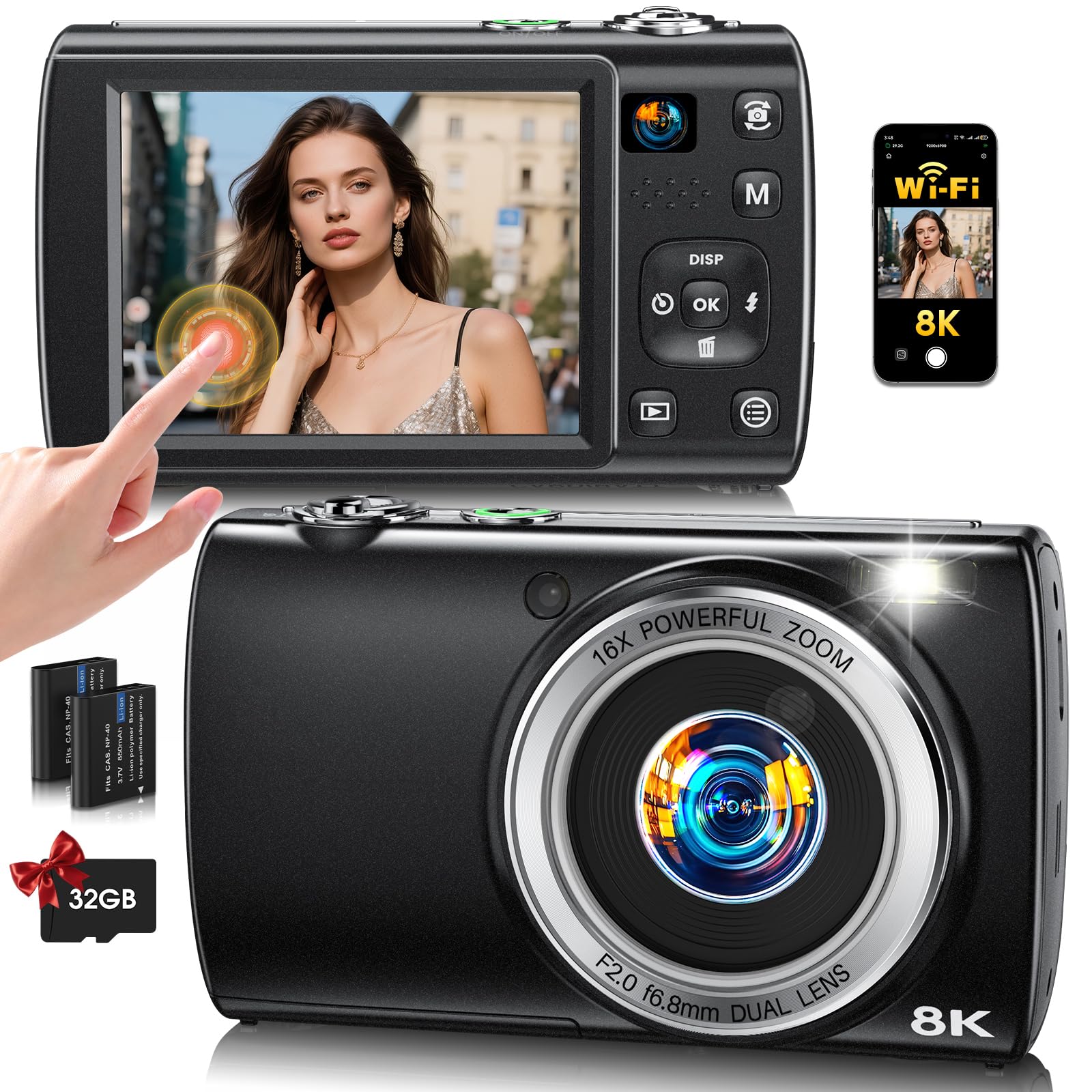
2. 8K Digital Camera for Photography, 2026 Latest WiFi 88MP Vlogging Camera for YouTube with Dual Lens, Touch Screen, Autofocus Anti-Shake, 16X Zoom
A rare front-and-rear dual-camera setup in a budget camera, plus a responsive touchscreen.
This LOUM camera does something almost no other compact camera under $200 does: it has a front-facing camera for selfies and vlogging alongside the main rear lens. The 2.8-inch IPS touch screen makes navigating menus and tapping to focus feel modern, not clunky. It records video up to 8K (7680×4320 at 15FPS), and captures 88MP photos through interpolation. The 5-Axis anti-shake stabilization helps keep handheld video steady — a real plus for creators on the move.
Reviewers point out it has “decent autofocus/stabilization” and is “great for travel, beginners, or everyday use.” It includes two rechargeable batteries, a 32GB memory card, a strap, and a carrying bag, so nothing is left to chance. The WiFi lets you transfer images to your phone wirelessly, and the touchscreen supports 4:3, 16:9, and 1:1 aspect ratios for direct social media posting. The F2.0 aperture is reasonably wide for low light.
Compared to the Notoldpine 5K camera, the LOUM offers even higher video resolution (8K vs 5K) and that dual-lens selfie feature. However, the trade-off is that its 8K mode records at only 15FPS, which can look choppy for fast motion — you will likely use 4K or 1080p for smooth results. It also lacks optical zoom, leaning entirely on 16X digital zoom.
Styled for the social era: If your priority is self-recording with a front-facing camera and a touch interface, this is the most unique option on the list.
Best suited for: Teenagers, TikTok creators, and anyone who wants a front camera and touchscreen control in a complete starter kit.
skip it if: You need optical zoom or smooth 60FPS video — this is a digital-zoom, slow-motion camera best for static scenes.
3. Kodak PIXPRO FZ55-BK 16MP CMOS Sensor Digital Camera 5X Optical Zoom 28mm Wide Angle 1080P Full HD Video 2.7″ LCD Vlogging Camera (Black)
The standalone Kodak that proves simple, optical-zoom photography is still the best entry point.
This is the core FZ55 model without the bundle accessories, and it has earned over 7,800 ratings with a 4.5-star average — the most trusted pick in this guide. The 16MP CMOS sensor and 5X optical zoom with a 28mm wide-angle lens give you real framing flexibility. It uses a rechargeable Li-ion battery, unlike the FZ45 which runs on AA batteries, making it more convenient for daily carry. Buyers love that “it takes beautiful pictures with great quality” and that photos “still look amazing” after transferring them to a phone.
The camera supports up to 512GB SD cards (class 10, SDHC, SDXC), so storage is never a concern. It records 1080p Full HD video, and its 9-point autofocus system with contrast detection keeps subjects in focus in most scenarios. The 2.7-inch LCD is standard for the price. It is compact enough to slip into a small bag, and buyers mention it is “beginner-friendly” and “high quality on a budget.”
Compared to the FZ45, this FZ55 has a better 5X optical zoom (vs. 4X) and a rechargeable battery instead of AAs. The downside is that unlike the bundle version (Pick #1), this one sells without a memory card or case, so factor in that extra cost. If you already have an SD card, this standalone is the better deal.
Plain truth: The best balance of optical zoom, brand trust, and a rechargeable battery for the lowest price in the Kodak lineup.
Pick this if: You want the most reliable, simple point-and-shoot experience and plan to buy your own memory card.
4. Minolta 48MP Digital Camera with Rear Selfie Lens – 4K Ultra HD Video, 2.8″ LCD Screen, 16X Digital Zoom, Autofocus, Slow Motion, Time Lapse, Filters, Scene Modes, 32GB Card Included (Blue)
A dedicated rear selfie lens and 4K video in a genuinely pocket-friendly body.
Unlike most cameras that force you to guess for selfies, this Minolta has a built-in rear selfie lens so you can frame portraits confidently. It captures 48MP photos and 4K Ultra HD video, giving it better video resolution than the usual 1080p from the Kodak options. The 2.8-inch LCD screen is clear, and the camera ships with a 32GB memory card, rechargeable battery, USB cable, wrist strap, and pouch — everything to start shooting immediately.
Buyers report it is “easy to use,” “great for beginners,” and one mentioned their “daughter loved it on a trip to Paris” with battery lasting through a day of sightseeing. It also has creative features like slow motion, time lapse, and 9 scene modes. The F2.2 aperture helps a bit in lower light compared to the Kodak PIXPRO FZ55’s F3.9. It weighs only 0.3 pounds, making it one of the lightest options here.
Some owners mention the battery life is a weakness: one review mentions it only gets around 140 images on the highest quality setting. It also relies on 16X digital zoom, so at full zoom the image will be soft compared to any optical-zoom Kodak.
Travel Ready Features
- Rear selfie lens for confident self-portraits.
- 4K video for sharper home movies.
Known Flaw
- Limited battery life (~140 shots) and digital-only zoom.
Ideal for: Casual travelers and teens who want a compact, lightweight camera with a selfie lens and 4K video while staying affordable.
5. Kodak PIXPRO FZ45 Digital Camera, 16MP Point & Shoot with 4X Optical Zoom, 27mm Wide Angle, 2.7 Inch LCD, 1080p Video, Red

A true budget icon from Kodak — simple, cheap, and backed by over 6000 reviews.
The FZ45 is the most reviewed camera in this list with 6,121 ratings, and for good reason. It is a no-fuss point-and-shoot with a 16MP sensor that customers note produces “good image quality for price” with “natural colors in good lighting.” The 4X optical zoom and 27mm wide-angle lens give you real zoom without the grain of digital systems. It records 1080p Full HD video and has a 2.7-inch LCD screen. It works with SD, SDHC, and SDXC cards up to 512GB.
One key difference from the FZ55: the FZ45 runs on two AA alkaline batteries. Buyers point out the included AA batteries are low quality and recommend switching to rechargeable NiMH cells. The camera supports 9 autofocus points via contrast detection, which is decent for this tier. It also has a built-in flash, which is helpful for indoor snaps.
Compared to the FZ55, the FZ45 has a slightly weaker 4X zoom (vs. 5X), uses AAs instead of a rechargeable Li-ion battery, and has a 2.7-inch screen vs. the AZ255’s 3-inch display. However, some buyers actually prefer AA compatibility because batteries are easy to find anywhere. One reviewer noted it is “better than [the] FZ55 in varied light,” though most prefer the FZ55 for its rechargeable battery. The FZ45 is also the same 16MP as the FZ55, and at 8-bit depth, its color range is standard.
The honest angle: The cheapest optical-zoom Kodak you can buy. It works, it is simple, and if you need AA convenience, it is the one.
Best for: The absolute tightest budget where every dollar counts, or anyone who wants to use common AA batteries instead of proprietary packs.
6. Minolta MND20 44MP Digital Camera – 2.7K Ultra HD Video, 16X Digital Zoom, Anti-Shake Stabilization, Time Lapse, Face Detection, 2.9-inch LCD Display – Lightweight Compact Camera (Silver)
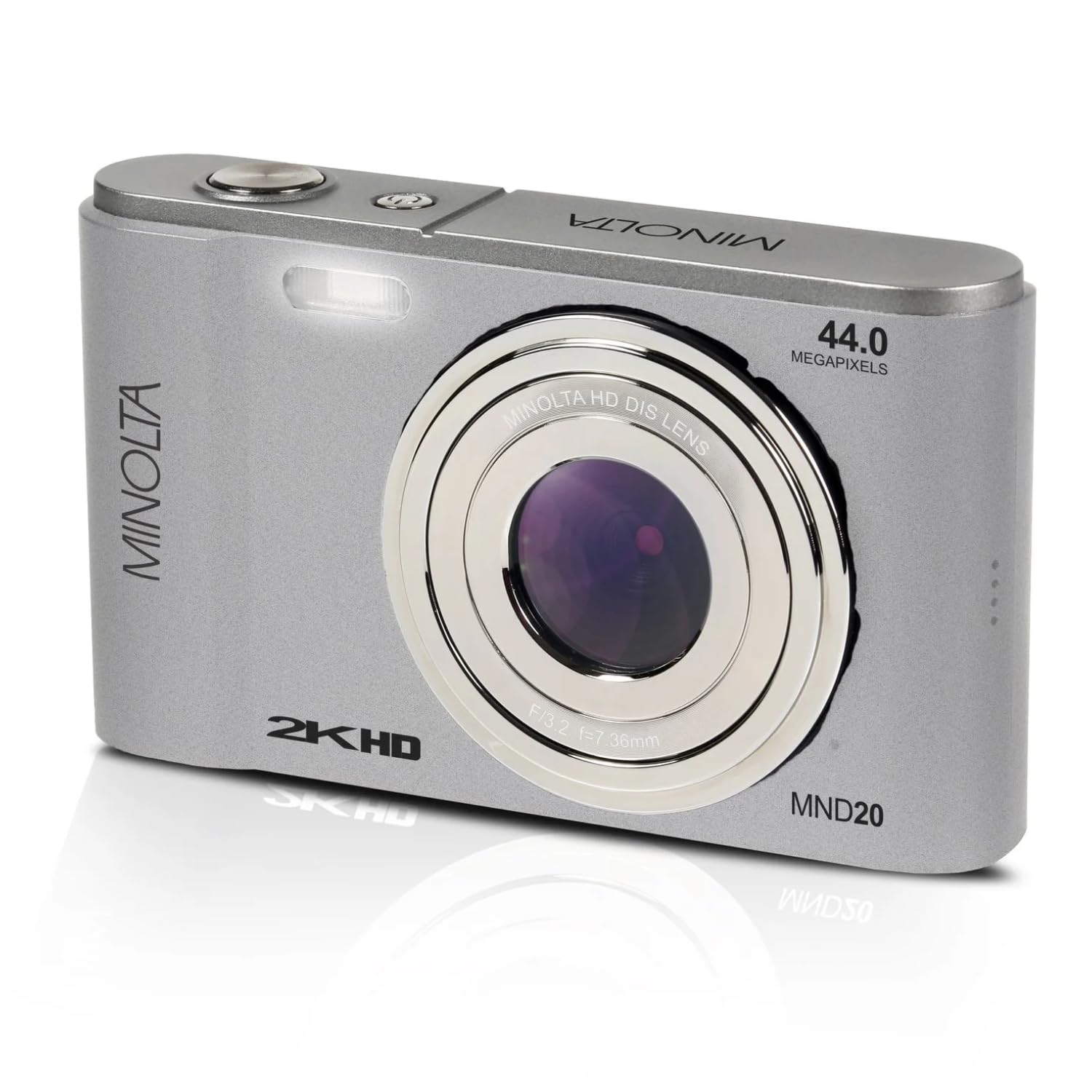
The lightest, cheapest option for a kid or teen wanting to explore photography.
Weighing just 8 ounces, the MND20 is the most portable camera in this comparison. It offers 44MP stills and 2.7K Ultra HD video — a step up from 1080p for video resolution. The 2.9-inch LCD screen is actually the largest standard screen among the non-superzoom cameras here, 7% larger than the Kodak FZ45’s 2.7 Inch display. It includes anti-shake stabilization, face detection, and time lapse modes, plus panorama and scene presets. Reviewers point out it is “pocketable” and a “good entry-level fun camera.”
Several shoppers say the actual sensor resolution is 12MP, with the 44MP figure being interpolated. The camera has no autofocus — it uses fixed focus — so close-up shots can come out blurry. One buyer warns “battery drains fast” and the proprietary battery is a weakness. At an f/3.2 aperture, it is also the dimmest lens here, making low-light shots noisy.
Compared to the Notoldpine 5K camera, the MND20 falls short on video (2.7K vs 5K), autofocus (none vs fast AF), and stills (interpolated 44MP vs 80MP). It is best viewed as a fun, disposable-style gadget for a child, not a serious photographic tool. Buyers report it is “best for ages 8-16 as inexpensive, easy-to-use option.”
The Positives
- Very lightweight at 8 oz for easy carrying.
- Includes anti-shake, face detection, and time lapse.
The Bottom Line
- Fixed focus and interpolated sensor mean images are softer than the competition.
- Proprietary battery with short life.
Who it fits: A young first-time photographer or someone wanting an ultra-cheap, ultra-light camera for occasional fun snaps — not for sharp, reliable results.
Understanding the Specs
Optical vs. Digital Zoom
Optical zoom uses glass lenses that physically move to magnify the scene. The image stays sharp because the camera captures real detail. A camera like the Kodak AZ255 with 25X optical zoom can bring a distant bird into crisp view. Digital zoom, found on cameras like the Minolta MND20, simply crops the image and enlarges the pixels — it looks like you zoomed in on a photo on your phone and stretched it. Digital zoom always reduces sharpness, so the number (like 16X or 18X) is not a measure of quality.
Megapixels and Interpolation
Megapixels (MP) are the number of tiny dots (pixels) that make up your photo. A 16MP camera like the Kodak FZ55 captures 16 million real pixels of detail. Some cameras claim 80MP or 88MP, but this is often achieved through “interpolation” — a software process that adds fake pixels based on the real ones. This makes the file larger, but not sharper. For a compact camera under $200, a true 16MP sensor from a trusted brand usually produces more honest, natural-looking images than an interpolated 80MP sensor.
Video Resolution: 1080p vs 4K vs 5K vs 8K
Video resolution names refer to the number of horizontal lines of detail. 1080p (Full HD) is 1,920 x 1,080 pixels. 4K is roughly 3,840 x 2,160 pixels — four times the detail. 5K and 8K go even higher. On a budget compact, higher video resolutions can look great in good light, but the frame rate (FPS) matters too. The LOUM 8K camera records at 15FPS at 8K, which can look stuttery. You will often get smoother results by dropping to 1080p at 30FPS or 60FPS on most of these cameras.
Aperture and Low-Light Performance
Aperture (f-stop like F1.8 or F3.9) controls how much light the lens lets in. A lower number (like F1.8) lets in more light, helping you shoot indoors or at dusk without blur or grain. The Notoldpine 5K camera has an F1.8 aperture — 11% wider than the LOUM’s F2.0 — which gives it a noticeable edge in dim conditions. Cameras with narrow apertures like the Kodak FZ45 (F3.0-F6.6) or Kodak FZ55 (F3.9) need brighter light to get clean shots.
FAQ
Is 4X optical zoom enough for everyday use?
Do these cameras work with a memory card I already own?
Can I use a compact camera under $200 for video streaming?
Which camera is best for a child or teen starting photography?
What is the difference between the Kodak FZ45 and the FZ55?
Does the 88MP or 80MP camera actually take sharper photos than the 16MP Kodak?
How important is a flip screen for vlogging?
Will these cameras work well in low light?
Do I need to buy additional accessories with these cameras?
Final Thoughts: The Verdict
For most people, the best compact camera under $200 is the Kodak PIXPRO FZ55 Bundle because it delivers a genuine 5X optical zoom, reliable 16MP image quality from a trusted brand, and every accessory you need — all in one simple package. If you are a vlogger or beginner who wants higher video resolution, a flip screen, and WiFi, grab the Notoldpine 5K Camera for its outstanding feature-per-dollar value. And if your priority is long-range photography — capturing the moon, distant wildlife, or sports — the standout is the Kodak PIXPRO AZ255 with its incredible 25X optical zoom and optical image stabilization.
How We Picked
We do not accept paid placement. Every pick is matched to a real buyer and a real use-case; we do not hands-on test units.
Sources & Methodology
Specifications: manufacturer listings and product documentation. Review insights: verified customer reviews, as of July 2026. Pricing: not shown on this page (it changes often); check the current price via the retailer link.
As an Amazon Associate, WellFizz earns from qualifying purchases. This does not affect which products we feature.
Related Guides

Mo Maruf
I created WellFizz to bridge the gap between vague wellness advice and actionable solutions. My mission is simple: to decode the research and give you practical tools you can actually use.
Beyond the data, I am a passionate traveler. I believe that stepping away from the screen to explore new environments is essential for mental clarity and physical vitality.