Our readers keep the lights on and my smoothie glass nicely filled. As an Amazon Associate, I earn from qualifying purchases.
Specs are compiled from manufacturer listings and verified buyer reviews and can change over time — please confirm the key details on the product page before buying.
You want a camera that fits in a jacket pocket yet pulls in a distant mountain peak or captures a sharp indoor interview — but the first thing you learn is most so-called “compact” cameras still feel like a compromise on video. The real challenge is finding one that balances a long zoom range with steady 4K footage, reliable autofocus, and a body that does not weigh you down. This guide breaks down the seven best options for recording video on the move, from budget-friendly bridge cameras to mirrorless interchangeable-lens systems.
I’m Mohammad Maruf — the founder and writer behind WellFizz. This guide is built by comparing the manufacturers’ published specifications and the patterns across verified customer reviews, so you get each pick’s real strengths and trade-offs instead of marketing spin.
Whether you are vlogging, filming family trips, or creating content, these picks were chosen for their ability to shoot 4K video in a body that won’t demand its own bag space. Read on to find the compact camera for videography that fits your budget and shooting style.
Quick Picks
- Sony Alpha a6400 Mirrorless Camera — Best Overall
- Nikon Z50 II with Two Lenses — Color Creator
- Nikon Z 50 with Two Lenses — Best Value Kit
- Canon EOS R100 Mirrorless Camera — Beginner’s Mirrorless
- Panasonic LUMIX FZ80D Point and Shoot — Super Zoom Bridge
- Canon PowerShot SX740 HS Digital Camera — Travel Zoom Compact
- Panasonic LUMIX TZ/ZS99 Point and Shoot — Pocket Hyperzoom
How To Choose The Best Compact Camera For Videography
Picking the right compact video camera means looking past the megapixel number and focusing on features that actually make your footage watchable: steady shots, reliable focus, and enough zoom range to get the shot you want without switching lenses.
Sensor Size and Low-Light Performance
A larger physical sensor, like an APS-C (Advanced Photo System type-C, roughly the size of a frame of 35mm film cut in half), captures more light per pixel than the smaller 1/2.3-inch sensors found in most point-and-shoot cameras. This directly translates to cleaner, less grainy footage when you shoot indoors, at dusk, or in any dimly lit scene. For serious videography, an APS-C sensor is a strong advantage.
Autofocus System: Phase Detection vs. Contrast Detection
For video, you want a camera that can smoothly pull focus from one subject to another without hunting or pulsing. Phase-detection autofocus (a system that splits incoming light to measure distance instantly) is generally faster and more reliable than contrast-detection (which finds focus by searching for the sharpest edge). More autofocus points mean the camera can track a subject moving across the frame with greater precision.
Optical Zoom and Image Stabilization
Optical zoom uses the lens’s glass elements to magnify the image without losing quality, unlike digital zoom which just crops and enlarges the pixels. A higher optical zoom number lets you fill the frame with subjects that are far away. Equally important is optical image stabilization (OIS), which physically shifts a lens element or the sensor to counteract hand shake. OIS is essential for smooth handheld video at long zoom lengths.
Quick Comparison
| Model | Best For | Sensor Type | Optical Zoom | Autofocus Points | Amazon |
|---|---|---|---|---|---|
| Sony Alpha a6400 | Fast Autofocus & Video | APS-C | Interchangeable (kit lens) | 425 | Amazon |
| Nikon Z50 II | Creative Color Presets | APS-C | 2x (16-50mm + 50-250mm kit lenses) | 231 | Amazon |
| Nikon Z 50 | Value Two-Lens Kit | APS-C | 2x (16-50mm + 50-250mm kit lenses) | 209 | Amazon |
| Canon EOS R100 | Entry-Level Mirrorless | APS-C | 2.5x (18-45mm kit lens) | 143 | Amazon |
| Panasonic LUMIX FZ80D | Super Telephoto Reach | 1/2.3-inch | 60x | 39 | Amazon |
| Canon PowerShot SX740 HS | Travel Zoom & Portability | 1/2.3-inch | 40x | Hybrid | Amazon |
| Panasonic LUMIX TZ/ZS99 | Pocketable 30x Zoom | 1/2.3-inch | 30x | 19 | Amazon |
In‑Depth Reviews
1. Sony Alpha a6400 Mirrorless Camera

The autofocus king that locks onto eyes and holds them, even in 4K.
If your video work involves people moving through the frame — whether it is a walking interview, a vlog, or a product demo — the a6400 is built for you. Its 425 phase-detection autofocus points cover 84% of the sensor, compared to the Panasonic ZS99’s 19 points. The Real-Time Eye Auto Focus (a feature that detects and tracks human and animal eyes) keeps your subject sharp without manual adjustments, which buyers report makes this the fastest 0.02 second AF they have ever used.
The a6400 shoots 4K video with the full width of the 24.2-megapixel APS-C sensor, so you get richer detail and better low-light performance than cameras with smaller 1/2.3-inch sensors. The 180-degree flip-up touchscreen makes it a natural for self-recording. The catch, as owners mention, is severe rolling shutter (a wobbling distortion when you pan quickly) in 4K and the lack of a headphone jack for monitoring audio — a curious omission for a video-focused model. Despite that, the combination of blazing autofocus, compact body, and interchangeable E-mount lenses (giving you access to a huge ecosystem of glass) makes it the most capable video tool in this lineup.
Video Performance Highlights
- World’s fastest 0.02 sec AF with real-time eye tracking for video
- 425 phase/contrast detection points over 84% of the sensor for smooth focus pulls
- Compact APS-C body with a 180-degree flip-up touchscreen for vlogging
Known Limitations
- Severe rolling shutter in 4K during fast pans
- No headphone jack for audio monitoring
- Touchscreen functionality is limited to focus, not full menu navigation
Grab this if: you need the fastest, most reliable autofocus for video in a compact, travel-friendly mirrorless body with interchangeable lenses.
Look elsewhere if: you regularly record fast-moving action shots with lots of panning, where rolling shutter becomes distracting, or if you require a headphone jack.
2. Nikon Z50 II with Two Lenses

A mirrorless camera that gives you pro-style color looks straight from the start.
This is the successor to the Z 50, and the big upgrade here is the Picture Control button, which puts 31 built-in color presets at your thumb. You can preview them live on the screen before you hit record, which is a genuine time-saver if you want a specific cinematic or social-media-ready look without color grading later. For a compact camera for videography, this feature alone shifts the Z50 II from a generalist to a creative tool.
Under the hood, it uses a 20.9-megapixel DX-format (APS-C) sensor that is several times larger than a smartphone sensor, and it records 4K UHD video at 60 frames per second — smoother motion than the Z 50’s 30 fps limit. The autofocus system has 231 points and can detect and track nine distinct subjects (people, dogs, cats, birds, vehicles) with dedicated bird and airplane modes. Customers note the autofocus is fast and the kit lenses are sharp, with one reviewer noting the kit lenses (a 16-50mm and a 50-250mm) cover a useful 16-250mm range with excellent clarity. The only real trade-off is the lack of in-body image stabilization, so you rely on the lens-based VR for steady handheld video, and the Z DX lens selection is currently limited with no wide-aperture primes planned.
Creative Video Features
- 31 built-in Picture Control presets with real-time preview
- 4K UHD video at 60 fps for smooth, detailed footage
- 9-subject autofocus detection with dedicated bird and airplane modes
Real Trade-Offs
- No in-body image stabilization (IBIS); relies on lens VR
- Limited native Z DX lens selection with no fast primes currently planned
- Includes two lenses, but swapping them adds bulk for travel
Best for: content creators who want to dial in a color look instantly and appreciate a two-lens kit that covers wide to telephoto.
skip it if: you need a single fixed-zoom lens for simplicity, or if you plan to expand into a large system of native lenses soon.
3. Nikon Z 50 with Two Lenses

A two-lens kit that punches above its weight for image quality and handling.
For the person who wants the versatility of interchangeable lenses without immediately spending on a premium body, the Z 50 kit with the 16-50mm and 50-250mm NIKKOR Z lenses is a smart entry point. The 20.9-megapixel DX-format sensor delivers incredibly low noise even at higher ISOs (the sensitivity setting for low light), which is rare at this price tier. The kit lenses together cover a 16-250mm range, giving you both a standard walk-around zoom and a dedicated telephoto without buying anything else. Buyers consistently praise the lens sharpness and compact handling, calling it an excellent walkaround kit for its size and weight.
However, the Z 50 records 4K video at up to 30 fps only, versus the Z50 II’s 60 fps, so fast-action or sports shooting will look less fluid. The flip-down LCD screen works for selfies but is blocked by a tripod head, which is an awkward design choice for vloggers. It also lacks in-body stabilization, just like the Z50 II. Despite these quirks, the sheer value of getting two high-quality lenses in a lightweight, durable body with a 55-millimeter lens mount (a wider throat that lets in more light for better edge-to-edge sharpness) makes it a compelling all-around package for learning video and photo.
Kit Value
- Includes two sharp kit lenses covering 16-250mm (wide to telephoto)
- 20.9 MP sensor with incredibly low noise for an APS-C camera
- Compact, lightweight body with excellent physical controls and handling
Video Caveats
- 4K limited to 30 fps — no 60p high-frame-rate option
- Flip-down screen for selfies is blocked when camera is on a tripod
- No in-body image stabilization and a limited native Z DX lens selection
Reach for this if: you want the most value from a two-lens kit, with excellent handling and image quality for both photo and video, without overspending.
Consider the Z50 II instead if: 60 fps video and the built-in color presets matter more to your workflow.
4. Canon EOS R100 Mirrorless Camera with RF-S18-45mm Lens

The lightest Canon R-series body makes 4K video approachable for first-time owners.
If you are entirely new to interchangeable-lens cameras and want a path into video while staying affordable, the R100 is a clean starting point. Its 24.1-megapixel APS-C sensor is essentially tied with the Sony a6400’s 24.2 megapixels, so you get a similar level of detail in good light. The Dual Pixel CMOS AF (a technology that uses every pixel on the sensor for phase-detection autofocus) covers up to 143 zones with human face and eye detection, and reviewers point out the fast continuous shooting — one noted they captured an arrow in flight at 1/4000 of a second — gives you a sense of the camera’s speed capability.
For video, it shoots 4K at up to 24 fps and Full HD at 60 fps, with an option for HD at 120 fps for slow motion. The kit RF-S18-45mm lens is compact and includes optical image stabilization rated at up to 4 stops of shake correction. The catch is that 4K is limited to 24 fps, not 30 or 60, which matters if you are filming standard 30p video or want smooth motion. One reviewer noted the battery lasts a day but the camera does not come with a dedicated charger (it charges in-camera via USB). Still, as the smallest and lightest camera body in the EOS R series, it offers excellent mobility and a path to grow into Canon’s RF lens system.
Entry-Level Strengths
- Smallest and lightest EOS R series body for excellent portability
- 24.1 MP APS-C sensor with Dual Pixel CMOS AF for reliable face/eye tracking
- RF mount gives access to Canon’s growing mirrorless lens system
Video Limitations
- 4K video limited to 24 fps — no 30p or 60p option
- 143 AF points are functional but trail the competition significantly
- No included battery charger; charges via USB-C in camera
Who it fits: beginners who want the lightest possible mirrorless body with an APS-C sensor and a clear upgrade path, and who shoot mostly in 24p.
Who should skip: anyone who needs 30p or 60p 4K video, or a larger buffer for continuous high-speed shooting.
5. Panasonic LUMIX FZ80D Point and Shoot

A 60x optical zoom in a lightweight body that fits in a hiking pack.
This is the camera you bring when the subject is far away and you cannot move closer — think wildlife, sports from the bleachers, or landscapes where you want to isolate a detail. The zoom range spans 20-1200mm (35mm equivalent), which turns a distant bird into a frame-filling subject. The POWER O.I.S. (Optical Image Stabilizer) is designed to suppress hand-shake vibration at the telephoto end, and one buyer confirmed the stabilization is good enough to shoot without a tripod.
For video, it records in 4K and has a 4K Photo mode that lets you extract an 8-megapixel still from video after the fact — a handy trick if you miss the exact moment as a photo. The Post Focus feature lets you tap any area to refocus after the shot. However, the 1/2.3-inch sensor is small, so low-light video is grainy; reviews specifically call out poor performance in dim conditions and photos that look grainy even at low ISO. The autofocus system has 39 contrast-detection points, which is adequate for slow subjects but trails the high-speed phase-detection systems. Buyers love the zoom reach for its price but advise it is best for bright outdoor shooting.
Zoom Reach
- 60x optical zoom (20-1200mm equivalent) — the longest reach in this guide
- POWER O.I.S. stabilization handles hand shake at full telephoto
- 4K video with Post Focus and 4K Photo frame extraction features
Sensor Trade-Offs
- Small 1/2.3-inch sensor produces grainy footage in low light
- 39 contrast-detection AF points are slow and less reliable for video tracking
- Non-intuitive interface with no WiFi; battery drains fast during zoom use
Perfect for: outdoor videographers who need maximum optical reach and are shooting in daylight or bright conditions — hikers and wildlife watchers will value the reach without the weight.
Not for: indoor events, evening shoots, or anyone who needs reliable autofocus tracking for moving subjects in video.
6. Canon PowerShot SX740 HS Digital Camera
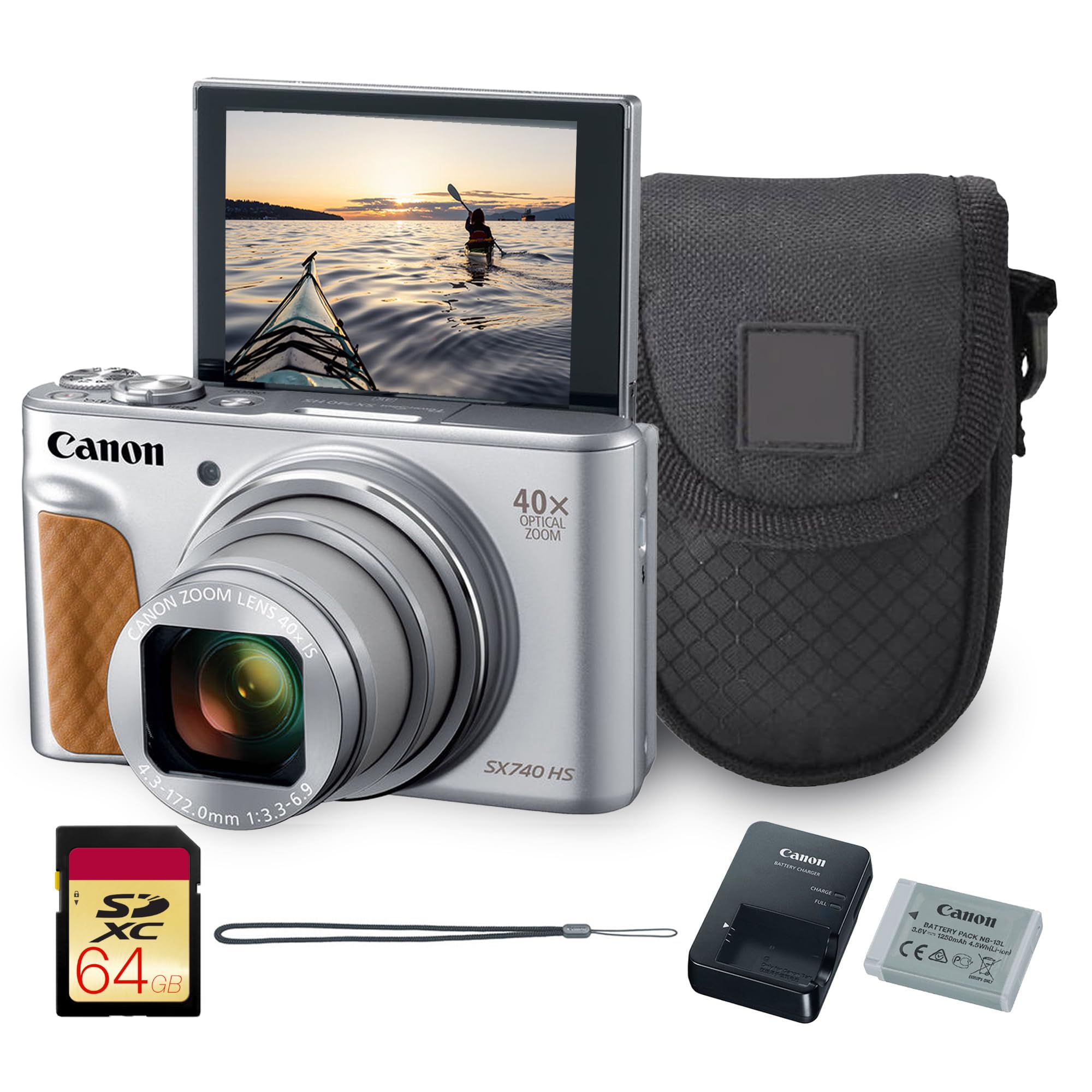
A 40x optical zoom that slips into a pocket, backed by a 20.3-megapixel sensor.
When you need to document a trip — from wide cityscapes to distant architectural details — without looking like a gear-heavy tourist, the SX740 balances reach and portability neatly. The 40x optical zoom covers a 24-960mm equivalent range, and Optical Image Stabilization keeps handheld footage steady at the long end. One buyer mentioned using it heavily on a 5-day trip without needing a single recharge, which speaks to the lithium-ion battery’s stamina. The 4K UHD video mode includes a time-lapse feature for creative storytelling, and the DIGIC 8 processor handles the processing with smooth frame rates.
The catch is the 1/2.3-inch sensor: at 20.3-megapixels, it captures less light than the APS-C sensors in the Sony a6400 or Nikon Z models. Low-light video will be noticeably noisier. The autofocus uses a hybrid system (combining phase and contrast detection) but with fewer dedicated points than the mirrorless competition, so tracking a fast walker in video requires good light. Also note that this bundle includes a 64GB memory card and a bag, which adds practical value. A word of caution from buyers: some units sold are international models that cannot be registered with Canon USA for warranty, so confirm the seller’s authorized status if warranty coverage matters to you.
Travel-Friendly Kit
- 40x optical zoom (24-960mm equivalent) with Optical Image Stabilization
- Long battery life — one buyer shot for 5 days without recharging
- Compact, non-bulky body with flip screen for selfies and 4K video
Video Compromises
- Small 1/2.3-inch sensor struggles with noise in low light
- Hybrid autofocus is less responsive than dedicated phase-detection systems for tracking
- Risk of receiving an international model without US warranty; verify seller
Best suited for: travelers who want a true pocket camera with a powerful zoom, excellent battery life, and the convenience of a bundled bag and memory card.
Better options for: night scenes or indoor events where a larger sensor makes a dramatic difference in video quality.
7. Panasonic LUMIX TZ/ZS99 Point and Shoot

A genuine pocket camera with a 30x LEICA zoom lens and 4K recording.
This is the camera for the person who absolutely refuses to carry a shoulder bag. The ZS99’s body is small enough to slip into an ordinary pants pocket, yet it packs a 24-720mm LEICA DC Vario-Elmar lens with 30x optical zoom and a 60x Intelligent Zoom mode. For video, it records 4K at 30p and offers HD high-speed video at 120 fps for slow-motion clips. The tiltable 1,840k-dot touchscreen helps you frame shots from awkward angles, and USB Type-C charging means you can top it up from a portable power bank — a travel-friendly detail that many point-and-shoots still lack.
Shoppers say that the zoom function and battery life were good, and one experienced photographer switching from a failed Sony SX740 said this model takes better photos with nicer quality at a lower price. However, the ZS99 has 19 autofocus points — a stark contrast to the 425 on the Sony a6400 — and relies on a hybrid autofocus system that struggles in low light. Some reviews describe the autofocus as poor and the menu as non-intuitive, with one user finding picture quality noticeably worse than their iPhone 16 Pro. The F3.3-F6.4 aperture range (the variable opening that controls light entry) is also slower at the telephoto end compared to the F2.8-F8.0 range on the Panasonic FZ80D, which impacts low-light video. It is a pure daylight zoom compact with compromises, but if pocketability is the absolute priority, it is one of the few game options.
Pocket Geometry
- 30x optical zoom (24-720mm LEICA lens) in a true pocket-sized body
- 4K 30p video with 120 fps HD slow-motion option
- USB Type-C charging and built-in Bluetooth v5.0 for easy image sharing
Performance Gaps
- 19 autofocus points struggle in low light and with moving subjects
- Slow F3.3-F6.4 aperture limits low-light performance
- Menu system is not very intuitive; some find picture quality below modern smartphones
Ideal for: daylight travelers who want 30x zoom in the smallest possible package with reliable battery life and easy charging on the go.
Pass on this if: you need reliable autofocus tracking for video, shoot in low light, or want a camera that clearly outperforms a current-generation smartphone.
Understanding the Specs
Sensor Size
The physical size of the light-capturing chip inside the camera. A larger sensor, like APS-C (Advanced Photo System type-C, roughly 23.6 x 15.7mm), gathers more light than a smaller 1/2.3-inch sensor (about 6.2 x 4.7mm). This directly determines how clean your video looks in dim lighting — bigger sensor equals less grain, more detail, and better color in the shadows. The Sony a6400, Nikon Z50 II, and Canon EOS R100 all use APS-C sensors, while the Panasonic FZ80D and Canon SX740 use the smaller 1/2.3-inch type.
Autofocus Points
The number of discrete focus detection zones on the camera’s autofocus sensor. More points mean the camera can track a subject moving across a wider area of the frame. Phase-detection points (used by Sony, Canon, and Nikon) are faster and more predictive for video than contrast-detection alone. The Sony a6400’s 425-point system is the most comprehensive in this list and is a big reason it handles focus in 4K video so reliably. Fewer points, like the 19 on the Panasonic ZS99, lead to more hunting and missed focus.
Optical Image Stabilization (OIS)
A mechanical system inside the lens or camera body that shifts glass elements or the sensor to counteract the tiny shakes from your hands. For video, this is critical because a bump that is barely visible in a photo becomes a jarring wobble in a moving image. The Panasonic FZ80D’s POWER O.I.S. is designed to handle the worst of the shake at its 60x telephoto end. Cameras without OIS (like the Nikon Z 50 and Z50 II) rely on lens-based VR or electronic stabilization, which can introduce a crop to the frame.
Optical Zoom Range
Measured in “X” (times), this is how many times the lens can magnify the image using glass elements without cropping the pixels. A 60x zoom lens goes from wide-angle to super-telephoto without any loss in resolution. For videography, a longer optical zoom means you can fill the frame with a distant subject — a speaker on a stage, a bird in a tree — without moving closer. The Panasonic FZ80D’s 60x zoom is the most powerful in this group, while the mirrorless kits use 2-2.5x standard zooms that trade reach for image quality.
FAQ
What is the difference between optical zoom and digital zoom for video?
Is an APS-C sensor worth the extra cost for video?
How important are autofocus points for video recording?
Can I use a compact camera for professional video work?
What is the best compact camera for vlogging?
Does 4K 60fps make a big difference over 4K 30fps?
Will a point and shoot camera with a 1/2.3-inch sensor outperform my smartphone for video?
How much storage do I need for 4K video?
Can I use a compact camera for livestreaming?
Why does my video look shaky without image stabilization?
Final Thoughts: The Verdict
For the majority of shoppers, the compact camera for videography that delivers the best all-around performance is the Sony Alpha a6400 because its blazing-fast autofocus, large APS-C sensor, and 4K video capability give you professional-grade footage in a body you can carry all day. If you want built-in creative color presets and a modern two-lens kit, grab the Nikon Z50 II. And for maximum optical reach in a lightweight bridge body, the standout is the Panasonic LUMIX FZ80D, which offers 60x optical zoom at a budget-friendly entry point.
How We Picked
We do not accept paid placement. Every pick is matched to a real buyer and a real use-case; we do not hands-on test units.
Sources & Methodology
Specifications: manufacturer listings and product documentation. Review insights: verified customer reviews, as of July 2026. Pricing: not shown on this page (it changes often); check the current price via the retailer link.
As an Amazon Associate, WellFizz earns from qualifying purchases. This does not affect which products we feature.
Related Guides

Mo Maruf
I created WellFizz to bridge the gap between vague wellness advice and actionable solutions. My mission is simple: to decode the research and give you practical tools you can actually use.
Beyond the data, I am a passionate traveler. I believe that stepping away from the screen to explore new environments is essential for mental clarity and physical vitality.