Our readers keep the lights on and my smoothie glass nicely filled. As an Amazon Associate, I earn from qualifying purchases.
Specs are compiled from manufacturer listings and verified buyer reviews and can change over time — please confirm the key details on the product page before buying.
You want a compact camera for landscape photography, but you face a real puzzle: how do you get a sensor that picks up detail in low light, a lens wide enough for sweeping views, and a body rugged enough for a wet hike, all in something you do not mind carrying up a mountain? The answer is not just about megapixels. It is about how the whole package handles changing light, a gust of wind, and fitting into your jacket pocket when the trail gets narrow.
I’m Mohammad Maruf — the founder and writer behind WellFizz. This guide is built by comparing the manufacturers’ published specifications and the patterns across verified customer reviews, so you get each pick’s real strengths and trade-offs instead of marketing spin.
The guide breaks down the best eight choices for a compact camera for landscape photography, from weather-sealed adventurers to sensor-heavy premium compacts, to help you pick the one that matches exactly how you shoot.
Quick Picks
- Fujifilm X100VI Digital Camera – Black — Best Overall
- Canon PowerShot V1, Hybrid Camera — Hybrid Power
- Sony RX100 II 20.2 MP Premium Compact Digital — Low-Light Specialist
- Canon PowerShot SX740 Digital Camera w/40x — Superzoom Reach
- OM System OLYMPUS Tough TG-7 Red Underwater — Rugged Explorer
- Panasonic LUMIX TZ/ZS99 Point and Shoot Camera — Travel Zoom
- Canon PowerShot ELPH 360 HS A Digital Camera — Pocket Classic
- Canon PowerShot V10 Compact Vlogging Camera — Ultra-Wide Compact
How To Choose The Best Compact Camera For Landscape Photography
Landscape photography forces every part of a camera to earn its place. You are balancing reach against portability, sensor size against lens speed, and durability against weight. Here are the three specs that matter most for the outdoors shooter.
Sensor size and dynamic range
A larger physical sensor (like a 1-inch type or bigger) collects more light per pixel, which means you can recover shadow detail without introducing noise. For landscapes shot at golden hour or under a canopy, a sensor that handles ISO 800 cleanly makes the difference between a keeper and a grey mess. Look for a sensor with at least 20 megapixels and read reviews about its dynamic range performance — the ability to hold highlight and shadow detail in the same frame.
Optical zoom range
A wide-angle starting point (24mm equivalent or wider) lets you capture the full sweep of a valley or a shoreline. A longer telephoto reach (100mm+ equivalent) lets you compress distance and isolate a mountain peak or a waterfall detail. Cameras with 4x to 30x optical zoom cover very different ground — decide whether you shoot mostly vast open scenes or need to reach into the distance.
Weather sealing and build
Landscapes happen outdoors, often near water, dust, or below freezing. A camera that is not sealed can fail on a misty morning at the coast. Look for explicit ratings like waterproof to 15 meters, dustproof, shockproof, or freezeproof. Even a basic splash-resistant seal adds confidence on an exposed ridge.
Quick Comparison
| Model | Best For | Sensor / Resolution | Optical Zoom | Weather Sealing | Amazon |
|---|---|---|---|---|---|
| Fujifilm X100VI | High-resolution street & landscape | 40.2MP APS-C | None (23mm fixed) | No (filter adapter needed) | Amazon |
| Canon PowerShot V1 | Hybrid stills & video landscapes | 22.3MP 1.4-type | 3.1x (16-50mm eq.) | No | Amazon |
| Sony RX100 II | Low-light wide landscapes | 20.2MP 1-inch | 3.6x (28-100mm eq.) | No | Amazon |
| Canon PowerShot SX740 | Long-reach telephoto landscapes | 20.3MP 1/2.3-inch | 40x (24-960mm eq.) | No | Amazon |
| OM System TG-7 | Rugged outdoor & underwater | 12MP 1/2.3-inch | 4x (25-100mm eq.) | Waterproof 15m | Amazon |
| Panasonic ZS99 | Travel zoom versatility | 20.3MP 1/2.3-inch | 30x (24-720mm eq.) | No | Amazon |
| Canon ELPH 360 HS | Pocketable everyday landscapes | 20.2MP 1/2.3-inch | 12x (25-300mm eq.) | No | Amazon |
| Canon PowerShot V10 | Ultra-wide vlogging landscapes | 15.2MP 1-inch | None (19mm fixed) | No | Amazon |
In‑Depth Reviews
1. Fujifilm X100VI Digital Camera – Black

The fixed-lens camera that delivers resolution matching full-frame systems, all in a body that fits a jacket pocket.
The X100VI is built around a 40.2MP X-Trans CMOS 5 HR sensor — that is a higher resolution than many full-frame DSLRs — paired with a fixed 23mm f/2 lens, which gives you a field of view like a 35mm lens on a full-frame camera. That f/2 aperture lets in enough light to shoot in fading light without a tripod. The 6.0-stop IBIS lets you shoot handheld at shutter speeds that would blur any unstabilized compact — a huge advantage for dawn and dusk landscapes.
Buyers report the built-in 4-stop ND filter is a standout for smoothing water or clouds in daylight without carrying extra glass. The 20 Film Simulation modes, including the new REALA ACE, produce JPEGs that often need no editing — a real time-saver when you are hiking and want to share from the trail. The 1.4x and 2x digital teleconverter gives you some reach when you cannot step closer. One reviewer noted “short battery life (IBIS drains it),” and the body lacks weather sealing, though a filter adapter can add splash resistance.
You get a hybrid viewfinder that switches between optical and electronic framing, an all-metal build, and 10-bit video depth for rich color grading. For the landscape purist who wants the highest image quality in the smallest possible package — and who works with the discipline of a fixed focal length — this is the standout choice in this category.
The Image Quality Edge
- 40.2MP sensor resolves fine detail that rivals full-frame cameras.
- 6-stop IBIS lets you shoot handheld in very low light.
- 4-stop built-in ND filter removes the need for a screw-on filter for long exposures.
- Film simulations produce share-ready JPEGs out of camera.
The Trade-Offs
- Fixed 23mm lens means no optical zoom — you zoom with your feet.
- Owners mention the autofocus can lag compared to newer mirrorless cameras.
- No weather sealing from the start; you need a filter adapter for wet conditions.
Who should reach for it: The landscape or street photographer who prizes ultimate sensor resolution and a classic 35mm field of view, and enjoys the creative constraint of a fixed lens.
Consider something else if: You need a zoom range for distant peaks or you shoot in heavy rain without wanting to add an adapter — this is not a sealed body.
2. Canon PowerShot V1, Hybrid Camera, Built-in Ultra-Wide-Angle Zoom Lens, 4K Video

The compact hybrid that pairs a large sensor with an ultra-wide zoom for big-sky landscapes, and does 4K video without overheating.
Canon put a 1.4-type sensor (roughly the size of a Micro Four Thirds sensor, bigger than the 1-inch type in most compacts) into a body smaller than many mirrorless cameras, giving you 22.3MP for stills and 18.7MP for video. That larger sensor means better dynamic range (the ability to keep detail in both bright and dark areas) and cleaner low-light shots than a 1-inch camera. The built-in 16-50mm F2.8-4.5 zoom lens (35mm equivalent) starts at a true ultra-wide 16mm, wider than the X100VI’s 23mm, perfect for capturing a full mountain ridge or a wide valley floor.
Customers note that the “autofocus is fast, consistent and stable” and that the lens is “impressively sharp at all ranges.” The cooling fan lets you record high-bit-rate 4K for longer stretches without overheating, a problem that plagues other compacts (one V10 buyer reported overheating shutdowns, which this design avoids). Canon Log 3 gives you 10-bit color depth for professional-grade color grading in post, starting at ISO 800.
The downsides are real. There is no OIS (optical image stabilization) here; the electronic stabilization works for static panning but reviewers point out it is “very ineffective for dealing with bouncing from walking.” The lack of a built-in flash and the SD card slot behind the battery door (fussy with a tripod plate attached) are minor irritants. But for wide-angle landscape work where you want a large sensor, a fast lens, and reliable video recording, this is a unique package compared to the fixed-lens X100VI.
Who wins with this: The landscape shooter who mixes still landscapes with 4K video, needs a wide zoom, and values a sensor larger than 1-inch without carrying an interchangeable-lens system.
The big catch: No optical image stabilization — you need steady hands or a tripod for sharp handheld shots, especially at the telephoto end.
3. Sony RX100 II 20.2 MP Premium Compact Digital Camera w/ 1-inch Sensor

A legendary compact that still offers one of the brightest lenses for gathering light at dusk, making it sharper in low light than the Canon PowerShot V1’s zoom.
The RX100 II pairs a 20.2MP 1-inch Exmor R CMOS sensor with a bright F1.8 Carl Zeiss Vario-Sonnar T lens. That f/1.8 aperture at the wide end gathers more light than an f/2.8 lens — so you can shoot the same landscape at a faster shutter speed in fading light. The 28-100mm equivalent focal range (3.6x optical zoom) gives you a wide-angle starting point and modest telephoto reach for compressing distant elements.
Buyers consistently say the image quality “matches APS-C kit lenses” and the camera provides “excellent handling of light-to-dark transitions.” The tiltable 1,229,000-dot LCD helps you frame low-angle shots near the ground, useful for foreground interest in landscapes. It records 1080 60p/24p HD video with full exposure control, and the built-in Wi-Fi and NFC (near-field communication, a quick wireless pairing method) let you transfer images to your phone on the trail.
The catch? You get 25 autofocus points — a fraction of what modern cameras offer — and one buyer mentioned the “bracketing limited to 0.7EV” which is restrictive for HDR (high dynamic range) landscape merges. The RX100 II is also an older model (no USB-C, no 4K video). But for its bright lens, proven sensor, and pocket size, it remains a smart pick for the budget-conscious landscape shooter who values aperture above all else.
Perfect for: The shooter who wants the brightest possible wide-aperture lens for low-light landscapes and appreciates the proven 1-inch sensor ecosystem.
Know before you buy: No 4K video, no USB-C, and a modest 3.6x zoom range — this is a specialist for aperture and image quality, not versatility.
4. Canon PowerShot SX740 Digital Camera w/40x Optical Zoom

The pocket superzoom that brings a 960mm reach to landscapes you cannot walk any closer to — far longer than the 300mm on the Canon ELPH 360 HS.
With a 40x optical zoom lens covering 24-960mm equivalent, the SX740 is the camera for landscape shots that demand telephoto compression — pulling a distant peak closer, isolating a waterfall cascading off a far cliff, or capturing the texture of a rock face across a canyon. The 20.3MP CMOS sensor keeps detail clean, and the Optical Image Stabilizer with Zoom Framing Assist helps you hold the frame steady when you are at full reach.
It shoots 4K video with 4K Time-lapse Movie mode, letting you create dramatic landscape time-lapses in-camera. Shoppers say it is “easy to use and love how clear the pictures look when zooming in.” The built-in Wi-Fi and Bluetooth let you transfer images on the go. At 7.4 fps continuous shooting (10 fps with AF locked), you can also capture fast-moving clouds or wildlife that wanders into the scene.
The trade-off is the smaller 1/2.3-inch sensor, which cannot match the dynamic range or low-light performance of 1-inch or APS-C cameras. The aperture ranges from F3.3 at wide to F6.9 at telephoto, meaning you will need good light or a tripod at the long end. Some buyers reported reliability issues with the unit stopping working. But if your landscape work is defined by the need to reach out and grab a distant subject, this zoom range is class-leading in a compact.
Best suited for: Landscape photographers who regularly shoot distant subjects — mountain peaks, far-off lighthouses, wildlife in habitat — and need reach over sensor size.
Skip this if: You shoot mostly at golden hour or in deep shade — the small sensor and slower telephoto aperture will struggle in low light.
5. OM System OLYMPUS Tough TG-7 Red Underwater Camera, Waterproof, Freeze Proof

The go-anywhere tank that shoots 4K underwater, in a freeze, or after a drop onto granite — something no other camera on this list can survive.
The TG-7 is built for landscapes in the harshest environments: waterproof to 15 meters (50 feet), shockproof from 2.1 meters (7 feet), crushproof to 100 kilogram-force (220 pound-force), and freezeproof down to -10°C (14°F). If your landscape photography involves river crossings, coastal spray, or alpine snow, this camera will keep working where most compacts would fail. The bright F2.0 lens (wider than the Panasonic ZS99’s F3.3) lets in more light for dawn and dusk shots.
It packs a 4x optical zoom lens with a variable macro system that lets you focus as close as 1 centimeter from the lens — useful for capturing tiny foreground details like lichen or frost crystals in the same scene as a wider landscape. It records 4K video and 120 fps high-speed movies, giving you 120 fps versus the PowerShot V10’s 60 fps, for smooth slow-motion of crashing waves or blowing grass. One buyer praised “excellent microscope mode” and said it is “great for travel and underwater use.”
The downside is the smaller 1/2.3-inch sensor and 12-bit depth, which produces more noise in low light compared to 1-inch sensor cameras. Buyers report “good battery but dies without warning.” The zoom is only 4x, much shorter than the 30x of the Panasonic ZS99. But for the adventurer who needs a camera to survive the elements, the TG-7 is the only choice that can be hosed off after a beach shoot.
Ideal for: The outdoor enthusiast who shoots landscapes in wet, dusty, cold, or rough conditions — kayaking, hiking in rain, or alpine photography.
One honest limit: The 4x zoom and small sensor cannot match the image quality or reach of other compacts in good light — this is a rugged specialist, not a high-resolution champ.
6. Panasonic LUMIX TZ/ZS99 Point and Shoot Camera, 30x Zoom with 24-720mm Lens

The Leica-lensed travel companion that covers 24mm wide to 720mm telephoto in one pocket — covering 24-720mm versus the TG-7’s 25-100mm.
The ZS99 packs a 30x optical zoom Leica lens (24-720mm equivalent) into a body that slips into a jacket pocket. This means you can shoot a wide valley at 24mm and then zoom all the way to a climber on the peak at 720mm without swapping lenses. The 20.3MP sensor and 5-Axis HYBRID O.I.S. (optical image stabilization that corrects five directions of shake) help you hold the telephoto end steady.
A 1,840k-dot tiltable touchscreen gives you flexibility for low-angle landscape compositions, and the USB-C charging means you can recharge from a battery bank on a multi-day trek. It records 4K video at 30p and HD high-speed video at 120fps, and the built-in Bluetooth v5.0 with a dedicated Send Image button makes transferring photos to your phone quick. One owner reported “better photos than Sony SX 740, nicer quality, less zoom but easier to function.”
The catch? The small 1/2.3-inch sensor and F3.3-6.4 aperture produce noisy images in low light — one buyer bluntly said “low light handheld photos nearly unusable.” The autofocus uses just one contrast-detect point (one point versus the 49 points on the Canon V10), and reviewers describe it as “poor autofocus, unintuitive menu.” For bright-day travel landscapes where reach matters over low-light performance, this is a capable zoom machine.
Reach for this if: Your landscape kit needs one camera that goes from wide-angle valley to extreme telephoto in a single body, and you mostly shoot in good daylight.
Look elsewhere if: You shoot often at twilight or in forest shade — the sensor and aperture struggle, and the single-point autofocus is frustrating in those conditions.
7. Canon PowerShot ELPH 360 HS A Digital Camera (Silver) | 20.2MP CMOS Sensor, 12x Optical Zoom
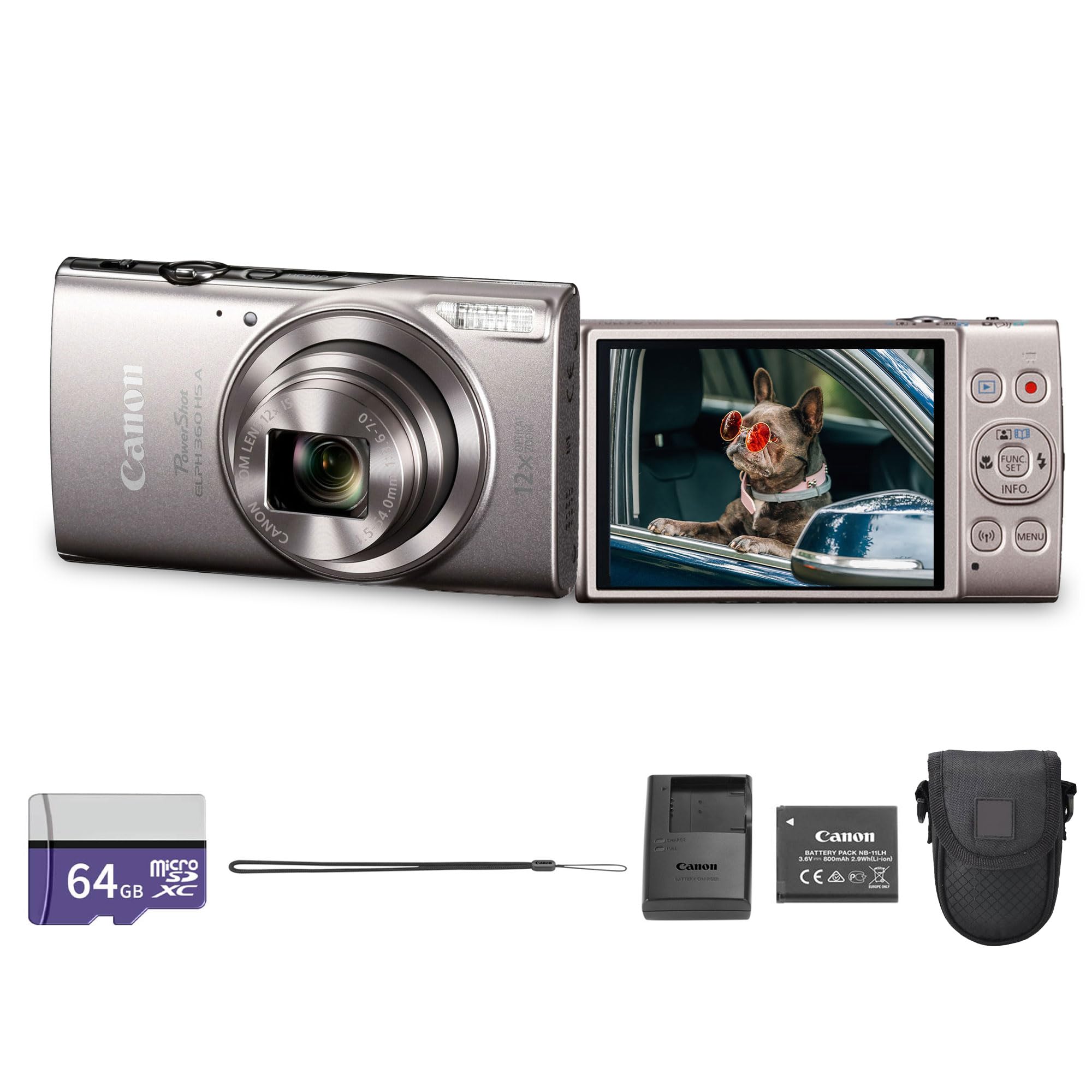
The true pocketable zoom that balances range and portability for casual landscape walks, with a 12x optical zoom that beats any smartphone.
The ELPH 360 HS is built around a 20.2MP CMOS sensor and a 12x optical zoom lens covering 25-300mm equivalent — a range that starts wide enough for landscapes and reaches into short telephoto for detail shots. It uses the DIGIC 4+ processor to deliver Full HD video at 30 fps and continuous shooting at 7.2 fps, which is enough for handheld landscape bracketing. The Intelligent IS (image stabilization) automatically adjusts for both stills and video, reducing shake when you are shooting without a tripod.
Buyers call it a “great little pocket camera with a lot of bells and whistles” and note “the picture quality is great, and the camera is easy to use.” The 3.0-inch 461k-dot LCD is bright enough for framing, and the Creative Shot and Hybrid Auto modes let you produce unique looks in-camera. Its biggest advantage over a smartphone is the 12x optical zoom — phones cannot match that reach without digital cropping.
The compromise is the smaller 1/2.3-inch sensor and the 25mm wide-end, which is not as expansive as the 19mm or 24mm starting points on other cameras. One reviewer called it “very small, tiny camera…. hard to use.” The 12x zoom is useful but far shorter than the 30x on the Panasonic ZS99 or the 40x on the Canon SX740. For the budget-minded hiker who wants a simple, truly pocketable zoom with decent image quality, the ELPH delivers without fuss.
Great for: The casual landscape walker who wants optical zoom beyond a smartphone without carrying bulk, and values simplicity and portability.
Not for: Serious low-light shooting or those who need extreme wide-angle or super-telephoto reach — the 25-300mm range is versatile but not specialized.
8. Canon PowerShot V10 Compact Vlogging Camera, 1″ CMOS Sensor, 4K Video

The fixed 19mm ultra-wide with a 1-inch sensor and a built-in stand for hands-free landscape video — the widest lens on this list.
The V10 has a unique shape in the compact landscape camera world: it packs a 1-inch 15.2MP back-illuminated CMOS sensor into a vertically-oriented body with a built-in stand that folds into the front or back. The fixed 19mm wide-angle lens (35mm equivalent) gives you the widest field of view of any camera in this list — wider than the 24mm on the Panasonic ZS99 — making it ideal for shooting expansive skies, forest canopies, or tight canyon interiors where you cannot step back. The 1-inch sensor means better dynamic range than smaller-sensor compacts, a real advantage for high-contrast landscape scenes.
It records 8-bit 4K video at up to 30 fps and Full HD at 60 fps, with three image stabilization modes (Off, On, and Enhanced) to smooth out walking shots. The stereo microphones with a third cancellation mic capture clear audio for video landscapes. Owners mention it is “compact and high-quality” and note “the quality and sound is great especially since the price is so affordable.” The built-in stand means you can set it on a rock or table for time-lapse or self-filming without a tripod.
The serious limit is the lack of any zoom — you are locked at 19mm, so distant landscape details are out of reach. The biggest problem, confirmed by a buyer, is overheating: “it was getting hot really quickly and then would turn itself off within a few minutes.” This makes it unreliable for longer video shoots in warm weather. The 15.2MP sensor has lower resolution than the ELPH 360’s 20.2MP, limiting crop ability. It is a niche tool for ultra-wide landscape video, not a generalist.
Best for: The landscape videographer who wants the widest possible fixed lens and a stand for hands-free shooting, and works in short clips.
One clear warning: The overheating issue is well-documented in reviews — if you need long recording sessions or shoot in hot sun, this will shut down on you.
Understanding the Specs
Sensor Size and Type
The sensor is the light-capturing chip inside the camera. A larger physical sensor — like a 1-inch type or APS-C — collects more light per pixel, which means cleaner images with less digital noise at higher ISO settings. For landscape photography, where you often shoot at dawn or under shade, a sensor that handles ISO 800 or 1600 cleanly lets you keep your shutter speed high enough to avoid blur from wind or hand shake. The best compact landscape cameras use at least a 1-inch sensor for this reason.
Optical Zoom and Focal Length
Optical zoom means the lens physically moves to change the field of view, unlike digital zoom which just crops the image. A lens that starts at 24mm equivalent or wider captures a broad landscape in one frame. A longer telephoto reach (100mm+ equivalent) lets you compress a scene and pull distant elements — like a mountain peak — closer together. For landscapes, a wide starting point matters more than extreme telephoto, but a zoom gives you flexibility to compose without moving physically.
Image Stabilization
Image stabilization counteracts the tiny shakes from your hands to produce sharper images at slower shutter speeds. It comes in two forms: optical image stabilization (OIS), which moves lens elements, and in-body image stabilization (IBIS), which shifts the sensor. IBIS is more effective because it stabilizes any lens attached, but OIS is still very useful. For landscape photography, stabilization lets you shoot handheld at dusk without a tripod, saving weight in your pack.
Weather Sealing
Weather sealing means the camera body is gasketed to resist moisture and dust. It is not the same as waterproofing — a weather-sealed camera can handle light rain and spray, but cannot be submerged. For landscape photographers who shoot near waterfalls, on the coast, or in misty valleys, weather sealing prevents corrosion and internal fogging. Dedicated rugged cameras like the OM System TG-7 go further with explicit waterproof and shockproof ratings, letting you shoot in rain or even underwater without a housing.
FAQ
Is a compact camera better than a smartphone for landscape photography?
What size sensor should I look for in a compact landscape camera?
Do I need weather sealing for landscape photography?
How much optical zoom do I need for landscape photography?
Can I shoot RAW on compact cameras for landscape editing?
Is the Canon PowerShot V10 good for still landscape photography?
What is the difference between optical and digital zoom for landscapes?
How does the Panasonic ZS99 perform in low light?
Is the OM System TG-7 good for macro landscape details?
Which compact camera has the longest battery life for all-day landscape shoots?
Final Thoughts: The Verdict
For most people, the compact camera for landscape photography winner is the Fujifilm X100VI because its 40.2MP sensor and 6-stop IBIS deliver image quality that rivals full-frame systems in a truly pocketable body. If you want a wide-angle hybrid that handles both stills and video with a large sensor, grab the Canon PowerShot V1. And for the outdoor adventurer who needs a camera that survives rain, drops, and freezing temperatures, the standout is the OM System Tough TG-7.
How We Picked
We do not accept paid placement. Every pick is matched to a real buyer and a real use-case; we do not hands-on test units.
Sources & Methodology
Specifications: manufacturer listings and product documentation. Review insights: verified customer reviews, as of July 2026. Pricing: not shown on this page (it changes often); check the current price via the retailer link.
As an Amazon Associate, WellFizz earns from qualifying purchases. This does not affect which products we feature.
Related Guides

Mo Maruf
I created WellFizz to bridge the gap between vague wellness advice and actionable solutions. My mission is simple: to decode the research and give you practical tools you can actually use.
Beyond the data, I am a passionate traveler. I believe that stepping away from the screen to explore new environments is essential for mental clarity and physical vitality.