Our readers keep the lights on and my smoothie glass nicely filled. As an Amazon Associate, I earn from qualifying purchases.
Moving from a smartphone to your first dedicated camera is a leap in image clarity, but the sheer number of lens specs, sensor sizes, and autofocus systems can stall that jump before it begins. The right compact body simplifies the learning curve while delivering results that feel professional from the first frame.
I’m Mohammad Maruf — the founder and writer behind WellFizz. I’ve spent hundreds of hours analyzing digital camera hardware, autofocus systems, and sensor performance across these specific entry-level models to separate genuine beginner-friendly design from spec sheet marketing.
After sorting through zoom ranges, stabilization types, and sensor technologies, this guide to the best compact camera for beginners focuses on the seven models that actually make learning photography rewarding rather than frustrating.
How To Choose The Best Compact Camera For Beginners
Selecting your first compact camera depends on matching the hardware to your primary subjects — wildlife demands long optical zoom, vlogging needs a wide lens and good audio, and general learning benefits from interchangeable lenses and intuitive controls.
Optical Zoom vs Digital Zoom
Optical zoom uses the lens glass to magnify the subject without losing resolution, while digital zoom simply crops and enlarges the image, degrading quality. For beginners shooting birds, sports, or distant landscapes, a camera with 50x or 60x optical zoom — like the Kodak AZ528 or Panasonic FZ80D — delivers sharp telephoto reach that a smartphone simply cannot match.
Sensor Size and Low-Light Performance
A larger sensor captures more light, producing cleaner images in dim conditions and allowing for natural background blur (bokeh). The 1-inch sensor in the Sony ZV-1F and the APS-C sensors in the Canon EOS R100 and Rebel T7 significantly outperform the smaller sensors found in most bridge cameras when shooting indoors, at dusk, or in shaded environments.
Image Stabilization for Handheld Sharpness
Optical Image Stabilization compensates for hand shake, which becomes critical at high zoom levels. The Panasonic FZ80D’s POWER O.I.S. and the OM System E-M10 Mark IV’s in-body 5-axis stabilization allow beginners to shoot handheld at slower shutter speeds without introducing blur, reducing the immediate need for a tripod.
Autofocus System and Tracking
Phase-detection autofocus, found in the Canon R100, locks onto subjects faster than contrast-detection systems, especially when tracking moving children or pets. The number of autofocus points — 143 on the Canon R100 versus 9 on the Rebel T7 — indicates how much of the frame the camera can intelligently focus on.
Quick Comparison
On smaller screens, swipe sideways to see the full table.
| Model | Category | Best For | Key Spec | Amazon |
|---|---|---|---|---|
| Canon EOS R100 (Kit) | Mirrorless | Learning photography with interchangeable lenses | 143 phase-detection AF points | Amazon |
| Panasonic LUMIX FZ80D | Bridge | Wildlife and travel with extreme zoom | 60x optical zoom (20-1200mm) | Amazon |
| Sony ZV-1F | Point-and-Shoot | Vlogging and content creation | 1-inch sensor & 20mm ultra-wide lens | Amazon |
| OM System E-M10 Mark IV | Mirrorless | Compact travel with retro controls | 5-axis in-body stabilization | Amazon |
| Canon EOS Rebel T7 | DSLR | Budget-friendly DSLR learning | 24.1MP APS-C sensor | Amazon |
| Canon EOS R100 (Body) | Mirrorless | Compact entry into RF mount system | Dual Pixel CMOS AF | Amazon |
| Kodak PIXPRO AZ528 | Bridge | Budget superzoom for outdoor shooting | 52x optical zoom (24-1248mm) | Amazon |
In‑Depth Reviews
1. Canon EOS R100 Mirrorless Camera with RF-S 18-45mm Lens Kit (Bundle)

This bundle pairs the Canon EOS R100 body with the RF-S 18-45mm kit lens, plus a shoulder bag and 64GB card, giving a beginner everything needed to start shooting immediately. The 24.1-megapixel APS-C sensor and DIGIC 8 processor deliver image quality that rivals much more expensive mirrorless cameras, with natural bokeh and crisp detail straight out of camera.
The Dual Pixel CMOS AF system with 143 phase-detection zones tracks human faces and eyes reliably, making it far easier to keep family portraits and moving children in sharp focus. The 6.5 fps burst rate captures fleeting moments without the frame rate dropping, and the compact body — the lightest in the EOS R series — slides into a day bag without the bulk of a traditional DSLR.
Wireless connectivity via Wi-Fi and Bluetooth allows instant transfer of photos to a smartphone for social sharing, and the bundle eliminates the common frustration of discovering you need a memory card or case after purchase. The kit lens offers optical image stabilization, which reduces handheld shake during walkaround shooting.
Why it’s great
- Phase-detection autofocus with 143 zones for reliable face and eye tracking
- APS-C sensor delivers professional-grade image quality and background blur
- Complete bundle includes bag and memory card for immediate use
- Compact and lightweight body ideal for daily carry
Good to know
- 4K video is limited to 24 fps with a crop factor
- No in-body image stabilization — relies on lens stabilization
- External charger not included in the basic kit
2. Panasonic LUMIX FZ80D Point and Shoot Digital Camera

The FZ80D is a bridge camera that brings a massive 60x optical zoom (20-1200mm equivalent) into a lightweight 1.4-pound body, making it an exceptional tool for beginners who want to photograph birds, wildlife, or distant subjects without carrying multiple lenses. The POWER O.I.S. stabilization system effectively suppresses hand-shake vibration at maximum telephoto, a spec that directly determines whether your zoomed shots come out sharp or blurred.
It records 4K video and includes a 4K Photo mode that lets you extract 8-megapixel stills from video footage — useful for capturing the exact frame of a bird taking flight or a child scoring a goal. The 2,360K-dot electronic viewfinder remains clear even in bright sunlight, solving the glare problem that plagues rear LCD screens during outdoor shooting.
The learning curve is moderate — reviewers note the menu system requires a week to feel intuitive — but the image quality at base ISO in good light rivals far more expensive cameras. Low-light performance is the main trade-off: the smaller sensor produces visible noise above ISO 800, so evening and indoor shooting demands careful lighting.
Why it’s great
- 60x optical zoom reaches subjects impossible for smartphone cameras
- POWER O.I.S. keeps telephoto shots sharp without a tripod
- Lightweight and compact for hiking and travel carry
- 4K Photo mode captures perfect frames from video bursts
Good to know
- Small sensor limits low-light image quality above ISO 800
- No Wi-Fi for wireless transfer in this model
- Battery drains faster with extended zoom use
3. Sony ZV-1F Vlog Camera for Content Creators

The ZV-1F is purpose-built for video creators, featuring a 20mm ultra-wide lens that fits entire scenes into frame even when the camera is held at arm’s length for selfie-style recording. The large 1-inch sensor and F2 maximum aperture create defocused backgrounds naturally, eliminating the need for expensive fast lenses to achieve that blurred-background look.
Eye-AF and autofocus tracking lock onto faces reliably, and the Product Showcase mode automatically shifts focus to an object held up to the lens — a feature unique to this category that saves content creators from manual focus pulls. The directional 3-capsule microphone with an included windscreen captures clear voice audio without requiring an external mic, and the side-articulating touchscreen simplifies composition for solo shooters.
The trade-off is the fixed 20mm lens with no optical zoom, which limits flexibility for photographing distant subjects. Battery life runs around 45 minutes of continuous recording, so vloggers should budget for spare batteries. The body is compact enough to slip into a jacket pocket, making it the most portable option here.
Why it’s great
- 1-inch sensor produces excellent low-light video and natural bokeh
- Directional microphone with windscreen captures clean audio out of the box
- Product Showcase mode automates focus shifts for demonstrations
- Flip-out screen and compact body ideal for vlogging on the go
Good to know
- Fixed 20mm lens offers no optical zoom for distance shooting
- Battery lasts roughly 45 minutes of continuous recording
- No built-in flash
4. OM System Olympus E-M10 Mark IV Silver

The E-M10 Mark IV is a mirrorless camera that prioritizes portability without sacrificing stability, thanks to its in-body 5-axis image stabilization rated for 4.5 shutter speed steps of compensation. This means beginners can shoot handheld at 1-second exposures and still get sharp images — a capability that typically requires a tripod with other cameras in this class.
The 20-megapixel Micro Four Thirds sensor and 14-42mm EZ pancake kit lens combine to create a package that fits inside a jacket pocket, making it the most genuinely pocketable interchangeable-lens option here. The flip-down monitor activates a dedicated selfie mode automatically, and the 16 Art Filters — including Instant Film for a nostalgic look — give beginners creative effects without post-processing.
The contrast-detection autofocus with 121 points is quick in good light but can hunt in dim conditions compared to phase-detection systems. The bundled micro-USB charging (not USB-C) and slower app-based wireless transfer are dated, but the build quality, retro aesthetic, and exceptional stabilization make it a favorite among travelers who value compactness.
Why it’s great
- 5-axis in-body stabilization allows handheld sharpness at slow shutter speeds
- Pocketable with pancake kit lens — smallest interchangeable-lens option here
- Automatic selfie mode with flip-down screen for vloggers
- Built-in Art Filters add creative effects without software
Good to know
- Contrast-detection AF struggles in low light compared to phase detection
- Charging uses micro-USB rather than modern USB-C
- Burst speed is slower than competing mirrorless cameras
5. Canon EOS Rebel T7 DSLR Camera with 18-55mm Lens

The Rebel T7 remains a benchmark entry-level DSLR because it distills photography fundamentals into a straightforward body with a familiar optical viewfinder — no battery anxiety about EVF drain, no menu lag from touchscreen complexity. The 24.1-megapixel APS-C sensor captures the same sensor size found in Canon’s far more expensive bodies, ensuring image quality that remains competitive years after release.
The 9-point autofocus system is the clear limitation here — it covers a small central area of the frame and lacks the intelligent tracking of newer mirrorless systems. For static subjects like landscapes, portraits, and still life, it works perfectly, but fast-moving children or pets will test its abilities. The optical viewfinder offers approximately 95% coverage, which means the final image is slightly wider than what you see through the eyepiece.
Built-in Wi-Fi and NFC simplify image transfer to a smartphone, and the camera can function as a high-quality webcam via Canon’s utility software — an unexpected bonus for beginners who also need a better video conferencing setup. The EF-S lens mount provides access to the largest used lens ecosystem available, making future upgrades affordable.
Why it’s great
- APS-C sensor delivers excellent image quality at an entry-level price point
- Optical viewfinder provides lag-free composition and longer battery life
- Vast EF-S lens ecosystem for affordable future upgrades
- Built-in Wi-Fi for easy sharing and webcam functionality
Good to know
- 9-point AF system is dated and struggles with moving subjects
- No 4K video recording — limited to Full HD
- Optical viewfinder has approximately 95% coverage
6. Canon EOS R100 Mirrorless Camera with RF-S 18-45mm Lens

The EOS R100 body with the RF-S 18-45mm lens is Canon’s most affordable entry point into the RF mirrorless mount, offering 24.1 megapixels on an APS-C sensor with Dual Pixel CMOS AF that covers 143 autofocus zones. Unlike the Rebel T7’s optical viewfinder, the R100 uses a 2.36-million-dot OLED electronic viewfinder that shows exposure and depth of field in real time — a significant learning aid for beginners.
The DIGIC 8 processor enables 4K video at 24 fps and Full HD at 60 fps, plus 120 fps slow-motion capture in HD. The continuous shooting rate reaches 6.5 frames per second with One-Shot AF, which is fast enough for casual sports and active children. The human face and eye detect AF works reliably for both stills and video, and the animal/vehicle detect AF extends tracking capability beyond people.
As the smallest and lightest body in the EOS R series, it prioritizes mobility. Reviewers consistently praise its beginner-friendly GUI with custom quick menus and the wireless photo transfer to smartphones. The kit lens includes optical image stabilization at up to 4 stops of shake correction. No external battery charger ships with the basic kit, and the 4K crop factor limits wide-angle video applications.
Why it’s great
- Dual Pixel CMOS AF with 143 zones provides reliable face and eye tracking
- Compact and lightweight — smallest EOS R series body for easy carrying
- 4K video and 120 fps slow-motion HD for creative shooting
- Real-time exposure preview through high-resolution OLED viewfinder
Good to know
- 4K video recording introduces a crop factor on the sensor
- No external battery charger included
- Bundled lens has a variable aperture of F4.5-6.3
7. Kodak PIXPRO Astro Zoom AZ528-BK
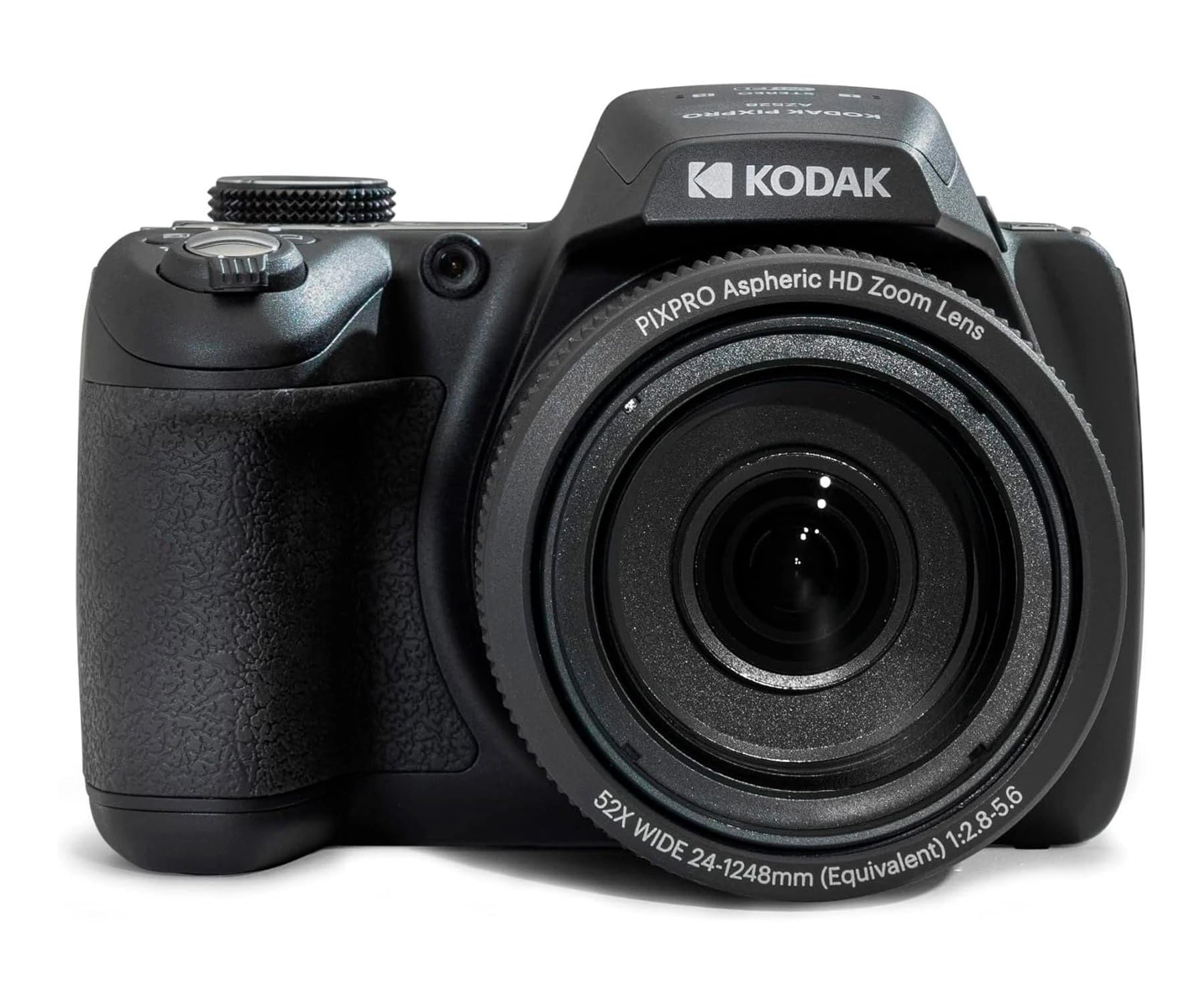
The Kodak AZ528 is a budget-friendly bridge camera built around a 52x optical zoom lens that reaches from a 24mm wide angle to a 1248mm telephoto equivalent — genuine optical reach that brings distant birds, wildlife, and stadium action into clear view without the degradation of digital zoom. The 16-megapixel backside-illuminated CMOS sensor improves low-light sensitivity compared to older sensor designs, and the built-in optical image stabilization helps keep telephoto shots steady at maximum zoom.
The 6 fps burst mode captures rapid sequences of action, and the included Wi-Fi enables wireless image transfer and remote control via smartphone. The 3-inch LCD screen provides adequate composition review, and the camera accepts SD cards up to 512 GB — enough for thousands of high-resolution JPEGs and hours of Full HD video from extended shooting days in the field.
Reviewers consistently describe the AZ528 as easy to learn within about a week, with a comfortable grip and intuitive controls. The primary compromise is image quality at full zoom when handheld — steady hands or a monopod are necessary at 52x magnification. Battery life is described as adequate but not exceptional, and the body can scuff more easily than higher-priced alternatives.
Why it’s great
- 52x optical zoom provides genuine telephoto reach without digital degradation
- BSI CMOS sensor offers better low-light sensitivity than standard sensors
- Built-in Wi-Fi for wireless transfer and remote control
- Accepts up to 512GB SD cards for extended shooting sessions
Good to know
- Maximum zoom requires steady hands or support to avoid blur
- Battery life is limited compared to premium bridge cameras
- Body scuffs more easily than higher-priced alternatives
FAQ
Should I buy a bridge camera or a mirrorless camera as a beginner?
How many megapixels do I really need as a beginner?
Do I need a tripod with a stabilized camera?
What memory card compatibility should I look for?
Final Thoughts: The Verdict
For most users, the best compact camera for beginners winner is the Canon EOS R100 Bundle because it combines an APS-C sensor, phase-detection autofocus, and a complete kit with bag and memory card at a price point that outpaces smartphone quality while leaving room to grow with interchangeable lenses. If you prioritize extreme zoom for wildlife without the complication of lens changes, grab the Panasonic LUMIX FZ80D. And for vlogging and content creation where video and audio quality matter most, nothing beats the Sony ZV-1F.

Mo Maruf
I created WellFizz to bridge the gap between vague wellness advice and actionable solutions. My mission is simple: to decode the research and give you practical tools you can actually use.
Beyond the data, I am a passionate traveler. I believe that stepping away from the screen to explore new environments is essential for mental clarity and physical vitality.