Our readers keep the lights on and my smoothie glass nicely filled. As an Amazon Associate, I earn from qualifying purchases.
The pocket camcorder market is a swamp of inflated specs, where a action camera promises “8K” but delivers footage that looks like it was shot through a frosted window. Between confusing sensor sizes, shaky marketing claims, and the eternal debate between optical and digital zoom, finding a truly compact camcorder that actually delivers clean, usable video has become harder than ever. You need a device that fits in a jacket pocket, captures smooth footage when walking, and doesn’t require a film school degree to operate.
I’m Mohammad Maruf — the founder and writer behind WellFizz. I’ve spent countless hours analyzing sensor specs, stabilization technologies, and real-world footage samples to separate the real 4K performers from the marketing gimmicks in this specific category.
Whether you are a travel vlogger, a new parent recording first steps, or a content creator looking for a secondary run-and-gun camera, this guide to the best compact camcorder breaks down the critical specs — from true sensor size to gimbal stabilization — that actually matter for compact video capture.
How To Choose The Best Compact Camcorder
A great compact camcorder needs to balance portability with genuine image quality. Here is exactly what you should look for before committing to a purchase.
Sensor Size: The 1-Inch Advantage
The single most important factor determining video quality in a compact camera is the physical size of its image sensor. A 1-inch CMOS sensor (found on premium models like the DJI Osmo Pocket 3 and the Xtra Muse) captures significantly more light than the tiny 1/2.3-inch sensors common in budget camcorders. This translates directly into cleaner footage with less grain in low light, better dynamic range in high-contrast scenes, and a more pleasing depth-of-field effect that separates your subject from the background. Budget models below almost exclusively use the smaller sensor — a compromise you will see in every evening shot.
Stabilization: Mechanical Gimbal vs. Electronic
Stabilization is the difference between watchable vlog footage and unwatchable nausea. Mechanical 3-axis gimbal stabilization physically counter-rotates the camera to cancel out your hand shakes, footsteps, and turning motions. It produces the smoothest possible footage without any crop or warping artifacts. Electronic Image Stabilization (EIS) works by cropping into the sensor and digitally realigning frames. It can smooth minor micro-jitters but introduces a crop factor and can produce a “jello” wobble effect in fast motion. For walking and action shots, a mechanical gimbal — like the one in the Xtra Muse and the DJI Osmo Pocket 3 — is dramatically superior.
Optical vs. Digital Zoom: Sharpen Your Decision
Optical zoom physically moves the lens elements to magnify your subject, retaining full resolution and clarity. Digital zoom simply crops into the image and enlarges the pixels — producing grainy, pixelated results. A camcorder with 20x optical zoom, like the Canon VIXIA HF G70 or the Sony FDR-AX43, can pull in a distant subject with pristine detail. Any digital zoom figure — whether 10x or 250x — is largely a marketing number that degrades image quality proportionally. For serious shooting, prioritize optical zoom capability.
Frame Rate and Resolution: 4K 60fps is the Sweet Spot
True 4K resolution (3840 x 2160) at 60 frames per second is the practical gold standard for modern compact camcorders. 4K 60fps gives you the latitude to create smooth slow-motion playback at 4K quality (by slowing it to 30fps in editing) while maintaining sharpness for standard playback. Many budget cameras claim “4K” but only deliver 30fps or lower, which significantly limits your editing flexibility. Frame rates above 4K (5K, 6K, or 8K) are currently only meaningful for specific professional workflows and require demanding storage and processing hardware that most compact cameras cannot properly support without overheating or severe battery drain.
Quick Comparison
On smaller screens, swipe sideways to see the full table.
| Model | Category | Best For | Key Spec | Amazon |
|---|---|---|---|---|
| DJI Osmo Pocket 3 | Premium | Ultra-smooth walk-and-talk vlogging | 1-inch CMOS / 3-Axis Mech Gimbal / 4K 120fps | Amazon |
| Canon XA60 | Professional | ENG journalism with XLR audio | 1/2.3″ CMOS / 20x Optical Zoom / Dual XLR Inputs | Amazon |
| Sony FDR-AX43 | Premium | Family events with balanced optical stabilization | 1/2.5″ Exmor R / 20x Optical Zoom / Balanced OIS | Amazon |
| Canon VIXIA HF G70 | Mid-Range | Long-range zoom with time stamp recording | 1/2.3″ CMOS / 20x Optical Zoom / DIGIC DV 6 | Amazon |
| Xtra Muse | Mid-Range | Budget-friendly gimbal vlogging | 1-inch CMOS / 3-Axis Gimbal / 4K 120fps | Amazon |
| ORDRO M3 | Value | Compact 5K pocket camera with flip screen | 5K 30fps / 3.5″ Flip Touch / 3250mAh Battery | Amazon |
| 5K Video Camera (FJFJOPK) | Value | Live streaming with 8x optical zoom | 5K / 8x Optical Zoom / 3.6″ Touch / Full Color Night Vision | Amazon |
| 8K Video Camera (FlyFrost) | Budget | Entry-level with night vision and accessory kit | 8K 15fps / 18x Digital Zoom / IR Night Vision | Amazon |
| SJCAM C400 | Budget | All-day 7-hour recording for outdoor vlogs | 4K 30fps / 154° Wide Lens / 6-Axis EIS / 64GB Card | Amazon |
In‑Depth Reviews
1. DJI Osmo Pocket 3 Capture More Combo

The DJI Osmo Pocket 3 sets the benchmark for what a compact camcorder should be. Its 1-inch CMOS sensor captures gorgeously detailed 4K footage up to 120 frames per second, and the mechanical 3-axis gimbal completely eliminates the need for any post-stabilization. ActiveTrack 6.0 locks onto subjects reliably, making solo vlogging or following a moving subject effortless. The 2-inch rotatable touchscreen instantly switches between horizontal and vertical shooting — a feature that saves enormous time when publishing across platforms like YouTube and TikTok.
Battery life hits around 166 minutes, and the Capture More Combo includes an external battery handle that extends runtime by 62% and adds a 1/4-inch-20 mounting thread for tripods. The included wireless dual-microphone lavalier system captures clean, wind-resistant audio directly into the camera, removing the need for a separate audio recorder. The USB-C PD charging is fast, and the compact form factor fits into a jacket pocket or a small sling bag without a second thought.
The only real trade-off is the fixed wide-angle lens — you cannot zoom optically, so distant subjects require you to physically move closer. The 10x digital zoom is serviceable in good light but degrades quickly. For walk-and-talk vlogging, travel diaries, and social media content creation, however, this is the undisputed compact king.
Why it’s great
- 1-inch CMOS delivers industry-leading low-light performance for its size class
- Mechanical 3-axis gimbal produces smoother footage than any EIS system
- Rotatable screen and ActiveTrack 6.0 make solo vlogging simple
- Includes wireless lavalier mics with intelligent noise reduction
Good to know
- No optical zoom — fixed wide-angle lens only
- Advanced features have a moderate learning curve
- Battery handle is required to reach the quoted full runtime
2. Canon XA60 Professional UHD 4K Camcorder

The Canon XA60 is a true professional tool shrunk into a portable body. It features dual XLR audio inputs with phantom power, a 20x optical zoom lens with an eight-bladed iris for natural bokeh highlights, and a DIGIC DV 6 image processor that delivers clean UHD 4K30 video in both XF-AVC and MP4 formats. The 3.5-inch capacitive touchscreen and tiltable OLED electronic viewfinder (EVF) give you flexible framing in bright sunlight, and the dual SD card slots support relay recording for uninterrupted coverage of long events.
UVC livestreaming via USB Type-C is a standout feature, letting you broadcast directly to a computer or streaming platform without a separate capture card. The Hybrid AF system with Face Detection locks onto subjects swiftly, and the optical image stabilization combined with the electronic system keeps hand-held footage remarkably steady. Infrared mode allows for clandestine or low-light operation without disturbing the scene.
The primary caution is the PAL format issue — some buyers have reported receiving European PAL units that are incompatible with North American NTSC standards. Verify the region code before purchase. Additionally, the large BP828 battery protrudes from the rear, making it less pocket-friendly than other options. This camcorder is best suited for documentary work, interviews, and professional live event coverage where audio quality and zoom reach are paramount.
Why it’s great
- Dual XLR inputs with phantom power for professional-grade audio capture
- 20x optical zoom lens with manual focus ring provides precise reach
- UVC livestreaming over USB-C without any capture card
- Infrared mode for discreet shooting in complete darkness
Good to know
- Some units ship in PAL format, not NTSC — verify before buying for North America
- Large battery protrudes noticeably from the rear body
- 4K recording at high bitrates consumes storage quickly
3. Sony FDR-AX43 UHD 4K Handycam Camcorder

Sony’s FDR-AX43 brings a built-in gimbal-style stabilization system — Balanced Optical SteadyShot — to a traditional camcorder form factor. This optical-mechanical hybrid captures the lens barrel physically to cancel out vibration, and it works exceptionally well for walk-around family shooting. The 1/2.5-inch Exmor R CMOS sensor performs decently in daytime conditions, and the 20x optical zoom (with 30x Clear Image Zoom for 4K and 40x for HD) gives you flexible reach for stage performances, sports, or wildlife.
Fast Intelligent AF reliably tracks faces and moving subjects, and the ZEISS Vario-Sonnar T lens with a 26.8mm wide-angle field of view provides a usefully broad perspective for group shots and indoor scenes. The camera records 4K video to a single SD card and includes Wi-Fi and NFC for wireless remote control via a smartphone. The Highlight Movie Maker feature automatically creates short highlight reels — a nice touch for parents who want quick memories without editing.
The most consistent complaint from long-term users involves the battery — it must be removed fairly quickly after discharge or it resets the date and time settings, which is a persistent annoyance. Also, the battery pack design protrudes awkwardly from the back, making it tricky to mount on a flat surface or a small selfie stick without an offset plate. For a user who wants a traditional camcorder grip with genuinely effective optical-based stabilization, this is a solid mid-range entry.
Why it’s great
- Balanced Optical SteadyShot provides gimbal-like stabilization without digital crop
- 20x optical zoom with Clear Image Zoom extends reach to 30x in 4K
- Fast Intelligent AF is responsive for active scenes like kids or sports
- Zeiss lens with wide-angle coverage is great for group videos
Good to know
- Date and time resets quickly after battery removal
- Battery protrudes awkwardly from the back — not ideal for compact bags
- No internal memory — requires an SD card to operate
4. Canon VIXIA HF G70 Camcorder

The Canon VIXIA HF G70 balances serious zoom range with a comfortable traditional camcorder ergonomic design. Its 20x optical zoom combined with the DIGIC DV 6 image processor produces sharp 4K UHD footage that looks clean up to moderate ISO levels. The Hybrid AF system with face detection keeps focus fast and accurate, and the 8-blade aperture creates pleasing circular out-of-focus highlights that give footage a more cinematic feel than its price suggests.
A unique feature of the G70 is the On-Screen Display (OSD) “Time Stamp” recording, which permanently embeds date, time, and timecode into the original camera file — an essential tool for evidence-gathering, event documentation, or any archival workflow requiring verifiable recording dates. UVC livestreaming via USB-C allows direct HD video streaming to a computer, bypassing the need for a capture card. Dual SD card slots enable relay recording for unlimited continuous coverage.
The primary limitation is low-light performance. The 1/2.3-inch sensor shows noticeable noise and gain artifacts when shooting indoors with standard room lighting, and the autofocus can exhibit a subtle “twitch” in 4K mode that is less apparent in 1080p recording. The stabilization is good for a traditional camcorder but cannot match the output of a mechanical gimbal. For outdoor daytime events, long ceremonies, and applications where zoom reach and professional codecs are needed, the G70 is an exceptional mid-range performer.
Why it’s great
- 20x optical zoom produces clean, sharp images even at maximum extension
- Time Stamp recording embeds date/time metadata directly into the video file
- UVC livestreaming over USB-C for direct computer streaming
- Dual SD card slots support relay and simultaneous recording
Good to know
- Low-light performance is mediocre — noise becomes visible above moderate gain
- 4K autofocus can exhibit a subtle twitch that is distracting in low light
- Digital-only stabilization — no mechanical gimbal assistance
5. Xtra Muse Vlogging Camera with 1” CMOS & 4K/120fps

The Xtra Muse is the closest thing to the DJI Osmo Pocket 3 at a significantly lower entry price, making it the go-to option for creators who want gimbal-smooth footage on a tighter budget. It pairs a 1-inch CMOS sensor with a built-in 3-axis gimbal stabilizer, delivering 4K resolution at up to 120 frames per second. The footage is noticeably sharp and vibrant in good lighting, and the stabilization handles walking, running, and even light jogging with minimal shake. The Master Follow feature keeps the subject centered in the frame even when you move around — useful for demonstration videos or active vlogs.
The 2-inch touchscreen responds reliably, and the quick-switch between horizontal and vertical orientation makes it easy to create content for both YouTube and TikTok without cropping in post. True 10-bit X-Log color modes capture up to one billion colors, providing significant flexibility for color grading in post-production — a feature rarely seen at this price tier. The bundle includes a 1/4-inch threaded handle, a carrying bag, and a wrist strap.
Battery life hovers around 161 minutes, which is solid but falls short of the DJI’s extended runtime with the battery handle. The gimbal can be a bit noisy in quiet indoor environments, and the microphone picks up the stabilization motor if the camera is held close to the subject. The main weakness is the lack of wireless audio support out of the box; you will need a separate external microphone setup for professional-quality sound. For creators who prioritize stabilization and sensor size over zoom range, the Xtra Muse offers extraordinary value.
Why it’s great
- 1-inch CMOS sensor produces significantly better low-light footage than budget sensors
- 3-axis mechanical gimbal delivers buttery-smooth footage for walking and moving shots
- 10-bit X-Log color mode provides professional-grade grading flexibility
- Compact size is genuinely pocket-friendly and travel-ready
Good to know
- No built-in wireless microphone — external audio solution required for best sound
- Gimbal motor can be audible in quiet recording environments
- Battery life is solid but cannot be extended with a hot-swap handle
6. ORDRO M3 5K Video Camera Camcorder
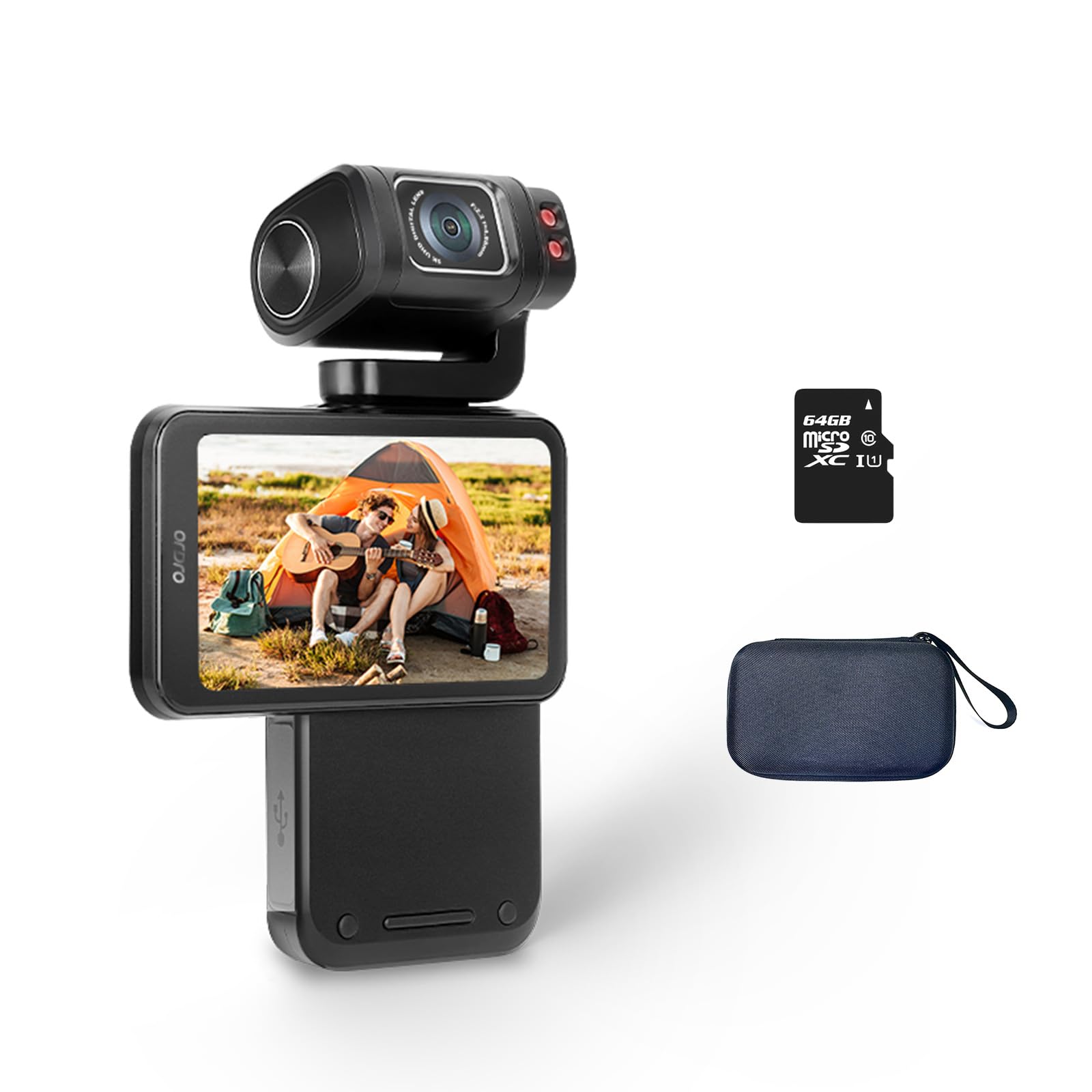
The ORDRO M3 stands out for its 5K 30fps and 4K 60fps recording capabilities in a body that is just 5.3 by 2.2 by 1.5 inches — small enough to slip into a front pocket. The 3.5-inch flippable touchscreen is larger than most competitors at this size, making framing and menu navigation genuinely pleasant. The 180-degree rotating lens is a clever design choice for self-recording, though it produces a slight motor noise during rotation that you will want to be aware of. The 3250mAh internal battery provides approximately 6 hours of runtime at 1080p, which is outstanding for all-day event recording.
Image stabilization is available in most video modes except 4K 60fps and 1080p 120fps, which is an important limitation to know if you want smooth hand-held footage at those higher frame rates. The camera supports external microphones via a 3.5mm jack — and this is strongly recommended, as the built-in audio is mediocre and will degrade the otherwise impressive video quality. Infrared night vision is functional for dark environments, though the image is monochrome. The included 64GB microSD card gets you started out of the box.
The biggest frustration reported by users is the automatic file splitting when a clip reaches approximately 4GB, which requires separate video-joining software to stitch together long recordings. Some units have also shown reliability issues, with isolated reports of cameras failing to power on after charging. For travelers who want a truly pocket-sized camera capable of 5K video and who are willing to use an external microphone, the M3 is an interesting budget-to-mid-range crossover.
Why it’s great
- 5K 30fps and 4K 60fps recording options for flexible high-resolution capture
- Extremely compact pocketable body with a large 3.5-inch flippable touchscreen
- 6-hour battery life at 1080p is excellent for all-day event recording
- 180-degree rotating lens simplifies selfie vlogging and creative angles
Good to know
- Built-in microphone quality is weak — an external mic is nearly mandatory
- Image stabilization is disabled at 4K 60fps and 1080p 120fps
- Video files split at 4GB automatically, requiring joining software
- Some reliability issues reported with units not powering on after charging
7. 5K Video Camera Camcorder with 8X Optical Zoom (FJFJOPK)
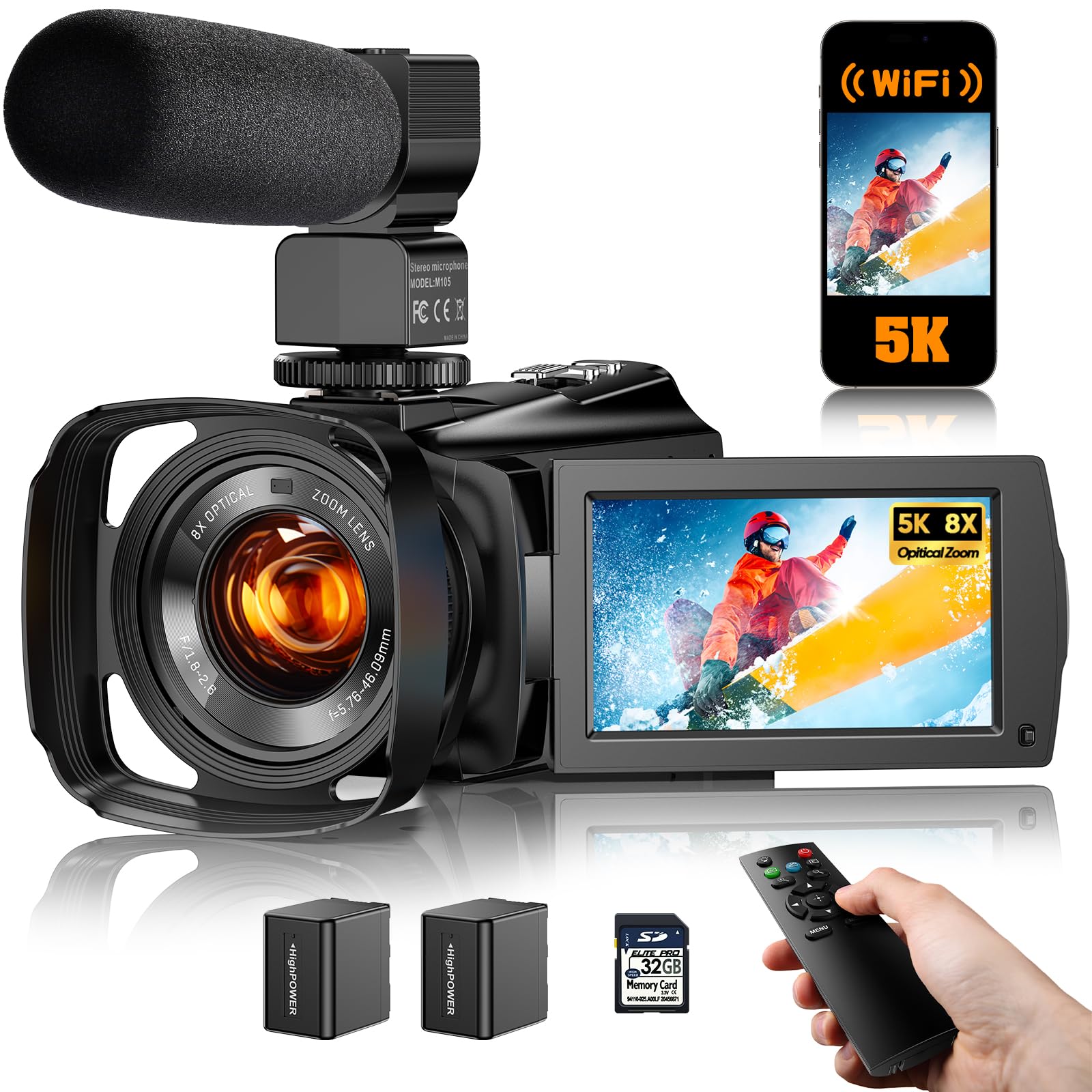
This camcorder from FJFJOPK aims squarely at the live-streaming and product demonstration market, and it delivers some genuinely useful features for those specific use cases. The 8x optical zoom is a meaningful advantage over the purely digital zoom options on budget action cameras — it preserves image clarity across its entire range. The 3.6-inch IPS touchscreen with 270-degree rotation makes it easy to see yourself while recording or presenting to a camera, and the touch response is responsive enough for quick menu adjustments.
The camera includes four scene presets — Default, Beauty, Jewelry, and Clothing — that adjust the image processing to better showcase specific types of products during live streams. The TOF laser-assisted autofocus is fast and accurate even in low light, and the customizable zone autofocus lets you choose between manual, single-shot, and continuous modes. Full-color night vision is functional and produces usable color footage in near-darkness, which is a step above the monochrome IR systems found in cheaper competitors.
The most significant reported issue is audio-video sync drift — some buyers have found that the sound track falls noticeably out of sync with the image during longer recordings, which is a deal-breaker for any professional use. The electronic image stabilization helps with casual hand-held shots, but it does not match the smoothness of a gimbal system. For a streamer or small business owner who needs optical zoom and full-color night vision in a compact package, this camera offers a compelling feature set at a budget-friendly price, provided you test the audio sync thoroughly within the return window.
Why it’s great
- 8x optical zoom maintains clarity throughout the zoom range
- TOF laser-assisted autofocus is fast and accurate in low light
- Full-color night vision captures usable footage in near-total darkness
- Product-specific scene presets (Jewelry, Clothing) for live streamers
Good to know
- Audio-video sync drift has been reported on longer recordings
- Audio quality from the built-in microphone is only mediocre
- EIS stabilization is not as smooth as a mechanical gimbal
8. 8K Video Camera 88MP UHD WiFi Vlogging Camcorder (FlyFrost)
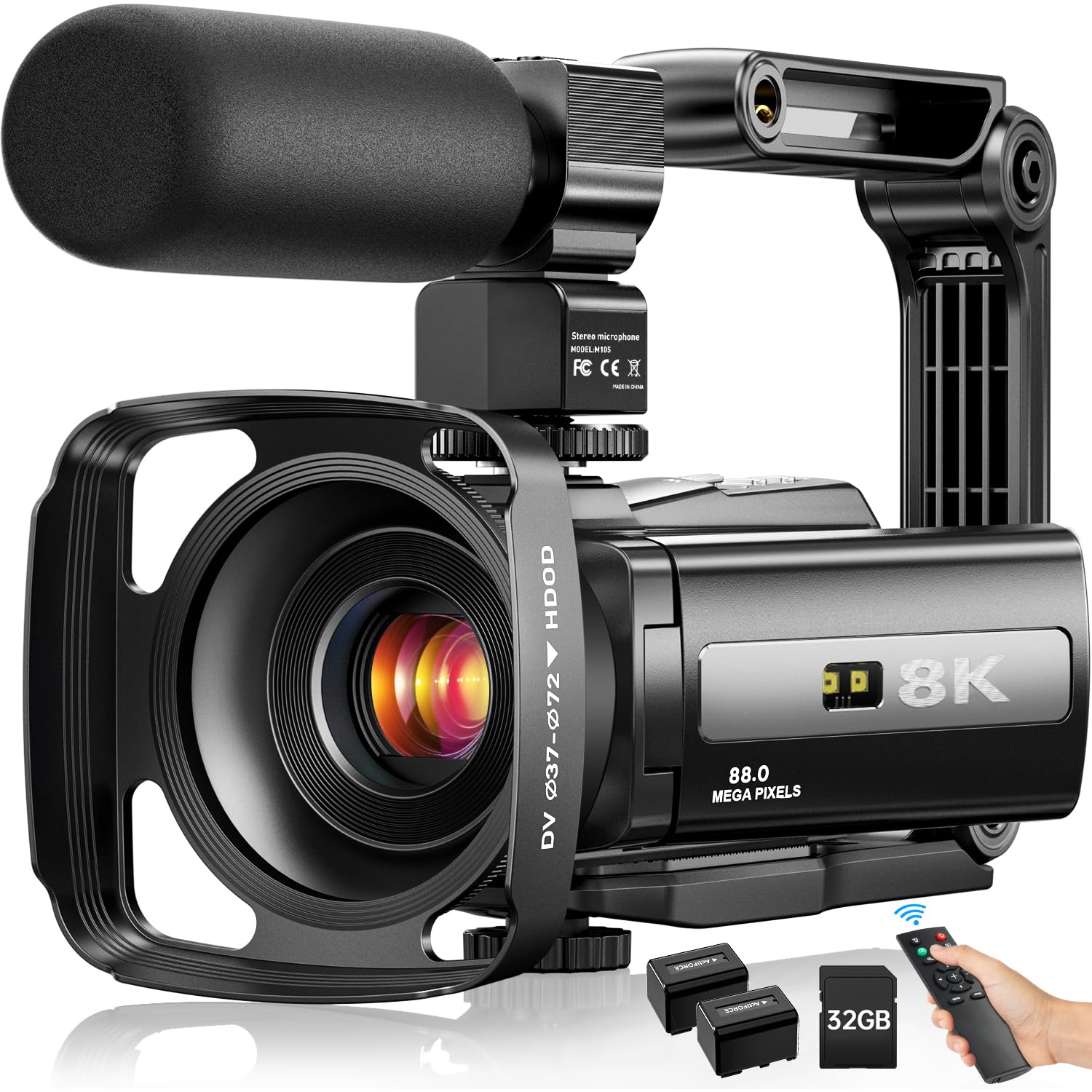
The FlyFrost 8K camera targets absolute beginners who want an all-in-one kit with a long list of specs. It includes a lens hood, handheld stabilizer, external microphone, remote control, two batteries, a 32GB memory card, and a carrying bag — everything you need to start vlogging immediately. The 3-inch touchscreen rotates 270 degrees, and the camera supports 8K video at 15fps and 88MP still images. In practice, the 8K mode is more of a marketing bullet than a usable feature — the frame rate is too low for smooth motion, and the processing overhead is significant.
The IR night vision works as advertised, providing black-and-white footage in total darkness, and the Wi-Fi connectivity via the “iSmart DV2” app allows remote control and file transfer. The external microphone included in the kit does reduce wind noise, improving the audio quality over the built-in mic. The stabilizer is a physical handheld support rather than a gimbal, so it helps with steadying the camera but does not provide the same smooth motion cancelation as a motorized stabilizer.
Multiple users have reported that the low-light performance is disappointing and that the 18x digital zoom becomes grainy quickly when zoomed in. The camera struggles with exposure transitions when moving from indoor to outdoor scenes, and the autofocus is not as responsive as more expensive options. For a complete beginner who wants a broad accessory set and is not demanding about image quality, this kit offers an accessible entry point. However, anyone who has used a mid-range smartphone camera will likely be underwhelmed by the actual video output.
Why it’s great
- Comprehensive kit includes microphone, stabilizer, remote, and extra batteries
- IR night vision allows recording in complete darkness
- Wi-Fi connectivity enables remote control and fast file transfer
- 270-degree rotating touchscreen for easy self-framing
Good to know
- 8K video is limited to 15fps — too choppy for most uses
- Digital zoom degrades image quality severely at higher magnifications
- Low-light performance is poor compared to entry-level smartphones
- Autofocus struggles with exposure transitions between bright and dim environments
9. SJCAM C400 4K Travel Vlogging Camera
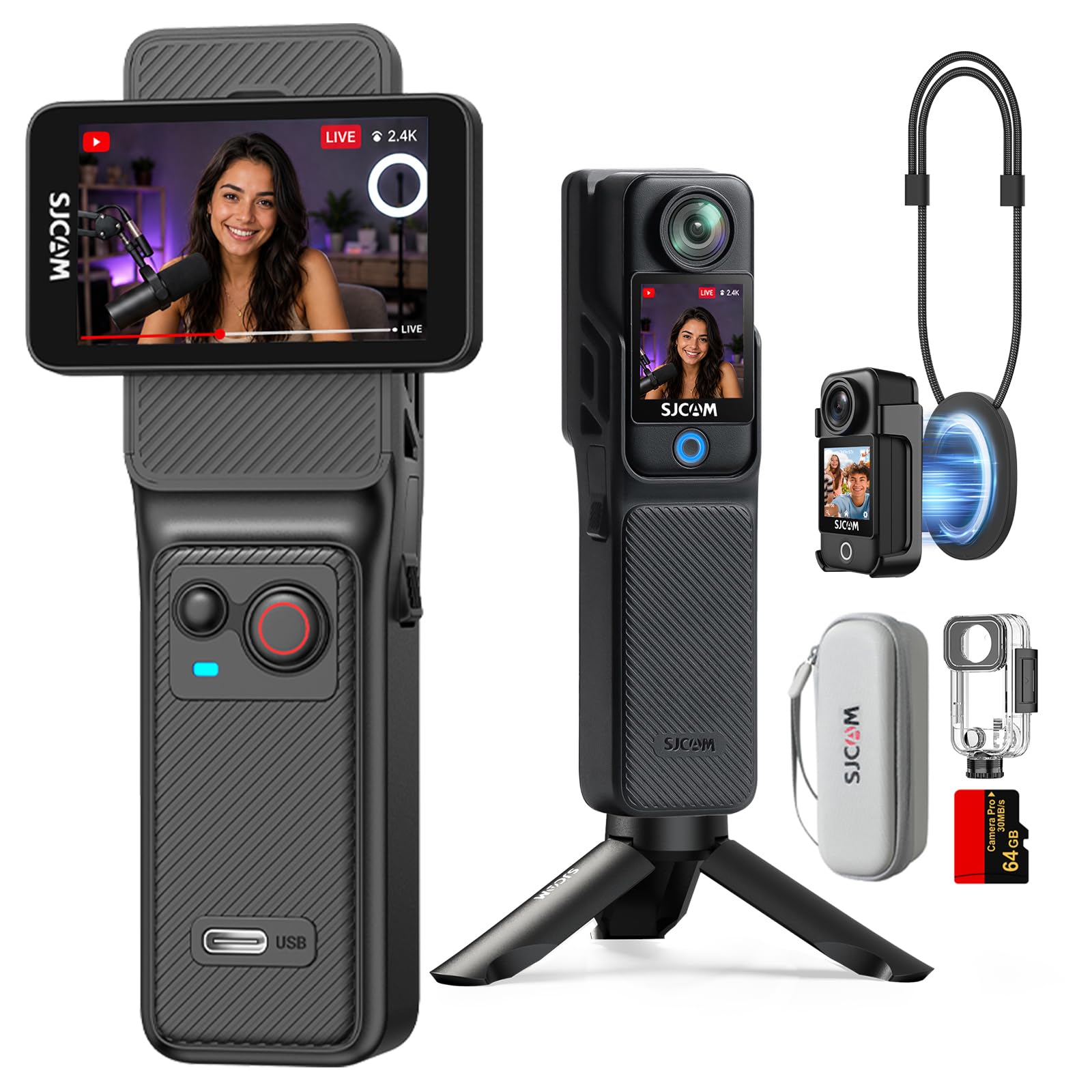
The SJCAM C400 is an action-camera-style compact vlog cam that sets itself apart with truly impressive battery endurance — a single charge delivers up to 7 hours of continuous recording at 4K resolution. This is a massive advantage for outdoor creators, travel vloggers, or anyone who shoots all day without access to a power bank. The 154-degree distortion-free wide-angle lens provides an immersive field of view that works well for first-person POV content, landscape shots, and wide-group recordings without the fisheye warp common on cheaper action cameras.
The 6-axis electronic image stabilization does a decent job of smoothing out minor shakes during walking, though it cannot match the performance of a mechanical gimbal. The dedicated app with 5G Wi-Fi allows fast file transfer and remote control, and the 64GB included memory card provides ample start-up storage. The 2.29-inch touchscreen is responsive, and the lightweight 189-gram body can be worn on a chest mount for hands-free recording. The f/2.0 aperture helps in moderate low-light conditions, but the image quality is clearly a step below what a 1-inch sensor camera delivers.
The video quality claims are the subject of some debate — while the camera records at 4K 30fps, several reviews note that the actual image sharpness and color accuracy do not match name-brand options at similar resolutions. The audio quality from the built-in microphone is acceptable for casual vlogging but will benefit from an external lavalier. The included accessories (carrying case, tripod, and extra mounts) add genuine value for travel users. For the budget-conscious creator who prioritizes battery life and wide-angle coverage above all else, the C400 is a practical, long-lasting companion.
Why it’s great
- Exceptional 7-hour battery life is class-leading for all-day recording
- 154-degree wide-angle lens with minimal distortion captures immersive POV footage
- Lightweight 189g design with chest-mount capability for hands-free use
- Includes 64GB card, tripod, and carrying case for immediate out-of-box use
Good to know
- 4K video quality does not match the sharpness of premium brand-name cameras
- Built-in microphone audio is acceptable but not great for professional use
- Electronic stabilization cannot match a mechanical gimbal for walking shots
- Dedicated app required for file transfer — no direct USB mass storage mode mentioned
FAQ
Why is a 1-inch CMOS sensor better for a compact camcorder than a 1/2.3-inch sensor?
Can I use a compact camcorder for professional live streaming?
Is a camera with 8K resolution worth buying for vlogging?
How important is external microphone support in a compact camcorder?
Final Thoughts: The Verdict
For most users, the best compact camcorder winner is the DJI Osmo Pocket 3 because it combines a 1-inch sensor with a mechanical 3-axis gimbal in a truly pocketable form, delivering the smoothest 4K 120fps footage with reliable tracking and great audio. If you want professional-grade XLR audio and 20x optical zoom for long-range documentary-style work, grab the Canon XA60. And for the best value with a mechanical gimbal and a 1-inch sensor at a lower price point, nothing beats the Xtra Muse.

Mo Maruf
I created WellFizz to bridge the gap between vague wellness advice and actionable solutions. My mission is simple: to decode the research and give you practical tools you can actually use.
Beyond the data, I am a passionate traveler. I believe that stepping away from the screen to explore new environments is essential for mental clarity and physical vitality.