Our readers keep the lights on and my smoothie glass nicely filled. As an Amazon Associate, I earn from qualifying purchases.
Specs are compiled from manufacturer listings and verified buyer reviews and can change over time — please confirm the key details on the product page before buying.
You want binoculars that fit in a jacket pocket or daypack but still let you see a distant shoreline, a bird on a hike, or a player on the field clearly — even in dim light. The challenge is finding a pair that balances magnification (how many times closer an object looks) and light-gathering ability (how bright the image stays) without turning blurry when the sun drops.
I’m Mohammad Maruf — the founder and writer behind WellFizz. This guide is built by comparing the manufacturers’ published specifications and the patterns across verified customer reviews, so you get each pick’s real strengths and trade-offs instead of marketing spin.
After sorting through the specs and real owner experiences, these seven models rose to the top for anyone searching for the best compact binoculars for travel — each one earns its spot based on glass quality, portability, and how well it handles the conditions you’ll actually face on the road.
Quick Picks
- Nikon Trailblazer II 8×25 — Best Overall
- Nocs Provisions Standard Issue 10×25 — Premium Pick
- Nikon Trailblazer 10x25mm — Top Performer
- Occer 15×30 Compact Binoculars — Best Value
- Occer 12×25 Compact Binoculars — Glasses-Friendly
- OPAITA 20×32 Compact Binoculars — High Magnification
- Hontry 12×25 Compact Binoculars — Family-Friendly
How To Choose The Best Compact Binoculars For Travel
Buying compact binoculars for travel means giving up some light-gathering ability in exchange for portability. The key is knowing which trade-offs are worth making for the way you actually use them.
Magnification and Objective Lens Size
The two numbers you see on every pair — like 12×25 — tell you the magnification (how many times closer an object appears) and the diameter of the front lens in millimeters. A larger objective lens, such as the 32mm on the OPAITA 20×32 model, lets in more light, which helps in dim conditions. But bigger lenses also mean a heavier binocular, so travel-friendly pairs stay around 25mm to 32mm.
Field of View
This is the width of the area you can see at a set distance, usually measured in feet at 1,000 yards. A wider field of view helps you track moving objects like birds or players on a field. The Occer 15×30 delivers a generous 368ft/1000yds, making it easier to follow fast action without losing your subject.
Exit Pupil and Eye Relief
The exit pupil is the circle of light that hits your eye — bigger is better in low light. The Occer 12×25 offers a 2.5mm exit pupil versus 1.6mm on the OPAITA 20×32, meaning the Occer is noticeably brighter at dusk. Eye relief matters if you wear glasses: you need at least 15mm to see the full image without pressing lenses against the eyepiece.
Quick Comparison
| Model | Best For | Magnification | Field of View | Eye Relief | Amazon |
|---|---|---|---|---|---|
| Occer 12×25 | Eyeglass wearers on a budget | 12x | 7.5° | 20 mm | Amazon |
| Occer 15×30 | Wide scenic views | 15x | 368ft/1000yds | 16 mm | Amazon |
| Nikon Trailblazer II 8×25 | Premium brand at a mid-range price | 8x | 435 ft | 10 mm | Amazon |
| Nocs Provisions 10×25 | Rugged waterproof performance | 10x | 315 ft | 10 mm | Amazon |
| Nikon Trailblazer 10×25 | Pro-level optical clarity | 10x | — | 6.3 mm | Amazon |
| OPAITA 20×32 | Maximum reach for distant subjects | 20x | 235 ft | 13 mm | Amazon |
| Hontry 12×25 | Family sharing with adjustable fit | 12x | 288 ft | 10 mm | Amazon |
In‑Depth Reviews
1. Nikon Trailblazer II 8×25
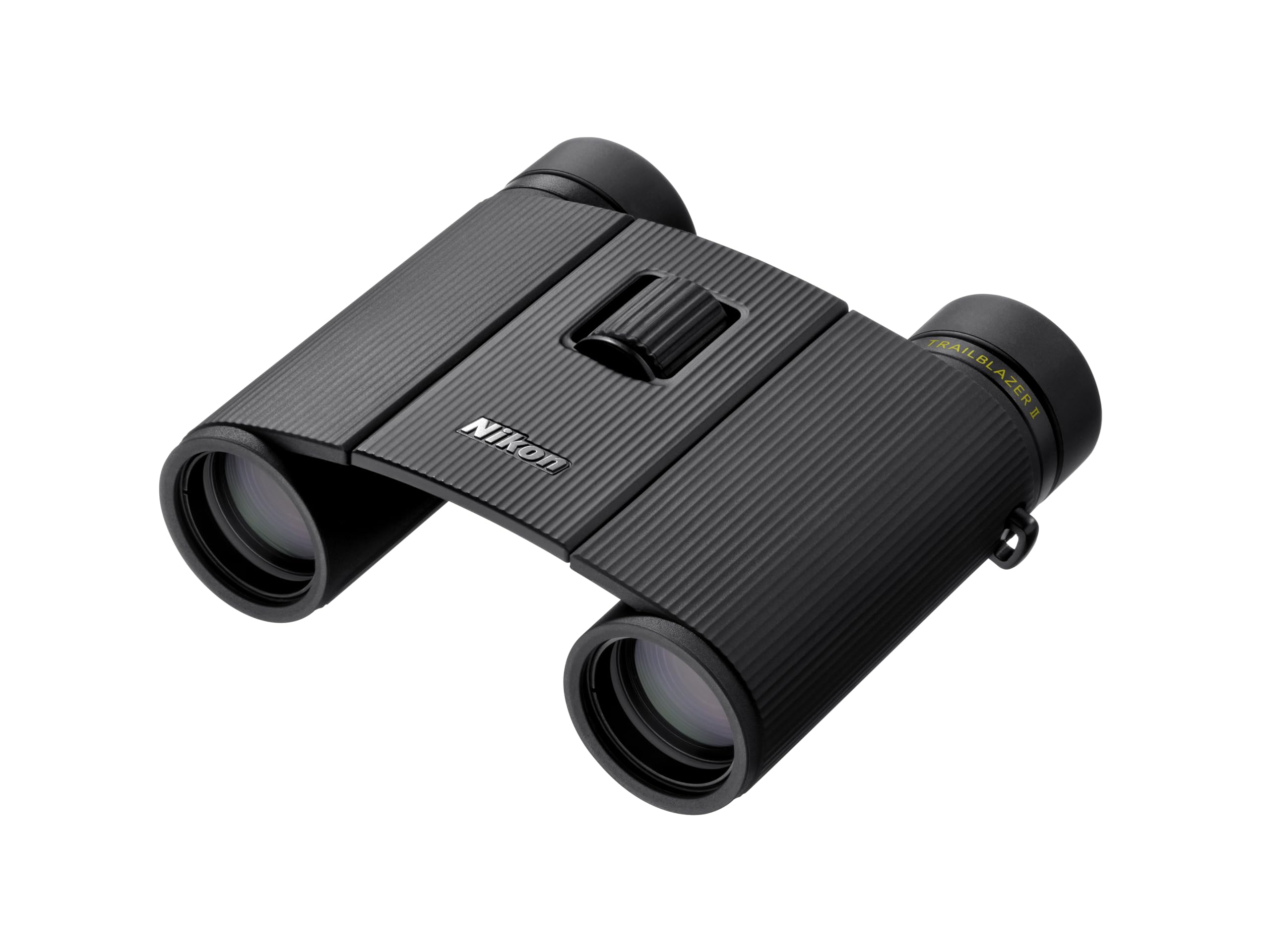
A trusted brand name that stays true to itself — clear, compact, and built to handle the trail.
Nikon delivers a field of view that makes tracking subjects easier: 435 ft at 1,000 yards is noticeably wider than the 315 ft on the Nocs Provisions 10×25, so you can follow a soaring eagle or a wide receiver without constant re-centering. The multilayer-coated lenses (coated with anti-reflective layers on multiple surfaces) boost brightness and color accuracy, and the turn-and-slide rubber eyecups with multi-click positions let you dial in the exact eye relief for a full view.
It is waterproof and fogproof (nitrogen-filled and O-ring sealed, so internal lenses never fog up in cold or humid conditions), and the rubber-armored body absorbs bumps. The 8x magnification means a steadier handheld image than higher-power picks, especially after a long day of walking. One minor gripe buyers report: no main lens caps are included, so you will want to store it in the included case.
Sharp & Steady
- Wider field of view than most compact models at 435 ft
- Multilayer-coated lenses for bright images in varied light
- Waterproof and fogproof build that handles weather
- Rubber armored body for a firm, non-slip grip
Missing Covers
- No main lens caps included (eyepiece caps fit loosely)
- Eye relief at 10 mm may be tight for some eyeglass wearers
Your go-to for all-day carry: This is the pair for anyone who wants a proven brand, a wide field of view, and a weatherproof build that shrugs off rain and dust — without paying pro-level prices.
One catch: You will need to buy or DIY a lens cap to protect the objectives when it is in a pack with keys and change.
2. Nocs Provisions Standard Issue 10×25

A rugged, waterproof optic that looks as good as it performs — and comes with a lifetime promise.
Fully multi-coated optics (where every glass surface gets multiple anti-reflective layers) push light transmission to the edges, giving you a bright, crisp image across the entire 315-foot field of view. The Swiss-designed BAK-4 prism (a type of glass that produces rounder, brighter exit pupils than cheaper BK-7 prisms) makes the image look sharp and realistic, not washed out. Owners mention the clarity is tough to top for the size.
At IPX7, these binoculars can survive submersion in up to three feet of water for 30 minutes — a meaningful difference from splash-resistant models. The patented Rugged Wave Grip keeps them locked in your hand even in rain. The multi-stop twist-up eyecups have three distinct positions for eyeglass wearers. And the “No-Matter-What” Lifetime Warranty means Nocs will repair or replace them if they break. The main downside, as one buyer put it, is the price — you are paying for the quality of the glass and that lifetime assurance.
Lifetime Quality
- True IPX7 waterproof rating (submersible to 3 ft for 30 minutes)
- Fully multi-coated optics and BAK-4 prism for bright, clear views
- Lifetime “No-Matter-What” warranty backs the purchase
- Comfortable ergonomic grip for extended use
Premium Price Tag
- Noticeably more expensive than other compact models
- Rubber coating may become sticky over years (a buyer’s long-term worry)
For the outdoor purist: If you hike, paddle, or backpack in unpredictable weather and want an optic that can take a dunking and still give you clear glass, this is the pair to buy once and keep for life.
Look elsewhere if: You just want a cheap pair for the occasional ballgame — this is overkill for casual use.
3. Nikon Trailblazer 10x25mm
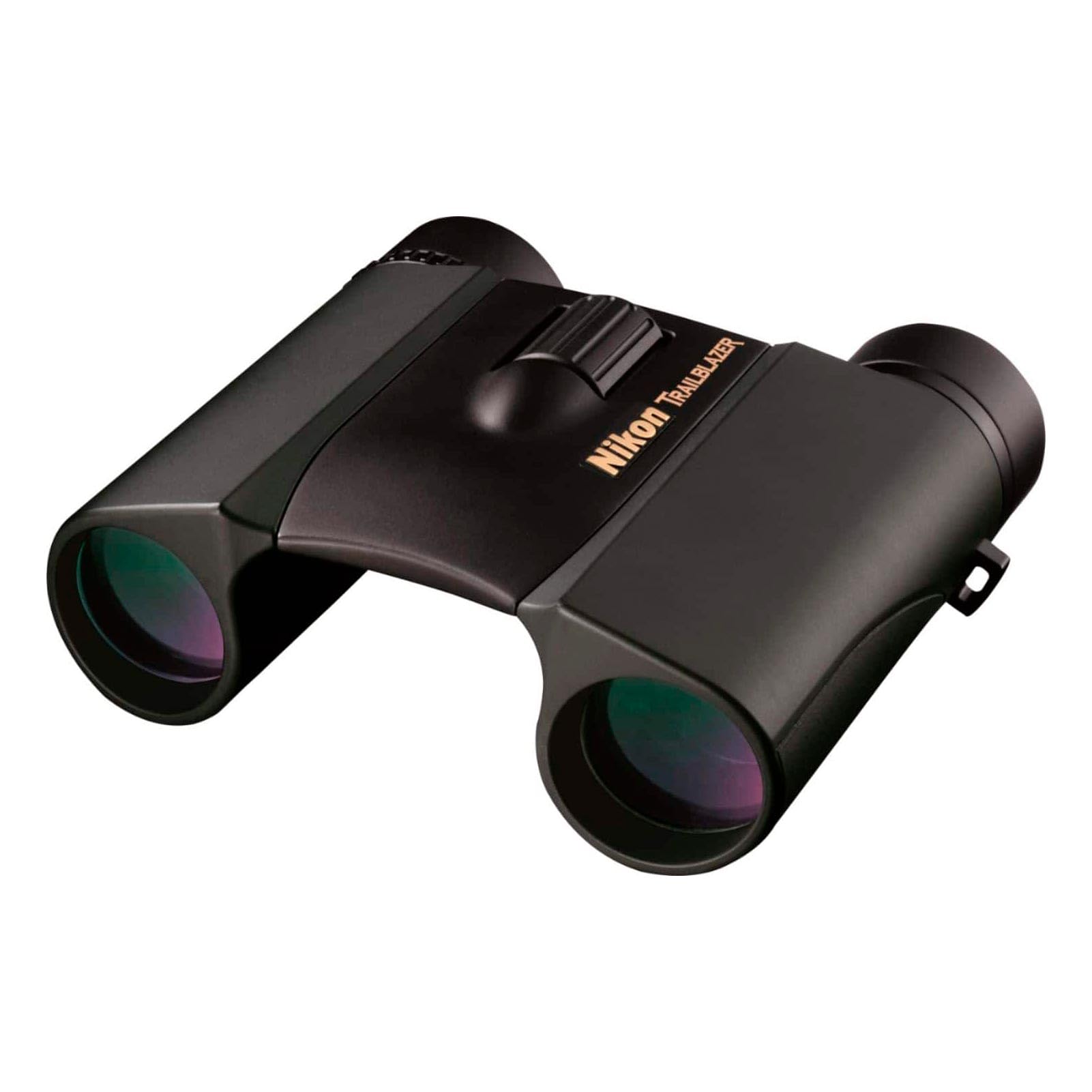
Serious optics in a compact roof-prism body that proves bigger is not always better.
Nikon packs fully multi-coated lenses into a foldable roof-prism design (a compact shape where the objective lenses align directly with the eyepieces, unlike the offset Porro prisms) that folds down to a pocketable size. The image stays crisp, vivid, and detailed from edge to edge, even in the dim light of early morning or late afternoon. The nitrogen-filled, O-ring sealed construction means it is fully waterproof and fogproof, so sudden rain or a drop in a puddle will not ruin your view.
The shock-absorbing rubber armor gives you a secure, non-slip grip in wet or cold conditions. A smooth central focus knob lets you dial in on anything from a close-up feather detail to a distant ridge line. The one trade-off: at a 6.3 mm eye relief, it is short — this is not the best pick if you wear glasses and need to keep them on. One reviewer noted the eyepiece cups tend to slide back down, which can be annoying during active use.
Optical Excellence
- Fully multi-coated lenses deliver bright, high-contrast images
- Waterproof and fogproof build handles any weather
- Compact folding roof-prism design fits easily in a pocket
- Smooth central focus knob and durable rubber armor
Short Eye Relief
- 6.3 mm eye relief is tough for eyeglass wearers to use comfortably
- Eyecups may not stay locked in the extended position
First choice for non-glasses users: If you do not wear glasses and value top-tier optical clarity in a tiny package that fits your jeans pocket, this is the pick — it outperforms cheaper sub- models by a wide margin.
skip it if: You rely on glasses for sharp vision; the short eye relief will force you to squint or take them off.
4. Occer 15×30 Compact Binoculars

A 15x optic with a BAK-4 prism that gives you a genuinely wide view without draining your wallet.
That extra width makes a real difference when you are scanning open landscapes or tracking birds in flight. The 30 mm objective lens diameter is 30 mm versus the 12×25 model’s 25 mm, pulling in more light for a brighter image. The BAK-4 prism and FMC broadband coating (fully multi-coated on all surfaces) push light transmission to 96.48%, so colors stay true even in low light.
At 12.8 oz it is light enough for all-day carry, and the twist-up eyecups with 16 mm eye relief work well for both bare eyes and glasses. Customers note the image is crisp and sharp for the price. The honest catch is that some owners feel the true magnification is closer to 8x despite the 15x claim, and the diopter adjustment ring (the ring that fine-tunes focus for each eye to compensate for vision differences) can drift out of position.
Wide & Bright
- Widest field of view in the test group at 368ft/1000yds
- BAK-4 prism and FMC coating for bright, realistic colors
- 30 mm objective pulls in more light than 25 mm models
- Lightweight at 12.8 oz
Drifting Focus
- Some reviewers point out actual magnification feels closer to 8x
- Diopter adjustment can slip during use
- Strap quality poor — many replace it immediately
The go-to for scenic travelers: The 368 ft field of view and 30 mm lens make this the binocular you want for sweeping ocean views, open plains, or any situation where you want to take in the whole scene.
Be aware: The diopter can drift mid-use, so you may need to re-adjust after stowing it in a bag.
5. Occer 12×25 Compact Binoculars

Travel-friendly binoculars with eye relief long enough for sunglasses — a rare find at any price.
The 20 mm eye relief on the Occer 12×25 is 20 mm eye relief versus the 10 mm eye relief found on the Hontry 12×25 and the Nikon Trailblazer II 8×25. That gap means you can keep your glasses on and still see the full image without pressing your lenses against the eyepiece. The 2.5 mm exit pupil is 2.5 mm exit pupil versus the 1.6 mm exit pupil on the OPAITA 20×32, giving you noticeably brighter views at dusk or in shaded forests.
The FMC broadband coating (fully multi-coated across all surfaces) and BAK-4 prism keep images looking sharp and realistic. The compact body is waterproof (sealed against light rain and splashes) and weighs next to nothing in a daypack. While buyers rave about the clarity for the price, one experienced user notes the “real magnification ~8x despite 12x claim,” and the strap is prone to detaching. The 12×25 format is inherently dimmer than larger objective models in deep twilight.
Spectacle-Friendly
- 20 mm eye relief — best of the group for eyeglass wearers
- 2.5 mm exit pupil for bright views in lower light
- BAK-4 prism and FMC coating for clear images
- Waterproof build at a budget-friendly price
Magnification Overstated
- Real magnification feels closer to 8x despite the 12x claim
- Included strap is weak and may detach
- 25 mm objective limits low-light performance
Best pick for glasses wearers: If you wear prescription glasses or sunglasses while birding or sightseeing, the 20 mm eye relief means you will actually see the full picture — no squinting or removing your specs.
Not for low-light specialists: The 25 mm objective lens struggles in deep woods or twilight; reach for a 30 mm+ model for dawn/dusk use.
6. OPAITA 20×32 Compact Binoculars

A 20x power and 32 mm objective that bring distant details into view — if you can keep it steady.
The OPAITA 20×32 gives you 20x magnification versus the Occer 12×25’s 12x power, which means a whale spout a mile out at sea becomes clearly visible. The 32 mm objective lens diameter is 32 mm versus the Occer 12×25’s 25 mm, pulling in more light. It includes a carrying bag, neck strap, and cleaning cloth. Shoppers say that the image is clear with diopter adjustment, making it a functional tool for concerts and wildlife.
But here is the reality of 20x magnification in a compact body: the 1.6 mm exit pupil is small, which means the image gets dim in anything short of bright daylight. Any hand shake is magnified 20 times, so you will want to brace against a railing or hold your breath consciously. One caveat from a buyer: a lens came apart inside a backpack and required repair with Loctite, suggesting the build quality is not at pro level.
Maximum Reach
- 20x power for extreme close-up viewing of distant subjects
- 32 mm objective lens for better light collection
- Clear optics with diopter adjustment
- Includes case, strap, and cleaning cloth
Shake & Dimness
- 1.6 mm exit pupil is dim in low light
- 20x hand-held magnification is tough to keep steady
- Build quality concerns: a buyer reported a lens came apart
Reach for it if: Your travel includes days of open-ocean whale watching or mountain-to-mountain spotting where 20x reach outweighs the shaky image.
Swap it out if: You mainly use binoculars at dawn, dusk, or from a moving vehicle — the small exit pupil and high magnification will frustrate you.
7. Hontry 12×25 Compact Binoculars
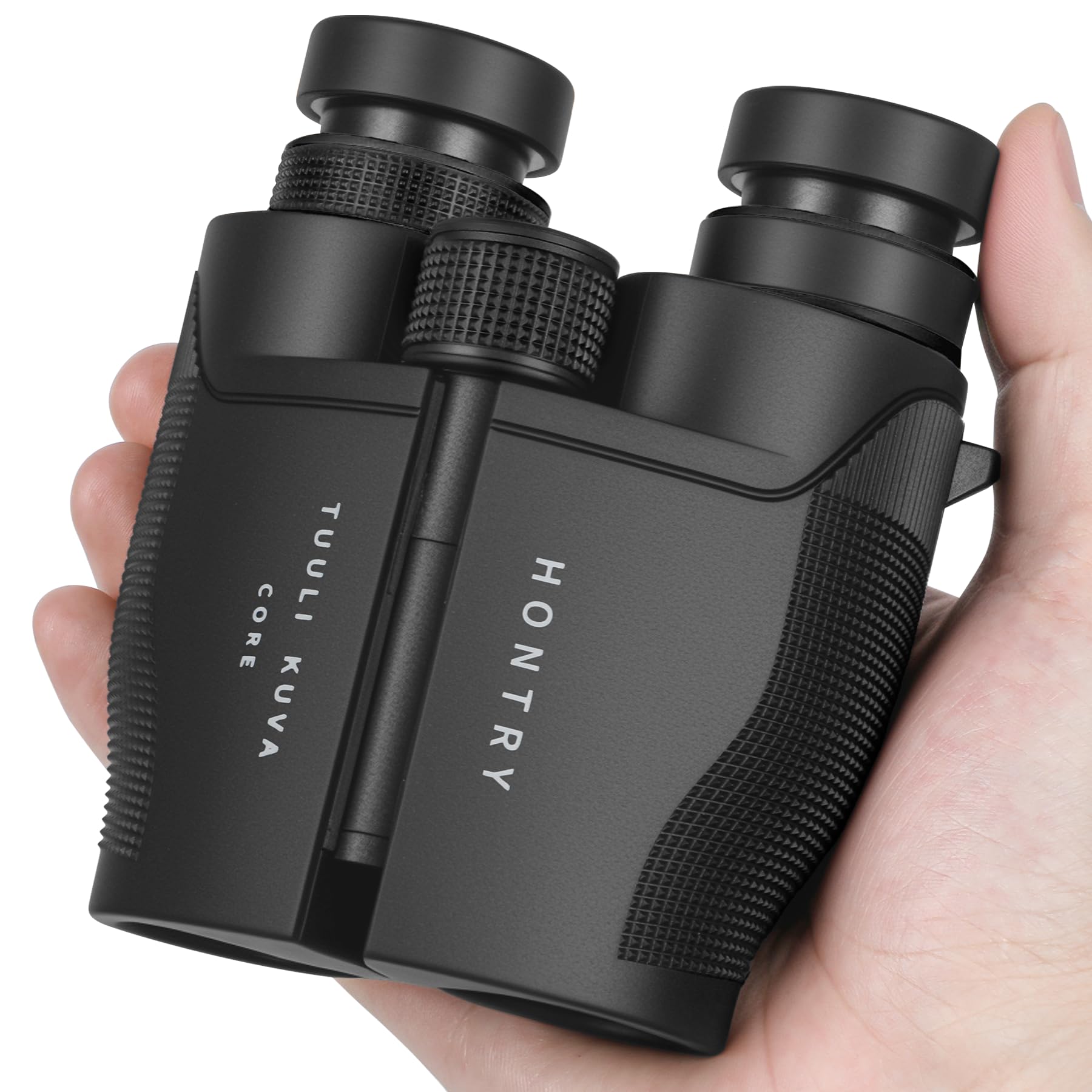
A lightweight, palm-sized binocular with an interpupillary dial that fits everyone from kids to parents.
The Hontry 12×25 weighs only 10.6 oz and measures palm-sized, so it disappears into a jacket pocket or glove box. The adjustable interpupillary distance from 60 to 75 mm means the bridge can be narrowed for a child’s face or widened for an adult without losing the image circle. Buyers report it is the “perfect size for child’s eye distance” and produces a “clearer image than adult binoculars,” making it a genuine family-shareable travel optic.
The BAK-4 prisms and fully coated lenses (anti-reflective layers on all surfaces) keep colors true and edges sharp even in the dim light of early morning or sunset. The 12x power is a solid middle ground between the shaky 20x of the OPAITA and the more modest 8x of the Nikon Trailblazer II. One owner admits the quality is “ok” and that you could “probably find a better pair” if you are willing to spend more, so expectations should stay realistic for the price.
Shareable Design
- Adjustable IPD 60-75 mm fits kids, teens, and adults
- Lightweight at 10.6 oz with palm-sized form
- BAK-4 prisms and fully coated lenses for clear, sharp views
- Silicone grip texture stays secure even with wet hands
Budget Compromise
- 10 mm eye relief is short for glasses wearers
- Overall quality feels mid-range — not a premium optic
Perfect for families on the move: If you need one pair of binoculars that works for both you and your kids on a hiking trip or a cruise, the adjustable IPD and light weight make it the obvious choice.
Skip it for: Serious birders or anyone who needs top-tier glass or long eye relief for glasses — upgrade to the Occer 12×25 or Nikon Trailblazer II instead.
Understanding the Specs
Magnification and Objective Lens
The first number (10x, 12x, 15x, 20x) tells you how many times closer an object appears. The second number (25, 30, 32) is the diameter of the front lens in millimeters — bigger means more light enters, giving you a brighter image. For travel, 8x to 12x is the balance: high enough to see details, low enough to hold steady without a tripod. A 25mm lens keeps the binoculars compact, while 30-32mm gives better low-light performance at a slight weight penalty.
Field of View
Measured in feet at 1,000 yards (e.g., 368ft/1000yds), this is the width of the scene you can see. A wider field of view makes it easier to track moving subjects like birds or players. The Occer 15×30 leads this group at 368 ft, while the OPAITA 20×32 has a narrower 235 ft — a trade-off you get with higher magnification. For general travel and wildlife, aim for at least 300 ft/1000yds.
Exit Pupil
This is the circle of light that leaves the eyepiece and enters your eye. You calculate it by dividing the objective lens diameter by the magnification (e.g., 25mm ÷ 12x = 2.5mm). A larger exit pupil (2.5mm or more) gives you a brighter image in low light. The Occer 12×25 and Nikon Trailblazer 10×25 both offer 2.5mm, while the OPAITA 20×32 drops to 1.6mm, which will look dim in twilight.
Eye Relief
This is the distance in millimeters between your eye and the eyepiece where you can still see the full image. If you wear glasses, you need at least 15mm of eye relief. The Occer 12×25’s 20mm is the gold standard here — double the 10mm found on the Hontry, Nikon Trailblazer II, and Nocs Provisions models. Shorter relief means you have to mash your glasses against the lens or take them off.
FAQ
What does 12×25 mean on compact binoculars?
Is 12x or 10x better for travel binoculars?
Can I use compact binoculars with glasses?
What is the best magnification for bird watching?
Are cheap compact binoculars worth buying?
What does BAK-4 prism mean?
How important is waterproofing for travel binoculars?
What size binoculars can fit in a pocket?
What is the difference between FMC and regular coated lenses?
Will 20x binoculars work for stargazing?
Final Thoughts: The Verdict
For the majority of shoppers, the best compact binoculars for travel winner is the Nikon Trailblazer II 8×25 because it pairs a generous 435-foot field of view with proven weatherproof build quality from a trusted optical brand at a price that does not break the bank. If you want maximum ruggedness and a lifetime warranty, grab the Nocs Provisions Standard Issue 10×25. And for the budget-conscious traveler who needs the widest view in the group, the Occer 15×30 delivers a remarkable 368ft field of view and a BAK-4 prism for under.
How We Picked
We do not accept paid placement. Every pick is matched to a real buyer and a real use-case; we do not hands-on test units.
Sources & Methodology
Specifications: manufacturer listings and product documentation. Review insights: verified customer reviews, as of July 2026. Pricing: not shown on this page (it changes often); check the current price via the retailer link.
As an Amazon Associate, WellFizz earns from qualifying purchases. This does not affect which products we feature.
Related Guides

Mo Maruf
I created WellFizz to bridge the gap between vague wellness advice and actionable solutions. My mission is simple: to decode the research and give you practical tools you can actually use.
Beyond the data, I am a passionate traveler. I believe that stepping away from the screen to explore new environments is essential for mental clarity and physical vitality.