Our readers keep the lights on and my smoothie glass nicely filled. As an Amazon Associate, I earn from qualifying purchases.
Specs are compiled from manufacturer listings and verified buyer reviews and can change over time — please confirm the key details on the product page before buying.
Walking across a clean window line is among the most satisfying feelings in professional cleaning — no streaks, no smudges, just pure clarity. But if you are filling a spray bottle every few hours or watching your profits dry up in the sun, the wrong cleaner will cost you far more than its price tag. That is exactly where this guide lands: straight at the difference between a cleaner that works on the clock and one that fights you for every pane.
I’m Mohammad Maruf — the founder and writer behind WellFizz. This guide is built by comparing the manufacturers’ published specifications and the patterns across verified customer reviews, so you get each pick’s real strengths and trade-offs instead of marketing spin.
Every product here passes the test of commercial-grade volume and professional performance, so you can confidently grab a commercial window cleaner that actually holds up to a full day of squeegee work without leaving you with residue, dry-time issues, or a bag full of half-empty bottles.
Quick Picks
- Glass Gleam 4 – Glass and Window Cleaner — Best Overall
- Zep Ammonia Free Glass Cleaner Concentrate — Best Value
- SC Johnson Professional Windex Glass — Premium Pick
How To Choose The Best Commercial Window Cleaner
Buying window cleaner for professional use is very different from grabbing a spray bottle at the grocery store. You are buying by the gallon, you are refilling dozens of bottles a week, and every second your cleaner takes to dry or leaves a streak means lost time and a worse result. Here are the three most important factors to weigh.
Concentrate Ratio Is Your Real Price Tag
The biggest difference between these products is how many gallons of ready-to-use cleaner you get from one gallon of concentrate. One of the picks below stretches into a massive 512 gallons, while another makes 32 gallons. A high ratio means you carry less weight and pay less per spray bottle you fill, but you also need to be precise with your dilution.
Drying Speed and Working Time
If you clean windows in direct sunlight or windy conditions, your cleaner can evaporate before you get the squeegee across. Professional window cleaners consistently point out that a cleaner with longer working time allows you to spread it, scrub, and pull a squeegee without fighting dry edges. Some formulas need a splash of dish soap to slow down drying.
Surface Safety and Residue
Commercial window cleaners touch more than just glass — they end up on tinted windows, acrylic displays, chrome fixtures, and automotive plastics. An ammonia-free formula prevents clouding on tinted surfaces, and a non-residue formula keeps mirrors and glass looking clear even when the sun hits them head on.
Quick Comparison
| Model | Best For | Concentrate Yield | Weight | Formula Type | Amazon |
|---|---|---|---|---|---|
| Glass Gleam 4 | Highest yield per gallon | 512 gallons RTU | 9 lbs | Ammonia-free concentrate | Amazon |
| Zep Ammonia Free Concentrate | Best all-around value | 32 gallons RTU | 35.7 lbs (case of 4) | Ammonia-free concentrate | Amazon |
| SC Johnson Windex Glass & More | Ready-to-use bulk refill | Ready to use (4 gallons) | 8.72 lbs | Ready-to-use, multi-surface | Amazon |
In‑Depth Reviews
1. Glass Gleam 4 – Glass and Window Cleaner – Highly Concentrated – 1 Gallon

A single gallon of concentrate that open up over five hundred gallons of finished cleaner.
If you are scrubbing high-rise windows or running a crew that goes through gallons a day, this is the one that changes the math on your entire supply budget. Glass Gleam 4 produces a massive 512 gallons of ready-to-use product from one jug — a yield that blows past the Zep concentrate by a factor of sixteen. At just 9 pounds, the jug itself is light enough to toss into a work bag without breaking your back, unlike the 35.7-pound case of Zep.
Buyers report this concentrate is “dilutable from liter to gallon,” giving you total control over mixing strength. Career window cleaners specifically call out how well GG-4 holds up in direct sun and wind — one reviewer with three decades on the job in Honolulu says it “does not dry out your hand like dawn soap and stay on the glass long enough to squeegee.” That long working time in brutal conditions is the difference between a clean pane and a dried-on mess. The detergent system also includes polymeric water softeners that reduce dirt redeposition, meaning you do not have to rewash the same glass twice.
The honest trade-off is that some users find it low-suds and quick-drying in certain conditions. One reviewer who runs a professional window cleaning company notes GG-4 “drys very quickly,” but reports that adding a splash of Dawn fixes the issue. If you prefer a sudsy cleaner that sits longer before squeeging, you may need to tweak your mix slightly.
class-leading Yield
- 512 gallons from one jug — lowest cost per bottle by far
- Biodegradable formula with high-tech water softeners
- Weighs just 9 lbs — easy to carry between job sites
- Developed specifically for glass by professional chemists
Works Best with a Mix Adjustment
- Very low suds — some users prefer a visible foam for coverage feedback
- Dries quickly in hot sun if you do not move fast enough
- Third-party reviewer found it “okay” without a detergent splash
The Yield King: Grab Glass Gleam 4 if you run a busy crew or high-volume cleaning route and want the absolute lowest cost per spray bottle — the 512-gallon output crushes everything else in this list.
One trade-off: You may want to add a drop of dish soap to slow drying on hot, sunny days; the formula runs low-suds and fast.
2. Zep Ammonia Free Glass Cleaner Concentrate – 1 Gallon (Case of 4)

A four-pack of ammonia-free concentrate that turns a single jug into a full day of cleaning.
Zep has been trusted by professionals since 1937, and this concentrate case of four 1-gallon jugs reflects that heritage — each jug mixes at a 1:32 ratio, meaning one ounce of concentrate with 32 ounces of water makes a full spray bottle. The case yields 32 total gallons of ready-to-use cleaner, which is a lot less output than Glass Gleam 4 but still generous for a shop or a solo operator grinding through daily routes. The key advantage here is that you get four separate jugs, so you can distribute them across different trucks or job bins.
The formula is ammonia-free, so it is safe on tinted glass, acrylic surfaces, and even automotive plastics — one professional detailer specifically notes that glass cleaners typically damage car plastic, but this one does not. The same reviewer calls the price “absolutely ridiculous” in a good way given the 1:32 ratio. Users also report the floral scent leaves windows and chrome fixtures shiny, and that the cleaner leaves no residue or streaks even in direct sunlight. At 35.7 pounds for the case, it is noticeably heavier than the other picks here — the Glass Gleam jug alone is 4.1 times lighter at 9 pounds.
Buyers also mention that mixing is straightforward: dilute 1 ounce of concentrate with 32 ounces of water. A consistent theme is to not mix it too strong, as an over-concentrated batch is harder to wipe off. Keep it to the recommended ratio and Zep delivers a streak-free shine that holds up on mirrors, chrome, and glass all day long.
Safety First: This is the pick for anyone cleaning tinted car windows, acrylic displays, or mixed surfaces — the ammonia-free formula means no clouding or damage to plastics, and professionals confirm it protects car interior trim.
Heavy Haul: The 35.7-pound case is a solid workout to lug; if you are carrying concentrate up stairs or ladders, the Glass Gleam 4 at 9 pounds is much friendlier.
Shop Favorite: Reach for Zep if you want a trusted ammonia-free concentrate that arrives in four separate jugs for easy distribution across trucks or job bins, and you are comfortable carrying 35.7 pounds of cleaner.
skip it if: You need the highest yield per dollar — Glass Gleam 4 makes 512 gallons from one jug versus Zep’s 32- gallon total.
3. SC Johnson Professional Windex Glass and More Multi-Surface Cleaner, 128 fl. oz. Bottles, 4 Count
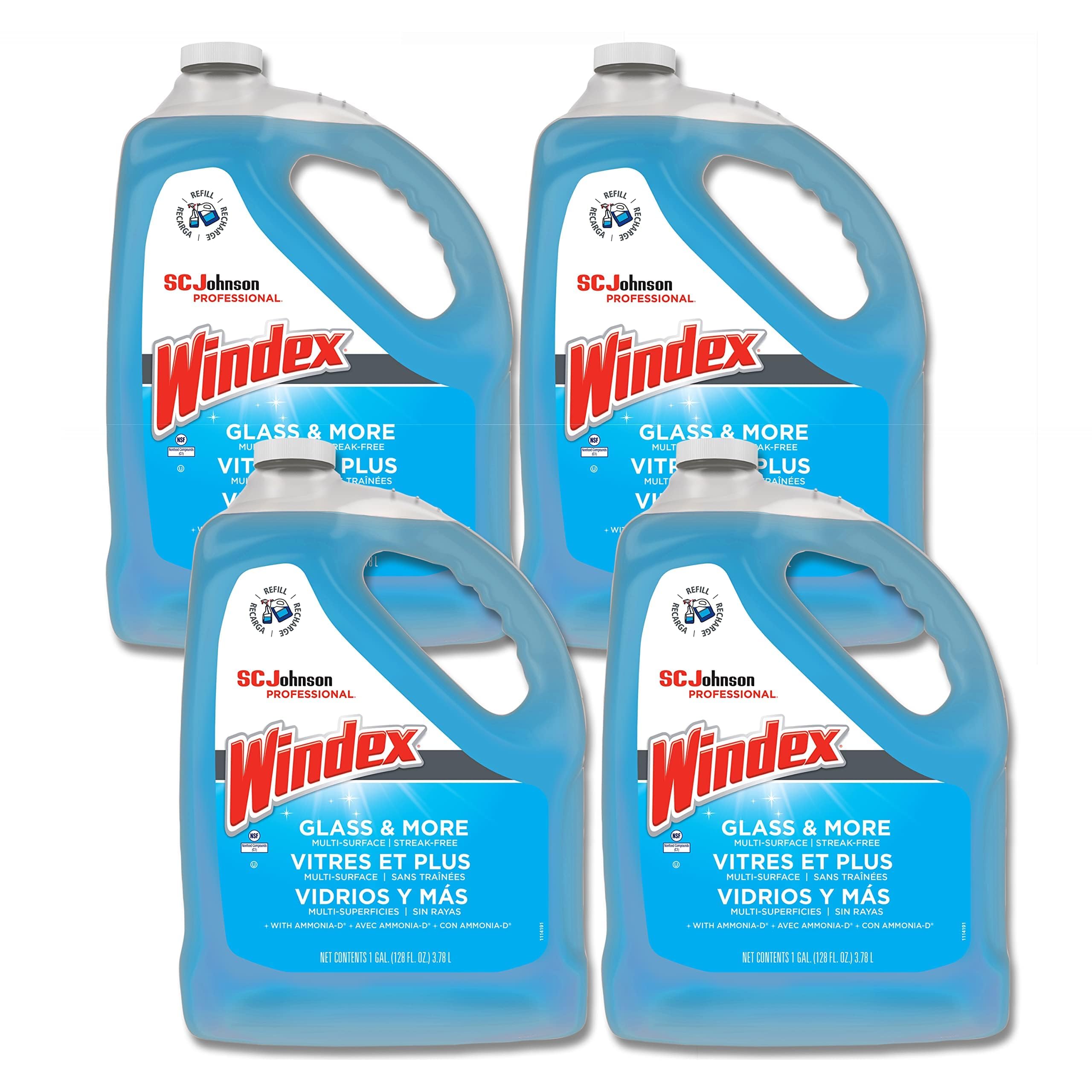
Four ready-to-use gallons of the most recognized name in window cleaning.
Windex is the brand that everyone knows, and this commercial pack gives you four 128-ounce ready-to-use bottles that do not require any mixing. If you are cleaning a restaurant, retail store, or small office and you want to hand a bottle to a staff member with zero instructions, this is your cleanest workflow. Unlike the concentrates above that demand a measuring cup and a marking pen, these are ready to spray straight onto glass, chrome, porcelain, ceramic tile, Formica counters, vinyl, tabletops, and mirrors.
The formula starts working on dirt and grime even before you wipe — so you can spray, let it sit for a second, and pull a squeegee. It is also tested against Plexiglas MC and G-Grade acrylic sheet, making it a safe option for multi-surface commercial cleaning. At 8.72 pounds for the entire case, it is the lightest total weight here (the Zep case is 4.1x heavier at 35.7 pounds) and the dimensions of 16 x 11.79 x 12.31 inches stack neatly under a cart or shelf. The trade-off is that you are paying for water — four gallons of ready-to-use product is much less cleaning volume than a concentrate that makes 32 or 512 gallons. Buyers call it a “great bargin” and note it “lasts long cleans great,” but for high-volume routes the concentrates stretch far further.
Reviewers consistently rate this pack as a solid, no-think solution for daily cleaning. One professional user notes it is “better for daily cleaning areas so as not to create a super resilient superbug,” implying the product is gentle enough for regular use on surfaces that see a lot of traffic. Another reviewer uses it as a mopping solution, which speaks to its low-residue formulation on floors as well as glass.
Instant Use: This is the can’t-go-wrong choice for small teams or multi-surface cleaning where you do not want to train staff on dilution ratios — just open and spray.
Higher Per-Bottle Cost: You are paying for four gallons of ready-to-use product rather than a concentrate that makes 32 or 512 gallons, so the cost per spray bottle is significantly higher than the alternatives.
Grab and Go: Pick the Windex pack if you want zero-mix convenience and the trusted brand name, especially for light commercial or retail cleaning where carrying a heavy concentrate jug does not make sense.
Not for High Volume: If you refill dozens of spray bottles a week, skip this and grab a concentrate — you will get more cleaner per dollar and less plastic waste.
Understanding the Specs
Concentrate Yield (RTU Gallons)
This tells you how many gallons of ready-to-use cleaner you can make from a single gallon of concentrate. A higher number means you carry less weight and spend less per spray bottle you fill. Glass Gleam 4 delivers 512 gallons, while Zep’s 1:32 ratio gives 32 gallons. If you are running a high-volume crew, chasing the highest yield is the single smartest money move you can make.
Weight and Portability
A gallon of concentrate or ready-to-use cleaner has to travel from your supply shelf to a truck, up stairs, and onto a job site. The Zep case of four jugs weighs 35.7 pounds, which is a serious haul. The Glass Gleam single gallon is just 9 pounds, and the Windex four-pack is 8.72 pounds. If you work alone or carry your supplies by hand, lighter is dramatically better for your back and your pace.
FAQ
How many spray bottles can I fill from a gallon of window cleaner concentrate?
Can I use commercial window cleaner on tinted car windows?
What does RTU mean on a window cleaner label?
Why does my window cleaner leave streaks in direct sunlight?
Is there a difference between residential and commercial window cleaner?
How should I store a gallon of window cleaner concentrate?
Can I mix commercial window cleaner with other chemicals?
What surfaces should I avoid cleaning with commercial window cleaner?
Final Thoughts: The Verdict
For most people, the commercial window cleaner winner is the Glass Gleam 4 because its 512-gallon yield crushes the cost-per-bottle of everything else on the list, it weighs just 9 pounds, and veteran window cleaners confirm it holds up in hot sun and strong wind. If you want a trusted ammonia-free concentrate that comes in four separate jugs for easy distribution, grab the Zep Ammonia Free Concentrate. And for zero-mix, hand-it-to-staff convenience across multiple surfaces, the SC Johnson Professional Windex four-pack is ready to use the moment it arrives.
How We Picked
We do not accept paid placement. Every pick is matched to a real buyer and a real use-case; we do not hands-on test units.
Sources & Methodology
Specifications: manufacturer listings and product documentation. Review insights: verified customer reviews, as of July 2026. Pricing: not shown on this page (it changes often); check the current price via the retailer link.
As an Amazon Associate, WellFizz earns from qualifying purchases. This does not affect which products we feature.
Related Guides

Mo Maruf
I created WellFizz to bridge the gap between vague wellness advice and actionable solutions. My mission is simple: to decode the research and give you practical tools you can actually use.
Beyond the data, I am a passionate traveler. I believe that stepping away from the screen to explore new environments is essential for mental clarity and physical vitality.