Our readers keep the lights on and my smoothie glass nicely filled. As an Amazon Associate, I earn from qualifying purchases.
Specs are compiled from manufacturer listings and verified buyer reviews and can change over time — please confirm the key details on the product page before buying.
If you run a restaurant, office, or small business, buying bottled water gets expensive fast — and the storage hassle never ends. Many commercial water filtration systems connect directly to your main line, while others are installed under a sink for point-of-use filtration. Either way, every tap delivers clean, great-tasting water on demand without the plastic waste or delivery schedule. The trick is picking one that matches your daily volume, the contaminants in your source water, and the space you have to install it.
I’m Mohammad Maruf — the founder and writer behind WellFizz. This guide is built by comparing the manufacturers’ published specifications and the patterns across verified customer reviews, so you get each pick’s real strengths and trade-offs instead of marketing spin.
Whether you are outfitting a coffee shop or a whole office, this roundup of the best commercial water filtration system breaks down nine top contenders by flow rate, filter capacity, and what real-world owners actually experience after installation.
Our Picks at a Glance


How To Choose The Best Commercial Water Filtration System
Picking the wrong system usually means one of two problems: the water trickles out too slowly during a lunch rush, or the filters clog up in a few weeks because they were not designed for your specific contaminant. Here is what actually matters when comparing them.
Flow Rate — How Much Water You Need Per Minute
This is the single number that decides if a system can handle your peak demand. A high-flow unit pushing 15 to 24 gallons per minute (GPM) will keep multiple faucets, an ice machine, and a dishwasher all running at once. A smaller under-sink RO system with a 0.7 GPM flow rate is perfect for a single drinking-water tap but will frustrate anyone trying to fill a pot quickly. Match the system’s GPM to your busiest hour, not your average day.
Filter Capacity and Lifespan
Capacity is measured in total gallons the filter can process before it needs replacing. A 100,000-gallon cartridge might last a family a full year, but a busy cafe could burn through it in months. Check the filter life cycle (often listed as 6 to 12 months or a specific gallon rating) and multiply by the price of a replacement set. The cheapest system upfront can cost far more over time if its proprietary filters are expensive.
Contaminant Removal — Know Your Source Water
City water typically needs chlorine, sediment, and taste/odor reduction. Well water often requires iron, manganese, and bacteria removal — which may call for a UV light stage that plain carbon filters cannot provide. If you care about Total Dissolved Solids (TDS) like calcium and fluoride, you need a reverse osmosis (RO) system, not a standard whole-house filter. The unit’s third-party certifications (NSF/ANSI standards) tell you exactly what it has been tested to remove.
Installation and Footprint
Freestanding systems with a metal frame take up floor space (often 30 inches tall or more) but are easier to service. Under-sink units save floor space but need cabinet clearance and sometimes two drilled holes for the faucet and drain. A system with 1-inch inlet/outlet ports will maintain higher flow rates than a model with smaller plumbing. Always confirm the port size matches your existing pipes.
Quick Comparison
| Model | Best For | Flow Rate | Filter Capacity | Weight | Amazon |
|---|---|---|---|---|---|
| iSpring WGB22B-PB★ Best Overall | Whole-House Chlorine & Odor | 15 GPM | 100,000 gal | 29.8 lbs | Amazon |
| Express Water WH300SCKPCompact Pick | Heavy Metal & Scale Protection | 17 GPM | 100,000 gal | 63 lbs | Amazon |
| Waterdrop WHF3T-FGWell Water Specialist | Well Water Iron & Manganese | 15 GPM | 100,000 gal | 49 lbs | Amazon |
| Everpure EF-3000 | Under-Sink Drinking Water | 2.5 GPM | 3,000 gal | 4 lbs | Amazon |
| Ecoviva RO800G | High-Volume RO Drinking Water | 0.54 GPM | 800 GPD | 22.4 lbs | Amazon |
| Bluonics 24 GPM UV | Whole-House UV Bacteria Kill | 24 GPM | — | 16 lbs | Amazon |
| Bluonics UV + Sediment + Carbon | Well Water Bacteria & Sediment | 12 GPM | — | 49 lbs | Amazon |
| iSpring CRO1000 | Heavy-Duty Commercial RO | 0.7 GPM | 1,000 GPD | 20.5 lbs | Amazon |
| Aquasure Signature Series | Water Softening + Filtration | — | 600,000 gal | 67 lbs | Amazon |
In‑Depth Reviews
1. iSpring WGB22B-PB
Our pick — over 4.5★ from 800+ verified ratings; the strongest balance of quality and price.
The crowd-favorite whole-house filter that fixes chlorine smell and itchy skin in one install.
You get clean water without losing healthy minerals, thanks to a 2-stage system that uses a coconut-shell carbon block and a lead-reducing filter to remove chlorine, taste, and odor. The 15 GPM (gallons per minute) flow rate and 1-inch inlet/outlet ports keep water pressure steady across the whole building. Each filter handles 100,000 gallons, so a family can go a full year between changes — among the most economical picks for homes and light commercial use.
Owners across many reviews report immediate results: the bleach-like smell from city water disappears, dry skin and hair improve noticeably, and the water becomes clear and drinkable straight from the tap. The included braided lines with ball valves add roughly in value, and the head unit comes pre-assembled so installation is largely DIY-friendly. The catch is the non-tapered ports on the bracket — they need extra Teflon tape (buyers recommend 10 wraps plus pipe dope) to get a leak-free seal.
At 29.8 pounds and a 16 x 8 x 28 inch footprint, it is manageable for a single person to mount against a wall. If you have heavily chlorinated city water and want to tackle it at the main line, this is the system the owner community trusts most.
What Wins People Over
- Eliminates chlorine taste and odor from every tap immediately
- High 15 GPM flow rate means no pressure drop during peak use
- 100,000-gallon filter capacity keeps replacement costs low
The One Gotcha
- Non-tapered bracket ports require extra Teflon tape or pipe dope to seal
Reach for this if: you need a straightforward, high-capacity whole-house system for city water with chlorine issues and want DIY-friendly maintenance.
Think twice if: your water has high iron, manganese, or bacteria levels — this 2-stage carbon setup is not designed for those contaminants.
2. Express Water WH300SCKP
A freestanding 3-stage workhorse that fights heavy metals, scale, and chlorine at 17 GPM.
The Express Water ULTIMATE PROTECTION system is designed for homes and small businesses that want a serious barrier against lead, arsenic, chromium, and scale buildup. Its three-stage process — sediment, carbon, and anti-scale — runs at 17 gallons per minute, beating the iSpring’s flow rate slightly while handling a wider range of heavy metals. The stainless steel frame and three built-in pressure gauges make it easy to monitor performance at a glance.
The real win here is the anti-scale stage. Laboratory-packed polyphosphate works inside the filter to prevent lime scale from forming in pipes, water heaters, and dishwashers — which can save thousands in appliance repairs over the long run. Buyers report that the taste and smell of chlorine vanishes immediately after install, and many note their TDS levels dropped significantly (one measurement went from 330 to 40). The trade-off is weight: at 63 pounds and a 29 x 8.5 x 30 inch frame, this is not a solo wall-mount job. It sits on its own stand, which simplifies placement but demands floor space.
Customer service gets high marks here too — multiple incidents of a faulty filter being replaced free of charge, even after months of use. If heavy metals are a known concern in your water report, this system is purpose-built for that threat.
Best Applied Use: Whole-home defense against lead, arsenic, and chromium where chlorine taste and scale are also present. The 100,000-gallon filter capacity keeps replacements to about once a year. The catch is that it does not reduce TDS — if you need pure RO water, Express Water recommends pairing it with one of their RO systems.
Choose it for: heavy metal protection and scale prevention in a mid-size home or office.
skip it if: your space cannot accommodate a 63-pound freestanding unit or you need dissolved-solids removal from the same system.
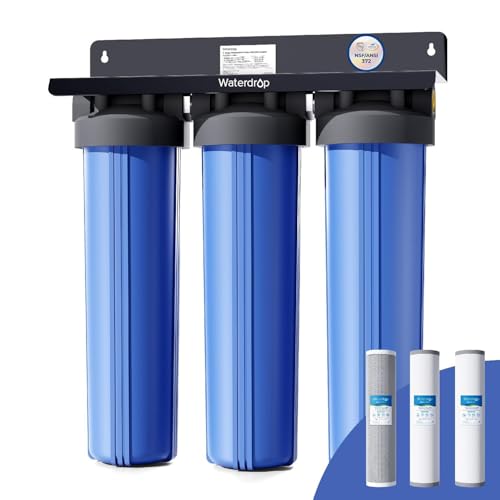
3. Waterdrop WHF3T-FG
A 3-stage system with dual iron/manganese cartridges that actually solves brown-stain well water.
The Waterdrop WHF3T-FG is a 3-stage whole-house filter that packs a 7-stage filtration process into its three canisters, focusing heavily on iron and manganese removal — two of the most common and stubborn well-water problems. SGS testing confirms it reduces iron by 95.9% and manganese by 99.7%, which translates to no more rust-colored stains in sinks, toilets, and laundry. At 15 GPM and 100,000 gallons of capacity, it competes directly with the iSpring on flow but targets a very different contaminant profile.
Owners switching from well water report a night-and-day difference: brown iron stains that required weekly cleaning now only need monthly attention. The water becomes clear, the metallic sulfur smell disappears, and the taste improves enough to drink straight from the tap. The system uses a double iron/manganese removal cartridge combined with a GAC filter, and the expected life is 6 to 12 months for the iron filter and 12 months for the GAC. The unit is noticeably heavier than the iSpring at 49 pounds, and its 22.9 x 8.46 x 26.1 inch dimensions require a sturdy wall mount.
The main installation quirk — multiple owners mention needing a 2-inch copper nipple for leak-free connections that is not included — so plan a quick hardware store run before starting. Once running, the improvement in water quality is immediate and dramatic.
What Owners Rave About
- Nearly eliminates iron stains and sulfur odor from well water within days
- Solid build quality with SGS certification for lead-free materials
- High 15 GPM flow rate supports a whole house without pressure loss
Installation Note
- Requires an additional 2-inch copper nipple for a leak-free connection — not included in the box
Ideal for: well water with high iron, manganese, and hydrogen sulfide odor that leaves brown stains on fixtures.
Not for: city water that primarily needs chlorine reduction — the iSpring is a simpler, cheaper fit for that.
4. iSpring CRO1000

A true commercial RO system that pumps 1,000 gallons per day for restaurants and labs.
The iSpring CRO1000 is built for businesses that cannot wait for water — coffee shops, bars, tea houses, and light industrial settings. It produces 1,000 gallons per day with a flow rate of 0.7 GPM (gallons per minute), and its tankless design means it only filters water when you open the tap, avoiding the stale taste of stored RO (reverse osmosis) water. The 4-stage process uses commercial-grade 20 x 4.5 inch filters: a PP (polypropylene) sediment filter with a transparent housing (so you can see when it is dirty), two carbon block filters, and a 1,000 GPD (gallons per day) RO membrane in a stainless steel housing.
The system rolls on a freestanding metal frame with locking brakes, making it easy to move for maintenance. Built-in inlet and outlet pressure gauges let you monitor the system at a glance — iSpring recommends an optional booster pump if your incoming water pressure is below 80 psi. The consensus across many owner reports is that water flow is the standout feature (it is the single most-discussed positive), with the unit reliably producing crisp-tasting RO water without the storage tank. Replacement filters for stages 1 through 3 should be swapped every 3 to 12 months depending on usage, while the RO membrane lasts 2 to 3 years.
A few owners note that shipping damage to connectors happens occasionally, and the included manual can be unclear on tube sizes. Still, the overwhelming majority call it a workhorse that handles high demand without a hiccup.
Perfect for: a coffee shop or office that needs continuous, on-demand RO water without a storage tank. The 20.5-pound weight and wheels make it the most mobile commercial RO system here. The catch is that the 0.7 GPM flow rate is fine for filling a carafe or glass but not for filling a large sink.
Grab it for: a point-of-use RO system that can keep up with a busy cafe or small restaurant kitchen.
Look elsewhere if: you need whole-house filtration or your business demand exceeds 1,000 gallons per day.
5. Bluonics UV + Sediment + Carbon (B0BSKLH3KD)
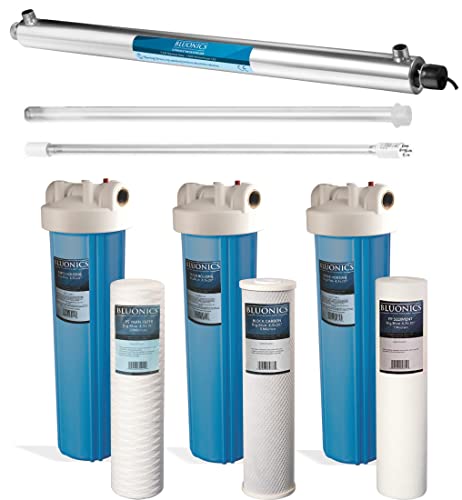
A four-stage system combining sediment, carbon, and dual-bulb UV to tackle well-water bacteria.
This Bluonics system is a 4-stage solution specifically engineered for well water that carries bacteria along with sediment and chlorine. Stage 1 uses a 20-micron (a micron is one-millionth of a meter) string-wound sediment filter to catch sand and silt, Stage 2 is a 5-micron carbon block for chlorine and odor, Stage 3 is a finer 1-micron sediment filter, and Stage 4 is a 55W (watt) UV (ultraviolet) light with a rare dual-bulb design — two 55W bulbs means the system keeps working even if one bulb weakens, and you get a built-in backup. At 12 GPM, the flow rate is lower than the single UV unit below, but the multi-stage pre-filtration ensures the UV chamber gets clear water, which is critical for disinfection effectiveness.
Annual maintenance runs below, which beats the quotes some owners received from water treatment companies for equivalent results. If bacteria is your primary concern and you have the space for three tall canisters plus the UV chamber, this is a smart, self-contained solution.
What Makes It Unique
- Dual 55W UV bulbs provide backup sterilization and longer effective life
- 4-stage graduated filtration clears water before UV exposure for maximum bacteria kill
- Costs a fraction of pro-installed alternatives with similar results
What to Watch
- Filter housing threads require heavy Teflon tape and putty to prevent leaks
Best if: you have well water with confirmed bacteria and want a UV system that also handles sediment and chlorine in one package.
Pass if: you only need carbon filtration — the UV stage is unnecessary overhead for clean city water.
6. Bluonics 24 GPM UV System (B06XQS3X89)
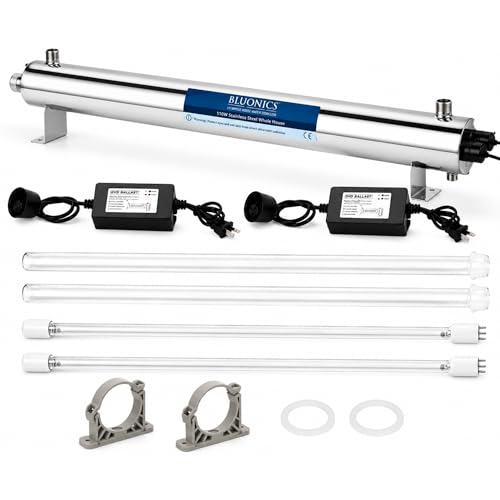
A 110W UV system that blasts 24 gallons per minute — the highest flow rate in this roundup.
If your primary water quality issue is biological (bacteria, viruses, cysts) and you need to treat water for an entire large home or a light commercial building, this Bluonics unit is the flow-rate king. It hits 24 GPM with a 110W UV lamp inside a stainless steel chamber, using 1-inch NPT connections. The kit includes two electronic ballasts — one for continuous operation and a backup — along with two UV lamps, two quartz sleeves, and four O-rings. The LED indicator and audible alarm tell you at a glance if the lamp is running or needs attention.
The big trade-off is that this is a UV-only system. It does not include sediment or carbon pre-filtration, so cloudy water will reduce the UV’s effectiveness. If your water has visible sediment, you will need to add a separate pre-filter before this unit. Owners mention successful DIY installation with basic plumbing knowledge, though the overall satisfaction split is the widest in the list: roughly half praise the build quality and value, while the other half report repeated failures — cracked quartz sleeves, leaking end caps, and ballast burnout. The durability feedback is genuinely mixed, with several owners noting that bulbs lasted only 3 months.
If you go this route, buy spare bulbs at the same time and consider adding a sediment pre-filter regardless of your water source. It is a powerful tool for the right situation, but not one to install and forget.
High-flow specialist: the 24 GPM capacity is class-leading in this list, making it suitable for large commercial kitchens or multi-unit buildings. The included backup ballast is thoughtful, but the mixed durability reviews suggest keeping a close eye on the quartz sleeve and bulb after installation.
Choose it when: your water is biologically unsafe but already clear — no sediment, no heavy metals — and you need high flow to serve many taps.
Skip it when: your water has visible sediment or you want a single-box solution; you will need to add pre-filtration separately.
7. Ecoviva RO800G
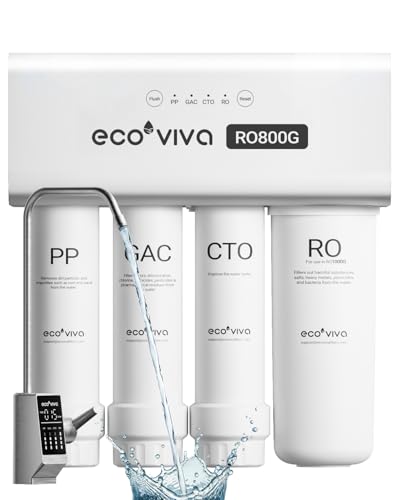
A German-designed, tankless 9-stage RO system with an alkaline boost and a smart faucet.
The Ecoviva RO800G brings true commercial-grade RO performance (800 gallons per day at 0.54 GPM) in a compact under-sink package (18.8 x 17.1 x 6.5 inches). what separates it is the 9-stage filtration process, which includes an alkaline boost filter that adds healthy minerals back into the water after RO purification. The 3:1 pure-to-drain ratio means it wastes significantly less water than traditional RO systems, and the stainless steel smart LED faucet displays real-time TDS (total dissolved solids) and filter life — no guessing when to change cartridges.
The system is certified under NSF/ANSI 58, 53, 42, 61, and 372, and the manufacturer claims it removes 99% of over 1,000 contaminants including PFAS, lead, arsenic, and fluoride. The fully sealed German-engineered design keeps vibration and noise low, which matters in a quiet office breakroom. A few early customers note minor leaking at connection points that was hard to resolve because customer service is AI-driven rather than human. Replacement filters are proprietary and cost roughly per set, so factor that into your long-term budget.
For a small office, coffee shop, or tea house that wants great-tasting alkaline water on demand, this is a strong competitor to the iSpring CRO1000 — just with a slightly lower daily output and a much smaller footprint.
Standout Features
- 9-stage filtration with alkaline remineralization for improved taste
- 3:1 pure-to-drain ratio wastes much less water than standard RO
- Smart faucet shows TDS and filter life in real time
Considerations
- Proprietary replacement filters cost around per set
- Customer support is AI-driven, not human, which frustrates owners with leaks
Reach for this if: you want a tankless under-sink RO with alkaline water output and modern monitoring in a compact commercial space.
Think twice if: you prefer human customer support or you want standard-size filters that any hardware store stocks.
8. Everpure EF-3000

A commercial-grade under-sink drinking water system with a metal canister and 0.5-micron filtration.
The Everpure EF-3000 is a focused drinking water system designed for the kitchen, prep sink, pot filler, wet bar, or ice maker. Its commercial-grade metal canister protects the filter from splitting or bursting under pressure — a serious advantage over plastic-housing systems in high-traffic environments. The system reduces particles as small as 0.5 microns by mechanical means and helps prevent lime and scale buildup in water-using appliances. At just 4 pounds and 3 x 4 x 16 inches, it is the smallest and lightest unit here, fitting easily into tight under-sink spaces.
The flow rate of 2.5 GPM is faster than typical under-sink RO systems but much slower than the whole-house units — it is perfect for filling a drinking glass or coffee carafe, not for running a dishwasher simultaneously. The 3,000-gallon filter capacity is a fraction of the 100,000-gallon whole-house systems; that is because it is designed solely for a single tap, not the whole building.
Most owners praise the easy installation, great water taste, and reasonable price point. However, there are isolated but very serious reports of the valve or canister failing within hours of professional installation, causing an overnight leak that flooded the unit and the neighbor’s unit below. That is a low-incidence event (the small sample size makes it hard to gauge frequency), but it is the kind of failure that matters in a commercial setting. If you buy this, add a flood alarm under the sink as cheap insurance.
Focused solution: the EF-3000 excels as a dedicated drinking water tap with excellent flow for its size. The metal canister is a genuine durability upgrade over plastic competitors. The capacity is 3000 gallons versus 100000 gallons on the whole-house systems, so budget for more frequent cartridge changes.
Best for: a single sink, prep station, or ice maker that needs commercial-grade durability in a small footprint.
Not for: whole-house or high-volume applications — the 2.5 GPM flow rate cannot keep multiple taps running.
9. Aquasure Signature Series AS-SE600A

A professional-grade water softener and filter combo that treats up to 600,000 gallons for 1-2 bathrooms.
The Aquasure Signature Series is different from every other system on this list — it is a water softener first, with integrated filtration. It uses a digital metered control head that automatically regenerates based on actual water usage, so you never run out of soft water or waste salt on unnecessary cycles. The system treats up to 32,000 grains of hardness and delivers a total capacity of 600,000 gallons, which is the highest capacity in this roundup by a wide margin. It is designed for homes with 1-2 bathrooms or small commercial spaces that need soft water for appliances, skin, and hair.
The filtration side uses KDF media to reduce chlorine, VOCs, pesticides, bad odors, sediment, and heavy metals, while the resin tank strips out calcium and magnesium that cause hard-water scale. Reviewers point out dramatic improvements: hard-water crust on fixtures disappears, dishes and laundry come out cleaner, and skin feels noticeably less dry after showering. The digital control head means no manual timers or programming headaches — set the hardness level and the system handles the rest. The fiberglass-lined polyethylene tank resists corrosion, and Aquasure backs it with free lifetime US-based tech support and a 5-year extended warranty (if you activate online within 60 days).
The big installation note is that the backwash cycle is manual by default — a few owners flooded their basements during the learning curve before they bought the automation upgrade part. At 67 pounds and 57 inches tall, it also requires a dedicated floor space and solid plumbing connections (1-inch high-flow threaded ports). If your primary problem is hard water scale rather than bacteria or heavy metals, this is the most complete single-box treatment available.
Why It Stands Out
- Combines whole-house filtration with a 32,000-grain water softener in one unit
- Digital metered control regenerates based on actual use, saving salt and water
- 600,000-gallon total capacity is the highest in this list
Installation Reality
- Backwash cycle is manual by default — consider the automation upgrade to avoid flood risk
Perfect for: a small business or 1-2 bathroom home that wants soft water plus filtration in one automated system with huge capacity.
Not for: anyone who only needs carbon filtration or UV sterilization and does not want a tall 57-inch tank.
Understanding the Specs
Flow Rate (GPM)
Gallons Per Minute tells you how much water the system can process at once. A whole-house system with 15 to 24 GPM can serve multiple sinks, an ice machine, and a dishwasher simultaneously without a noticeable pressure drop. A drinking-water RO system at 0.5 to 0.7 GPM is fine for a single tap but will frustrate you if you try to fill a large pot quickly. Match the GPM to your busiest moment, not your average flow.
Filter Capacity (Gallons)
This is the total amount of water a single set of filter cartridges can treat before replacement is needed. A 100,000-gallon capacity might last a family a full year, while a 3,000-gallon under-sink filter would need changing every few months in heavy use. Do not compare capacity numbers across different filter types — a 3,000-gallon RO membrane and a 100,000-gallon sediment filter are doing completely different jobs.
Micron Rating
Microns measure the size of particles the filter can catch. A 20-micron sediment filter catches visible sand and rust. A 5-micron carbon block catches finer sediment and some cysts. A 0.5-micron filter (like the Everpure EF-3000) catches even smaller particles including some bacteria. Lower micron numbers mean finer filtration but also more resistance to flow, so the system needs sufficient pressure to push water through.
NSF/ANSI Certification
Third-party testing that verifies a filter actually reduces the contaminants it claims to reduce. Standard 42 covers aesthetic effects (chlorine taste and odor). Standard 53 covers health-related contaminants (lead, arsenic, VOCs). Standard 58 covers reverse osmosis systems. Standard 372 confirms lead-free materials. A certified system has been independently tested, not just self-labeled by the manufacturer.
FAQ
What is the difference between a whole-house filter and a reverse osmosis system?
Do I need a UV filter for my commercial water system?
How often do I need to replace the filters?
Can I install a commercial water filter myself?
What size filter cartridges should I look for?
Will a water filter system reduce my water pressure?
What is the difference between 1-inch and 3/4-inch ports?
Can I use a system designed for well water on city water?
How do I know which contaminants are in my water?
Final Thoughts: The Verdict
Across the board, the best commercial water filtration system winner is the iSpring WGB22B-PB because it delivers proven chlorine and taste/odor removal at 15 GPM with a 100,000-gallon capacity and straightforward DIY installation. If you need heavy metal protection and anti-scale treatment in a freestanding package, grab the Express Water WH300SCKP. And for well water with iron stains and bacteria worries, the Waterdrop WHF3T-FG or the Bluonics UV combo are the ones to reach for.
How We Picked
We do not accept paid placement. Every pick is matched to a real buyer and a real use-case; we do not hands-on test units.
Sources & Methodology
Specifications: manufacturer listings and product documentation. Review insights: verified customer reviews, as of July 2026. Pricing: not shown on this page (it changes often); check the current price via the retailer link.
As an Amazon Associate, WellFizz earns from qualifying purchases. This does not affect which products we feature.
Related Guides

Mo Maruf
I created WellFizz to bridge the gap between vague wellness advice and actionable solutions. My mission is simple: to decode the research and give you practical tools you can actually use.
Beyond the data, I am a passionate traveler. I believe that stepping away from the screen to explore new environments is essential for mental clarity and physical vitality.