Our readers keep the lights on and my smoothie glass nicely filled. As an Amazon Associate, I earn from qualifying purchases.
Specs are compiled from manufacturer listings and verified buyer reviews and can change over time — please confirm the key details on the product page before buying.
Vacuuming a concrete floor is a different job than cleaning a carpet. Concrete throws off fine silica dust, heavy grit, and sometimes standing water — and a standard home vacuum chokes on all three. This guide breaks down the three real options that are built for that punishment, what each one actually costs in weight, setup, and maintenance, and which one suits your daily work.
I’m Mohammad Maruf — the founder and writer behind WellFizz. This guide is built by comparing the manufacturers’ published specifications and the patterns across verified customer reviews, so you get each pick’s real strengths and trade-offs instead of marketing spin.
Whether you are grinding, stripping, or just keeping a warehouse clean, these are the models that handle the dust, the water, and the abuse without slowing you down. Here is the straight read on the commercial vacuum for concrete floors.
Quick Picks
- Bosch GAS20-17AH 17-Gallon Dust Extractor — Best Overall
- ProTeam ProGuard 20 20-Gallon Commercial Wet Dry Vacuum — Strip & Squeegee
- Sanitaire Tradition Upright SC886G Commercial Vacuum — Budget Champion
How To Choose The Best Commercial Vacuum For Concrete Floors
Picking the wrong machine for concrete is expensive twice — once at checkout and again when it clogs or blows dust everywhere. Here are the three decisions that determine whether a vacuum will do the job or leave you frustrated.
Filtration is the first gate
Concrete grinding and cutting produce silica dust, a serious fine particle. A standard shop vac with a cloth filter will let that dust pass right back into the air. You need a HEPA filter (a high-efficiency filter that traps 99.97% of particles as small as 0.3 microns) to keep the air clean and comply with OSHA silica dust rules. A vacuum without HEPA is a liability on a concrete jobsite.
CFM beats horsepower on concrete
Horsepower ratings are often misleading because they are measured at the motor, not at the hose. CFM (cubic feet per minute) tells you the actual volume of air the machine moves — that is what sucks up heavy debris like grit, pebbles, and slurry. Look for at least 150 CFM for light cleanup, and 300 CFM or more for connecting to a grinder or sander.
Auto filter cleaning keeps you working
Fine concrete dust clogs a filter fast. On standard vacs, you stop every 10 to 15 minutes to knock the filter clean. Machines with an automatic filter cleaning system — which shakes or pulses the filter every few seconds — let you work continuously without that interruption. If you are grinding a large floor, this feature alone saves an hour or more per day.
Quick Comparison
| Model | Best For | Type | CFM / Power | Weight | Amazon |
|---|---|---|---|---|---|
| Sanitaire Tradition SC886G | Upright dry debris on concrete + carpet | Upright Bagged | N/A (Extended Life Motor) | 15.8 lbs | Amazon |
| ProTeam ProGuard 20 | Wet stripping / large area liquid pickup | Wet/Dry Canister | 11.5 Amps | — | Amazon |
| Bosch GAS20-17AH | Concrete grinder dust extraction | HEPA Dust Extractor | 300 CFM / 17.5 Amp motor | 39 lbs | Amazon |
In‑Depth Reviews
1. Bosch GAS20-17AH 17-Gallon Dust Extractor with Auto Filter Clean
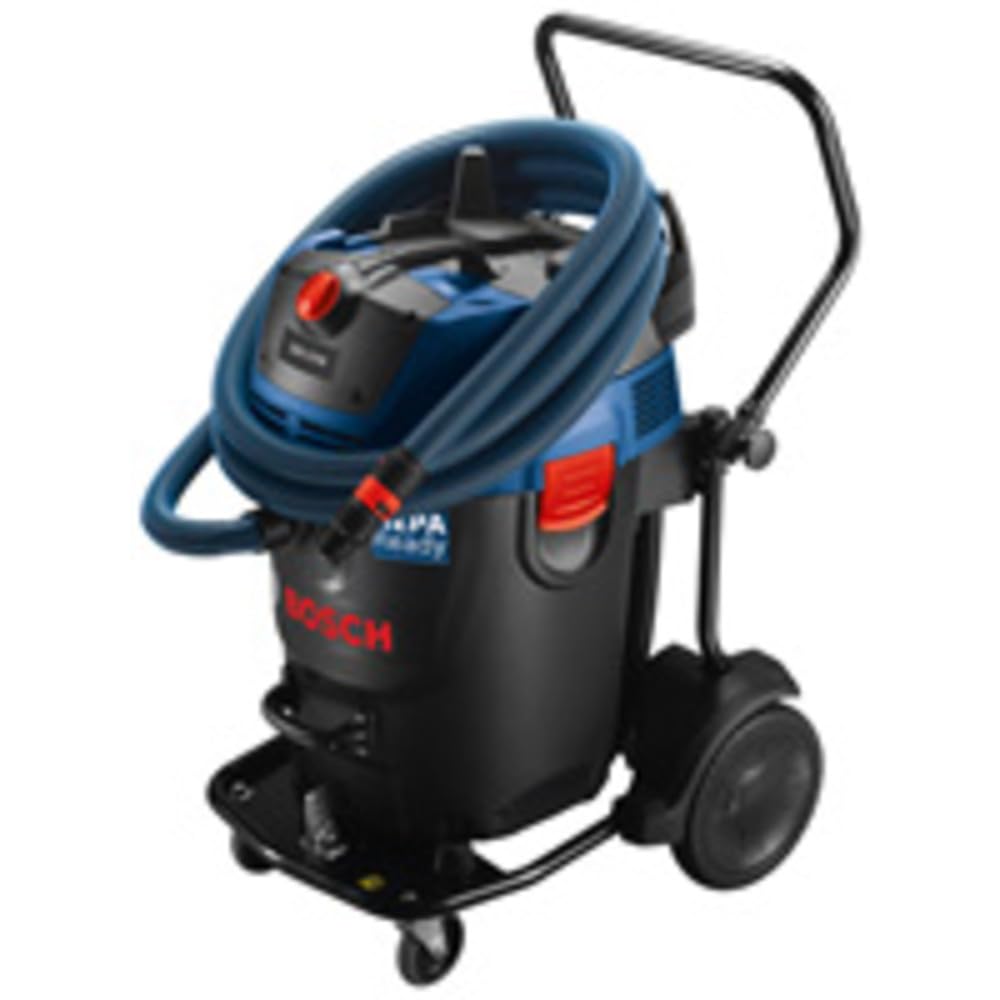
The 39-pound workhorse that ties directly to a concrete grinder and tries to stay ahead of OSHA rules.
This is the one you buy when the job involves active grinding, cutting, or chasing silica dust compliance. The Bosch GAS20-17AH moves 300 CFM (cubic feet per minute of air) through a 13-foot anti-static hose — enough airflow to pull dust directly from a grinder shroud before it hits the room air. Its HEPA filter (a high-efficiency barrier that catches 99.97% of particles at 0.3 microns or larger) gives you a real path toward OSHA silica dust compliance, which is a legal requirement on many commercial concrete jobs now.
The automatic filter cleaning system pulses the filter every 15 seconds, so suction stays consistent even when you are grinding for hours — you do not stop to knock the filter. This machine is 39 pounds, more than twice the weight of the Sanitaire upright below, and that extra heft comes from the wheeled steel frame and metal castors (wheels designed for rugged job site durability). Buyers report it “is working good with concrete grinder” directly, which is exactly the use case here. The catch is the 17-gallon capacity fills fast with heavy debris, and owners note that replacement filter bags are expensive — a real operating cost if you are doing daily production work.
Designed for Grinders
- 300 CFM airflow connects to concrete grinders for direct dust capture
- HEPA filter traps 99.97% of 0.3-micron particles for silica dust compliance
- Auto filter clean every 15 seconds keeps suction strong without stopping
- Wheeled metal frame with dumping mechanism and metal castors for job site abuse
Operating Costs
- 39 lbs is noticeably heavier than the Sanitaire’s 15.8 lbs — a 2.5x weight gap
- 17-gallon capacity fills quickly with heavy concrete debris
- Replacement bags and HEPA filters are expensive, per owners
- Limited 1-year warranty on a premium-priced machine
Grab it for: concrete grinding, cutting, and any silica-generating task where compliance and continuous suction are non-negotiable.
Look elsewhere if: you only need dry debris cleanup or wet pickup on a finished floor — lighter options cost less and are easier to move.
2. ProTeam ProGuard 20 20-Gallon Commercial Wet Dry Vacuum with Squeegee

The wide-squeegee tank that turns stripping wax on concrete from a slow mess into a single-pass job.
If your concrete floor work is about stripping old wax, picking up standing water, or flood cleanup rather than grinding, this is the tool. The ProTeam ProGuard 20 has a front-mounted squeegee that is 41 inches wide across the full vacuum path — you push it straight forward and the water or chemical solution gets sucked up in one pass. The 20-gallon drum (stainless steel) handles large liquid volumes without needing to stop and empty constantly.
One buyer reports the vac “SIGNIFICANTLY CUTS STRIP/WAX TIME IN HALF!” — and that matches the design: the 50-foot power cord and 10-foot hose let you cover a lot of floor without replugging. The tip-and-pour drain port at the bottom means you do not have to lift a full 20-gallon tank to dump it. The trade-off is in assembly and build: reviewers mention that the unit is 100% plastic with many parts to put together, and one unit arrived with a bent wheel pole. It is not designed to connect to a concrete grinder — this is a surface cleanup machine for already-laid floors.
Liquid Handling
- Front mount squeegee strips and picks up water in a single forward pass
- 20-gallon drum with tip-and-pour drain port for easy emptying
- 11.5-amp motor provides strong suction for liquid recovery
- 50-foot cord and 10-foot hose reduce plug changes on big floors
Build Concerns
- 100% plastic construction feels less durable than the Bosch metal-frame unit
- Requires significant assembly with many parts to attach
- Quality control on packaging and wheels has been inconsistent per buyers
- Not designed for grinder dust extraction — no HEPA or auto filter clean
Choose this for: fast wet stripping, flood cleanup, and liquid pickup on large concrete surfaces where speed matters more than fine dust control.
Pass if: you primarily grind concrete or need OSHA-compliant silica capture — this vac does not have the filter to handle fine dry dust
3. Sanitaire Tradition Upright SC886G Commercial Vacuum
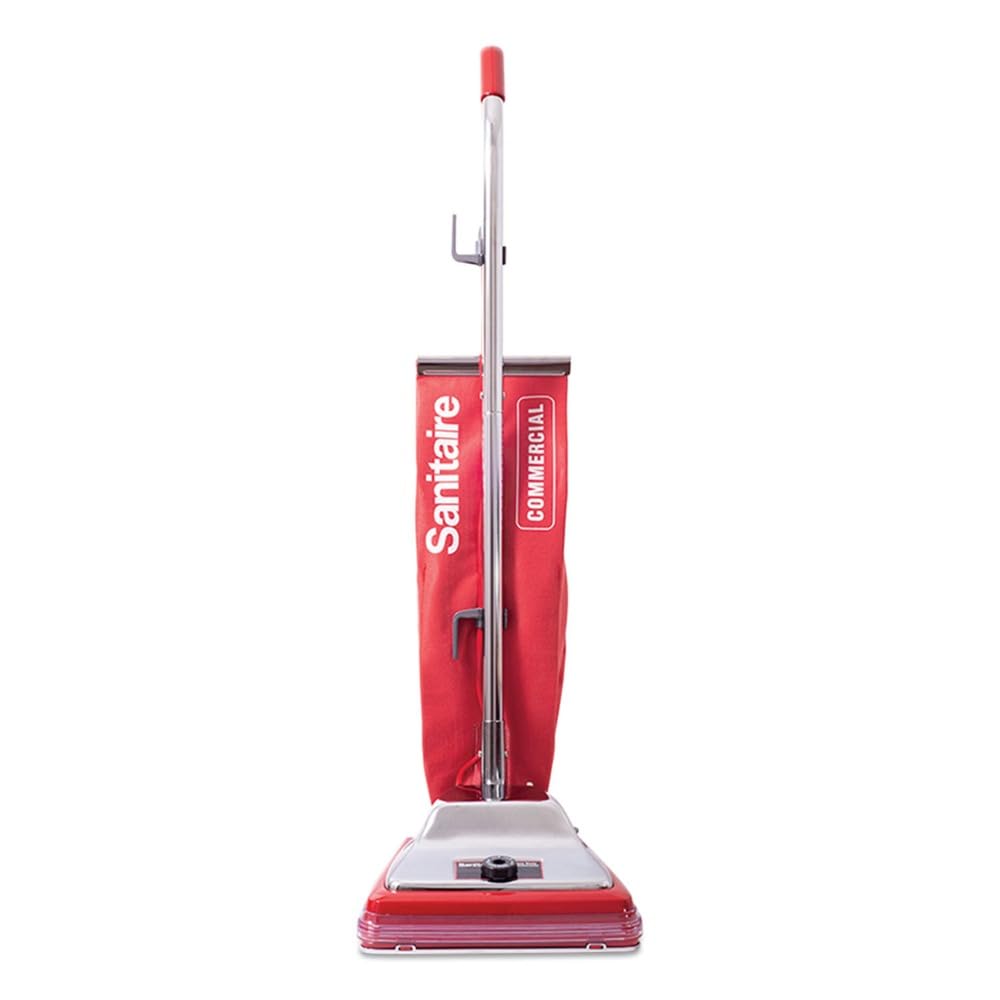
The featherlight upright that is half the weight of the Bosch but strictly a dry-floor machine.
Not every concrete job involves water and grinders. If your concrete floor is in a workshop, warehouse, or basement where the task is dry sawdust, dirt, and debris, this Sanitaire upright saves you a lot of weight and money. At 15.8 pounds, it is a fraction of the 39-pound Bosch — a 2.5x gap — and its 17.3 by 8.5-inch footprint is smaller than the ProTeam’s 41-inch width, so it tucks into tight corners easily.
You get a 50-foot power cord (a cleaning reach of up to 7,800 sq. ft. before switching plugs) and an 18-quart bag that handles a lot of dry debris. The Extended Life Motor is rated for more than 2,000 hours of commercial use — five times the motor life of a typical household vacuum. One buyer mentions using it “in my basement area that is half workshop (concrete floor) and half carpet” to drag sawdust off concrete without losing suction. The catch is that the brush roller cannot be turned off, so it is not safe for bare concrete if you care about scratching — and there is no HEPA filter for fine silica, so you want a dust mask for bag changes.
Light & Maneuverable
- 15.8 lbs and compact 17.3″ x 8.5″ footprint is easy to carry between job sites
- 50-foot cord covers up to 7,800 sq. ft. without replugging
- 2,000-hour motor life is five times longer than a household vacuum
- Tool-free brush roll and belt replacement for quick maintenance
Dry Only / No HEPA
- Brush roller does not turn off — not ideal for bare concrete (risk of scratching)
- No HEPA filter — fine silica dust can pass through during use or bag changes
- Bagged design means buying and replacing paper bags regularly
- Not designed for wet pickup or connection to power tools
Best for: light commercial dry sweeping on concrete where you need to maneuver around furniture, tools, or between concrete and carpet areas.
skip it if: you grind concrete, need wet pickup, or require HEPA filtration for silica — this is not that tool
Understanding the Specs
CFM (Cubic Feet per Minute)
CFM is the actual volume of air the vacuum moves through the hose. This matters more on concrete than motor amps because heavy debris like grit and grinding dust needs airflow, not just static suction. A unit that claims 300 CFM, like the Bosch, can pull debris from a grinder shroud. A vacuum listed only by amperage (like the ProTeam at 11.5 amps) may move less air in practice.
HEPA Filtration and Silica Dust
HEPA (High-Efficiency Particulate Air) filters trap at least 99.97% of particles at 0.3 microns. Concrete grinding creates crystalline silica particles that are smaller than the dust from drywall or wood. Without a HEPA filter, those particles blow straight back into the air you breathe. The Bosch’s three-layer filter bag and HEPA cartridge are designed specifically for this, while the Sanitaire’s bag-only system does not seal fine dust.
FAQ
Will a regular shop vac work on concrete floors?
What size vacuum do I need for a concrete grinder?
Can I use an upright vacuum on a concrete floor?
What does auto filter cleaning mean?
How do I know if a vacuum is OSHA compliant for silica?
Is a 20-gallon vacuum too big for one person?
Can I pick up water with a dust extractor?
How often do I need to change the filter bag on a concrete vac?
What is the difference between a dust extractor and a shop vac?
Do all commercial vacs work on both wet and dry concrete?
Final Thoughts: The Verdict
For most concrete jobs that involve grinding and dust control, the winner is the Bosch GAS20-17AH because its 300 CFM airflow, HEPA filter, and auto filter cleaning system are the only setup that stays OSHA-relevant and suction-consistent during active grinding. If you are stripping wax or cleaning up water from a flooded concrete floor, grab the ProTeam ProGuard 20 — that front squeegee turns a slow mop-and-bucket job into a single push pass. And if you just need a lightweight dry-vac for a workshop concrete floor without grinding or water, the Sanitaire SC886G gets the job done at a fraction of the weight and cost, with the honest caveat that it cannot handle fine dust or wet messes.
How We Picked
We do not accept paid placement. Every pick is matched to a real buyer and a real use-case; we do not hands-on test units.
Sources & Methodology
Specifications: manufacturer listings and product documentation. Review insights: verified customer reviews, as of July 2026. Pricing: not shown on this page (it changes often); check the current price via the retailer link.
As an Amazon Associate, WellFizz earns from qualifying purchases. This does not affect which products we feature.
Related Guides

Mo Maruf
I created WellFizz to bridge the gap between vague wellness advice and actionable solutions. My mission is simple: to decode the research and give you practical tools you can actually use.
Beyond the data, I am a passionate traveler. I believe that stepping away from the screen to explore new environments is essential for mental clarity and physical vitality.