Our readers keep the lights on and my smoothie glass nicely filled. As an Amazon Associate, I earn from qualifying purchases.
Walking into a bakery with a mixer that strains, overheats, or walks across the counter during a heavy dough batch is a productivity killer you cannot afford. A genuine commercial stand mixer differs from consumer models in motor architecture, gearbox design, and duty cycle — it is built to run batch after batch without thermal shutdown or stripped gears.
I’m Mohammed Maruf — the founder and writer behind WellFizz. I have spent hundreds of hours analyzing motor torque curves, planetary gear systems, bowl-lift mechanisms, and NSF certification requirements so you can pick a machine that actually delivers on its commercial promise.
This guide isolates the machines that survive real bakery output, and it presents the data you need to confidently choose your best commercial stand mixer without guessing which specs actually matter for daily dough production.
How To Choose The Best Commercial Stand Mixer
A commercial stand mixer is a capital investment, not an impulse buy. The three variables you must evaluate before purchase are bowl capacity, motor transmission type, and duty cycle rating. Ignore marketing fluff about “professional looks” — focus on real mechanical specs that dictate whether the unit will handle your daily 50-pound dough load or fail within six months.
Bowl Capacity vs. Batch Size
Capacity is listed in quarts, but the usable volume is roughly 40 to 60 percent of that number for dough — a 20-quart bowl handles about 8 to 12 pounds of bread dough, not 20. If you are mixing multiple batches daily, size up by at least one tier so the motor is not constantly running at max load. An 8-quart bowl works for small-scale pizza shops and pastry kitchens; a 15- to 20-quart bowl fits bakeries producing dozens of loaves per shift.
Motor Power and Gear Drive
Induction motors with gear-driven transmissions deliver consistent torque at low RPM, which is essential for heavy dough. Direct-drive DC motors (like those in the KitchenAid Commercial series) offer quieter operation and less heat buildup, but they rely on electronic controls that can fail in humid environments. Gear-driven systems with metal helical gears outlast belt-driven or plastic-gear machines in commercial settings. Look for at least a ½ HP motor for 7- to 8-quart mixers and 1 HP or higher for 20-quart models.
Planetary Action vs. Spiral Mixing
Planetary mixers (the most common design) rotate the attachment in one direction while the attachment orbits the bowl in the opposite direction, ensuring thorough mixing without scraping. Spiral mixers, like the Ooni Halo Pro, use a stationary spiral dough hook and a rotating bowl — this action develops gluten more efficiently for pizza and bread dough but lacks the versatility for whipping or creaming. Choose planetary for all-purpose use; choose spiral if your primary output is high-gluten dough.
NSF Certification and Build Materials
NSF certification means the mixer meets strict sanitation standards for commercial kitchens — all food-contact surfaces must be certified stainless steel or NSF-listed plastic, and the design must allow complete disassembly for cleaning. Non-certified “commercial-style” mixers often use painted aluminum or thin chrome plating that flakes or corrodes. Aluminum attachments (like the Globe SP08) are lighter but can react with acidic ingredients over time; stainless steel attachments are the gold standard for longevity and food safety.
Quick Comparison
On smaller screens, swipe sideways to see the full table.
| Model | Category | Best For | Key Spec | Amazon |
|---|---|---|---|---|
| Ooni Halo Pro Spiral Mixer | Spiral | Pizza & Bread Dough | 58 speed settings, 60-1000+ RPM | Amazon |
| KitchenAid KSM8990 Commercial | Planetary | All-Purpose Commercial | 1.3 HP DC motor, NSF listed | Amazon |
| KitchenAid KSMC895 with Bowl Guard | Planetary | High-Safety Kitchens | 8-qt bowl, integrated stainless guard | Amazon |
| Globe SP08 | Planetary | High-Volume Small Bakery | ¼ HP gear drive, 15-min timer | Amazon |
| Waring Commercial Luna WSM7L | Planetary | Quiet Countertop Mixing | ½ HP induction motor, 11 speeds | Amazon |
| GE Profile Smart Stand Mixer | Planetary | Tech-Forward Home Baking | Auto Sense torque feedback, 7-qt | Amazon |
| VEVOR 20Qt Commercial Mixer | Planetary | Budget Commercial Bakery | 1100W motor, 30-min timer | Amazon |
| Happybuy 30Qt Commercial Mixer | Planetary | High-Capacity Batch Mixing | 1250W motor, 30-qt bowl | Amazon |
| Towallmark 20Qt Commercial Mixer | Planetary | Reliable Mid-Volume Workflow | 304 stainless bowl, safety guard | Amazon |
| VEVOR 15Qt Commercial Mixer | Planetary | Entry-Level Small Bakery | 550W motor, lever adjuster | Amazon |
| Happybuy 20Qt Commercial Mixer | Planetary | Cost-Effective High Volume | 1100W motor, 20-qt bowl | Amazon |
In‑Depth Reviews
1. Ooni Halo Pro Spiral Mixer

The Ooni Halo Pro introduces professional spiral mixing technology to a countertop form factor, using a rotating bowl and a stationary spiral dough hook to build gluten networks faster than planetary mixers. The breaker bar — a patent-pending feature — scrapes the bowl wall and folds dough inward, mimicking hand-kneading mechanics. With 58 discrete speed settings ranging from 60 RPM to over 1,000 RPM, you can fine-tune mixing intensity for everything from delicate brioche to stiff bagel dough.
The motor includes an active cooling fan that prevents overheating during extended kneading cycles, a critical advantage over planetary mixers that often trigger thermal protection after 10–15 minutes of continuous dough work. The 7.3-quart stainless steel bowl is removable and dishwasher-safe, unlike many commercial planetary bowls that must be hand-washed in place. The included attachments — spiral dough hook, flexible beater, geared whisk, and breaker bar — cover the full mixing spectrum, though the whisk is noticeably less robust than the dough hook assembly.
At under 50 pounds, the Halo Pro is relatively portable for a commercial-grade unit, and the capacitive touch controls with a rotary dial feel intuitive after a short learning curve. Users report that kneading time drops from 45 minutes on a KitchenAid to 10–15 minutes for equivalent dough development. The trade-off is that spiral mixers excel almost exclusively at dough — whipping cream or creaming butter is possible but not as efficient as on a planetary machine.
Why it’s great
- Spiral action develops gluten in half the time of planetary mixers
- Cooling fan allows continuous kneading without thermal shutdown
- 58 speed settings provide granular control over mixing intensity
Good to know
- Whisk attachment is less durable than the dough hook
- Higher noise level compared to planetary mixers at high RPM
2. KitchenAid KSM8990 Commercial Series

The KSM8990 is KitchenAid’s NSF-certified commercial workhorse, built around a high-efficiency DC motor that delivers 1.3 HP with significantly less heat buildup than the AC motors in consumer models. The bowl-lift design provides rock-solid stability during heavy loads, and the lever mechanism smoothly raises the 8-quart stainless steel bowl into perfect contact with the beater. The 11-wire elliptical whip aerates egg whites and cream faster and more uniformly than standard balloon whisks, and the spiral dough hook handles double batches of stiff yeast dough without stalling.
All food-contact components — flat beater, dough hook, whip, and bowl — are stainless steel, eliminating the paint-chipping issues that have plagued KitchenAid’s consumer lines. The DC motor runs cooler and quieter than induction alternatives, and users report consistent performance after years of weekly use in small commercial bakeries. The 8-quart bowl is tall, which can make ingredient additions awkward; many owners pair this unit with a separate 5-quart bowl for smaller batches to avoid scraping the tall sides.
Speed control protection prevents accidental startup during cleaning, a small but meaningful safety feature for commercial environments. The unit is heavy at 25 pounds but remains countertop-appropriate — it fits under standard cabinets with clearance to spare. Some users note a slight wobble at high speeds, though it is less pronounced than on smaller KitchenAid models. The included pouring shield is plastic but functional for containing dry ingredients during initial mixing.
Why it’s great
- NSF certification ensures compliance with commercial sanitation standards
- DC motor runs cool and quiet through extended mixing cycles
- All stainless steel attachments prevent flaking and corrosion
Good to know
- 8-qt bowl is tall, making small-batch ingredient addition difficult
- Bowl-lift mechanism is slightly less convenient than tilt-head for frequent access
3. KitchenAid KSMC895 with Bowl Guard

The KSMC895 is functionally identical to the KSM8990 but adds an integrated stainless steel bowl guard that prevents hands, utensils, or loose ingredients from entering the mixing zone during operation. This guard is particularly valuable in commercial kitchens where multiple staff work around the mixer — it satisfies health department safety requirements without requiring a separate interlock system. The bowl guard is fixed to the mixer arm and swings into position over the bowl, with a chute for adding ingredients mid-cycle.
The same 1.3 HP DC motor and 8-quart bowl-lift platform power this model, providing the same quiet, cool-running performance as the KSM8990. The redesigned right-angle transmission is sealed to prevent grease leaks and operates more quietly than previous generations. The spring clip that holds attachments is robust, and the included 11-wire elliptical whip, flat beater, and spiral dough hook are full stainless steel. Users report that the whip aerates egg whites faster than any previous KitchenAid model due to the denser wire arrangement.
A notable limitation is that attachments from older KitchenAid models may not be compatible with the bowl guard version — the guard’s mounting collar changes the attachment interface. Some users discovered this incompatibility after the return window closed, so verify attachment compatibility before purchasing. The 5-quart bowl (sold separately) leaves a gap under the bowl guard that is not covered, which can allow small items to fall into the mixing area if not careful.
Why it’s great
- Integrated stainless bowl guard adds critical safety in commercial kitchens
- Sealed transmission eliminates grease leaks and reduces noise
- Dense 11-wire whip provides faster, more consistent aeration
Good to know
- Bowl guard limits attachment compatibility with older KitchenAid models
- 5-qt bowl leaves a gap under the guard that is not fully covered
4. Globe SP08 8-Quart Planetary Mixer
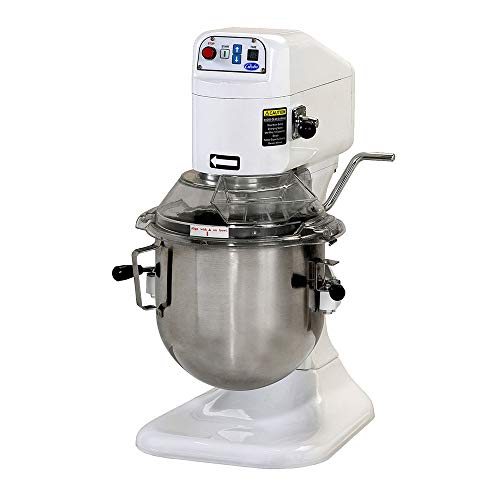
The Globe SP08 is a pure commercial machine built for durability over convenience — it weighs 61 pounds, uses a gear-driven planetary transmission, and has no plastic parts in the drivetrain. The ¼ HP custom-built motor is modest on paper, but the gear reduction system delivers high torque at low speeds, making it capable of handling double batches of bagel or pasta dough that would stall a consumer mixer. The bowl-lift mechanism uses dual bowl clamps that hold the 8-quart stainless steel bowl firmly in place, and the mixer automatically shuts down when the bowl is lowered for cleaning or removal.
The included attachments — spiral dough hook, flat beater, stainless steel wire whip, spatula, and polycarbonate splash cover with ingredient chute — cover the full range of commercial mixing tasks. The splash cover clips on securely and keeps flour contained during initial mixing, though some users report that the mixer can throw flour if the cover is not used, especially at higher speeds. The 15-minute timer with front-mounted touchpad controls is a practical addition for consistent batch timing.
Globe’s warranty does not cover home use — this is a machine intended for licensed commercial kitchens, and the company will void the warranty if they determine the unit was used in a non-commercial setting. The mixer is taller than the KitchenAid 8-quart model, which may create clearance issues under standard cabinets. Users consistently praise the quiet gear-driven operation and the fact that the motor never strains, even at maximum load, but note that the aluminum attachments can react with acidic ingredients over time.
Why it’s great
- Gear-driven transmission delivers consistent torque for heavy dough
- Dual bowl clamps prevent bowl lift during stiff mixing
- 15-minute timer enables consistent, hands-off batch timing
Good to know
- Aluminum attachments may react with acidic ingredients
- Warranty voided if used outside licensed commercial kitchen
5. Waring Commercial Luna WSM7L

The Waring Luna WSM7L is a countertop planetary mixer designed for environments where noise level matters — bakeries adjacent to dining areas, test kitchens, or production spaces where staff need to communicate. The ½ HP gear-driven induction motor operates noticeably quieter than equivalent KitchenAid models at every speed, and the permanently lubricated transmission eliminates the need for periodic oil changes. The tilt-back head design allows quick access to the 7-quart stainless steel bowl and attachments, though the head release lever requires two hands to operate safely.
The front-mounted speed control dial and LED power light are intuitive, and the 11-speed range provides granular control from gentle folding to high-speed whipping. The included stainless steel whisk and dough hook, along with the aluminum mixing paddle, cover standard applications, though the paddle’s aluminum construction may show wear faster than stainless alternatives. The removable clear-view splash guard with feed chute allows ingredient addition mid-cycle without stopping the mixer.
Users who upgraded from aging KitchenAid units consistently report that the Luna handles double batches of bread dough without overheating, and the quiet operation makes extended mixing sessions less fatiguing. The mixing shield does not create a perfect seal against the bowl, which can allow small amounts of flour to escape at higher speeds. Some units have shown paint chipping around the bowl rim after a few months of commercial use, which is a cosmetic concern but does not affect performance. The two-year motor warranty and one-year parts-and-labor coverage provide reasonable protection for a mid-range investment.
Why it’s great
- Exceptionally quiet operation for a planetary mixer of this power class
- Permanently lubricated transmission requires no maintenance
- 11-speed range allows precise control from gentle to aggressive mixing
Good to know
- Paint chipping reported on some units after months of heavy use
- Splash guard does not form a complete seal against the bowl
6. GE Profile Smart Stand Mixer

The GE Profile Smart Stand Mixer brings sensor-driven mixing to the countertop, using Auto Sense technology that monitors motor torque feedback to detect changes in dough or batter consistency and automatically adjust speed. The built-in smart scale allows you to weigh ingredients directly in the mixing bowl, eliminating the need for separate measuring cups and reducing cleanup. The digital brushless DC motor runs at low temperature and delivers consistent power without the heat buildup of traditional AC motors, making it suitable for extended mixing sessions.
The 7-quart stainless steel bowl is sized for medium-batch commercial work — suitable for bakeries producing 12 to 18 loaves per batch or pizzerias mixing 8 to 10 pounds of dough. The included attachments — commercial-grade 11-wire whip, stainless beater, and stainless dough hook — are all NSF-grade and should hold up to daily use. WiFi connectivity enables guided recipe downloads and over-the-air firmware updates, though the smart features can be unreliable; some users report that the auto-sense function failed to adjust properly and required manual intervention to complete recipes.
The mixer is notably heavy — 44 pounds — and the bowl-lift design (there is no tilt-head option) makes scraping the bowl during mixing somewhat awkward. The footprint is larger than a standard KitchenAid 7-quart, so verify counter space before purchasing. The scale and timer functions are genuinely useful for production baking, but the smart features feel half-baked — they work well for simple recipes but struggle with complex multi-stage bakes. If you value connectivity and data, this is a forward-thinking choice; if you want a no-nonsense mechanical machine, look elsewhere.
Why it’s great
- Auto Sense technology adjusts speed based on dough consistency feedback
- Built-in scale weighs ingredients in-bowl, reducing cleanup steps
- Brushless DC motor runs cool and delivers consistent torque
Good to know
- Smart features can be unreliable and require manual overrides
- No tilt-head option makes bowl scraping and access difficult
7. VEVOR 20Qt Commercial Mixer

The VEVOR 20Qt Commercial Mixer delivers serious bowl capacity and a 1100W gear-driven motor at a price point that undercuts most competitors by a wide margin. The cast-iron HT200 frame and Q235 steel housing give it a 138-pound heft that virtually eliminates vibration or walking during heavy dough mixing. The lever adjuster for raising and lowering the bowl is faster and more convenient than the traditional wheel mechanism found on competing units in this price class, and all food-contact surfaces — bowl, hooks, and rods — are made from food-grade stainless steel (SUS201 and SUS304).
The three-speed transmission offers 130 RPM for dough, 193 RPM for fillings, and 458 RPM for whipping, though you must stop the machine before shifting gears. The 30-minute timer knob is a practical addition for production environments — set it and walk away, and the mixer stops automatically when the time expires. Users report that this machine handles 6 to 9 loaves of bread per batch with no strain, and the quiet operation is surprising given the motor power. The safety interlock system requires the bowl cover, timer setting, and green button to be engaged before the motor will start, which adds a layer of protection but can be frustrating during fast-paced production.
The main compromise is that VEVOR does not offer a front utility drive for accessories like meat grinders or pasta rollers, which limits versatility. The unit ships in a sturdy crate that requires a crowbar to open, and it is critical to verify voltage (models are typically 110–120V despite some listings mentioning 220V). Customer service responsiveness is mixed — some users report difficulty reaching support for warranty issues. For a bakery that needs high-volume planetary mixing without the premium price tag, this mixer represents the best functional value in the 20-quart class.
Why it’s great
- 20-qt bowl handles high-volume batches without motor strain
- Lever adjuster is faster than wheel-based bowl raising systems
- Extremely quiet operation for a 1100W gear-driven machine
Good to know
- No front utility drive for accessory attachments
- Safety interlock system can be cumbersome during rapid production
8. Happybuy 30Qt Commercial Mixer
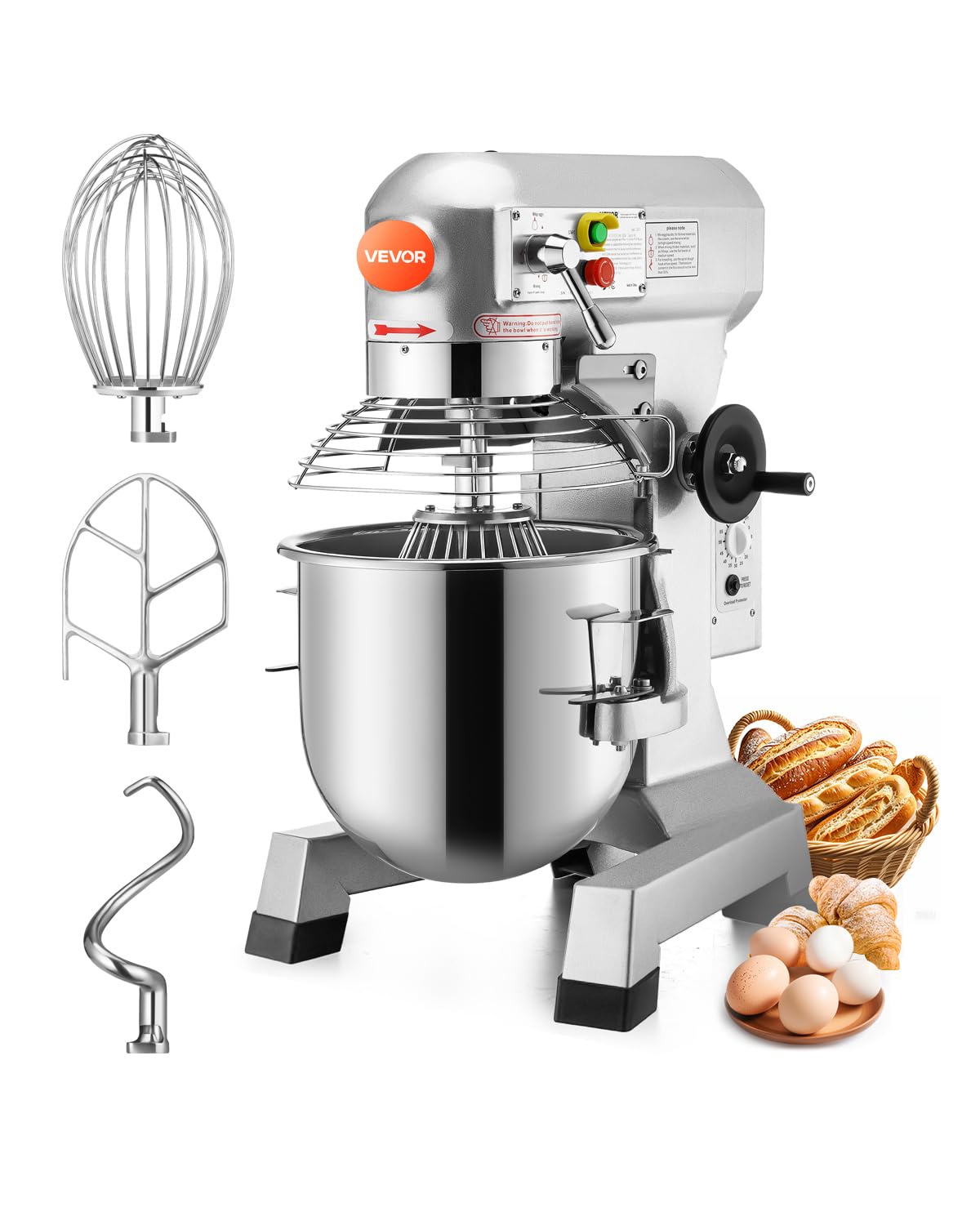
The Happybuy 30Qt is a floor-standing planetary mixer that targets production bakeries and commercial kitchens mixing dough in 30- to 50-pound batches. The 1250W motor is paired with a gear-driven transmission that produces 100 RPM at low speed for dough, 166 RPM at medium for fillings, and 360 RPM at high for whipping — all with enough torque to handle stiff bagel or pasta dough without bogging down. The 30-quart stainless steel bowl can accommodate up to 7.7 pounds of food at once, but in practice, the usable dough capacity is around 15 to 20 pounds depending on hydration.
The turning wheel mechanism for raising and lowering the bowl is mechanical and reliable, though it requires more effort than the lever adjusters on some newer designs. The safety shield interlock is robust — the machine will not start unless the shield is fully closed, and it automatically shuts down if the shield is opened during operation. The timer function is set via a knob and allows up to 30 minutes of automated mixing, which is useful for consistent batch production. All food-contact components are food-grade stainless steel, and the detachable bowl and stirrers clean up easily in a commercial dishwasher.
Quality control is inconsistent — some units arrive with paint on the whip or paddle that prevents proper mixing clearance, and resolving issues through the seller can require persistence (multiple emails and phone calls). The unit is very large — 150 pounds and 34.7 inches tall — so plan for floor space and delivery logistics. Users who got a good unit report years of reliable service for large-batch production, including 5,000 biscotti in two days or 80 cinnamon rolls per batch. For operations that need maximum volume per cycle at a reasonable cost, this mixer delivers, but the buying experience carries some risk.
Why it’s great
- 30-qt capacity enables high-volume batch production in one cycle
- 1250W gear-driven motor handles stiff dough without bogging
- Food-grade stainless steel bowl and attachments are easy to sanitize
Good to know
- Quality control issues reported with paint on attachments
- Seller support can be difficult to reach for warranty claims
9. Towallmark 20Qt Commercial Mixer

The Towallmark 20Qt mixer uses a 304 food-grade stainless steel bowl — a step up from the 201-grade stainless found on some budget models — which offers better corrosion resistance and longevity in high-moisture commercial environments. The 1100W gear-driven motor provides three speeds (105, 180, and 408 RPM) and is paired with a 30-minute timer that allows unattended mixing. The safety guard is made of stainless steel wire and must be in place for the motor to engage; a rubber band trick is commonly used by users to bypass the interlock, but this is not recommended for safety reasons.
Users running bagel bakeries report that the 15-quart version handles 150 bagels per week with ease, and the 20-quart model scales up proportionally. The stainless steel attachments — spiral dough hook, flat beater, and wire whip — cover the essential mixing tasks, and the bowl height is adjusted via a turning wheel that is easy to operate even with wet hands. The unit is heavy and stable, with no walking during stiff dough mixing, and it runs quieter than many comparably priced machines.
Some users have reported that thick cookie dough can cause the mixer to stop and require a reset, which suggests the thermal protection may engage at lower loads than expected for a commercial machine. The lift handle on some units has broken, forcing users to manually lift the bowl — a significant ergonomic issue for daily production. The lack of a gradual speed increase means dry ingredients can escape from the bowl on startup, even with the guard in place. For light- to medium-volume bakeries that prioritize stainless quality and stable performance, this mixer is a solid mid-range option, but it may not survive heavy daily use in high-output settings.
Why it’s great
- 304 food-grade stainless steel bowl resists corrosion in wet environments
- Stable, heavy build prevents vibration during heavy dough mixing
- 30-minute timer enables unattended batch production
Good to know
- Thick cookie dough may trigger thermal protection and stop the motor
- Lift handle has been reported to break under regular use
10. VEVOR 15Qt Commercial Mixer
The VEVOR 15Qt is the smallest floor-standing mixer in this guide, designed for small bakeries, pizzerias, and commercial kitchens that need planetary mixing power without a massive footprint. The 550W motor is adequate for dough batches up to 6 pounds and handles cream, fillings, and egg whites without strain. The lever adjuster for the bowl is the same design as the larger VEVOR models — fast and convenient compared to wheel adjusters — and the 15-quart stainless steel bowl is large enough for production runs without being difficult to handle during cleaning.
Three speed settings (135, 220, and 409 RPM) cover the standard mixing spectrum, and the timer knob allows up to 30 minutes of automated operation. The cast-iron HT200 frame provides stability, and the unit’s 105.8-pound weight keeps it planted during heavy mixing. Users report that this machine increases small bakery output from 2 loaves to 8–9 loaves per batch, and the quiet operation is a recurring point of praise — it runs noticeably quieter than comparable units from other budget brands.
Like all VEVOR models in this class, there is no front utility drive for expanding functionality with attachments. The safety interlock system requires the bowl cover, timer, and green button to be engaged in sequence, which can slow down fast-paced production. Some users have noted that the voltage listing can be confusing — the unit operates on 110–120V despite some marketing materials referencing 220V — so verify your electrical supply before ordering. For small-scale commercial operations or high-volume home bakeries, this mixer provides a reliable entry point into planetary mixing without overcommitting on budget or space.
Why it’s great
- Compact footprint fits smaller commercial kitchens without sacrificing capacity
- Lever adjuster provides faster bowl positioning than traditional wheels
- Very quiet operation for a 550W gear-driven mixer
Good to know
- No front utility drive limits accessory expansion
- Safety interlock sequence can slow down fast-paced production
11. Happybuy 20Qt Commercial Mixer
The Happybuy 20Qt is a floor-standing planetary mixer that provides 1100W of mixing power and a 20-quart stainless steel bowl at a price that makes it attractive for startups, food trucks, and small bakeries. The three-speed transmission (100, 166, and 360 RPM) covers dough, fillings, and whipping, though shifting between speeds requires stopping the machine. The 30-minute timer and safety shield interlock function as expected, and the turning wheel bowl adjustment is mechanical and durable if not particularly fast.
Users who run dog food bakeries or high-volume cookie operations report that this mixer handles 50-meal batches and 80-cinnamon-roll dough loads without complaint. The build quality is sufficient for daily use — the stainless steel bowl is rust-proof and easy to clean, and the attachments (dough hook, flat beater, wire whip) are durable enough for production environments. Some users have been running the same unit for three years of regular commercial use, producing thousands of biscotti or cookie batches with no mechanical failures.
Quality control varies significantly — some units arrive with paint on the whip or paddle that prevents proper mixing clearance, requiring replacement. Customer service from this seller has been described as evasive, with some users needing to escalate to Amazon’s A-to-Z guarantee to get issues resolved. The unit is large (160 pounds, 37 inches tall) and requires significant floor space. For buyers willing to gamble on quality control in exchange for very low entry cost, this mixer offers functional capacity that rivals units costing several times more — but the risk of receiving a defective unit is higher than with established commercial brands.
Why it’s great
- 20-qt capacity at a price point significantly below comparable models
- Proven to handle high-volume production for years in some bakeries
- All food-contact components are food-grade stainless steel
Good to know
- Quality control is inconsistent — paint defects reported on attachments
- Customer service from seller can be difficult to reach for warranty issues
FAQ
Can I use a commercial stand mixer in a home kitchen?
How important is NSF certification for a commercial stand mixer?
What is the difference between planetary and spiral mixing?
Why do some commercial mixers require stopping before changing speeds?
How much dough can a 20-quart mixer actually handle?
Final Thoughts: The Verdict
For most commercial users, the best commercial stand mixer winner is the Ooni Halo Pro Spiral Mixer because its spiral mixing technology, 58-speed precision, and active motor cooling deliver faster, more consistent dough development than any planetary mixer in its class. If you need NSF-certified all-purpose versatility with the flexibility to whip, cream, and knead in one machine, grab the KitchenAid KSM8990 Commercial Series. And for high-volume bakeries that need to mix 15 to 20 pounds of dough per batch without breaking the budget, nothing beats the functional value of the VEVOR 20Qt Commercial Mixer.

Mo Maruf
I created WellFizz to bridge the gap between vague wellness advice and actionable solutions. My mission is simple: to decode the research and give you practical tools you can actually use.
Beyond the data, I am a passionate traveler. I believe that stepping away from the screen to explore new environments is essential for mental clarity and physical vitality.