Our readers keep the lights on and my smoothie glass nicely filled. As an Amazon Associate, I earn from qualifying purchases.
Specs are compiled from manufacturer listings and verified buyer reviews and can change over time — please confirm the key details on the product page before buying.
You run a pizzeria or a bakery, so you know the pain: a mixer that struggles through stiff dough, blows a motor mid-service, or forces you to keep one eye on the clock when you need both hands on the line. A proper commercial spiral mixer solves all that—it kneads heavy loads fast, runs hour after hour without overheating, and frees you up to prep the next batch. The real question is which one earns a spot on your counter without wrecking your budget.
I’m Mohammad Maruf — the founder and writer behind WellFizz. This guide is built by comparing the manufacturers’ published specifications and the patterns across verified customer reviews, so you get each pick’s real strengths and trade-offs instead of marketing spin.
Whether you are opening a new shop or upgrading from a home-grade machine, these two models deliver the best value for your dollar. Read on to find the best commercial spiral mixer that actually fits your kitchen flow and your daily dough volume.
Quick Picks
- VEVOR Commercial Mixer — Best Overall
- Garvee Commercial Dough Mixer — Best Value
How To Choose The Best Commercial Spiral Mixer
Choosing the right spiral mixer depends on your daily dough volume, available floor space for a 100-pound-plus machine, and if you want a set-and-forget timer.
Motor Power and Speed Count
Look for at least a 450-watt motor, which both of the picks here deliver. That wattage easily handles stiff doughs like pizza, bagel, and bread. Some machines offer multiple speeds—a low speed around 113 rpm for kneading, a medium speed around 184 rpm for mixing fillings, and a high speed around 341 rpm for whipping. A single-speed machine is simpler and often cheaper, but it works best only if you make a narrow range of doughs.
Bowl Capacity and Construction
An 8.5-quart to 10-quart stainless steel bowl is the balance for a small commercial kitchen or a serious home baker. The larger bowl lets you mix up to roughly 6.6 pounds of dough in one go. Food-grade stainless steel is non-negotiable—it resists rust, handles acidic ingredients, and cleans up fast. A detachable bowl is easier to clean than a fixed bowl, but fixed bowls are often sturdier and less prone to wobble.
Safety and Timer Features
A safety shield that cuts power when opened is mandatory for any commercial kitchen. A built-in timer—ideally with a 30-minute or 60-minute maximum—lets you set the mix and return to other tasks without hovering. The machine should also shut down automatically if the shield is not fully closed.
Quick Comparison
In‑Depth Reviews
1. VEVOR Commercial Mixer

You get three speeds and a detachable 10-quart bowl, so one machine tackles pizza dough one minute and cake batter the next.
If you are running a small pizzeria or bakery, the 450-watt motor in the VEVOR is tuned for speed. It has three adjustable speeds: 113 rpm (revolutions per minute, how fast the hook spins) for kneading heavy dough, 184 rpm for mixing fillings, and 341 rpm for whipping creams. That means you are not stuck with one speed—you can switch between a stiff bagel dough and a delicate cake batter on the same machine. The 10-quart stainless steel bowl holds up to about 2.2 pounds of food at once, which translates to several loaves of bread or a solid pizza batch per cycle.
The upgraded timer knob is a standout. Set it up to 30 minutes and walk away; the machine stops automatically when the time is up. Buyers report that this feature alone “reduced pizza dough time from 40 to 10 minutes,” because you are not standing there watching the dough climb the hook. A safety shield (a clear guard that cuts power if opened) kills power if it is not fully closed, which is a must in a busy kitchen.
The catch? The lowest speed is still fairly fast, so owners note that dry flour can throw if you add it too quickly. The base can also rock on an uneven floor—one fix was a shim under a foot. But for the rating and the all-stainless build, the consensus is clear: this is a durable workhorse that earns its place in a commercial kitchen. The VEVOR is more versatile than the Garvee because it handles batters and creams, not just dough.
Speed & Capacity Edge
- Three speed settings (113, 184, 341 rpm) handle dough through whipped cream
- 10-quart bowl fits more dough per batch than the Garvee’s 8.5 quarts
- Timer knob auto-stops at up to 30 minutes
Real-World Trade-offs
- Lowest speed is fast enough to throw flour if added too quickly
- At 123.5 pounds, it is the heavier machine; plan for a sturdy surface
Reach for this if: you need a versatile three-speed mixer with a larger bowl for bread, pizza, and occasional cake work.
Think twice if: you have a tight budget for floor space or plan to make mostly small-batch, single-type dough—the Garvee is lighter and cheaper.
2. Garvee Commercial Dough Mixer
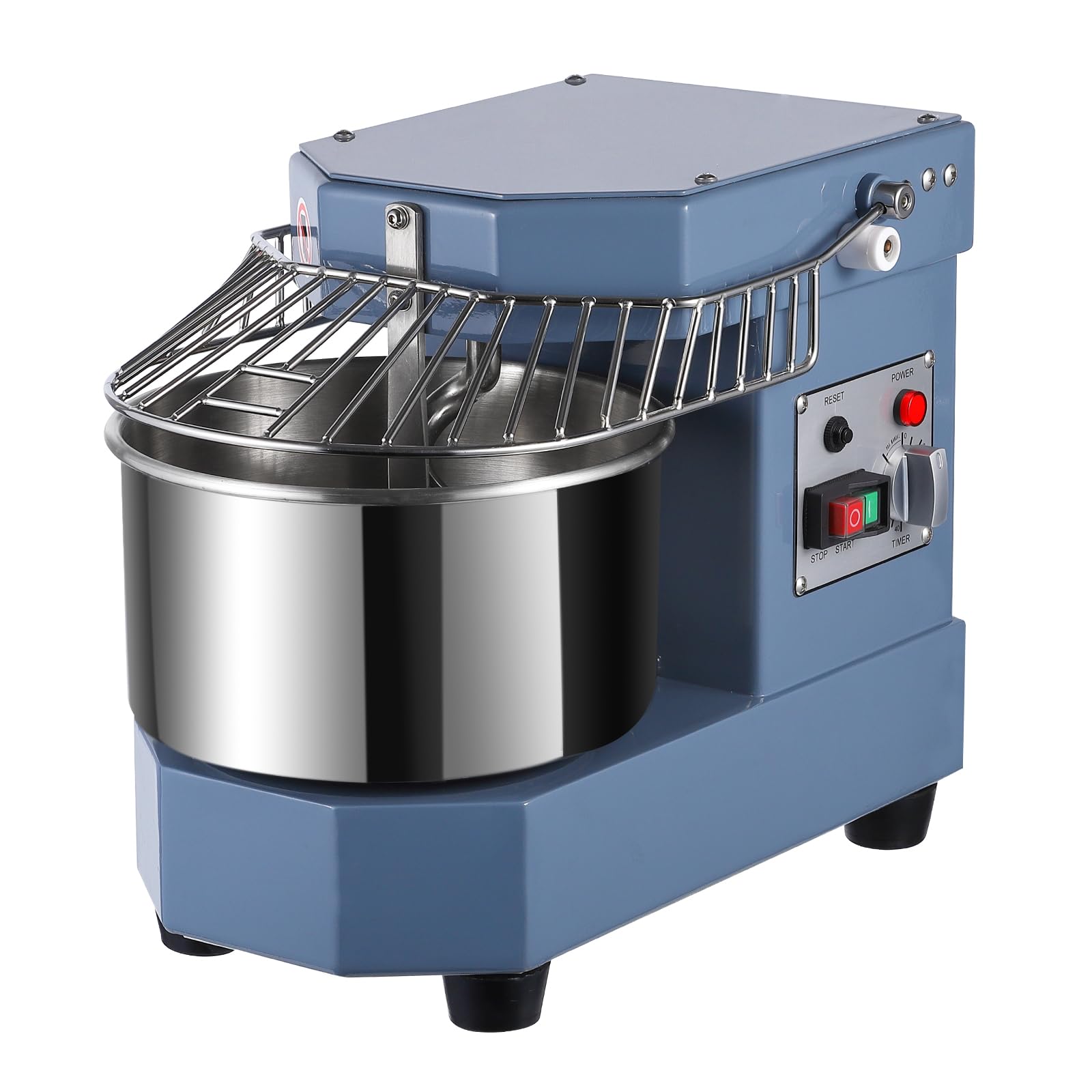
Dual rotation means the bowl and hook spin simultaneously, so high-hydration dough like Neapolitan pizza gets a thorough knead without triple the time.
Garvee took a different approach. Instead of multiple speeds, this machine uses a single-speed spiral with dual rotation: the bowl turns at 21 rpm (revolutions per minute, how fast the bowl itself rotates) while the hook spins at 159 rpm in the opposite direction. That simultaneous motion increases the contact area between the dough and the hook, which is exactly what you want for high-hydration Neapolitan dough. The 8.5-quart bowl handles up to 6.6 pounds of dough in about 10 to 15 minutes. Owners mention it “handles 50-75 pizzas without issues”—a real statement for a busy pizza counter.
The timer goes up to 60 minutes, double the VEVOR’s 30-minute range, which is handy if you are doing long, slow fermentation mixes. A reset button solves accidental breakdowns, and the indicator light shows power status at a glance. Build quality is the second most-praised aspect of this mixer (seven mentions), and owners describe it as “like a small tank.” It is 99.3 pounds—lighter than the VEVOR’s 123.5 pounds but still heavy enough that several owners recommend putting it on a wheeled cart.
The trade-off: the fixed bowl makes cleaning harder since you cannot lift it off and take it to the sink. Ease of cleaning is the most-discussed negative, with seven owners calling it a pain. The machine also works best with 1500 grams or more of dough per batch; smaller amounts risk overheating the motor. For a dedicated pizza or bread shop running big batches, this trade-off is easy to accept. For a baker who changes recipes constantly, the fixed bowl may frustrate.
Pure Dough Specialist: The dual rotation and single-speed design are tune for stiff dough like pizza and bread, not for cake batter or whipped cream. If your kitchen lives and breathes dough, this is the more focused pick.
Best for: pizzerias and bakeries that run high volumes of the same dough and don’t need multi-speed versatility.
Who should pass: anyone who needs to mix cake batters, whip cream, or frequently change between dough types—the fixed bowl and single speed slow down cleanup and flexibility.
Understanding the Specs
Motor Power and Drive System
Both picks use a 450-watt motor with a gear-driven or chain-driven transmission. That wattage is enough to knead stiff dough without bogging down. The key difference is speed count: VEVOR gives you three speeds (low, medium, high) while Garvee uses a single speed with dual rotation. If you make a variety of mixes, go with three speeds. If you mostly do one type of dough, the simpler system works fine and costs less.
Bowl Capacity and Bowl Type
Capacity is listed in quarts. A 10-quart bowl holds roughly 2.2 pounds of food, while an 8.5-quart bowl holds up to 6.6 pounds of dough (the difference is the volume of wet vs. dry mix). Detachable bowls are easier to clean but can wiggle over time. Fixed bowls are sturdier but require you to clean in place—something to consider if you run multiple batches back to back.
FAQ
Will a 450-watt spiral mixer handle stiff pizza dough all day?
Can I use a spiral mixer for cake batter or whipped cream?
How much counter space do I need for a machine this heavy?
Is a fixed bowl better than a detachable bowl?
How long does the timer run on these mixers?
Will the safety shield shut the machine off if it’s open?
Can I make small dough batches in a 10-quart mixer?
Which one is better for Neapolitan pizza dough?
Final Thoughts: The Verdict
For most buyers, the best commercial spiral mixer winner is the VEVOR Commercial Mixer because its three speeds, detachable 10-quart bowl, and 30-minute timer cover the widest range of doughs and batters while staying within a realistic budget for a small shop. If you run a dedicated pizza operation and want a focused dough machine, grab the Garvee Commercial Dough Mixer—it is lighter, cheaper, and built by Neapolitan pizza owners for Neapolitan pizza owners.
How We Picked
We do not accept paid placement. Every pick is matched to a real buyer and a real use-case; we do not hands-on test units.
Sources & Methodology
Specifications: manufacturer listings and product documentation. Review insights: verified customer reviews, as of July 2026. Pricing: not shown on this page (it changes often); check the current price via the retailer link.
As an Amazon Associate, WellFizz earns from qualifying purchases. This does not affect which products we feature.
Related Guides

Mo Maruf
I created WellFizz to bridge the gap between vague wellness advice and actionable solutions. My mission is simple: to decode the research and give you practical tools you can actually use.
Beyond the data, I am a passionate traveler. I believe that stepping away from the screen to explore new environments is essential for mental clarity and physical vitality.