Our readers keep the lights on and my smoothie glass nicely filled. As an Amazon Associate, I earn from qualifying purchases.
Specs are compiled from manufacturer listings and verified buyer reviews and can change over time — please confirm the key details on the product page before buying.
A commercial-grade recumbent bike is a serious investment. A commercial-grade recumbent bike’s long-term value depends on frame durability, resistance quality, and seat ergonomics. This guide focuses on the specs and owner feedback that reveal true commercial-grade performance.
I’m Mohammad Maruf — the founder and writer behind WellFizz. This guide is built by comparing the manufacturers’ published specifications and the patterns across verified customer reviews, so you get each pick’s real strengths and trade-offs instead of marketing spin.
Choosing the right commercial recumbent bike means weighing build quality, user capacity, and long-term support. The three machines here represent distinct tiers of commercial-grade quality.
Our Picks at a Glance

How To Choose The Best Commercial Recumbent Bike
When buying for heavy use, prioritize frame, seat adjustability, and resistance system over console features. Frame, seat adjustability, and resistance system determine whether a bike lasts five years or a lifetime.
Weight Capacity and Frame Weight
Maximum user weight is the most reliable indicator of frame durability. A bike rated for 350 lbs uses thicker steel and sturdier welds than one rated for 300 lbs. The bike’s own weight also tells you something — a heavier machine (over 140 lbs) tends to stay planted during hard intervals and supports heavier riders without wobble.
Resistance Type and Range
Magnetic resistance (magnets create pedal friction without touching any parts) is the gold standard for silent, maintenance-free operation. More levels (16 to 40) give finer control so you can dial in exactly the effort you need for rehab or progressive training. Eddy current (generator-powered) systems add the convenience of no power cord but can feel different at the pedals.
Seat Adjustability and Comfort
A recumbent bike’s seat does the heavy lifting for your back. Look for a seat that tilts and slides forward/backward — at least five tilt positions and a wide forward-back range ensure that users from 5′ to 6’5″ can find a proper leg extension without straining the lower back. Mesh or ventilated backrests help keep you cool during longer sessions.
Warranty and Parts Support
Commercial-grade bikes should come with a lifetime frame warranty. Parts coverage for 5 to 7 years and in-home labor for at least a year are signs the manufacturer backs the build quality. Check whether replacement parts are easily available and whether customer service is responsive, especially if you are buying for a clinic or gym.
Quick Comparison
| Model | Best For | Weight Capacity | Item Weight | Resistance Levels | Amazon |
|---|---|---|---|---|---|
| 3G Cardio Elite RB X★ Best Overall | Home gym / silent training | 350 lbs | 115 lbs | 16 | Amazon |
| Spirit Fitness XBR95 | Rehab / generator-powered | 350 lbs | 147.3 lbs | 40 | Amazon |
| PhysioStep LXT-700 | Clinical / high weight capacity | 400 lbs | 210 lbs | 32 | Amazon |
In‑Depth Reviews
1. 3G Cardio Elite RB X Recumbent Exercise Bike
Our pick — over 4.5★ from 400+ verified ratings; the strongest balance of quality and price.
You get a whisper-quiet ride that rolls through a standard doorway, thanks to a 115-pound frame.
This Arizona-built machine is the crowd’s favorite for a reason. Owners consistently praise its near-silent operation — you can watch TV or listen to music without any mechanical whir. The standout feature is the oversized cushioned seat that tilts through five positions and slides across 25 forward-back settings. Riders from 5′ to a full 6’5″ can find a comfortable position without back strain.
Where it shines brightest is the FreeSync FTMS Bluetooth (a wireless tech that lets your bike talk to fitness apps). You bring your own screen (a tablet shelf is included) and pair with apps like Zwift, Peloton app, or Kinomap. No membership required, no proprietary walled garden. The 16 levels of magnetic resistance feel smooth and progressive. The included wireless heart rate strap and handheld sensors give you accurate pulse tracking without chest-strap friction.
The trade-off is weight capacity — at 350 lbs it is 50 lbs less than the PhysioStep’s 400 lbs. But the metal frame handles and integrated wheels make it far easier to move through standard doorways than the 210-pound PhysioStep. Buyers report it is “built like a tank” and exceptionally comfortable for long sessions. It is the smartest all-around pick for home gyms and light commercial use. If you need 400 lbs of support, however, the PhysioStep is the one to pick.
What wins owners over
- Near‑silent magnetic resistance — owners call it “very quiet” and “smooth as butter”
- Highly adjustable seat that tilts 5 ways and slides 25 positions for custom fit
- Lifetime frame warranty and 7-year parts coverage back the commercial claim
- FTMS Bluetooth (a wireless fitness-app connection) pairs with Zwift, Peloton app, and other platforms without a subscription
The honest limit
- At 350 lbs max user weight, heavier riders will need the 400‑lb PhysioStep
- Assembly takes about 2 hours — some owners pay extra for delivery and setup
- 16 resistance levels are fewer than the Spirit XBR95’s 40, so advanced athletes miss finer gradations
Your go‑to if: you want a whisper‑quiet bike that fits riders from 5′ to 6’5″, pairs with any fitness app, and comes with a lifetime frame.
Think twice if: you need to support users over 350 lbs or prefer the freedom of a cordless generator system.
2. Spirit Fitness XBR95 Recumbent Bike
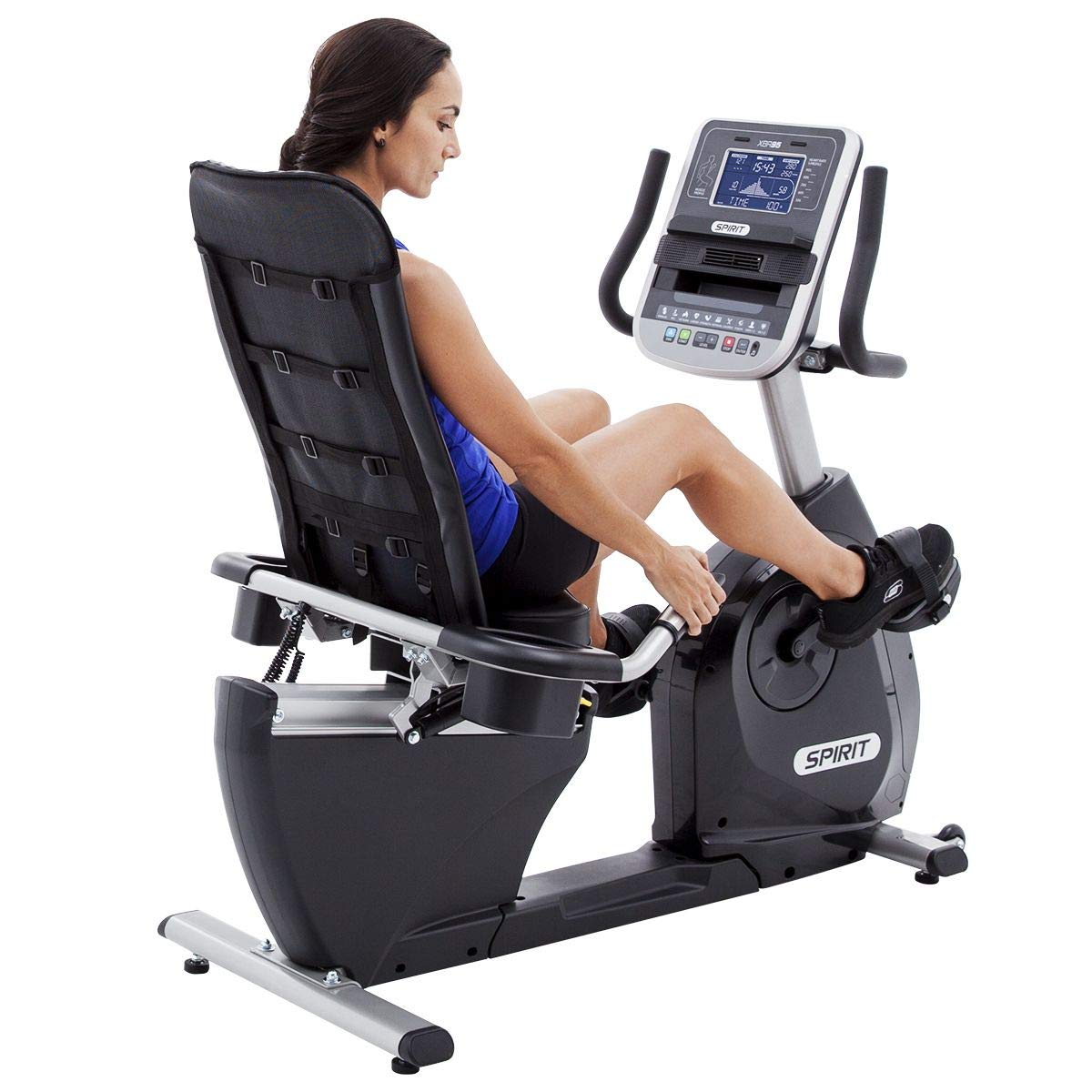
You get 40 resistance levels and a generator system that does not need a wall outlet.
The Spirit XBR95 stands apart with its cordless generator system — you plug it into nothing. Place it in the middle of a room or on a patio without worrying about a wall socket. Its 40 levels of magnetic resistance are the widest range in this comparison. That gives you far finer gradations than the 3G Cardio’s 16 levels. This matters if you are slowly progressing through rehab and need tiny jumps in effort.
The 30-pound flywheel (a weighted disc that keeps pedals moving smoothly between strokes) delivers a road-like feel. The seat itself is widely praised as super-comfortable with an adjustable cooling mesh back that keeps sweat from pooling. The 7.5-inch blue backlit LCD is clear and easy to read mid-workout. You get hand pulse grips plus wireless heart rate (wireless pulse tracking) monitoring right on the handlebars.
The honesty here: the review sample is smaller than the competition’s. A few owners mention durability concerns — one reviewer noted the bike “broke after year and a half,” and another mentioned chronic monitor failures and a seat wobble. The frame is the heaviest of the standard bikes at 147.3 lbs, so moving it is a two-person job. But that heft keeps it rock-solid during hard pedaling. For a rehab setting or a home user who prioritizes resistance variety and zero-cord freedom, the XBR95 delivers genuine commercial quality. If you want the proven track record of the 3G Cardio with its near-silent ride and larger owner community, that bike is the safer bet.
Where it leads: The 40 resistance levels and generator power supply make it the most versatile bike for placement freedom and progressive resistance tuning.
Where it trails: The smaller review pool and scattered reports of long-term reliability mean you should buy from a dealer with strong return support.
Reach for this if: you want 40 levels of resistance and the ability to park the bike anywhere without a power cord.
Look elsewhere if: you want the confidence of a proven track record with hundreds of reviews — the 3G Cardio or PhysioStep have much larger owner communities.
3. PhysioStep LXT-700 Recumbent Linear Step Cross Trainer

The clinical‑grade stepper carries 400 lbs through a patented linear stepping motion instead of a circular pedal stroke.
This is not a recumbent bike in the traditional sense. It is a recumbent linear step cross trainer, which means your feet move in a natural stepping arc rather than a circular pedal stroke. The patented 2:1 stepping ratio (your feet go forward and back in a straight line) mimics the motion used in physical therapy. It is markedly easier on the knees and hips than a standard bike. Physical therapists around the world spec it for post-surgery rehab.
The headline numbers are the strongest in this group: a 400-pound maximum user weight — 83% higher than the 3G Cardio’s 350 lbs. The frame weighs 210 pounds, nearly double the 3G Cardio’s 115 lbs. So it stays absolutely planted under the heaviest users. The oversized 20-inch orthopedic foam seat rotates a full 360 degrees with a swivel handle. That makes transfers from a wheelchair or walker dramatically easier. The telescopic tilt display shows speed, time, distance, pulse, RPM (revolutions per minute), watts, calories, and level on a large 9-inch color-coded screen.
The honest trade-off is the support experience. Some customers note that customer service “was busy and never returned the call.” One detailed owner noted multiple failures including a display cable installed backwards and a clanking noise that required a technician to replace connecting rods. The 1-32 resistance range is generous, but the bike needs AC power (110V-220V), so placement is less flexible than the Spirit’s generator system. For a clinic or a home user who needs the highest weight capacity and the lowest-impact motion available, this is the most capable machine in the roundup. If you want plug-and-play reliability and responsive phone support, the 3G Cardio is a simpler, better-backed machine for most home gyms.
Its defining strength: The 400‑lb capacity and 360‑degree swivel seat make it the only true option for bariatric users and those with limited mobility — no other machine here comes close.
Its defining weakness: Customer service responsiveness is inconsistent. The handful of detailed negative reviews point to potential build‑quality variance that a buyer should verify with the seller upfront.
Best for: clinical rehab settings, bariatric users, or anyone whose priority is the lowest joint impact possible and a 400‑lb support ceiling.
Best skipped by: home users who want plug‑and‑play reliability and responsive phone support — the 3G Cardio is a simpler, better‑backed machine for most home gyms.
Understanding the Specs
Resistance Type and Levels
Magnetic resistance uses magnets to create pedal friction without physical contact between parts, which means zero noise and virtually no maintenance. The number of levels (16 to 40) determines how finely you can dial in effort — more levels matter for rehab where gentle progression is critical, while 16 levels are plenty for most home cardio workouts. Generator-powered systems like the Spirit XBR95 create their own electricity as you pedal, so no power cord is needed. The resistance feel can be slightly different from a traditional magnetic brake.
Flywheel Weight
The flywheel is a weighted disc that keeps the pedals moving smoothly between your pedal strokes. A heavier flywheel (around 30 pounds) creates a more road-like feel because it stores more momentum — you do not get that jerky stop-start sensation when you ease off the pressure. Lighter flywheels feel less smooth but are easier to start moving, which can be helpful for someone early in rehab.
FAQ
What is the difference between a recumbent bike and a recumbent linear stepper?
How much weight can a commercial recumbent bike support?
Do commercial recumbent bikes need to be plugged in?
How long does a commercial recumbent bike last?
Can a recumbent bike help with knee or hip rehab?
What does “commercial grade” mean on a recumbent bike?
How much space do I need for a commercial recumbent bike?
Is a recumbent bike better than an upright bike for back pain?
Can I connect my tablet or phone to a commercial recumbent bike?
How do I maintain a commercial recumbent bike?
Final Thoughts: The Verdict
For the majority of shoppers, the commercial recumbent bike winner is the 3G Cardio Elite RB X because it combines near-silent operation, a lifetime frame warranty, and the most owner-praised comfort at a weight that still rolls through a doorway. If you want the widest resistance range (40 levels) and the freedom of a cordless generator system, grab the Spirit Fitness XBR95. And for the highest weight capacity and the lowest-impact linear stepping motion — ideal for clinical rehab — the PhysioStep LXT-700 is the one to reach for.
How We Picked
We do not accept paid placement. Every pick is matched to a real buyer and a real use-case; we do not hands-on test units.
Sources & Methodology
Specifications: manufacturer listings and product documentation. Review insights: verified customer reviews, as of July 2026. Pricing: not shown on this page (it changes often); check the current price via the retailer link.
As an Amazon Associate, WellFizz earns from qualifying purchases. This does not affect which products we feature.
Related Guides

Mo Maruf
I created WellFizz to bridge the gap between vague wellness advice and actionable solutions. My mission is simple: to decode the research and give you practical tools you can actually use.
Beyond the data, I am a passionate traveler. I believe that stepping away from the screen to explore new environments is essential for mental clarity and physical vitality.