Our readers keep the lights on and my smoothie glass nicely filled. As an Amazon Associate, I earn from qualifying purchases.
Specs are compiled from manufacturer listings and verified buyer reviews and can change over time — please confirm the key details on the product page before buying.
A single camera can leave blind spots the size of a car on a commercial lot. The real measure of a commercial outdoor security camera system is whether you can cover multiple zones with steady high-resolution footage, store weeks of video locally, and get alerts that actually mean something — not a false alarm every time a leaf blows past. The three systems here deliver that; consumer WiFi bulbs cannot.
I’m Mohammad Maruf — the founder and writer behind WellFizz. This guide is built by comparing the manufacturers’ published specifications and the patterns across verified customer reviews, so you get each pick’s real strengths and trade-offs instead of marketing spin.
Choosing a system for a warehouse, parking lot, or multi-tenant property means balancing camera resolution (megapixels), storage (terabytes), and cable length (feet) — and knowing which to prioritize.
Our Picks at a Glance

How To Choose The Best Commercial Outdoor Security Camera System
Buying a commercial system is different from grabbing a single camera for the front door. Wiring a whole property means your choices on cable length, storage, and alert handling will save hours of frustration later. Focus on these four factors first — they separate a system that works from one that gathers dust.
Camera Resolution: 5MP vs 8MP vs Higher
Resolution determines how far away you can still read a license plate or recognize a face. A 5MP camera delivers about 5 million pixels per frame — that is sharp enough for most parking lots and doorways. An 8MP (4K) camera gives you roughly 8 million pixels, so you can zoom into a recorded image afterward and still see details like a face. The trade-off is storage: higher-resolution cameras fill a hard drive faster, so the system needs a larger drive or smarter recording settings to compensate.
Storage Capacity and Recording Duration
The hard drive inside the NVR (network video recorder, the box that stores all footage) is where every frame lands. A 3TB drive can hold about 15 days of footage from 8 cameras at 4K. A 4TB drive gives you a bigger buffer, and systems with two HDD bays (hard drive bays) let you expand later. If you need 30 days of archive for compliance or insurance reasons, aim for a system that supports at least 10TB total or has a second drive slot ready.
Total Cable Length and Installation Reach
Cable length is the hidden spec that makes or breaks a large-property install. A system that ships 480 feet of total Ethernet cable forces you to place cameras close to the NVR. One with 1,280 feet covers a much wider footprint — think separate buildings on the same lot. Measure the distance from your NVR location to the furthest camera point, then add 20% for routing around corners and through walls. That number tells you whether the included cables will reach or if you need a system with longer pre-terminated runs.
Detection and Alert Accuracy
A camera that sends a push alert every time a cat walks past is worse than no alert at all. Systems with AI-based human and vehicle detection filter out animals, trees, and rain, so your phone only buzzes when something worth investigating happens. This also saves storage because the system can record only on motion events rather than continuously. Look for terms like “AI Human/Vehicle Detection” in the specs — that feature separates a smart system from a noisy one.
Quick Comparison
| Model | Best For | Cameras Included | Total Cable Reach | Storage | Amazon |
|---|---|---|---|---|---|
| ONWOTE 16CH AcuSearch 12MP★ Best Overall | Maximum coverage across large properties | 16 | 1,280 ft | 4TB | Amazon |
| ONWOTE 16CH 6K 12MP NVR | Higher resolution cameras for detailed ID | 8 | 480 ft | 4TB | Amazon |
| Hiseeu 4K 8CH TVI System | Budget-friendly entry with smart color night vision | 8 | 616 ft | 3TB | Amazon |
In-Depth Reviews
1. ONWOTE 16 Channel NVR PoE Security Camera System, AcuSearch, 12MP 4K 16CH
Our pick — over 4.5★ from 100+ verified ratings; the strongest balance of quality and price.
The one system that blankets 1,280 feet of property with 16 wired cameras and a smart search tool.
This system solves cable reach first: the included Cat5 cables stretch a total of 1,280 feet — nearly a quarter mile — compared to 480 feet for the other ONWOTE kit. That gives you the flexibility to place cameras across multiple buildings or a large parking lot without running your own Ethernet. Each of the 16 cameras captures at 5MP (5 million pixels) with a 122-degree diagonal view, sharp enough to identify people at doorways. The NVR (network video recorder, the box that stores footage) packs a 4TB hard drive that records 24/7, with a second HDD bay (hard drive bay) that supports up to 20TB total.
AcuSearch technology lets you pinpoint a suspect or event across all 16 channels of synchronous playback — meaning you watch all cameras at once. Owners call it “instant video search” for tracking a person across a property in minutes. The AI human and vehicle detection filters out animals and leaves, so your phone only buzzes when something real happens. One buyer who “replaced disappointing Lorex” praised the crisp picture quality and the responsive technical support that helped repair a squirrel-chewed cable. The main physical caveat: the camera cord can bump against the mounting bracket, which slightly limits how far you can tilt the lens.
What wins people over
- 16 cameras and 1,280 feet of cable — 1,280 feet of cable, compared to 480 feet for shorter kits — for smooth full-perimeter coverage
- AcuSearch lets you review 16 channels at once, so tracking a person across a property takes minutes instead of hours
- Camera quality earns the most praise by far, with owners calling the image crisp and the digital zoom impressive
The honest trade-off
- Each camera is 5MP (not 8MP), so if you need to zoom in on distant license plates, the 8MP system below offers sharper pixel density per camera
- The camera cable routing can bump against the bracket, making fine-tuned angle adjustments a little finicky
Reach for this if: you have a large warehouse, separate buildings on one lot, or a property where 480 feet of cable simply does not reach — the 1,280-foot total cable length solves that problem outright.
The alternative for sharper zoom: if you need higher per-camera resolution for zoomed identification and you have fewer than eight camera positions, the ONWOTE 8MP system below delivers 8 million pixels per frame for crisper digital zoom.
2. ONWOTE NVR PoE Security Camera System 4K, 16 Channel 6K 12MP Commercial NVR 4TB

Where each camera resolves 8 million pixels for sharper zoomed-in identification across wider angles.
If your priority is reading a face or license plate from a distance rather than blanketing the most square footage, this system trades total camera count for higher per-camera resolution. Each of the 8 cameras delivers 8MP (8 million pixels) with a 134-degree diagonal field of view — 8MP per camera, whereas the 16-camera kit above has 5MP. That means you can zoom into a recorded image afterward and still see details like a plate number. The NVR (network video recorder) is the same 16-channel 12MP unit with a 4TB hard drive and support for up to 20TB, so you can add up to 8 more cameras later.
Buyers who have had the system running since 2021 report that it “works great” for home and small business use, with easy setup and excellent customer support that replaced failed cameras quickly. The AI human and vehicle detection handles DIY configuration well, and the 16-channel synchronous playback (watching all cameras at once) is a real time-saver. The honest quirks from owners: one camera arrived with a night-vision artifact and a red tint, and the software does not allow image rotation — so if you mount a camera upside down, the video stays upside down. The included cables total 480 feet, compared to 1,280 feet for the 16-camera kit, so cameras must stay closer to the NVR.
Where it shines
- 8MP resolution per camera — 8 million pixels — delivers noticeably sharper digital zoom compared to a 5MP camera, so distant details like license plates stay readable when you zoom in
- Wide 134-degree diagonal field of view reduces the number of cameras needed to cover open areas like parking lots
- Owners consistently highlight the responsive 24/7 phone and email support as a real safety net
Where it frustrates
- Total cable length is 480 feet — compared to 1,280 feet for the 16-camera kit — so cameras cannot be placed as far from the NVR
- No in-software image rotation; if you mount a camera upside down, the video stays upside down
- An occasional unit arrives with a stuck night-mode camera, though support ships a replacement quickly
Best for: a business owner or property manager who needs sharp 8MP footage for identifying people and vehicles at medium range, and plans to expand to 16 cameras gradually.
A caution on reach: if your property is spread out over a long distance, the 480-foot total cable will force you to place cameras close to the NVR, making the 16-camera kit with 1,280 feet a better fit.
3. Hiseeu 4K Wired Security Camera System with Smart Color Night Vision | Audio, 3TB Hard Drive
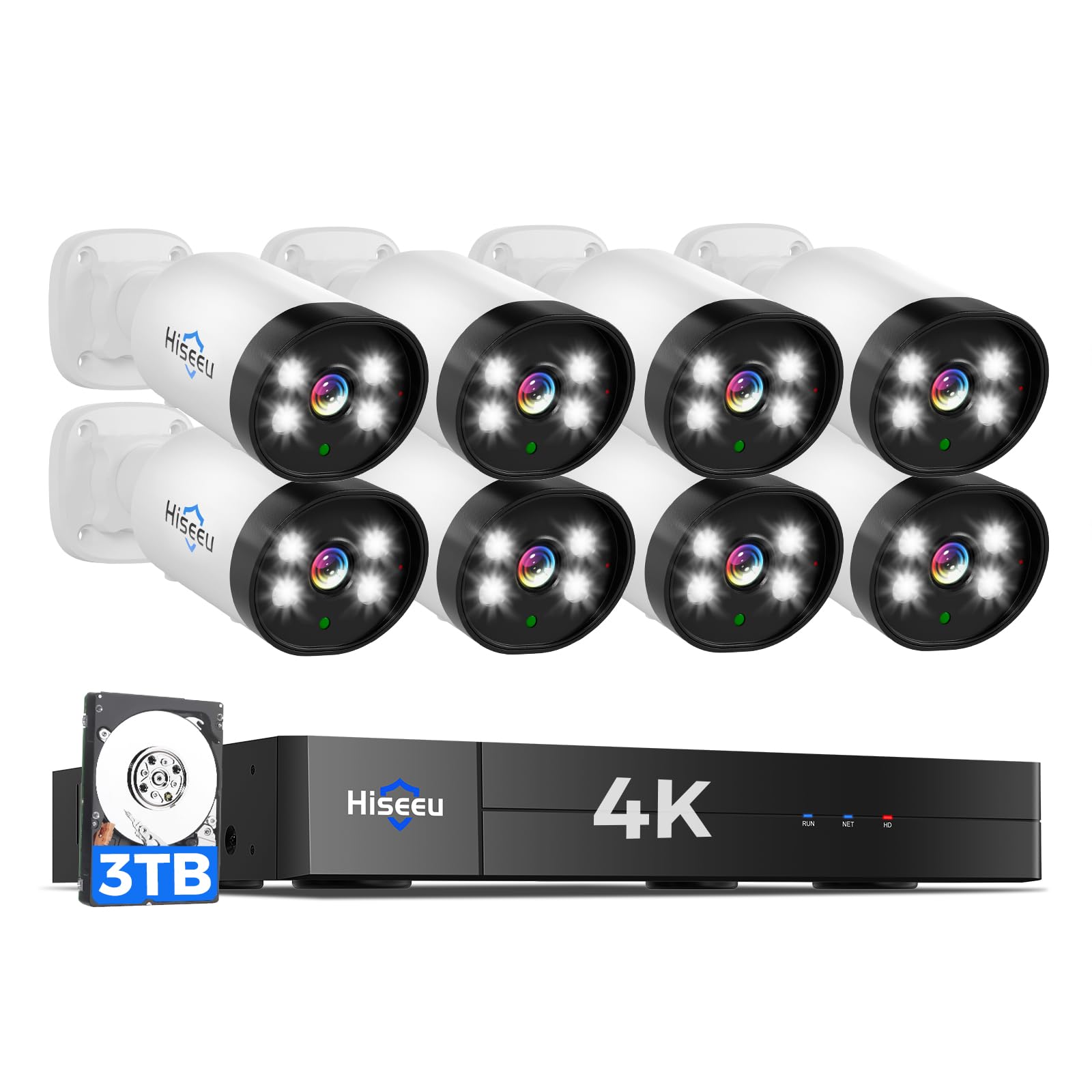
A smarter color night-vision system that shifts from infrared to full-color only when motion is detected.
This is the entry point into commercial-grade wired surveillance without the higher cost of the ONWOTE systems. Its headline feature — Smart Color Night Vision — solves a common frustration: most outdoor cameras switch to black-and-white infrared at night, but the Hiseeu turns on an integrated spotlight and shifts to full-color footage only when it detects a person. That saves energy and avoids lighting up the neighborhood all night. The 8 cameras capture at 8MP (4K resolution) through a wired TVI (transport video interface, a coaxial-style connection) system. It ships with four 96-foot BNC cables (coaxial cables with bayonet connectors) and four 58-foot BNC cables, for a total of roughly 616 feet of reach.
Customer support gets consistent praise across reviews — “amazing quick to respond and fix the issue,” one owner wrote, noting that a faulty camera was replaced at no cost. The app is user-friendly, the storage is rated good for the money, and the IP67 weatherproof rating (a step above IP66, meaning the camera can be submerged in 1 meter of water for 30 minutes) handles extreme temperatures from -40°F to 140°F. The main trade-off: the system records at 15 fps (frames per second), which is noticeably choppier than the 20-25 fps of the ONWOTE systems, so fast-moving vehicles may appear with slight motion blur. A few owners also report that the second camera showed “no signal” from the start or that the color night-vision lights did not activate on motion.
What stands out
- Smart Color Night Vision switches from infrared to full color only when a human triggers it, so the lights are not on all night
- IP67 rating protects against extreme cold and heat, from -40°F to 140°F, making it suitable for harsh climates
- Owner experiences consistently mention fast, helpful customer support that replaces faulty units without hassle
Where it cuts corners
- 15 fps frame rate is lower than the 20-25 fps of the ONWOTE systems, leading to minor motion blur on fast cars or runners
- A small number of units arrive with one camera showing “no signal” or a stuck night-vision mode, though support handles it quickly
- 3TB storage is 1TB smaller than the 4TB drives in the ONWOTE kits, so you get roughly 15 days of continuous recording instead of 20+
Reach for this if: your budget is tighter but you still want 4K (8MP) resolution per camera and a smart night-vision feature that does not blind the neighborhood all night.
Think twice if: your property sees frequent fast traffic — the 15 fps frame rate may miss detail on a speeding car, making the higher-fps ONWOTE systems a better fit.
Understanding the Specs
Megapixels and Real-World Zoom
A camera’s megapixel count (5MP vs 8MP) tells you how many tiny squares of information each frame contains. More megapixels means a sharper digital zoom after the fact — the difference is whether a license plate stays readable when you zoom in 3x or turns into a blur. For a commercial parking lot where you need to identify plate numbers from 30 feet away, an 8MP camera gives you a meaningful edge. For standard doorway and hallway coverage, 5MP is more than enough and saves hard drive space.
PoE (Power over Ethernet) vs TVI Analog
PoE systems send both power and video data through a single Ethernet cable — you run one Cat5 cable to each camera, plug it into the NVR, and the camera powers on. No separate electrical outlet is needed at the camera location. TVI analog systems (like the Hiseeu above) use coaxial-style BNC cables and require a separate power cable run, but the cable itself can be longer without signal degradation. PoE is cleaner for new installs; TVI is more forgiving on very long cable runs over 100 feet.
Frame Rate and Motion Smoothness
Frame rate (measured in fps, or frames per second) controls how smooth the video looks when something moves. A 15 fps system like the Hiseeu is fine for watching people walk or stand — each second of video contains 15 still images. A 20-25 fps system captures 20-25 images per second, which makes a running person or a moving car appear much smoother. If you are monitoring a parking lot entrance where cars drive past at 20 mph, aim for 20 fps or higher so the plate is not a blur in any single frame.
IP Ratings: IP66 vs IP67
The IP (Ingress Protection, a standard rating for dust and water resistance) tells you how well the camera resists dust and water. IP66 means the camera is dust-tight and can handle powerful water jets — a heavy rainstorm or a hose-down. IP67 is one level tougher: the camera can be submerged in 1 meter of water for 30 minutes. For a camera mounted under an eave or on a wall, IP66 is sufficient. For a camera mounted low to the ground where snow or floodwater might pool around it, IP67 adds confidence.
FAQ
Can I mix different ONWOTE cameras on the same NVR?
Do these systems work without an internet connection?
How long does the hard drive record before overwriting old footage?
What is AcuSearch technology and why does it matter?
Can I add more than 16 cameras later?
Does the Hiseeu system support remote viewing on a phone app?
What happens during a power outage? Do the cameras recover automatically?
Can I use a single mouse and keyboard to control the NVR across multiple monitors?
How does the Smart Color Night Vision on the Hiseeu system save energy?
Final Thoughts: The Verdict
For most commercial installations, the commercial outdoor security camera system winner is the ONWOTE 16-channel AcuSearch 12MP system with 1,280 feet of cable, because it solves the two hardest problems at once: covering a large perimeter with 16 wired cameras and making event review fast through AcuSearch. If your priority is sharper 8MP per-camera detail for zoomed identification and you need fewer cameras, grab the ONWOTE 16-channel 4K NVR system. And for a budget-friendly start that still delivers 4K resolution and smart color night vision, the Hiseeu 8-camera kit is the one to reach for — especially if responsive customer support matters more than the highest frame rate.
How We Picked
We do not accept paid placement. Every pick is matched to a real buyer and a real use-case; we do not hands-on test units.
Sources & Methodology
Specifications: manufacturer listings and product documentation. Review insights: verified customer reviews, as of July 2026. Pricing: not shown on this page (it changes often); check the current price via the retailer link.
As an Amazon Associate, WellFizz earns from qualifying purchases. This does not affect which products we feature.
Related Guides

Mo Maruf
I created WellFizz to bridge the gap between vague wellness advice and actionable solutions. My mission is simple: to decode the research and give you practical tools you can actually use.
Beyond the data, I am a passionate traveler. I believe that stepping away from the screen to explore new environments is essential for mental clarity and physical vitality.