Our readers keep the lights on and my smoothie glass nicely filled. As an Amazon Associate, I earn from qualifying purchases.
A leaf-covered lawn hides a problem that most homeowners and landscapers know all too well: the sheer volume of debris defies manual handling. Raking and bagging an acre of autumn leaves can take hours, and the bags pile up faster than you can haul them away. A machine that vacuums, shreds, and compresses that material into a fraction of its original volume is not a luxury—it is a calculated investment in reclaiming your weekends.
I’m Mohammad Maruf — the founder and writer behind WellFizz. I’ve spent hundreds of hours cross-referencing motor specs, impeller designs, bag capacities, and real-world user reports to build a definitive guide that separates durable commercial-grade performers from backyard toys that will leave you stranded mid-season.
This guide evaluates nine leading models ranging from handheld gas units to tow-behemoths, with detailed breakdowns of engine displacement, mulching ratios, and debris reduction rates so you can confidently choose the best commercial leaf vacuum mulcher for your property size and workload.
How To Choose The Best Commercial Leaf Vacuum Mulcher
Choosing the right unit means understanding three interdependent factors: how much debris you process per season, what kind of material dominates your yard (leaves vs. twigs vs. pine needles), and how much storage space you have between uses. A handheld gas vac that mulches well on a quarter-acre lot will choke on a three-acre property with heavy oak drop. A tow-behind with a 40-gallon bag is overkill for a small city lawn but indispensable for rural acreage.
Engine Power and Impeller Design
Engine displacement measured in cubic centimeters (cc) tells you the raw grunt available. For handheld units, 25cc to 30cc is the sweet spot—enough suction to lift wet leaves without tiring your arm by the third bag. Tow-behind units need at least 190cc to maintain suction through a long hose and fill a large bag. The impeller is equally critical: serrated steel blades physically shred material as it passes, while string-based mulchers rely on centrifugal force to tear leaves apart. Steel blades handle small twigs; strings do not.
Mulch Ratio and Collection Bag Capacity
The mulch ratio tells you how much volume reduction to expect. A 30:1 ratio means thirty bags of leaves become one. That is the difference between making five trips to the compost pile and making a single dump. Bag capacity must match your property’s debris load: 40 gallons works for a suburban yard, while commercial landscapers need 200+ gallon tow-behind systems to avoid constant emptying.
Vacuum Mode vs. Blower Mode
Many units offer both blow and vac modes, but the vacuum function is the more mechanically demanding operation. A unit that blows 170 mph may only pull 400 CFM in vacuum mode because the impeller path is partially blocked by the collection bag. Dedicated vacuum mulchers typically have wider intake openings and smoother internal channels to maintain consistent suction under load.
Quick Comparison
On smaller screens, swipe sideways to see the full table.
| Model | Category | Best For | Key Spec | Amazon |
|---|---|---|---|---|
| Agri-Fab Mow-N-Vac | Tow-Behind | Large estates | 208cc engine, 32 cu ft bag | Amazon |
| Billy Goat KV601 | Tow-Behind | Commercial landscapers | 190cc Briggs, 40 gal bag | Amazon |
| Champion 200905 | Self-Propelled | Medium properties | 224cc engine, 3″ chipper | Amazon |
| Landworks GUO067-FBM | Self-Propelled | Heavy debris | 7 HP gas, 3″ capacity | Amazon |
| Echo ES-250 | Handheld | Small-medium yards | 25.4cc, 391 CFM | Amazon |
| Husqvarna 125BVx | Handheld | Everyday blowing/vac | 28cc, 470 CFM, 170 MPH | Amazon |
| STIHL SHA 56 | Battery Handheld | Quiet operation | 36V battery, 81 dB | Amazon |
| SuperHandy GUO056 | Electric Standalone | Stationary mulching | 15-amp, 11″ steel blades | Amazon |
| Flowtron LE900 | Electric Standalone | Leaf-only mulching | 30:1 mulch ratio, 17 lbs | Amazon |
In‑Depth Reviews
1. Agri-Fab Mow-N-Vac

The Agri-Fab Mow-N-Vac is a tow-behind behemoth that redefines what a leaf vacuum can accomplish. Its 208cc LCT engine delivers up to 80 MPH suction, pulling debris through a 54-inch-wide mower deck hose and into a 32-cubic-foot hard-top collection hopper. The hard top minimizes dust during operation, a detail that matters when you are covering multiple acres in a single session. Owner feedback consistently highlights how the system mulches grass clippings and leaves into a fine, packable material that degrades quickly in compost.
Assembly takes an afternoon, and the included templates make hose fitting compatible with most zero-turn mowers. Users note a learning curve around turning radius and bag fill level—the hopper is top-heavy, so wide turns and conservative filling prevent tipping. The hose often arrives longer than needed; cutting it to match your tractor’s deck height eliminates drag and improves suction efficiency. The unit runs on standard gasoline and requires routine oil changes like any small engine.
The Agri-Fab’s real strength is its throughput. On a 3-acre property with heavy oak and maple leaf drop, owners report cutting collection time by 70% compared to standalone mulchers or bagging mowers. The 32-cu-ft bag holds roughly four times what a typical commercial walk-behind bagger collects, meaning fewer dump cycles and more continuous work. This is the machine for property managers, large homeowners, and small landscaping crews who need maximum volume reduction with minimal operator fatigue.
Why it’s great
- Massive 32-cu-ft bag reduces dump frequency dramatically
- Hard-top design cuts dust compared to open mesh bags
- 208cc engine provides reliable suction for wet leaves
Good to know
- Hose may need trimming to prevent drag
- Top-heavy design requires careful maneuvering on slopes
2. Billy Goat KV601

The Billy Goat KV601 is engineered for operators who demand brute-force suction and commercial durability. Its 190cc Briggs & Stratton engine drives a large 5-blade impeller with serrated edges specifically designed to maximize debris reduction and maintain airflow even when the 40-gallon collection bag is half full. The impeller’s geometry creates a vortex that pulls material in aggressively, reducing leaves and small twigs to a fine, nearly dust-like consistency that packs tightly in the bag.
Variable height adjustment lets you switch between hard surface vacuuming and turf work without stopping to swap wheels. The bag uses marine-style clasps instead of zippers, a durability upgrade that prevents the common failure point seen on lower-end units. Users consistently praise how easily the machine starts after storage—fresh fuel and oil top-off are usually sufficient to fire on the first pull. The 40-gallon bag fills fast on properties with dense canopy coverage, but the machine’s power makes emptying feel productive rather than tedious.
Where the KV601 truly shines is its build quality. The steel frame, reinforced bag frame, and sealed wheel bearings are built to withstand daily commercial use. Landscapers report using these units for multiple seasons without major repairs, only routine maintenance like spark plug and air filter changes. If your property or client list demands a machine that works as hard as you do, the Billy Goat justifies its premium positioning through sheer longevity and consistent suction performance.
Why it’s great
- Serrated 5-blade impeller maximizes material reduction
- Marine-style bag clasps outlast zipper-based designs
- Variable height adjustment for multiple surface types
Good to know
- 40-gallon bag fills quickly on large properties
- Premium price point may exceed casual homeowner budget
3. Champion 200905

The Champion 200905 combines a dedicated chipper chute with a shredder intake, making it a genuine dual-purpose machine for properties that generate both branch debris and leafy material. Its 224cc single-cylinder OHV engine provides enough torque to chip branches up to 3 inches in diameter, while the separate shredder chute handles leaves, shrubbery, and debris up to half an inch. The included 2-bushel collection bag is modest for the chipper output but practical for yard waste that you intend to compost immediately.
Assembly is straightforward, and the engine starts reliably with a steady pull—owners report that aggressive yanking is unnecessary and actually hinders starting. The chipper chute uses hardened steel blades that stay sharp through multiple seasons of regular use. Some users note that the rubber intake guards are stiff initially, making it difficult to feed crooked branches; removing the guards solves the issue but increases chip spread distance to 20–30 feet. The rear access clean-out port is a practical feature that simplifies jam removal compared to competitors that require partial disassembly.
The Champion’s compact footprint (26.6 by 23.3 inches) makes it easier to store than larger units, and its 113-pound weight is manageable for two people to move. On a 1-acre lot with mixed hardwood and pine, owners report that the machine handles everything from dry leaves to green oak branches without bogging down, as long as you feed material at a steady, moderate pace. The 2-year limited warranty and free lifetime technical support add peace of mind for a machine in this class.
Why it’s great
- Separate chipper and shredder intakes handle branches and leaves
- Starts reliably with steady pull, no aggressive yanking needed
- Clean-out port simplifies jam removal
Good to know
- Rubber intake guards can be stiff for bent branches
- Collection bag is only 2 bushels for chipper output
4. Landworks GUO067-FBM

The Landworks GUO067-FBM packs a 7 HP horizontal-shaft OHV engine into a compact frame that starts on the first pull even after seasonal storage. Its 3-inch maximum branch capacity is matched by a 15:1 reduction ratio, meaning a wheelbarrow full of mixed branches and leaves reduces to a manageable bucket of fine mulch. The large extended feeding hopper makes loading easy, and the adjustable discharge chute (90° to 145°) gives precise control over where the mulch lands—useful for directing material into a trailer or compost pile.
Assembly takes about 20 minutes with metric sockets (10, 12, and 13mm), and the build quality exceeds expectations for its weight class. The reinforced welding on the frame and high-speed steel blades hold up well under regular use, though larger branches require a steady, slow feed to prevent stalling. Owners who have used the machine for multiple seasons report that it still starts on the first pull after a year of intermittent use, though the muffler welds may develop wobble over time. The engine is conservative on fuel, and the 0.73-gallon tank lasts through a full afternoon of chipping.
Where the Landworks stands out is its portability for a gas chipper. At 97 pounds, it is light enough for one person to roll across a lawn, yet its 7 HP engine delivers chipper-shredder performance that rivals larger stationary units. The vertical discharge chute and adjustable guide mean you can fill a trailer without constantly repositioning the machine. This is the ideal unit for homeowners with 1–3 acres who need the versatility to chip branches and shred leaves without dedicating a garage bay to a massive stationary chipper.
Why it’s great
- Compact and portable at 97 lbs for a 7 HP chipper
- Adjustable discharge chute directs mulch precisely
- Starts first pull even after seasonal storage
Good to know
- Large branches require slow feed to avoid stalling
- Muffler welds may need reinforcement over time
5. Echo ES-250
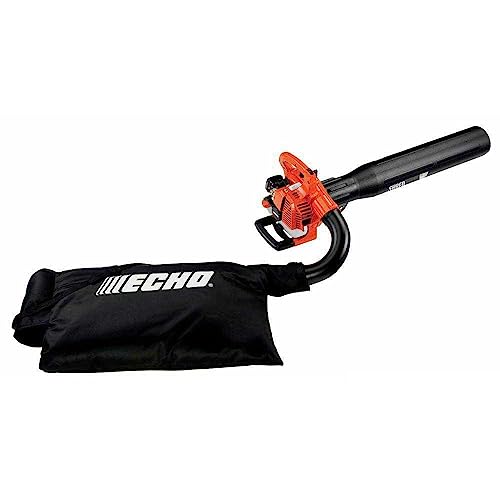
The Echo ES-250 is a handheld gas leaf vacuum that punches well above its weight class. Its 25.4cc 2-stroke engine generates 391 CFM of airflow at 165 MPH, enough suction to lift wet oak leaves and small sticks without the operator needing to angle the tube aggressively. The variable speed control gives fine-grained throttle modulation, which is useful when transitioning from open lawn to tight garden beds where you need less suction to avoid pulling up mulch.
Owners unanimously praise the starting reliability—pre-mixed gas and a few primer pumps typically fire the engine on the first or second pull. The unit weighs 11 pounds dry, which is manageable for extended use, and the 16.9-ounce fuel tank provides roughly 30 minutes of continuous run time at full throttle. The vacuum mode uses metal mulching blades that reduce leaf volume by approximately 12:1, turning a full yard’s worth of leaves into a single bagful. The included shoulder strap and debris bag are functional, though some users replace the Velcro bag connection with a bungee for a more secure fit.
Where the ES-250 differentiates itself from other handheld vacs is its consistent suction over time. Many handheld units lose vacuum power as the bag fills, but Echo’s impeller design maintains airflow by pulverizing material before it enters the bag. This means you spend less time shaking the bag to settle debris and more time moving through the yard. The EPA-compliant engine also runs cleaner than older 2-stroke designs, producing less smoke and odor during operation.
Why it’s great
- Reliable starting with pre-mixed gas and primer pump
- Maintains suction even as bag fills
- Variable speed control for precise throttle modulation
Good to know
- Velcro bag connection may need bungee reinforcement
- Shoulder strap design could be more ergonomic
6. Husqvarna 125BVx

The Husqvarna 125BVx is a 28cc handheld blower-vac combo engineered for users who need strong blowing performance (470 CFM, 170 MPH, 12.5 N of clearing force) with the occasional ability to vacuum and mulch. The 2-cycle engine reduces emissions by up to 60% compared to older designs and improves fuel efficiency by 20%, a meaningful difference when you are covering a half-acre property multiple times per season. The cruise control function is a genuine convenience—set the throttle and focus on directing the tube rather than holding the trigger.
The vacuum attachment uses metal mulching knives that reduce leaf volume effectively, and the bag is large enough to handle a full yard’s worth of leaves before needing to dump. Owners report that the unit starts easily and runs quieter than previous Husqvarna models, with a measured noise level around 70 dB—quiet enough for residential use without hearing protection for short periods. The auto return stop switch resets to the on position automatically, simplifying the restart process after refueling.
The trade-off for this versatility is that vac mode can clog on heavy debris, particularly wet leaves or pine needles that have matted together. The tube-to-vac transition requires removing the blower tube and attaching the vacuum kit, a process that takes about a minute once you are familiar with the latches. Some owners recommend using synthetic oil and non-ethanol fuel to extend engine life, and the spark arresting screen is a thoughtful addition for fire-prone areas. For homeowners who want one tool that does both jobs adequately, the 125BVx is a strong contender.
Why it’s great
- Cruise control reduces hand fatigue during long sessions
- Emissions reduced 60% with improved fuel efficiency
- Starts easily and runs quieter than previous Husqvarna models
Good to know
- Vac mode can clog on wet, matted debris
- Blow-to-vac mode transition takes practice
7. STIHL SHA 56

The STIHL SHA 56 represents the new wave of battery-powered handheld vacuum mulchers that eliminate fuel mixing, pull cords, and exhaust fumes. Its 36-volt AK20 battery system delivers cordless convenience with noise levels at 81 dB—significantly quieter than any gas handheld, making it suitable for noise-sensitive neighborhoods or early-morning cleanup. The suction is strong enough to pick up wet leaves and light debris, and the integrated mulching impeller reduces volume effectively before material enters the collection bag.
Owner feedback reveals a critical purchasing consideration: many listings for the SHA 56 do not include the battery and charger, despite product images showing them. Buyers must verify the specific SKU or bundle (like the one including AK20 battery and AL101 charger) to avoid receiving a non-functional unit. When properly equipped, the AK30 battery provides roughly 30 minutes of run time and takes 2–3 hours to charge, making this setup best suited for small to medium properties where you can work in timed sessions or keep a spare battery charging.
The SHA 56’s ergonomic design is a clear advantage over gas handhelds for operators with smaller stature or those who experience arm fatigue from heavier units. At approximately 7 pounds (battery included), it is significantly lighter than any gas handheld vac, allowing longer operation with less strain. The adjustable speed trigger gives precise suction control, and the tube design reduces clogging compared to earlier battery vac models. This is the right choice for homeowners who prioritize low noise, zero emissions, and easy operation over raw runtime.
Why it’s great
- Extremely quiet operation at 81 dB
- Lightweight and ergonomic, reduces operator fatigue
- Zero emissions, no fuel mixing or pull cords
Good to know
- Battery and charger sold separately in some configurations
- 30-minute runtime requires battery management for larger yards
8. SuperHandy GUO056

The SuperHandy GUO056 is an electric standalone mulcher that prioritizes stationary throughput over portability. Its 15-amp motor spins three 11-inch steel blades at 4,100 RPM, providing enough cutting force to reduce dry leaves, grass clippings, and small stems up to half an inch in diameter. The powder-coated steel housing is built to withstand repeated use without cracking, and the overload protection circuit prevents motor burnout when you accidentally feed material too quickly.
This unit is not designed for wet or damp material—owners consistently report that damp leaves clump and clog the blade assembly, requiring disassembly to clear. It excels at processing dry hay, straw, and leaf litter into fine bedding or compost base. Some users have repurposed the SuperHandy as a hay chopper for senior animals with dental issues, finding that it works faster and clogs less than string-based mulchers. The included 6-inch wheels make it easy to move around a garage or shed, though the 53.7-pound weight means you will not be carrying it far.
A notable limitation is the lack of a collection bag or discharge chute in the base configuration. The machine grinds material and drops it onto the ground below, creating a mess that requires jury-rigging a chute and bag setup. This is a minor inconvenience for users who plan to mulch directly into a compost bin or trailer, but it is a significant drawback for those expecting a complete ready-to-use system. For the price, the build quality is excellent, but the missing collection components push this unit toward niche applications rather than general-purpose mulching.
Why it’s great
- Powerful 15-amp motor with 11-inch steel blades
- Powder-coated steel housing is exceptionally durable
- Effective hay chopper for animal bedding or feed
Good to know
- No collection bag included, requires DIY chute
- Clogs quickly with damp or wet material
9. Flowtron LE900

The Flowtron LE900 is an electric standalone mulcher that has been a staple in the budget segment for years. Its universal motor drives a patented two-step double shredding process using replaceable cutting lines (not steel blades), achieving a maximum 30:1 mulch ratio when set to fine coarseness. The 21-inch wide funnel accepts double handfuls of material, and the rotating hopper allows feeding from any angle without repositioning the machine. At 17 pounds, it is remarkably lightweight and breaks down for compact storage in a shed or truck bed.
The LE900 is strictly a dry-leaf machine. Owners who attempt to process wet leaves, grass clippings, or material with twigs mixed in quickly encounter jams and motor overload. The reset button is located inside the unit, requiring bag removal to access—a design flaw that becomes frustrating during active use. Assembly is straightforward, but the plastic hopper is prone to cracking if overtightened; careful assembly with the included instructions is essential. The legs tend to loosen from vibration during extended operation, so periodic retightening is necessary.
Despite its limitations, the LE900 fills a genuine need for owners who deal with massive volumes of dry deciduous leaves and want the highest possible volume reduction. The 30:1 ratio means a pile of leaves that would fill 30 paper bags compresses into a single bag of fine mulch. The replacement cutting lines (Flowtron LER-100) are inexpensive and easy to install, keeping long-term maintenance costs low. For large properties where leaves accumulate in drifts and the budget is tight, the LE900 delivers impressive reduction performance—provided you feed it only what it can handle.
Why it’s great
- 30:1 mulch ratio provides extreme volume reduction
- Lightweight at 17 lbs and breaks down for storage
- Inexpensive replacement cutting lines
Good to know
- Clogs and overloads with wet leaves or twig debris
- Reset button location requires bag removal to access
FAQ
Can a handheld leaf vacuum mulcher handle wet leaves effectively?
What is the practical difference between a mulch ratio of 12:1 and 30:1?
How often should I replace the cutting lines on a string mulcher like the Flowtron LE900?
Is a tow-behind leaf vacuum worth the investment for a 1-acre property?
Do battery-powered leaf vacuums like the STIHL SHA 56 have enough power for commercial use?
Final Thoughts: The Verdict
For most users seeking the best commercial leaf vacuum mulcher, the winner is the Agri-Fab Mow-N-Vac because its 208cc engine and 32-cu-ft bag provide the best balance of throughput, durability, and value for large properties. If you want a powerful handheld that doubles as a blower, grab the Husqvarna 125BVx. And for zero-emission, quiet operation on smaller yards, nothing beats the STIHL SHA 56 battery system.

Mo Maruf
I created WellFizz to bridge the gap between vague wellness advice and actionable solutions. My mission is simple: to decode the research and give you practical tools you can actually use.
Beyond the data, I am a passionate traveler. I believe that stepping away from the screen to explore new environments is essential for mental clarity and physical vitality.