Our readers keep the lights on and my smoothie glass nicely filled. As an Amazon Associate, I earn from qualifying purchases.
A dull blade in a busy kitchen is not just a productivity killer—it’s a safety hazard. A commercial knife sharpener must deliver consistent, repeatable edges across high volumes of use, from delicate filets to heavy cleavers, without damaging expensive steel or requiring a sharpening expert on staff.
I’m Mohammad Maruf — the founder and writer behind WellFizz. I’ve spent hundreds of hours analyzing abrasive materials, angle-guide systems, and motor specifications in this narrow category to separate the tools that genuinely restore metal from those that just grind it away.
Whether you run a high-volume restaurant or a serious home prep station, finding the right best commercial knife sharpener means looking past the marketing and into the grit rating, angle precision, and build material that actually match your workflow.
How To Choose The Best Commercial Knife Sharpener
A sharpener for commercial use needs to survive heavy cycles, handle varied blade geometries, and maintain precise angles without shifting. The wrong choice can eat through expensive knives or leave you with edges that fail mid-service.
Abrasive Type and Durability
Diamond abrasives are the gold standard for commercial settings because they cut hard steel quickly and maintain their grit over hundreds of sharpenings. Bonded whetstones wear faster and need truing, while ceramic rods are best for honing between full sharpening cycles. Check whether the abrasive is plated (diamond) or vitrified (stone)—plated diamond lasts longer but costs more upfront.
Angle Control and Repeatability
A commercial sharpener must lock into a precise angle and return to it reliably. Look for systems with positive stops, click-adjustable guides, or digital angle indicators. A deviation of even 2° across the blade length will produce an uneven edge that fails quickly. Guided systems (either electric or manual) are vastly superior to freehand rods in high-volume environments.
Throughput and Ease of Cleaning
If you sharpen more than ten knives per day, an electric belt-driven system or a three-stage diamond wheel sharpener will save hours. Manual guided systems offer superior edge quality but take longer per knife. Also consider whether the unit has a built-in vacuum or is dishwasher-safe—metal and abrasive dust accumulate fast in a commercial kitchen.
Quick Comparison
On smaller screens, swipe sideways to see the full table.
| Model | Category | Best For | Key Spec | Amazon |
|---|---|---|---|---|
| Chef’sChoice 15XV (Metal Housing) | Electric Premium | Daily commercial use, 15° edges | 100% Diamond Abrasives, 3-Stage, 5 lbs | Amazon |
| Tormek T-4 | Water Cooled Stone | Chisels, plane irons, precision tools | Water Cooled 8″ Stone, 20 lbs | Amazon |
| Work Sharp Ken Onion Mk.2 | Belt Electric | Versatile sharpening, scissors & axes | Flexible Belts, Variable Speed 15-30° | Amazon |
| KME Precision System | Manual Guided | Hard steel, exact angles | 140-1500 Grit Diamond Hones, 17-30° | Amazon |
| Work Sharp E5 Culinary | Electric Belt | Quick kitchen knife sharpening | Flexible Belts, Built-in Vacuum | Amazon |
| SHARPAL 202H System | Manual Guided | Full grit progression, mirror polish | 7 Abrasive Plates, 10-35° Adjustable | Amazon |
| Chef’sChoice 15XV (Standard) | Electric Mid-Range | Home to light commercial, serrated blades | 100% Diamond Abrasives, 3-Stage | Amazon |
| Warthog V-Sharp Elite | Manual Jig | Hunting & pocket knives, adjustable angles | Diamond Rods, 15-30° Adjustable | Amazon |
| F. DICK DICKORON Classic | Sharpening Steel | Daily honing between sharpenings | Sapphire Corrugation, 65 HRC | Amazon |
In‑Depth Reviews
1. Chef’sChoice 15XV Professional Electric (Metal Housing)

The Chef’sChoice 15XV with metal housing is engineered for durability in high-turnover kitchens. Its 100-percent diamond abrasive stages and precision spring-loaded angle guides convert traditional 20° edges into a 15° Trizor XV edge in about one minute, with resharpening taking only ten seconds. The 5-pound weight keeps the unit stable on any counter, and the metal upper housing withstands the bumps of daily commercial use better than the standard plastic version.
Stage 1 and 2 use plated diamond abrasives to sharpen and hone, while stage 3 employs a patented flexible stropping system that polishes the edge and maintains serrated blades. Noise levels hover between 65 and 75 dB—noticeable but not deafening during a busy service prep. The spring guide automatically adjusts to blade thickness, so there is no learning curve for new staff.
This model excels at maintaining a fleet of German and Japanese stainless knives at peak sharpness with minimal effort. It does remove more metal per pass than a manual guided system, so it is best for knives that see regular sharpening cycles rather than rare restoration. The 3-year warranty adds confidence for high-volume environments where equipment takes daily abuse.
Why it’s great
- Metal housing adds real durability for daily commercial use
- 15° Trizor XV edge delivers exceptional slicing performance
- 10-second resharpening keeps workflow uninterrupted
Good to know
- Removes more metal per cycle than manual guided systems
- Polishing stage less effective on deeply scalloped serrated blades
2. Tormek T-4 Water Cooled Sharpening System
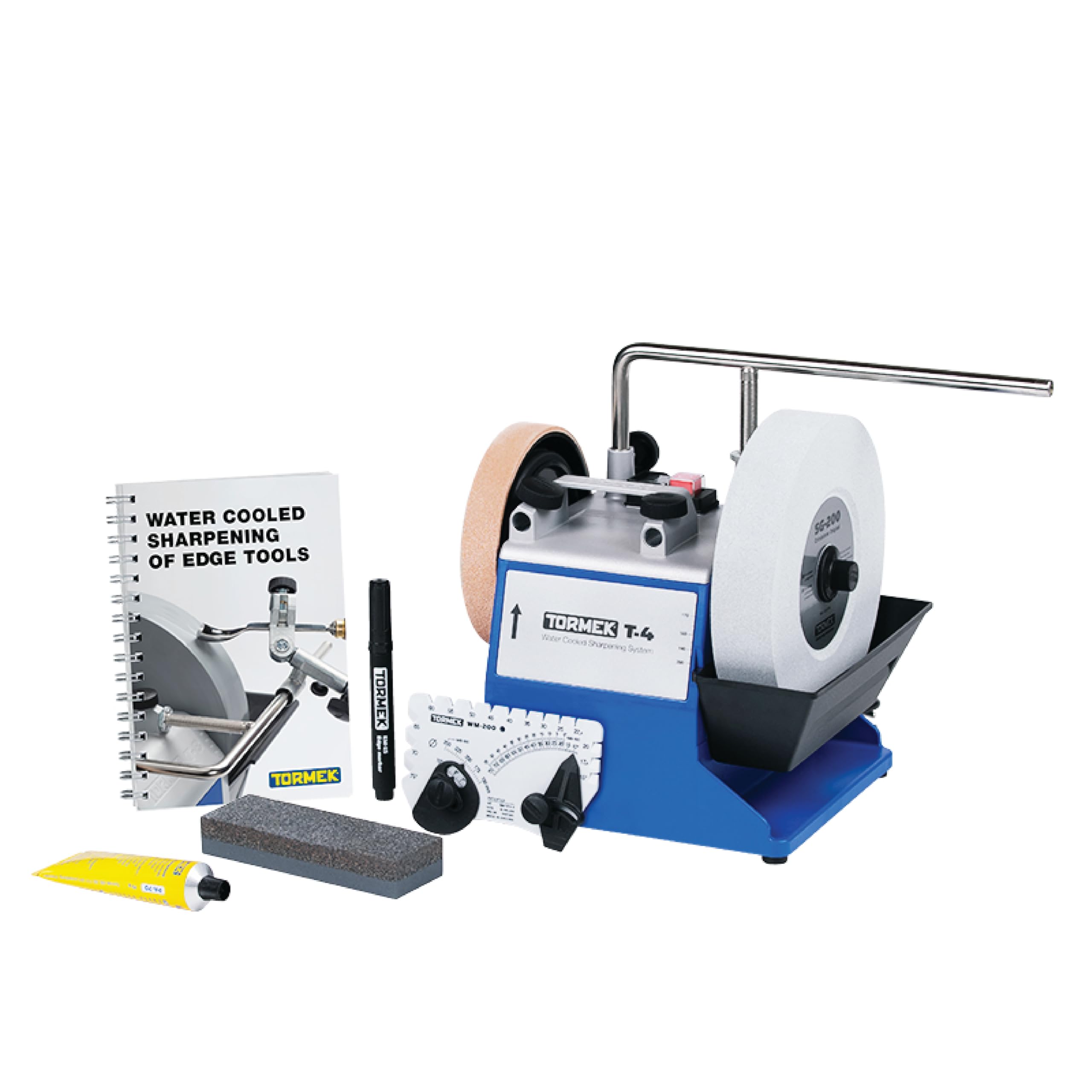
The Tormek T-4 is the industry reference for water-cooled sharpening, using a slowly rotating 8-inch stone submerged in water to prevent steel overheating—critical for maintaining the hardness of edge tools like chisels, plane irons, and high-carbon kitchen knives. The zinc cast top and integrated base create a stable platform that eliminates vibration, while the universal support with micro-adjust scale allows precise angle setting for any blade width.
This system uses the same jigs as the larger Tormek T-7, including the knife jig (sold separately), and includes the SP-650 stone grader that refreshes the stone surface. The 20-pound weight means it stays put during heavy use, but it also means you need dedicated bench space. The water trough keeps metal particles contained and prevents dust from flying into the air—a serious advantage in a food-prep environment.
Where the T-4 shines is edge consistency across multiple tools. Once you set the jig, every pass removes the same amount of steel at the same angle, producing perfectly flat bevels. The tradeoff is speed—the slow 90 RPM stone takes longer per knife than a belt-driven system, making the T-4 ideal for precision tool maintenance rather than high-volume knife sharpening. Users note that the included jigs are minimal; expect to buy the SE-77 square edge jig and knife jig separately for full functionality.
Why it’s great
- Water cooling preserves blade hardness and prevents burning
- Consistent angle repeatability across all edge tools
- Low dust and metal particle containment for clean workspaces
Good to know
- Requires separate jigs for knives and chisels—not included
- Slower throughput compared to belt-driven electric sharpeners
3. Work Sharp Ken Onion Mk.2 Knife & Tool Sharpener

The Work Sharp Ken Onion Mk.2 uses flexible abrasive belts—the same method manufacturers use to grind factory edges—combined with electronic speed control to deliver professional-level results across knives, scissors, serrated blades, and even axes. The adjustability of 15–30° angle guides and variable motor speed means you can dial in a coarse belt for reprofiling a damaged blade or a fine belt for a polished working edge on a chef’s knife.
At just 2 pounds, this unit is portable enough to move between stations, though its plastic housing is less durable than metal-cased competitors for full-time commercial use. The belt system runs hot, so users should avoid pressing hard—light passes keep the blade temperature down and extend belt life. An assortment of belts (P80 to P1000) lets you cover everything from heavy repair to honing, but the included kit only covers basic grits.
This sharpener excels as a versatile tool for kitchens that also maintain shears, garden tools, or hunting knives. The learning curve is moderate: users must guide the blade evenly across the belt to avoid creating a convex edge. The 3-year warranty and Oregon-based support add confidence for long-term ownership. Many users recommend buying extra 800 and 1000 grit belts specifically for kitchen knives to get the best finish.
Why it’s great
- Adjustable angle from 15° to 30° covers most blade types
- Variable speed motor lets you match belt speed to steel hardness
- Sharpens scissors, axes, and serrated blades in addition to knives
Good to know
- Belts wear and need replacement—ongoing consumable cost
- Plastic housing less durable for heavy commercial impact
4. KME Precision Knife Sharpener System with Gold Series Diamond Hones

The KME Precision System is a guided manual sharpener built for exacting edge geometry on hard steels like S90V and ZDP-189. Its spherical bearing rod guide eliminates angle deviation during the stroke, and the rotating clamp lets you switch sides without re-mounting the blade—preserving the exact same angle on both bevels. The included four Gold Series diamond hones (140 extra-coarse, 300 coarse, 600 fine, 1500 extra-fine) cover the full range from reprofiling to sharpening.
Continuous angle adjustment from 17° to 30° in 1° increments means you can match the blade’s original geometry or experiment with lower angles for improved slicing performance. The wood base keeps the unit stable, and the included hard carry case makes it portable. Users report that the diamond stones cut aggressively even on the toughest powdered metallurgy steels, and the 1500 grit hone produces an edge suitable for EDC and kitchen knives out of the box.
Where the KME stands apart is repeatability. Once you set the angle, every stone in the kit follows the same guide path, producing uniformly flat bevels free of convexity. The tradeoff is speed—manual guided sharpening takes longer per knife than an electric system. Many users add a leather strop or a Chosera 5000 stone for a surgical polish. The system is best for small-batch sharpening where edge quality matters more than throughput.
Why it’s great
- Spherical bearing guide delivers zero angle deviation
- Rotating clamp eliminates re-mounting for consistent bevels
- Diamond hones cut hard and exotic steels easily
Good to know
- Slow process—not ideal for high-volume commercial knife sharpening
- Small screws and bolts may loosen during use and require re-tightening
5. Work Sharp Professional Electric Culinary E5

The Work Sharp E5 is the only electric culinary sharpener that uses flexible abrasive belts—exactly how knife manufacturers create factory edges—combined with pre-programmed sharpening cycles that finish in under 90 seconds. Three settings let you shape a damaged edge, sharpen a dull blade, or hone a working knife, and the unit automatically shuts off at cycle end. The built-in vacuum captures sharpening debris, keeping counters clean in a food-prep environment.
The E5 accommodates all popular knife brands and styles, including high-end exotic steels, and also sharpens kitchen scissors and poultry shears. The angle is fixed at 20°, which matches most Western-style kitchen knives but will not accommodate Japanese 15° blades without the optional upgrade belt kit. The plastic housing is lighter than metal alternatives but feels robust enough for daily home or light commercial use.
This unit is best for users who want the speed of a belt-driven system with the cleanliness of a vacuum. The tradeoff is limited angle adjustability—the base model only sharpens at 20°, and the upgrade kit costs extra. Belt tension and alignment require occasional attention, but the overall user experience is straightforward enough for staff training. The 1.26 kg weight makes it easy to store when not in use.
Why it’s great
- Flexible belts replicate factory sharpening method
- Built-in vacuum keeps workspaces free of metal dust
- Pre-programmed cycles remove guesswork for consistent results
Good to know
- Angle is fixed at 20° without the optional upgrade kit
- Plastic housing may not survive drops in a busy commercial kitchen
6. SHARPAL 202H Precision Knife Sharpening System
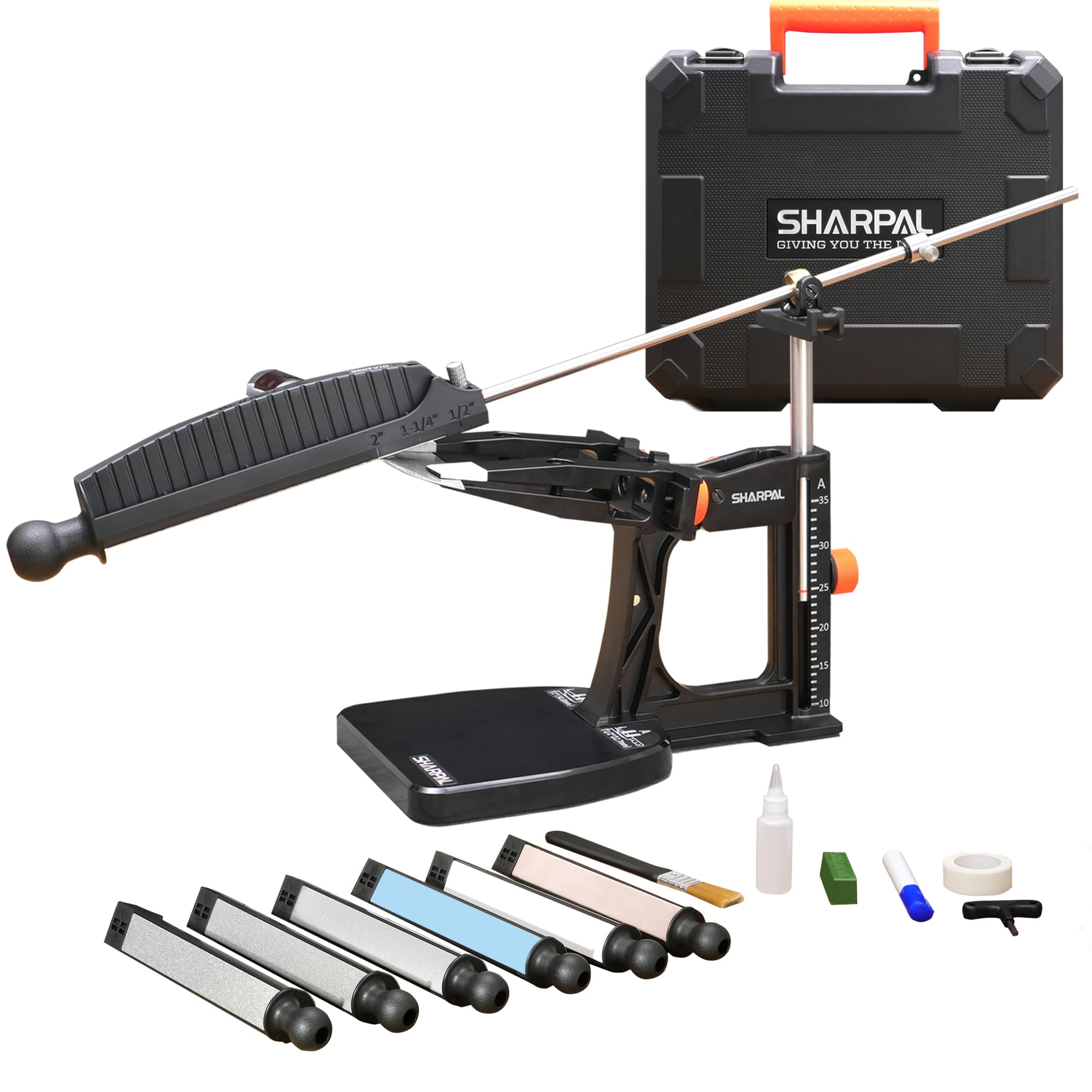
The SHARPAL 202H is a comprehensive guided manual system that includes seven abrasive plates—monocrystalline diamond plates in 220, 325, 600, and 1000 grit, whetstone plates in 3000 and 6000 grit, and a leather strop with green polishing compound. That grit range covers everything from aggressive reprofiling to a mirror-polished edge, all in one carry case. The system adjusts smoothly from 10° to 35° using a patented distance-based setting that keeps the edge-to-clamp distance fixed regardless of blade width.
Dual sliding clamps hold blades of any length securely, and the flip mechanism maintains the same angle on both sides without re-measurement. The heavy-duty metal construction and anti-slip base keep the unit stable during use, even with heavy pressure on coarse diamond plates. Users note that the 220 grit diamond plate raises a burr in seconds on dull knives, and the 6000 grit whetstone produces a polished edge suitable for precision slicing.
This system stands out for its complete grit progression and thoughtful accessories. The rigid carry case keeps everything organized and protected, making it suitable for mobile sharpening services or kitchen staff who bring their own kit. The tradeoff is that manual guided sharpening takes longer per knife than an electric system—expect 7–10 minutes per knife for a full progression from coarse to polished edge. The 3-year warranty and California-based customer service add peace of mind.
Why it’s great
- Seven abrasive plates cover full grit range from 220 to 6000 plus strop
- Patented distance-based angle setting eliminates width variation errors
- Heavy-duty metal construction with anti-slip base ensures stability
Good to know
- Manual process takes longer per knife than electric alternatives
- Additional jaws for very thick blades (0.375″) not yet available
7. Chef’sChoice 15XV EdgeSelect Professional Electric (Standard Housing)

The standard Chef’sChoice 15XV uses the same 100-percent diamond abrasive technology and 3-stage EdgeSelect system as the metal-housing version but in a lighter gray housing. It converts traditional 20° edges to 15° Trizor XV edges, with first-time sharpening taking about one minute and resharpening in ten seconds. The patented flexible spring guides automatically adjust to blade thickness, making it easy for any staff member to use correctly.
Stage 1 and 2 use plated diamond abrasives, and stage 3 uses a flexible abrasive system that polishes the edge and supports serrated blades. The unit measures 10 x 4.25 x 4.25 inches and weighs 4.19 pounds—stable enough for countertop use but light enough to store. The 3-year limited warranty covers manufacturing defects. Users consistently report that this sharpener restores razor-sharp edges to German and Japanese knives with minimal effort.
This model is a solid choice for home kitchens and light commercial environments where the metal housing is not essential. It produces identical edge quality to the metal version at a lower investment. The plastic housing is less resistant to impact, so it is best placed on a stationary counter rather than being moved between stations. Some users note that the plastic lip under the blade exit can get notched by sharp knife tips over time.
Why it’s great
- Same 100% diamond abrasive stages as the metal-housing version
- 10-second resharpening cycle maintains edge during service
- Patented spring guides automatically adjust to blade thickness
Good to know
- Plastic housing less durable for daily commercial impact
- Plastic exit lip may notch over time from sharp blade tips
8. Warthog V-Sharp Elite Knife Sharpener with Wooden Base

The Warthog V-Sharp Elite uses a patented V-Sharp mechanism with spring-loaded diamond rods that sharpen both sides of the blade simultaneously. The system offers four adjustable angle settings—15°, 20°, 25°, and 30°—allowing you to match the edge geometry to the specific knife: 15° for delicate Japanese filets, 20° for kitchen knives, and 25–30° for heavy hunting or bushcraft blades. The metal frame and powder-coat finish provide durability, while the deluxe wooden base adds a traditional look.
The kit includes a 325-grit natural diamond hone for coarse sharpening and a hardened steel hone for finishing. Because the rods are spring-loaded, they maintain consistent pressure across the blade edge, producing a uniform bevel without requiring perfect hand technique. The compact 9 x 9 x 6-inch footprint fits easily on a countertop or in a drawer, making it suitable for kitchens with limited space.
This system is best for users who want a simple, consistent jig without the complexity of a full guided manual system. The tradeoff is that the V-Sharp mechanism cannot sharpen the last 1/8 inch of the blade near the heel, and the spring-loaded rods may scratch highly polished or decorative blades. Users recommend following up with a steel or fine whetstone to remove any rough edge left by the coarse diamond hone for the finest finish on kitchen knives.
Why it’s great
- Spring-loaded rods sharpen both sides simultaneously for speed
- Four angle settings cover everything from filets to machetes
- Compact footprint with deluxe wooden base for countertop use
Good to know
- Cannot sharpen the last 1/8 inch of the blade near the heel
- Spring pressure may scratch soft or decorative blade finishes
9. F. DICK DICKORON Classic Sharpening Steel

The F. DICK DICKORON Classic is a sharpening steel designed for daily honing between full sharpening sessions, not for restoring a dull edge. Its special sapphire corrugation creates a very smooth sharpening action that aligns and polishes the existing edge without removing significant metal. The oval shape provides a wider bearing surface than a round steel, giving the user more contact area and better control during the honing motion.
At 65 HRC, the steel rod is hard enough to handle any commercial kitchen knife without deforming, and the non-slip synthetic handle includes a finger guard for safety. The 11.8-inch rod length accommodates chef knives up to 10 inches. Made in Germany, the steel is corrosion-resistant, though a few users have reported surface oxidation in high-moisture environments—cleaning and drying after each use is recommended.
This tool is essential for any commercial kitchen that uses high-carbon or stainless knives and wants to extend the time between full sharpening cycles. It is not a replacement for a knife sharpener—it only hones. The oval shape takes a moment to get used to if you have always used round steels. The included plastic sheath protects the rod during storage. This is a finishing tool, not a primary sharpener, so it belongs in the rotation alongside a dedicated sharpening system.
Why it’s great
- Sapphire corrugation provides exceptionally smooth honing action
- Oval shape offers wider contact surface for better control
- 65 HRC hardness handles high-carbon and stainless steels without wear
Good to know
- This is a honing steel, not a sharpener—cannot restore a dull edge
- Oval shape requires a slight adjustment from traditional round steels
FAQ
What is the difference between a honing steel and a knife sharpener?
Should I choose a diamond abrasive or a whetstone for commercial use?
How often should a commercial kitchen sharpen its knives?
Can a water-cooled system like the Tormek T-4 be used for high-volume knife sharpening?
What blade angle is best for a commercial chef’s knife?
Final Thoughts: The Verdict
For most users, the best commercial knife sharpener winner is the Chef’sChoice 15XV Professional Electric with Metal Housing because it combines 100% diamond abrasives, a 3-stage system, and a durable brushed metal body that survives daily professional use while delivering consistent 15° edges in under a minute. If you need precision for edge tools and high-carbon knives, grab the Tormek T-4 Water Cooled System for its unmatched angle repeatability and burn-free grinding. And for versatile multi-tool sharpening at a moderate investment, nothing beats the Work Sharp Ken Onion Mk.2 with its flexible belt system and variable speed control.

Mo Maruf
I created WellFizz to bridge the gap between vague wellness advice and actionable solutions. My mission is simple: to decode the research and give you practical tools you can actually use.
Beyond the data, I am a passionate traveler. I believe that stepping away from the screen to explore new environments is essential for mental clarity and physical vitality.