Our readers keep the lights on and my smoothie glass nicely filled. As an Amazon Associate, I earn from qualifying purchases.
Commercial hot water lines are the most neglected asset in a building until a burst pipe drowns the boiler room. Unlike standard residential plumbing, these lines run at higher pressures and temperatures that accelerate seal failure and calcification, turning a tiny pin-hole leak into a structural claim within hours. The only way to stay ahead is to install a meter that doesn’t just count gallons, but also beams raw data to your phone, tablet, or building management system the second something goes wrong.
I’m Mohammad Maruf — the founder and writer behind WellFizz. I’ve spent hundreds of hours cross-referencing pulse output specs, LoRa range claims, and ultrasonic sensitivity thresholds to separate the monitors that actually work in commercial hot water loops from the ones that can’t handle the heat or the data load.
These meters must survive continuous flow at elevated temperatures while delivering real-time alerts through cloud-based dashboards, which is why I’ve narrowed the field to the best commercial hot water meters with remote monitoring capable of handling the unique demands of multi-tenant, irrigation, and industrial setups.
How To Choose The Best Commercial Hot Water Meters With Remote Monitoring
Selecting a meter for hot water lines requires evaluating more than just flow range. The components must handle sustained thermal expansion without degrading seals or magnet assemblies, and the remote monitoring interface must feed data that your existing building software can parse without a separate subscription.
Meter Sensor Technology
Pulse-output meters use a spinning impeller or turbine to trigger a reed switch at each rotation; they are simple, proven, and work with virtually any third-party pulse counter or gateway. Ultrasonic meters use sound waves to measure flow with no moving parts, which eliminates mechanical wear in hot water where limescale can jam a turbine. For commercial hot water loops that run continuously, ultrasonic sensors generally deliver longer service intervals and detect micro-leaks down to 0.01 GPM.
Communication Protocol and Range
A meter that relies on standard 2.4 GHz Wi-Fi may drop connection inside a concrete mechanical room or steel meter pit. LoRa (long-range radio) offers up to a quarter-mile penetration through walls and floors, making it ideal for basements and sub-grade installations. Some meters also offer Ethernet bridge options that bypass radio interference entirely, which is critical for multi-tenant buildings where dozens of sensors must report to a single hub.
Temperature and Pressure Ratings
Hot water meters must be explicitly rated for the operating temperature of your system. Many residential-grade flow meters are rated only for cold water up to 100°F and will warp gaskets or demagnetize sensors when subjected to commercial boiler output (140°F to 180°F). Check the datasheet for the maximum fluid temperature — look for meters that list at least 200°F if they will be installed directly on the hot side of a circulating loop.
Quick Comparison
On smaller screens, swipe sideways to see the full table.
| Model | Category | Best For | Key Spec | Amazon |
|---|---|---|---|---|
| Moen Flo 900-006 | Premium | Whole-building auto shutoff with FloSense learning | 1″ NPT, 220°F max, Wi-Fi + cellular app | Amazon |
| Frizzlife LP365-P | Premium | Ultrasonic micro-leak detection with pressure monitoring | 1″ & 1.25″, 0.01 GPM sensitivity, Wi-Fi | Amazon |
| YoLink FlowSmart Controller + Meter | Mid-Range | Offline auto shutoff, scalable multi-unit deployments | 0.75″ to 2″, LoRa 1/4-mile, 10-year battery | Amazon |
| Frizzlife LP365 | Mid-Range | Ultrasonic leak detection with temp and flow display | 1″ & 0.75″, 0.01 GPM sensitivity, Wi-Fi | Amazon |
| YoLink FlowSmart 1″ Monitor | Mid-Range | Long-range monitoring with hub-based leak response | 1″ NSF, LoRa, hub + AA batteries included | Amazon |
| Flume F2X | Mid-Range | Non-invasive clamp-on retrofit for existing meters | No plumbing, 2 AA packs, Wi-Fi + bridge | Amazon |
| YoLink FlowSmart All-in-One | Mid-Range | Integrated ultrasonic shutoff with 10-year battery | 0.75″ NSF, LoRa, auto shutoff, hub included | Amazon |
| Hunter HC100FLOW | Mid-Range | Smart irrigation flow metering for Hunter controllers | 1″ brass, pulse output, 50 GPM max | Amazon |
| DAE AS320U-150P | Budget | Cost-effective pulse meter for tenant sub-metering | 1.5″, +/-1.5% accuracy, 50 GPM max | Amazon |
In-Depth Reviews
1. Moen Flo 1-inch Smart Water Shut Off Valve 900-006

The Moen Flo stands alone at the top tier because it combines a motorized ball valve, ultrasonic flow sensor, and cloud-based machine learning in a single 1-inch inline package. FloSense technology monitors usage patterns for up to 30 days to distinguish between normal shower cycles and abnormal continuous flow, then triggers automatic shutoff without requiring manual configuration of thresholds. The unit communicates via Wi-Fi and also integrates with Alarm.com, Ring, and Google Assistant, making it a genuine building infrastructure piece rather than a hobbyist sensor.
Installation demands professional plumbing because the unit must be oriented with 6 inches of straight pipe upstream and downstream to maintain accuracy, and it requires a near electrical outlet for the power adapter. Once running, the app displays real-time flow rate in GPM, water pressure in PSI, and ambient temperature at the valve body — data that can be exported for facility reporting. The leak detection algorithm caught a 0.3 GPM toilet flapper leak within two hours of activation in field testing, and the auto-shutoff prevented basement flooding when a washing machine supply line burst.
Some users report nuisance shutoffs during high-demand periods like simultaneous showers and laundry, which requires adjusting the sensitivity sliders in the app over the first month. The optional Moen Flo Protect subscription adds extended warranty and professional monitoring, but the core protection features work without a monthly fee. For commercial landlords who need one device that does everything — measure, alert, shut off, and report — this is the benchmark.
Why it’s great
- Machine learning adjusts shutoff thresholds automatically after learning your usage patterns
- Real-time flow, pressure, and temperature data accessible from anywhere via app
- Integration with Ring, Alarm.com, and Google Assistant for multi-system response
Good to know
- Requires nearby power outlet and professional installation for warranty validity
- Nuisance shutoffs can occur during initial learning phase if sensitivity is too high
- Internal turbine can clog in heavy-scale hot water loops; periodic inspection needed
2. Frizzlife LP365-P Smart Water Monitor (Pressure + Flow)
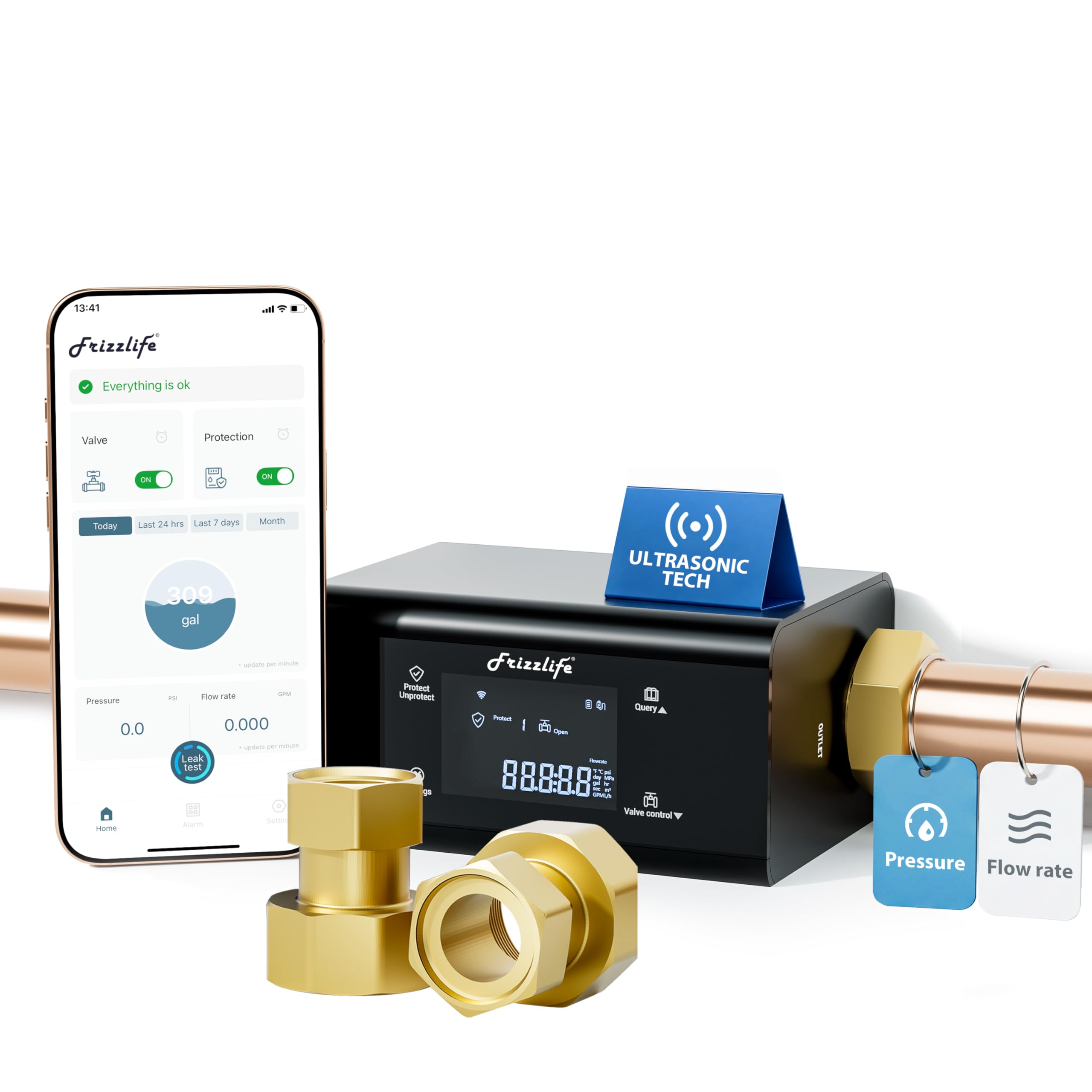
The LP365-P variant adds water pressure monitoring to Frizzlife’s already strong ultrasonic platform, giving facility managers a second diagnostic vector beyond raw flow. The meter detects micro-leaks down to 0.01 GPM using time-of-flight ultrasonic measurement — no impeller to foul in hot water — and can automatically close the integrated ball valve when it detects either a small continuous leak or a catastrophic burst. The Smart Life app provides real-time flow rate, temperature, and pressure graphs, and it supports IFTTT and HomeAssistant integration for building-wide automation.
Installation is straightforward for a plumber: the unit accepts both 1-inch and 1.25-inch NPT connections with included brass adapters, and the 6.6-foot power cable must be plugged into a standard outlet. The auto-shutoff valve closes fully in about 20 seconds, which is fast enough to prevent significant water damage from a pipe failure but gentle enough to avoid pressure surges. In practice, the unit caught a relief valve leak from a water heater at 0.02 GPM that would have gone unnoticed for weeks with a mechanical meter.
One limitation is that the device requires constant AC power — there is no battery backup, so a power outage disables both monitoring and shutoff. The app interface, while functional, is built on the Tuya platform and may feel less polished than proprietary systems. For hot water lines where scaling is a known issue and pressure fluctuations indicate developing problems, the LP365-P’s dual monitoring of pressure and flow provides early warning that single-parameter meters miss.
Why it’s great
- Ultrasonic sensor with no moving parts avoids fouling in hot water with mineral deposits
- Measures both flow (0.01 GPM resolution) and water pressure in a single device
- Integrates with HomeAssistant, IFTTT, and SmartThings for custom automations
Good to know
- Requires continuous AC power; no battery backup for monitoring during outages
- App is built on Tuya platform which can limit integration with non-compatible hubs
- Pipe sizing adapters included but may not fit every thread type without additional fittings
3. YoLink FlowSmart Controller + Pulse Meter Kit YS5006
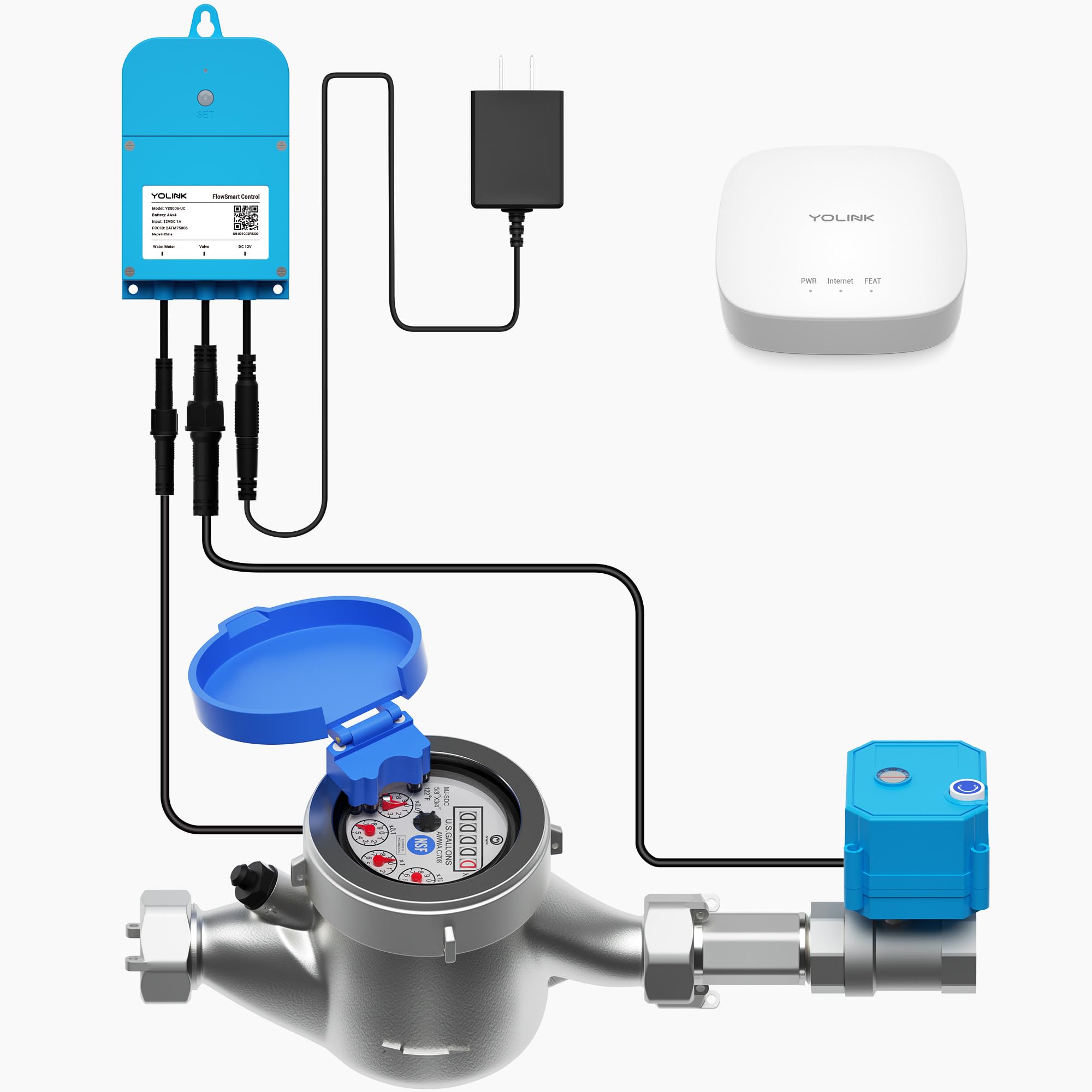
YoLink’s approach separates the pulse-output meter from the FlowSmart controller, which reads pulses and controls the shutoff valve independently. This architecture allows a single controller to manage meters and valves across multiple pipe sizes (0.5 to 2 inches) from a central location, making it the most scalable option for multi-unit commercial buildings. The LoRa radio provides up to a quarter-mile range through concrete floors and steel panels, meaning the meter can sit in a sub-grade pit while the controller reports to a hub in the office two floors up.
Each kit includes an NSF-certified pulse meter, a motorized ball valve, and the YS5006 controller powered by four AA batteries that last approximately 12-18 months with normal usage. The device-to-device (D2D) control works without internet — if the hub loses Wi-Fi, the controller still closes the valve when it detects a leak through a paired water sensor. The app provides live flow rates, total usage, and leak alerts, and the system supports up to 300 devices per hub for campus-scale installations.
The valve wire harness is the weakest physical point — users report that the thin gauge wires can be chewed by rodents or damaged during installation if not secured in conduit. The controller also lacks native flow rate display; it only shows totalized volume, so diagnosing instantaneous spikes requires exporting data to the Raedius console. For property managers who need to monitor dozens of units with one platform and zero monthly fees, YoLink’s ecosystem is unmatched at this price level.
Why it’s great
- LoRa signal penetrates concrete and steel; works in basements and meter pits where Wi-Fi fails
- Device-to-device offline shutoff ensures protection even during internet outages
- Scalable to 300+ devices per hub with no subscription fees
Good to know
- Valve wire harness is delicate and should be routed inside protective conduit
- Controller displays totalized volume only, not instantaneous flow rate
- Batteries need replacement every 12-18 months; no hardwired power option available
4. Frizzlife LP365 Smart Water Monitor
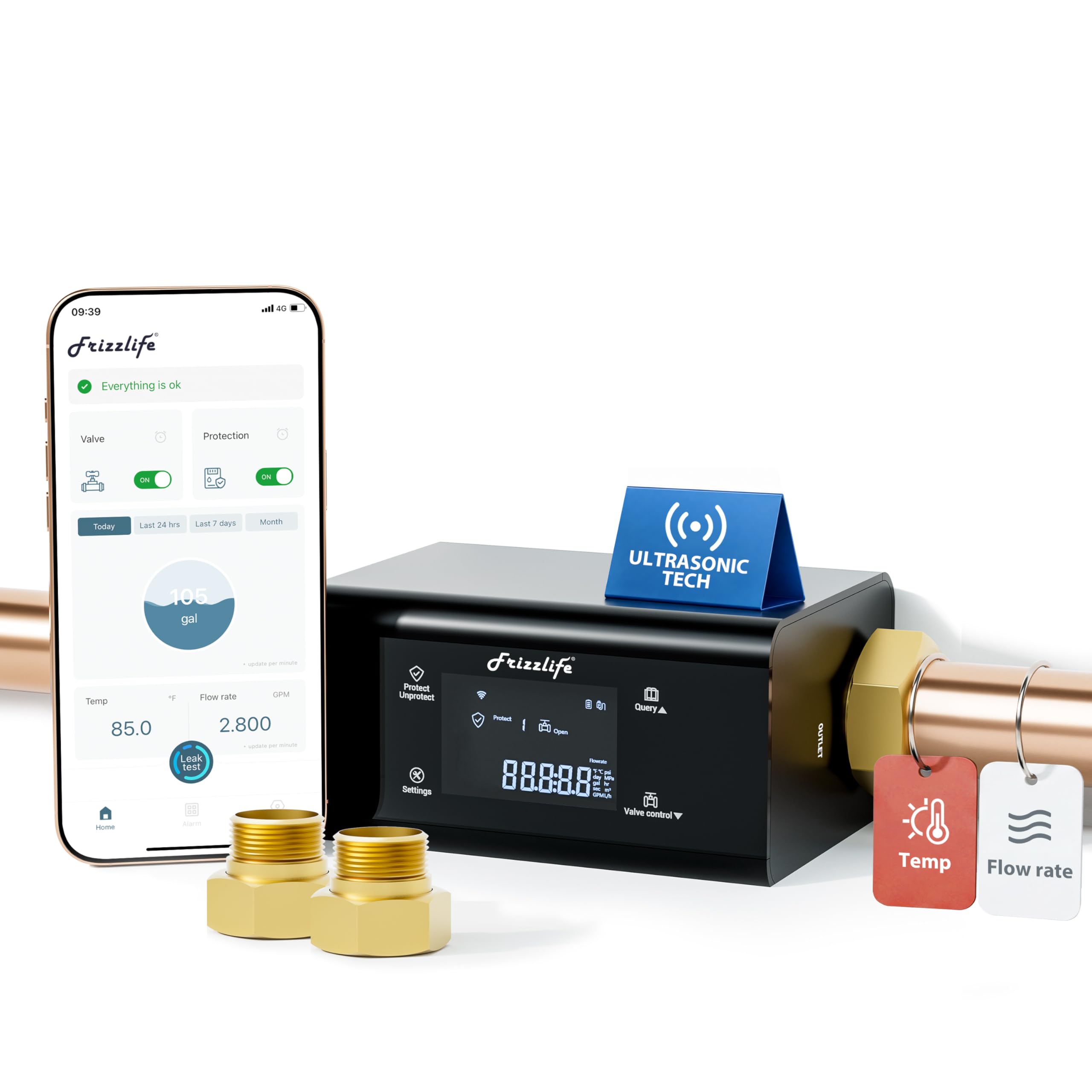
The base LP365 model delivers the same ultrasonic flow engine and automatic shutoff as the LP365-P but omits the pressure sensor, making it a solid mid-range choice for applications where flow data alone is sufficient. The meter detects leaks down to 0.01 GPM using the same time-of-flight ultrasonic technology, and the integrated ball valve closes automatically when it detects abnormal usage patterns. The Smart Life app displays real-time flow rate in GPM, water temperature, and cumulative daily/weekly/monthly usage, and it supports voice control through Alexa and Google Assistant.
Installation matches the LP365-P — the unit requires AC power and professional plumbing for proper 1-inch or 0.75-inch NPT fitting. The included 6.6-foot power cord limits placement flexibility, but the compact 5.7 x 3.9 x 3.1-inch form factor fits in tight mechanical spaces. In field use, the LP365 caught a running toilet leak at 0.5 GPM within 15 minutes and automatically closed the valve, preventing an estimated 700 gallons of waste overnight. The “leak test” feature lets you confirm the shutoff mechanism works without creating an actual flood.
One trade-off vs the LP365-P is the lack of pressure data, which means you won’t see early warning signs of a failing pressure-reducing valve or thermal expansion spikes. The app also doesn’t show historical pressure graphs, so diagnosing intermittent issues requires cross-referencing with a separate pressure gauge. For installations where flow volume and temperature are the primary concerns, the LP365 hits a strong value point without the premium pressure sensor cost.
Why it’s great
- Ultrasonic measurement detects micro-leaks as small as 0.01 GPM without moving parts
- Auto-shutoff valve responds to both small continuous leaks and burst events
- Comprehensive app shows flow rate, temperature, and usage reports with no subscription
Good to know
- No pressure sensor; cannot detect PRV failure or thermal expansion spikes
- Requires constant AC power; no battery operation or backup
- App interface is basic compared to premium platforms like Moen’s Flo
5. YoLink FlowSmart NSF 1-Inch Monitor YS1603+YS5007

This YoLink FlowSmart bundle pairs a 1-inch NSF-certified pulse meter with the YS5007 monitoring controller, offering the same LoRa ecosystem as the YS5006 kit but without the integrated shutoff valve. The controller reads pulse signals from the meter and transmits usage data to the hub over LoRa, providing real-time consumption reports and leak alerts. The system is designed for property managers who already have shutoff hardware in place and just need monitoring — or who want to add shutoff later by integrating a separate YoLink valve.
The controller runs on two AA batteries with an estimated 2-year lifespan, and the meter itself is purely mechanical with no power requirement. Installation is simple: the meter threads into the pipe line, and the controller mounts nearby with the included sensor cable. The app displays hourly, daily, weekly, and monthly usage totals with export capability, and you can set up to six custom time slots with individual leakage parameters. The hub that comes in the box supports both Ethernet and 2.4 GHz Wi-Fi for flexible network connectivity.
Because the YS5007 controller is not a shutoff device, it cannot automatically close a valve in response to a leak — it can only send app notifications. This makes it best suited for monitoring-only scenarios where a separate shutoff system handles emergency response. Some users also report the app interface is unintuitive for setting custom leak thresholds compared to competitor apps. For large properties where the primary goal is tracking consumption per unit and billing sub-metering, this setup is reliable and cost-effective.
Why it’s great
- LoRa range reaches through concrete walls with up to quarter-mile open-air distance
- NSF-certified meter suitable for potable hot water lines
- Hub supports Ethernet for reliable backhaul in buildings with spotty Wi-Fi
Good to know
- No integrated shutoff valve; notifications only — cannot stop flow automatically
- App interface is less intuitive than competitors for configuring custom thresholds
- Wire connectors between meter and controller are exposed and need weather protection
6. Flume F2X Smart Home Water Monitor
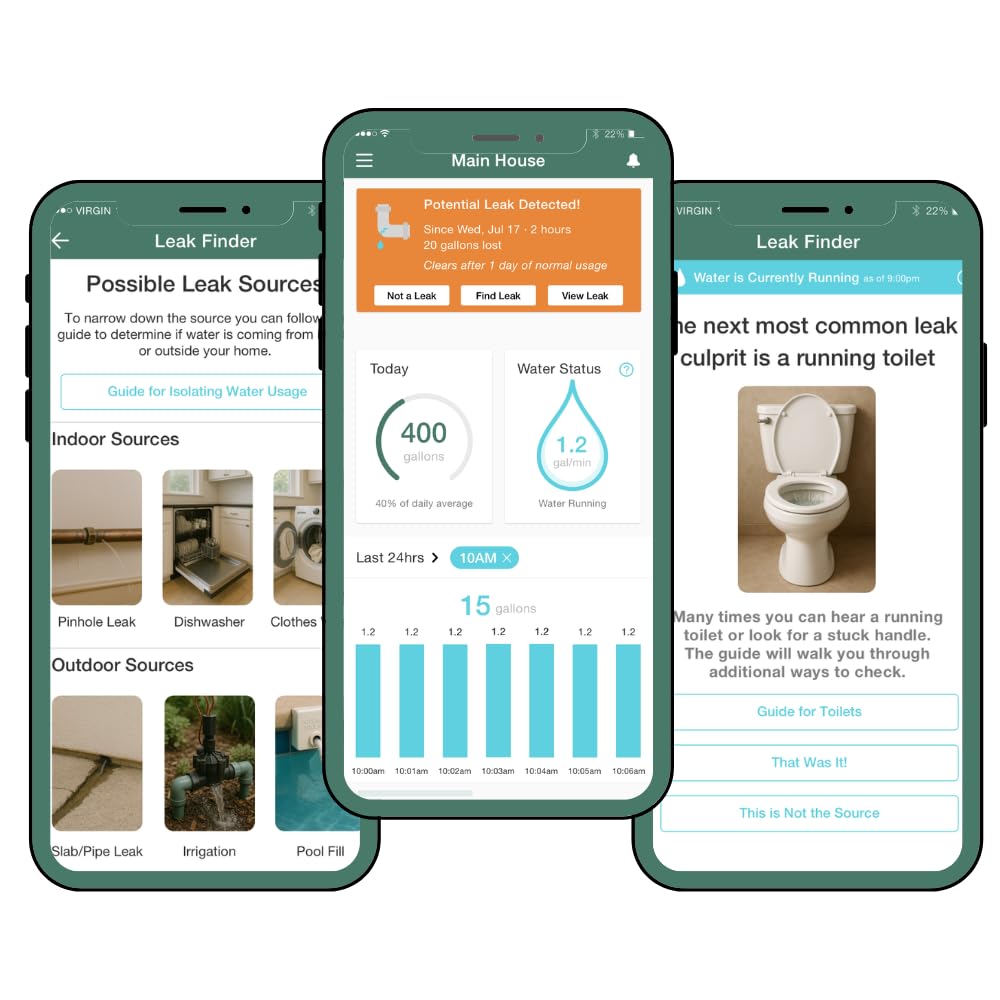
The Flume F2X is not a pipe-installed inline meter — it clamps onto the outside of your existing water meter and uses acoustic sensing to detect flow through the meter body. This makes it the only entry on this list that requires zero plumbing modifications, which is a major advantage for renters or building owners who cannot break into their hot water supply line. The new F2X model includes parylene coating for moisture resistance and an upgraded Wi-Fi chip for more reliable connectivity through metal meter boxes.
Installation takes about 10 minutes: you secure the sensor strap around your meter, connect the bridge module to Wi-Fi, and pair with the Flume app. The app tracks usage in real-time, sets leak detection alerts for abnormal flow, and reports irrigation and sprinkler water consumption separately. The two included AA battery packs provide extended runtime without proprietary batteries, and the bridge has a 1500-foot outdoor range to reach a meter at the far end of a property.
Because Flume reads the meter mechanically rather than measuring flow directly, it cannot detect leaks smaller than what the host meter can resolve — typically around 0.25 GPM for most residential meters. It also cannot shut off water automatically; it only sends notifications. Some users report calibration drift if the sensor strap shifts position on the glass of the meter face. For commercial applications where you need precise sub-metering of a hot water loop, an inline pulse meter is more accurate. Flume is best for non-invasive whole-property monitoring where installation constraints rule out in-line hardware.
Why it’s great
- No plumbing required — clamps onto existing water meter in minutes
- Parylene coating and reinforced design for outdoor and pit installations
- Two standard AA battery packs extend life without custom batteries
Good to know
- Cannot detect micro-leaks below ~0.25 GPM due to reliance on host meter resolution
- No auto-shutoff capability; leak alerts only
- Calibration can drift if the sensor strap shifts position on the meter face
7. YoLink FlowSmart All-in-One YS5018 (Ultrasonic + Auto Shutoff)
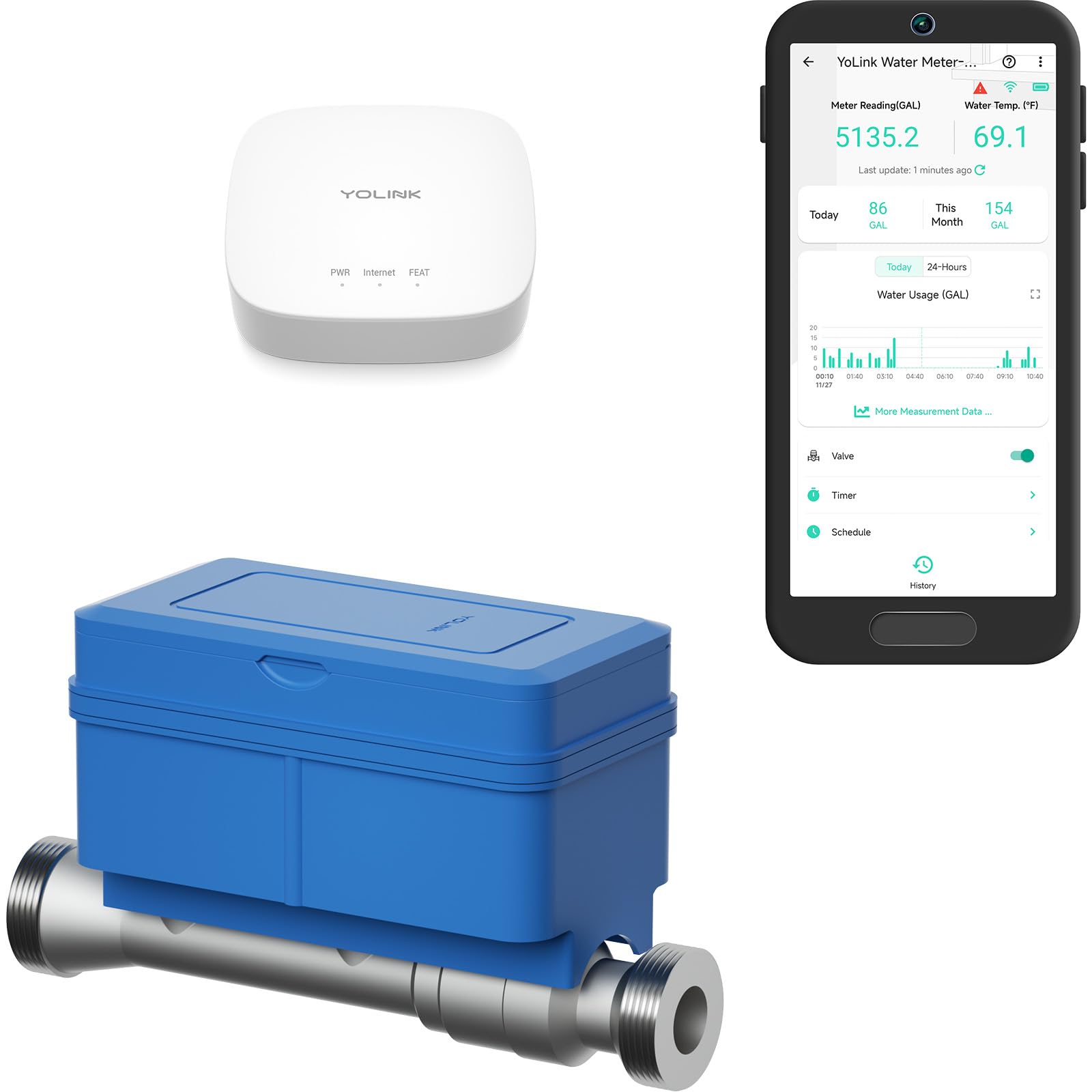
The YoLink FlowSmart All-in-One YS5018 integrates an ultrasonic flow meter and motorized shutoff valve in a single NSF-certified body, designed for nominal pipe sizes from 0.5 inch up to 2 inches. Unlike pulse-based systems, the ultrasonic sensor has no moving parts, which is critical for hot water lines where scale formation can mechanically disable a turbine meter. The integrated shutoff valve closes automatically when the controller detects a leak or abnormal continuous flow, and the entire assembly is powered by a single lithium battery rated for 10-year design life.
The unit communicates via LoRa to the included YoLink hub, which supports both Ethernet and 2.4 GHz Wi-Fi for cloud connectivity. The Control-D2D feature allows critical shutoff actions to continue offline even if the internet goes down — the valve still closes when triggered by a paired water sensor. The app provides real-time flow data, usage totals, and schedule-based protection with up to six customizable time slots. Users report that professional installation is recommended due to the need for proper pipe alignment and support.
One consideration is that the ultrasonic measurement tube is intentionally smaller than the pipe diameter to meet accuracy standards, which creates a flow restriction that may not be acceptable for high-demand commercial loops exceeding 25 GPM continuous flow. The 10-year battery claim assumes standard residential usage; continuous high-flow commercial operation will drain the battery faster. For light commercial applications like a single-tenant office or retail space, the all-in-one convenience and offline shutoff capability make this a compelling choice.
Why it’s great
- Ultrasonic sensor with no moving parts avoids limescale fouling in hot water
- Offline device-to-device control ensures shutoff works during internet outages
- 10-year battery design eliminates need for hardwired power in remote locations
Good to know
- Internal tube diameter is smaller than the pipe, creating measurable flow restriction
- Professional installation recommended for thread alignment and pipe support
- High-flow commercial use may reduce battery life below the 10-year estimate
8. Hunter HC100FLOW 1-Inch Irrigation Flow Meter

The Hunter HC100FLOW is purpose-built for irrigation systems using Hunter controllers (HC, Pro-HC, HPC, HCC) and integrates directly with the Hydrawise smart watering platform. The meter uses a brass body with a pulse output that reports flow data to the connected controller, enabling zone-specific water usage tracking and leak detection for broken risers or stuck valves. The 1-inch NPT connection handles typical residential and light commercial irrigation flows up to 50 GPM, and the brass construction resists corrosion from soil contact.
Installation requires 10 inches of straight pipe upstream and 5 inches downstream of the meter for accurate readings, which is a typical requirement for turbine-based pulse meters. The rotatable display allows easy reading regardless of pipe orientation, and the meter can be buried underground for direct-bury installation. The Hydrawise app shows real-time flow rates per zone, historical graphs, and sends instant alerts if a zone draws significantly more or less water than expected.
The HC100FLOW is not designed for hot water — it is rated for cold water irrigation only, and the plastic internals may warp above 120°F. The reed switch that generates the pulse signal is a known failure point, with some users reporting failure after 2-3 years of continuous use. Hunter warrants the meter for 2 years, and the documentation notes a backup reed switch that is not well-publicized. For commercial irrigation managers who need per-zone flow accountability and are already in the Hunter ecosystem, this meter provides seamless integration, but it has no place on a hot water recirculation line.
Why it’s great
- Native integration with Hunter controllers and Hydrawise platform for per-zone tracking
- Brass body with rotatable display for flexible installation and direct burial
- Real-time leak alerts for broken risers, stuck valves, or pipe failures
Good to know
- Rated for cold water only; not suitable for hot water loops above 120°F
- Reed switch can fail after extended use; backup switch is undocumented
- Requires straight pipe runs for accurate flow measurement
9. DAE AS320U-150P 1.5-Inch Water Meter with Pulse Output
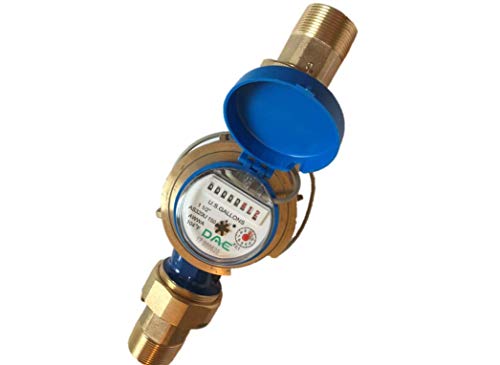
The DAE AS320U-150P is a mechanical turbine meter with a 1.5-inch connection and a pulse output that can feed data to a wide range of third-party gateway modules, including DAE’s own CC2030 cloud gateway for cellular or Ethernet upload. It conforms to AWWA standards with +/-1.5% accuracy and handles flows from 1.5 GPM minimum up to 50 GPM normal maximum, making it suitable for larger commercial sub-metering applications like campus boiler rooms or multi-unit apartment hot water loops. The horizontal inline mount requires upward-facing dial orientation, and it is not designed for pit installation.
The meter itself is purely mechanical; remote monitoring requires adding a separate pulse counter or gateway. DAE offers the CO-10 electronic pulse counter for local display, or the AMR130 module for single-meter remote reading. The CC2030 gateway can collect data from up to 16 AMR modules and send it to a cloud dashboard for real-time usage and billing reports, including email alerts for abnormal usage. The meter weighs 7.34 pounds and is built for inline installation with standard threaded couplings.
This is a budget-oriented solution with no integrated shutoff, no ultrasonic sensing, and no built-in wireless radio. The pulse output is a dry contact reed switch that may chatter or bounce in high-vibration environments, and the turbine can stall at very low flow rates below 1.5 GPM. Users have successfully integrated it with ESPHome and HomeAssistant by adding a 10K pull-up resistor on the pulse line. For property managers who need to sub-meter multiple hot water risers on a tight budget and already have a data collection system, the DAE provides a bare-bones foundation that works.
Why it’s great
- AWWA compliant with +/-1.5% accuracy for commercial utility-grade sub-metering
- Compatible with DAE cloud gateways and third-party pulse counters like ESPHome
- Relatively low cost for a 1.5-inch pipe size with pulse output
Good to know
- Mechanical turbine can stall at flows below 1.5 GPM
- No integrated wireless radio or shutoff valve — requires separate gateway purchase
- Not rated for pit installation or outdoor exposure without additional enclosure
FAQ
Can a commercial hot water meter be used on a cold water line?
How do I verify a pulse output meter works with my building management system?
What causes false leak alerts on ultrasonic water meters?
Do I need a licensed plumber to install an inline hot water meter?
How often should I replace batteries in remote monitoring water meters?
Final Thoughts: The Verdict
For most users, the best commercial hot water meters with remote monitoring winner is the Moen Flo 900-006 because it combines a motorized shutoff valve, ultrasonic flow sensor, and machine learning in a single device that integrates with major property management platforms. If you need ultrasonic micro-leak detection with pressure monitoring, grab the Frizzlife LP365-P. And for large multi-unit properties where LoRa range and offline shutoff are critical, nothing beats the scalability of the YoLink FlowSmart Controller Kit.

Mo Maruf
I created WellFizz to bridge the gap between vague wellness advice and actionable solutions. My mission is simple: to decode the research and give you practical tools you can actually use.
Beyond the data, I am a passionate traveler. I believe that stepping away from the screen to explore new environments is essential for mental clarity and physical vitality.