Our readers keep the lights on and my smoothie glass nicely filled. As an Amazon Associate, I earn from qualifying purchases.
Specs are compiled from manufacturer listings and verified buyer reviews and can change over time — please confirm the key details on the product page before buying.
Buying a commercial HEPA vacuum for mold means you need a machine that traps the microscopic spores a standard shop-vac would just blow right back into the air. This is not about picking up drywall dust — it is about whether the air you breathe gets cleaner or stays contaminated. The right machine uses a true HEPA filter that catches 99.97% of particles at 0.3 microns or larger, which is the standard for keeping mold spores from spreading during remediation.
I’m Mohammad Maruf — the founder and writer behind WellFizz. This guide is built by comparing the manufacturers’ published specifications and the patterns across verified customer reviews, so you get each pick’s real strengths and trade-offs instead of marketing spin.
Every machine on this list meets that critical 99.97% capture standard, and the reviews from owners doing actual remediation work reveal which ones hold up under daily abuse. What follows is the definitive breakdown of the best commercial hepa vacuum for mold, ranked by real-world performance and build quality.
Our Picks at a Glance


How To Choose The Best Commercial HEPA Vacuum For Mold
Mold spores are tiny, allergenic, and airborne. A vacuum intended for sawdust or drywall can actually worsen the problem by exhausting fine particles back into the room. You need a machine built for capture, not just suction. Here is what to look for when reading the spec sheets.
Filtration First: True HEPA vs. HEPA-Type
The word “HEPA” on a label does not guarantee a machine is safe for mold. Look for the actual capture percentage — a true HEPA filter must trap 99.97% of particles 0.3 microns in size. Anything labeled “HEPA-type” or “HEPA-style” lacks this certified standard and will let spores through. Every vacuum on this list meets the 99.97% standard.
Suction Power and Water Lift
Two numbers matter here: CFM (cubic feet per minute) measures airflow — how much air the vacuum moves — which determines how well it picks up loose dust and spores from surfaces. Water lift (measured in inches) tells you how strongly the vacuum pulls against a sealed surface, which matters for extracting spores embedded in carpet or cracks. For mold remediation, you want both numbers high enough to pull particles out of porous materials.
Canister vs. Backpack Design
Canister vacuums (like the Makita and Fein picks) sit on the ground and roll behind you — they hold more debris and often include power-tool sync features. Backpack vacuums (like the ProTeam picks) strap to your body and let you move through narrow stairways, attics, and crawlspaces without dragging a canister. For a full-house mold remediation job where you are moving between rooms constantly, a backpack saves your back. For a workshop or single-room project, a canister delivers more sustained suction.
Quick Comparison
| Model | Best For | Water Lift | Filtration | Capacity | Amazon |
|---|---|---|---|---|---|
| Makita VC4210L★ Best Overall | Heavy-drywall dust control | 92 in | 99.97% at 0.3µ | 11 gal | Amazon |
| Fein Turbo I HEPAQuiet Pro | Quiet, compact remediation | 98 in | HEPA (Class L) | 5.8 gal | Amazon |
| ProTeam ProVac FS6 | Large-area backpack cleanup | — | HEPA media | 11.6 lb carry | Amazon |
| ProTeam GoFit 6 HEPA | Mold remediation with EPA RRP | — | 99.97% at 0.3µ | 6 qt | Amazon |
| Festool CT 26 EI HEPA | Pro workshop + Bluetooth sync | 96 in | HEPA | 26 liters | Amazon |
In‑Depth Reviews
1. Makita VC4210L 11 Gallon Wet/Dry HEPA Filter Dust Extractor/Vacuum
Our pick — over 4★ from 200+ verified ratings; the strongest balance of quality and price.
The 11-gallon workhorse that cleans its own filter so you do not lose suction mid-job.
Mold remediation is dusty, dirty work, and nothing kills a vacuum’s effectiveness faster than a clogged filter. That is the Makita’s headline trick: an automatic filter cleaning system that fires every 20 seconds or so, clearing the flat filter so the 148 CFM of suction — backed by 92 inches of water lift — stays strong all day. Owners note the “pop noise” is noticeable but still quieter than standard shop vacs, and the auto-clean can be switched off when running wet mode. The HEPA filter captures 99.97% of particles 0.3 microns and larger, which is the exact standard needed for mold spore containment.
The 12-amp motor pulls hard, and the two-stage filtration catches 99.95% of particles 2 microns and larger at the main flat filter stage before they even reach the HEPA. An on-board tool-activated outlet starts and stops the vacuum with a 10-second “off” delay — a feature that clears the hose of lingering debris before you disconnect. Performance is what wins people over here (37 owners single it out as the reason to buy), and the dust removal capability is heavily praised. The main trade-off is the 1.5-inch hose: it does not handle large debris well, so this is pure fine-dust and spore extraction, not construction-site cleanup.
The recurring gripe is a filter-cleaning “thump” every 20 seconds — treat the auto-clean as an asset for mold jobs, not a bug, and disable it when picking up water. For a dedicated remediation machine that keeps running without you babying the filter, this earns the top spot.
Why Owners Stick With It
- Auto filter cleaning (every ~20 sec) keeps suction consistent through hours of fine dust work
- Quieter than Rigid and DeWalt shop vacs — owners consistently notice the lower noise
- Two-stage HEPA filtration captures mold-sized particles before they reach the motor
- Variable speed control lets you dial suction down for delicate surfaces
The Fit Note
- Auto-clean “thump” is loud the first time; you can disable it for wet pickups
- 1.5-inch hose chokes on anything larger than fine dust — pair with a cyclone pre-filter
Best for: remediation pros who need a canister vac that runs a full shift without filter clogs, especially on drywall sanding and mold spore extraction.
Think twice if: you need to pick up large construction debris — the narrow hose limits this to fine-dust work only.
2. Fein Turbo I HEPA Pro Set Wet/Dry Dust Extractor
A 5.8-gallon compact that runs at a whisper while pulling 98 inches of water lift.
If you have ever been on a remediation job in a finished home where noise matters — occupied units, hospitals, or any environment where a roar draws complaints — this Fein is the answer. It operates at 66 dB, which is about the level of a normal conversation, yet still delivers 151 CFM of airflow and 98 inches of water lift. The HEPA filter is approved for dust class L (light hazard), with a filter bag and included HEPA filter forming the two-stage defense against fine particulates.
The auto-start outlet with soft-start prevents power spikes when a sander or grinder kicks on — the vacuum runs synchronized to the tool, then shuts off a few seconds later to clear the hose. As owners put it, the Fein “doesn’t let the dust escape,” even during sanding drywall texture. The 19-foot power cord and 13-foot anti-static hose with swivel wheels mean you rarely stop to reposition. What the crowd raves about most is effectiveness (8 owners call it out) and the low noise level (5 mention it).
The honest knock is hose storage — there is no dedicated wrap; owners find themselves looping the hose around attachments in a way that falls off during transport. It is inferior to a Festool on storage, but the price sits well below that blue-and-green competitor. For a quiet, compact extractor that genuinely contains fine dust, this is the one to reach for.
Quiet muscle: 66 dB is noticeably quieter than standard shop vacs, yet the 151 CFM and 98-inch water lift beat the larger Makita on raw pull. If noise matters, this is your pick.
The one trade-off: no dedicated hose storage — plan to loop the hose around the unit or store it separately.
Perfect for: indoor mold remediation in noise-sensitive settings — apartments, occupied homes, or commercial kitchens.
Not ideal when: you need big capacity — at 5.8 gallons it fills faster than the 11-gallon Makita on heavy jobs.
3. ProTeam ProVac FS6 Backpack Vacuum with Restaurant Tool Kit

Strap on 11.6 pounds of HEPA filtration and clean 6,000-square-foot spaces without dragging a can.
For mold remediation that spans a whole basement or an entire house, a backpack vac saves hours of back-and-forth. The ProTeam ProVac FS6 puts the weight on your hips with an adjustable FlexFit harness and uses open-weave fabric to let heat dissipate, so you stay cooler during long sessions. A 50-foot power cord means you plug in once and move through every room on a typical floor without searching for the next outlet — a massive time saver. The four-level advanced filtration uses a HEPA media filter that traps fine dust with less downtime, and at 153 CFM the airflow is the highest on this list.
The customer voice here is direct: one owner confirms “using for mold remediation” and says the HEPA system works well when vacuuming an entire basement per remediation company directions. Another owner runs a 6,000-square-foot restaurant and calls it a great buy. The backpack design lets you move between furniture, up stairs, and into attics without wrestling a canister. For the foodservice industry — restaurants, bars, school cafeterias — the included restaurant tool kit addresses the specific crevices and surfaces those jobs demand.
A daily-use commercial cleaner notes the wand can detach from the hose, and one unit showed cord wear with heavy use. This is built for movement and ease, not brute-force sustained suction like the canisters above. But for covering ground in a large mold remediation project, nothing else on this list lets you move this fast.
Mobility first: the 50-foot cord and lightweight backpack design let you clean entire floors without unplugging, and the 153 CFM airflow is category-leading.
The catch: wand-to-hose connection can slip under daily commercial use — not a dealbreaker for remediation projects but something to check periodically.
Reach for this: if you are remediating a full home or commercial kitchen and need to move fast between rooms and up stairs.
Look elsewhere: if you need heavy water lift for embedded spores — backpack designs trade sealed-suction power for portability.
4. ProTeam GoFit 6 HEPA Commercial Backpack Vacuum with Remediation Tool Kit
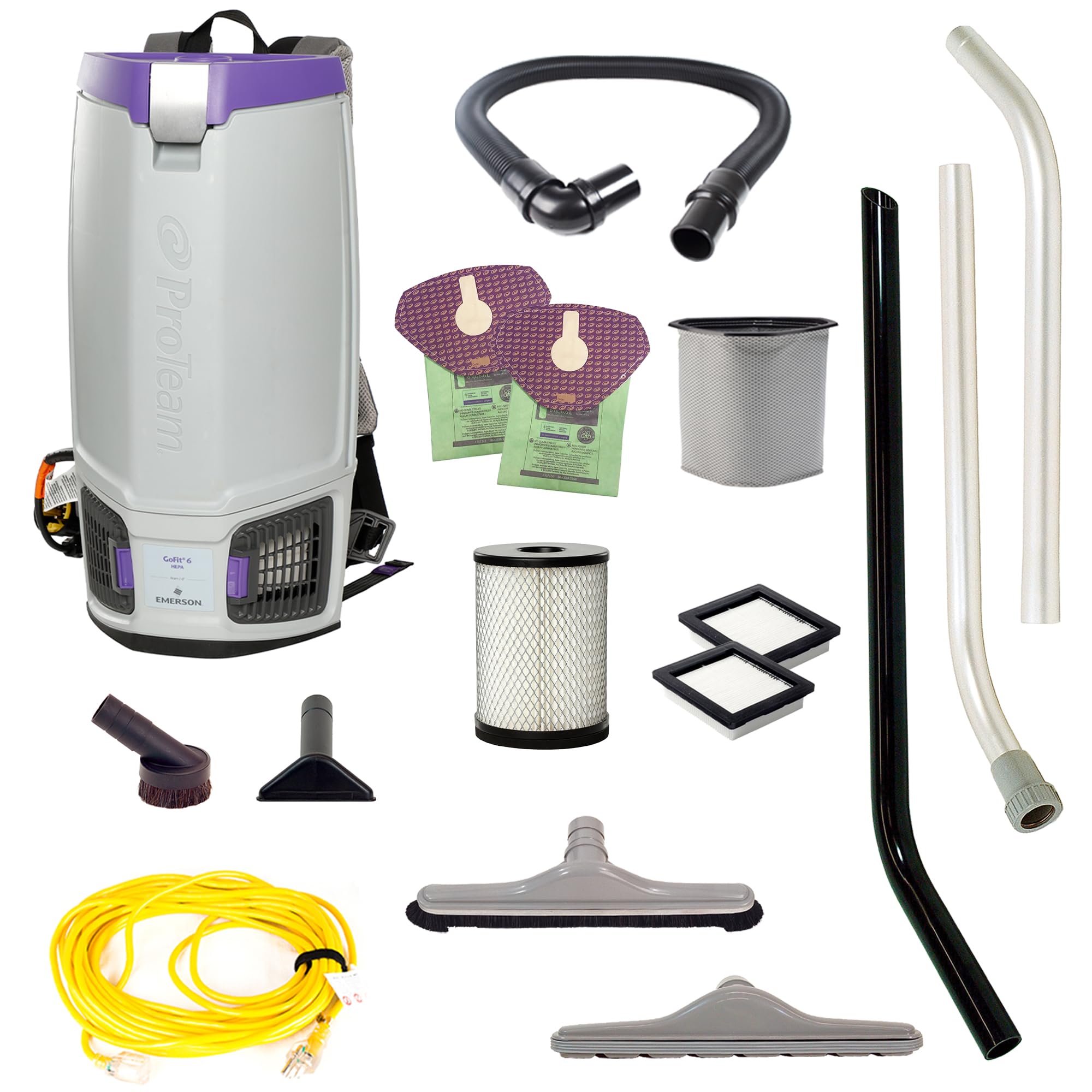
Meets the EPA’s strictest lead-renovation standard, and that same spec makes it a mold-remediation weapon.
This is the only vacuum on the list that carries the EPA RRP Rule stamp — it meets the government’s definition of a HEPA vacuum under the Lead Renovation, Repair, and Painting Rule. That same sealed-system design that keeps lead dust from escaping works perfectly for mold spores. The HEPA filtration captures 99.97% of airborne particulates as small as 0.3 microns, and the unique method is suction-only: the vacuum cleans carpets, hard floors, and other surfaces without stirring dust up into the air. The included Remediation Tool Kit gives you the nozzles and crevice tools specifically chosen for mold, soot, and smoke cleanup.
A 4-step quick-adjust harness lets you fine-tune the fit without tools, and the compact triangular shape responds naturally as you move. The reimagined switchbox has an improved cord wrap that reduces cable strain and extends cord life. Owners praise the excellent suction power on hardwood and low-pile carpet, and the HEPA filtration gets positive marks from those with allergies. At 13.3 pounds it is heavier than the FS6 backpack above — several owners note it “pesa bastante” (weighs quite a bit) and find it cumbersome in small rooms, though the suction makes up for it.
This is the pick when you need documented EPA RRP compliance on a job site, or when you want a backpack dedicated strictly to remediation with the right tools in the box.
Regulation-ready: the EPA RRP Rule compliance is a genuine differentiator — if the job requires documented HEPA vacuum specs, this is your machine.
Heads up: the 13.3-pound weight is noticeable on long shifts, and the longer floor attachment is awkward in tight bathroom corners.
Choose this: when the job requires EPA RRP compliance documentation, or when you want a dedicated remediation backpack with the toolkit included.
Pass if: you are a smaller-framed user — the 13.3 pounds and triangular shape can feel heavy and bulky for extended wear.
5. Festool 577871 Dust Extractor CLEANTEC CT 26 EI HEPA
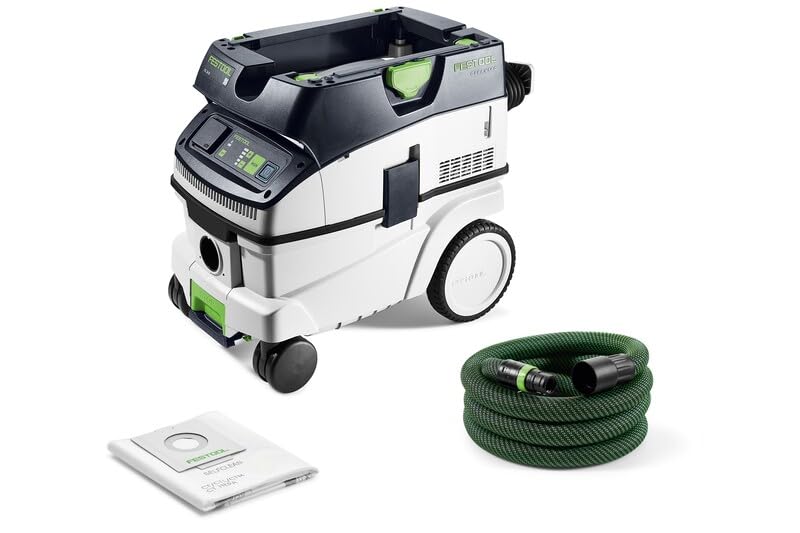
The crown jewel of dust extraction — Bluetooth sync, five suction levels, and a 96-inch water lift.
Festool occupies a category of its own in the extraction world, and the CT 26 EI HEPA justifies every bit of its reputation. It pulls 96 inches of water lift through a smooth 27/32-inch anti-static hose, and the five adjustable suction levels let you dial from feather-light (so a sander does not get stuck to the surface) to full pull for embedded mold spores. The integrated Bluetooth connects to Festool battery packs or an optional remote control, so the vacuum starts when you pull the trigger on a tool and stops with a programmable delay — zero fumbling for switches. Owners call it “easy to use, light and very powerful,” with one noting the suction is “by far superior to the Midi and Mini” Festool models.
The T-LOC system lets you stack Systainers directly onto the extractor — a convenience for workshop organization that also keeps all your gear mobile at once. At 26 liters capacity it sits between the 11-gallon Makita and the 5.8-gallon Fein, a the just-right size for a full day of remediation without constant bag changes. The included SELFCLEAN filter bag extends filter life, and the HEPA filtration means it is safe for fine particulates. Buyers report it is quiet — a low-pitched growl rather than the high whine of a shop vac — and the maneuverability on the integrated wheels is “very stable.”
The pain point is the price, and the fact that the Bluetooth remote (the one that makes the “EI” model shine) is an extra-cost add-on rather than standard. It also lacks basic floor-cleaning attachments from the start, so plan to buy a kit for general cleanup. But for a pro who wants the smoothest workflow — touch-button start, variable suction, and HEPA containment in one mobile package — this is the endgame.
Why It Commands the Price
- Five-level adjustable suction power — feather the pull so sanders and saws work naturally
- Bluetooth auto-start with battery packs or remote — vacuum triggers the moment you cut
- T-LOC Systainer stack keeps all tools mobile and organized
- Quiet, low-pitched operation that does not demand earplugs on a long day
The Honest Gaps
- Bluetooth remote sold separately — the full workflow upgrade costs extra
- No general-cleaning attachments included — budget for a nozzle or floor tool kit
Buy it for: the smoothest integration with power tools, variable suction that matches the task, and HEPA containment in a quiet, mobile package.
Skip if: the budget is tight — you can get identical HEPA performance and 96-inch water lift from other machines for significantly less.
Understanding the Specs
Water Lift
This measures how hard the vacuum pulls against a sealed surface, expressed in inches. Higher water lift (92-98 inches) means the vacuum can extract spores and fine dust from grooves, carpet fibers, and cracks where a standard shop vac leaves debris behind. For mold remediation, 90 inches or above is the target zone.
CFM (Cubic Feet per Minute)
This tells you how much air the vacuum moves in a minute. Higher CFM (148-153 on these picks) means the vacuum grabs loose particles floating on surfaces before they become airborne again. Mold cleanup needs both good CFM for surface pickup and good water lift for pore extraction — one without the other leaves spores behind.
FAQ
Can a regular shop vac handle mold cleanup?
What is the difference between HEPA and HEPA-type filters?
How often should I change the filter during mold remediation?
Is a backpack vacuum or a canister vacuum better for mold?
Can I use a HEPA vac for both mold and regular drywall dust?
How loud are these commercial vacuums during operation?
What does the EPA RRP rule mean for a vacuum?
Do I need an auto-start outlet on a mold remediation vacuum?
Final Thoughts: The Verdict
For most buyers, the best commercial hepa vacuum for mold is the Makita VC4210L because the auto-cleaning filter, 148 CFM suction, and 11-gallon capacity handle full-day remediation without losing suction. If you need quiet operation in occupied spaces, grab the Fein Turbo I HEPA. And for moving through a whole house or restaurant quickly, the ProTeam ProVac FS6 backpack is the one to reach for.
How We Picked
We do not accept paid placement. Every pick is matched to a real buyer and a real use-case; we do not hands-on test units.
Sources & Methodology
Specifications: manufacturer listings and product documentation. Review insights: verified customer reviews, as of July 2026. Pricing: not shown on this page (it changes often); check the current price via the retailer link.
As an Amazon Associate, WellFizz earns from qualifying purchases. This does not affect which products we feature.
Related Guides

Mo Maruf
I created WellFizz to bridge the gap between vague wellness advice and actionable solutions. My mission is simple: to decode the research and give you practical tools you can actually use.
Beyond the data, I am a passionate traveler. I believe that stepping away from the screen to explore new environments is essential for mental clarity and physical vitality.