Our readers keep the lights on and my smoothie glass nicely filled. As an Amazon Associate, I earn from qualifying purchases.
Building code compliance and occupant safety demand a fire alarm system that detects both smoke and carbon monoxide, delivers clear voice alerts, and interconnects across multiple zones without fail. Whether you are retrofitting an older structure or specifying a new build, the decision comes down to detection engine reliability, backup power architecture, and scalability across a property.
I’m Mohammad Maruf — the founder and writer behind WellFizz. My research for this guide involved cross-referencing UL 217 and UL 2034 certification standards, comparing sensor technologies across dozens of units, and analyzing hundreds of verified buyer reports to isolate which systems deliver low nuisance-alarm rates and consistent 10-year sensor life.
This guide breaks down the top contenders for the best commercial fire alarm systems, examining hardwired interconnect options, wireless RF linking, and remote monitoring units for vacant or multi-unit properties.
How To Choose The Best Commercial Fire Alarm Systems
Fire alarm systems for commercial and multi-unit buildings differ from residential units in one critical way: they must be designed for zone-based alerting, code-driven installation, and years of uninterrupted service with minimal false alarms. The wrong detector can cost you compliance headaches or, worse, occupant confusion during an actual emergency.
Interconnect Method: Wired vs. Wireless
Hardwired systems use a three-wire traveler (common to Kidde and First Alert) to link every unit physically. This is reliable for new construction but costly for retrofit. Wireless RF interconnection — used by X-Sense — lets you link up to 12 or more units without pulling cable, making it ideal for existing buildings. Both routes must ensure all units sound together when any single detector triggers.
Detection Engine: Photoelectric vs. Ionization vs. Dual
Commercial properties see more cooking, steam, and HVAC dust than a typical house. A photoelectric sensor is significantly less prone to nuisance alarms from these sources than an ionization sensor. Many units now combine a photoelectric smoke sensor with an electrochemical CO cell inside one housing, giving you two layers of detection without adding extra boxes on the ceiling.
Power Backup Architecture
A commercial system must stay functional during a power outage. The best options use a hardwired 120V AC connection with either a 10-year sealed lithium battery or a replaceable AA battery backup. Sealed batteries eliminate annual maintenance but require whole-unit replacement at end-of-life. Replaceable AA trays give you the ability to restore a failed detector without replacing the entire assembly.
Voice Alert vs. Simple Tone
Standard 85 dB piezo alarms are loud but do not tell occupants what is happening. Voice alert systems announce “Fire!” or “Warning! Carbon Monoxide!” — and premium models like the First Alert SMCO100V even state the room location. In a large building, this directional information can speed evacuation and reduce panic.
Quick Comparison
On smaller screens, swipe sideways to see the full table.
| Model | Category | Best For | Key Spec | Amazon |
|---|---|---|---|---|
| First Alert SMCO100V-AC | Premium | Voice & Location Alerts | Precision Detection; 6-pack | Amazon |
| Kidde 30CUA10-V 4-Pack | Premium | Hardwired Retrofit | UL 217 9th Ed.; 10-yr battery | Amazon |
| X-Sense SC01-W 6-Pack | Premium | Wireless RF Retrofit | 10-yr sealed lithium; RF link | Amazon |
| Kidde 30CUA10-V 3-Pack | Mid-Range | Voice & 3-unit starter | 85 dB; 10-yr backup | Amazon |
| X-Sense SC06-W 6-Pack | Mid-Range | Battery-only interconnect | Sealed 10-yr lithium; RF link | Amazon |
| SITERWELL GS886F 5-Pack | Mid-Range | Self-check & voice | 2x AA backup; self-check | Amazon |
| Sensaphone 400 | Specialty | Remote temp/power monitor | Landline alerts; -20°–150°F | Amazon |
In‑Depth Reviews
1. First Alert SMCO100V-AC Precision Detection 6-Pack
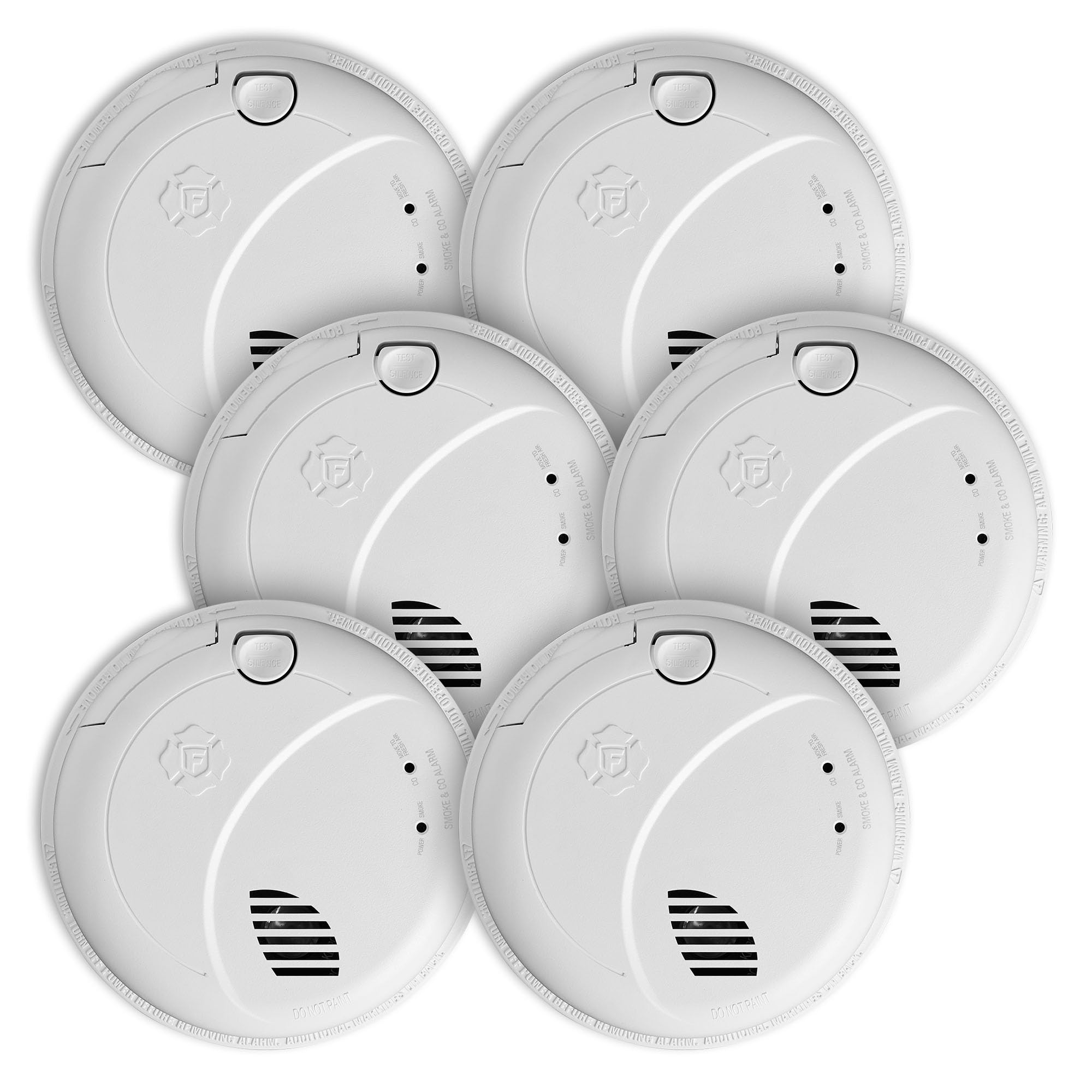
The First Alert SMCO100V-AC is the only unit in this lineup that announces the specific room location of a detected threat. Its Precision Detection photoelectric engine is engineered to meet the latest UL 217 and UL 2034 standards, drastically cutting down nuisance alarms from cooking or steam — a critical feature for commercial kitchens or break rooms.
Each hardwired unit includes a battery backup powered by standard AA batteries, allowing you to restore a single detector without replacing the whole assembly. The orange interconnect wire links all six units so that when one sounds, every unit in the building sounds. The voice alert first identifies the hazard type, then the location you assigned during setup.
Several verified buyers noted the alarm is extremely loud — intentionally so for evacuation conditions. The included Easy Adapter Plug simplifies replacing older Kidde or FireX models without rewiring the junction box. Some users experienced sensor failures after 1.5 years, though this is a minority pattern in the review corpus. For commercial properties where code requires both voice and location notification, this six-pack is difficult to beat.
Why it’s great
- Voice announces room location, not just hazard type
- Precision Detection reduces false triggers from cooking
- Plug-in adapter eases retrofit of legacy brands
Good to know
- Reports of early sensor failure in a small percentage of units
- AA backup batteries must be replaced every 2–3 years
2. Kidde 30CUA10-V Hardwired 4-Pack

Kidde’s 30CUA10-V 4-Pack is a hardwired combination smoke and CO detector that meets UL 217 9th Edition and UL 2034 4th Edition — the most current standards at the time of publication. The enhanced sensing technology is specifically tuned to suppress false alarms from cooking, a frequent complaint among commercial kitchen operators.
Each unit operates on 120V AC wiring with a 10-year sealed battery backup, meaning no annual battery swaps and no chirping in the middle of the night. The voice alert is clear and unambiguous: “Fire!” or “Warning! Carbon Monoxide!”. Interconnection is through the standard three-wire traveler, and multiple verified buyers reported that testing all four units simultaneously triggered every alarm as expected.
A small number of users reported that certain units produced continuous false alarms after being wired in series, and the mounting hardware is not included in the box — you supply the wire nuts and screws. The 10-year battery alone can save significant maintenance cost over the detector’s life compared to replaceable-battery units. This pack is a strong choice for property managers replacing end-of-life Kidde units in a consistent code-compliant lineup.
Why it’s great
- Meets UL 217 9th Edition and UL 2034 4th Edition
- 10-year sealed battery eliminates annual maintenance
- Voice alerts clearly differentiate smoke from CO
Good to know
- Does not include mounting hardware or wire nuts
- Rare reports of false alarms in series-wired configurations
3. X-Sense SC01-W Wireless RF 6-Pack
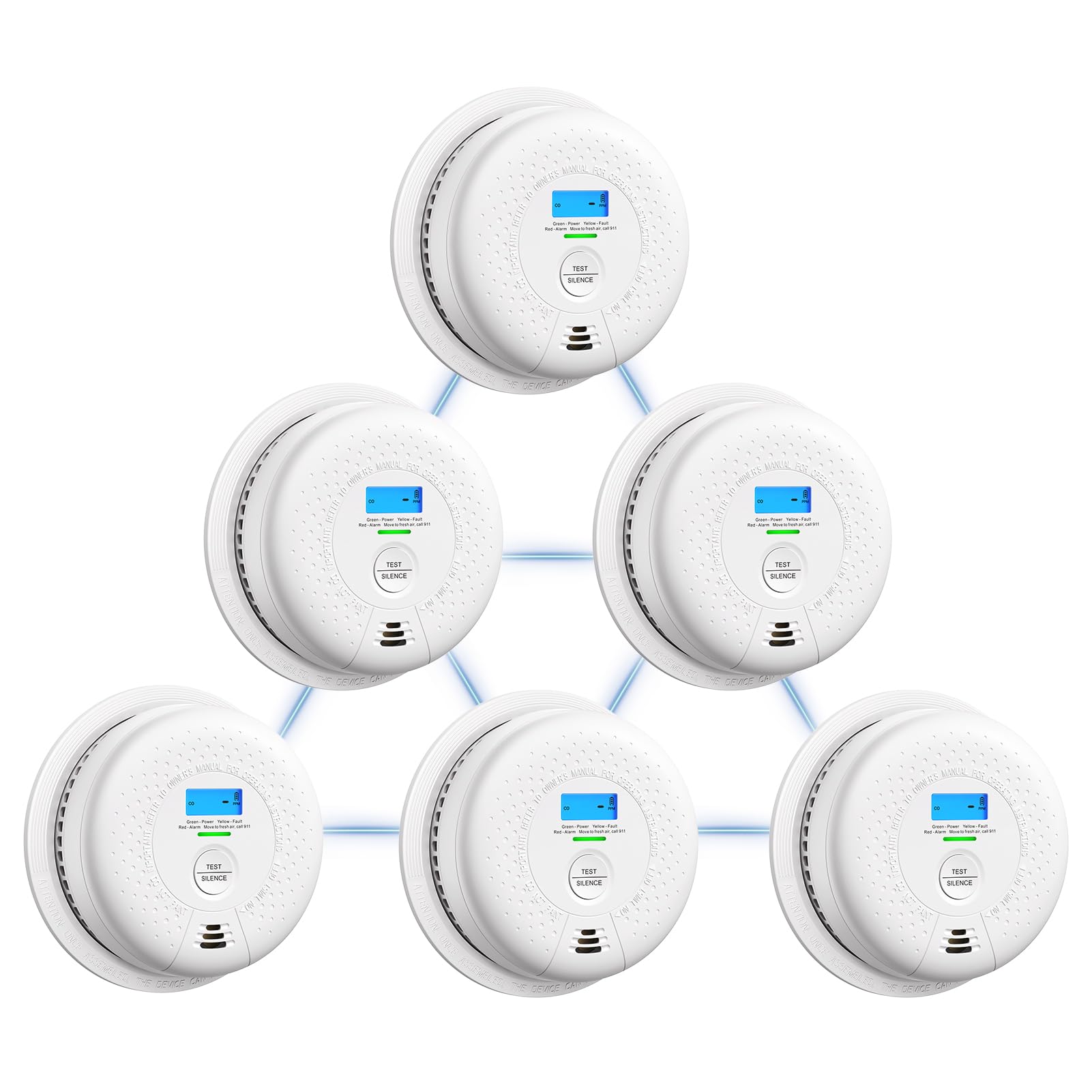
The X-Sense SC01-W is a battery-powered system that uses 915 MHz RF to wirelessly interconnect up to 12 units — ideal for commercial retrofits where pulling interconnect wire through finished ceilings is not practical. Each detector contains a 10-year sealed lithium battery, meaning no battery swaps and no power outages compromise the unit.
This model supports Wi-Fi, but the RF interconnect works independently of your internet connection. The large 5.7-inch mounting bracket covers old screw holes and wall stains from previous alarms, giving a clean finished look without patching. The 85 dB alarm and 2-in-1 detection (photoelectric smoke + electrochemical CO) are certified to UL 217 and UL 2034.
Buyers frequently praised the ease of programming — pairing the units takes only a few minutes using the test/silence button. A few users noted that the mounting plate does not fit all round electrical boxes, requiring an adapter or a standard round cover plate. For any commercial space where hardwiring is impossible or cost-prohibitive, this six-pack delivers whole-building interconnection without a single ceiling wire.
Why it’s great
- Wireless RF interconnect — no hardwiring needed
- Large bracket covers old ceiling stains and holes
- 10-year sealed battery powers entire product life
Good to know
- Mounting plate may not fit older round junction boxes
- Battery-only; no AC hardwiring option
4. Kidde 30CUA10-V Hardwired 3-Pack
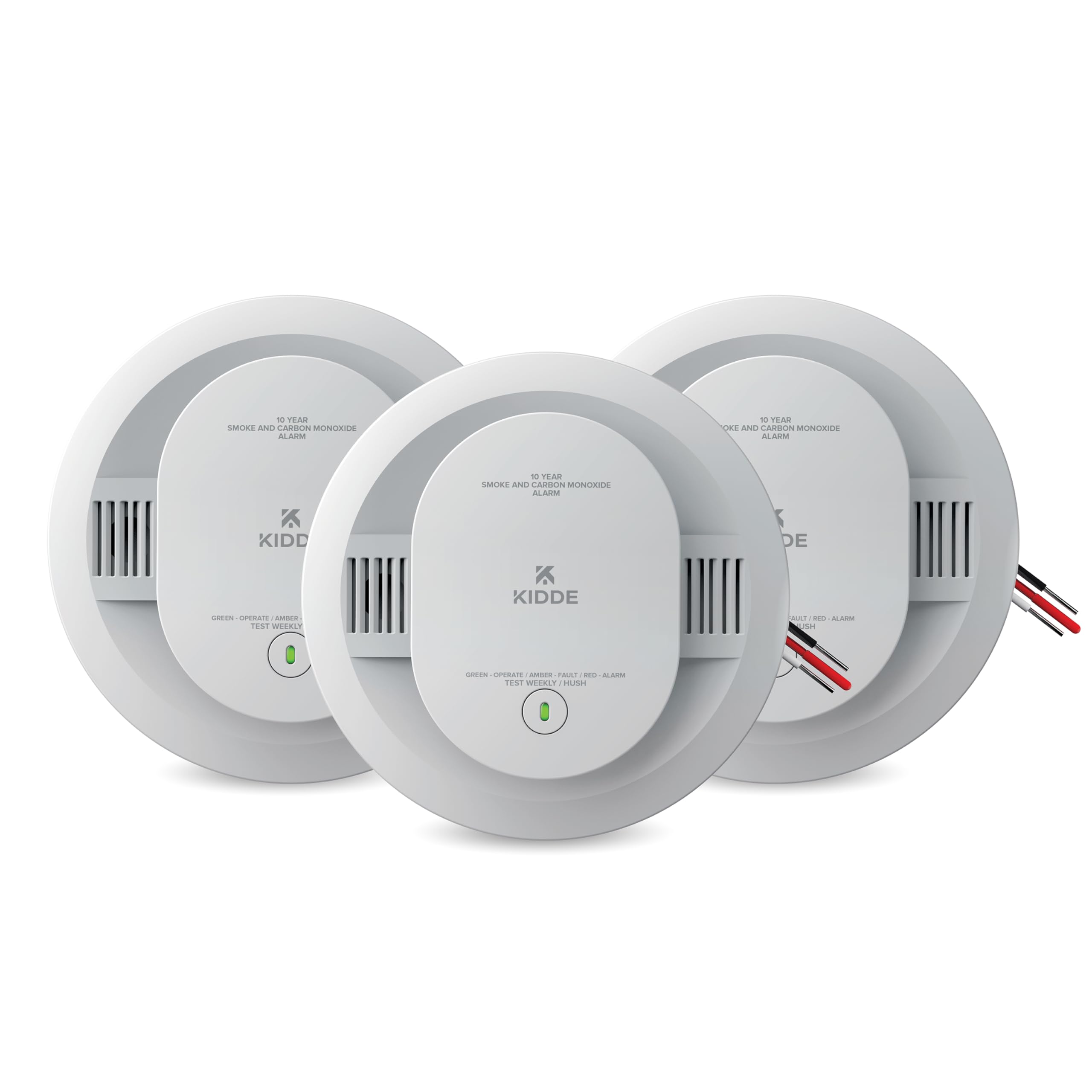
This 3-pack of Kidde model 30CUA10-V delivers the same 2-in-1 detection, voice alerts, and 10-year sealed battery as the 4-pack, but in a smaller quantity suited for smaller commercial spaces such as individual office suites, retail stockrooms, or break areas. The 85 dB alarm and red LED provide both audible and visual warnings.
The hardwired units are interconnectable through the standard traveler wire, and Kidde claims their sensing technology is engineered for over 25% faster smoke detection compared to previous generation models. Multiple verified buyers confirmed that the voice alerts clearly distinguish between smoke and CO, and the built-in battery avoids the late-night-chirping problem of replaceable 9V units.
Some buyers reported that the unit did not come with mounting hardware, requiring a separate trip to the hardware store. A few units triggered false alarms from incense or cooking, though this is a known sensitivity trade-off with any photoelectric-based detector. For a compact 3-unit starter that still carries the latest UL 217 10th Edition certification, this is a solid entry point.
Why it’s great
- Same core specs as the 4-pack in a lower quantity
- Voice alerts for both smoke and carbon monoxide
- 10-year battery backup saves on maintenance labor
Good to know
- Mounting hardware not included in the box
- Some reported false alarms from cooking or incense
5. X-Sense SC06-W Wireless Interconnect 6-Pack
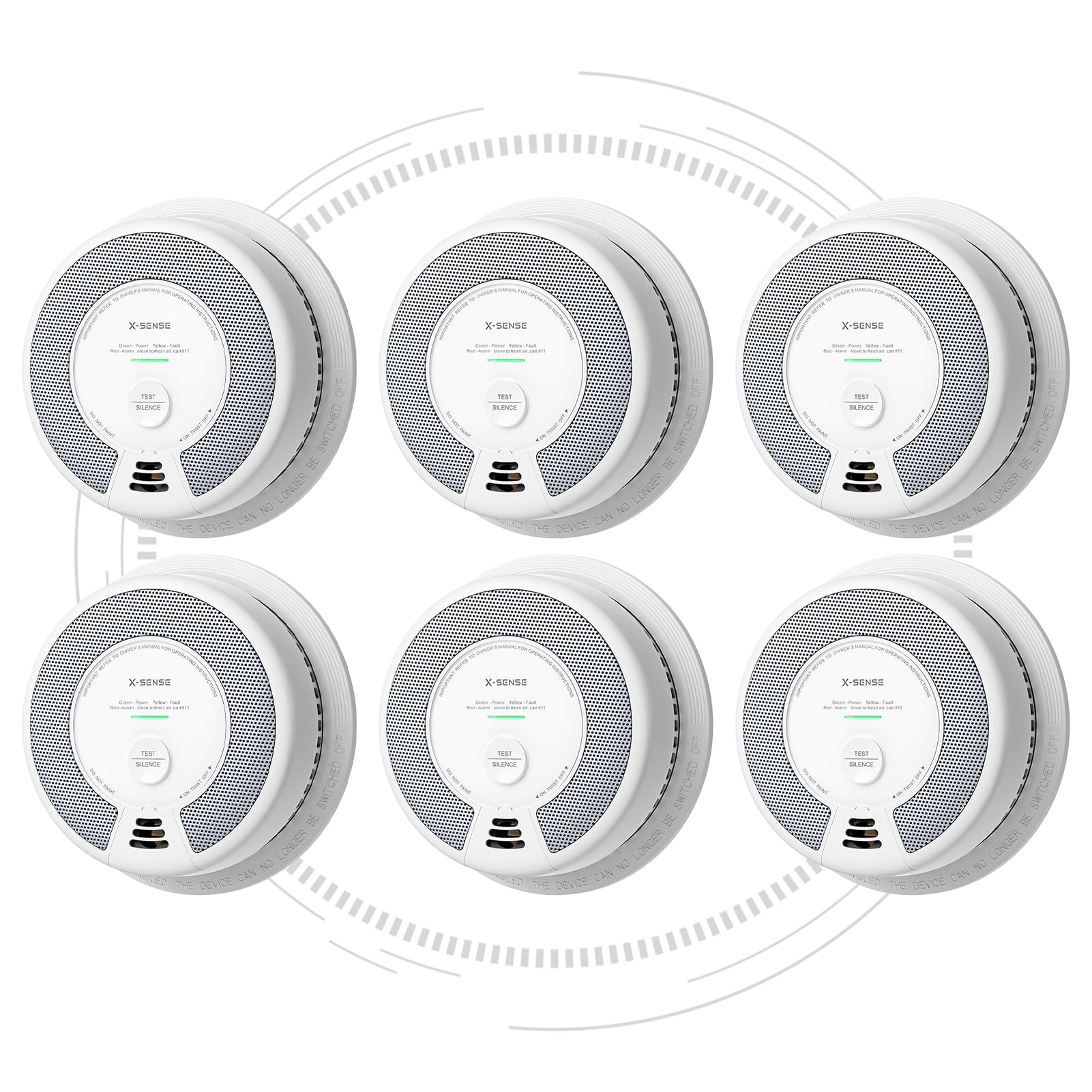
The X-Sense SC06-W is the battery-only sibling of the SC01-W, offering the same 10-year sealed lithium battery and wireless RF interconnect but at a lower entry point. It does not support Wi-Fi, but the RF interconnect works perfectly among all paired units — verified by multiple buyers who interconnected six detectors across basement, first, and second floors.
The 2-in-1 detection uses an ionization sensor for smoke and an electrochemical cell for CO, certified to UL 217 and UL 2034. Installation is straightforward: mount the bracket, insert the battery pull-tab, and pair units using the test/silence button. Several buyers praised the Apple-level packaging and the peace of mind that no annual battery swapping is required for the entire 10-year life.
The primary limitation is the absence of a hardwiring option — this unit is 100% battery-powered, so it cannot tie into a 120V AC circuit for nonstop monitoring. A few users noted that the bundled units were not pre-paired as advertised, requiring manual pairing. For a straightforward wireless retrofit on a budget, this six-pack offers a strong per-unit value.
Why it’s great
- 10-year sealed battery — no maintenance required
- Reliable RF interconnect across multiple floors
- Competitive per-unit price for a 6-pack
Good to know
- No hardwired AC option; battery-only operation
- Units may arrive unpaired; manual pairing required
6. SITERWELL GS886F Hardwired Interconnect 5-Pack
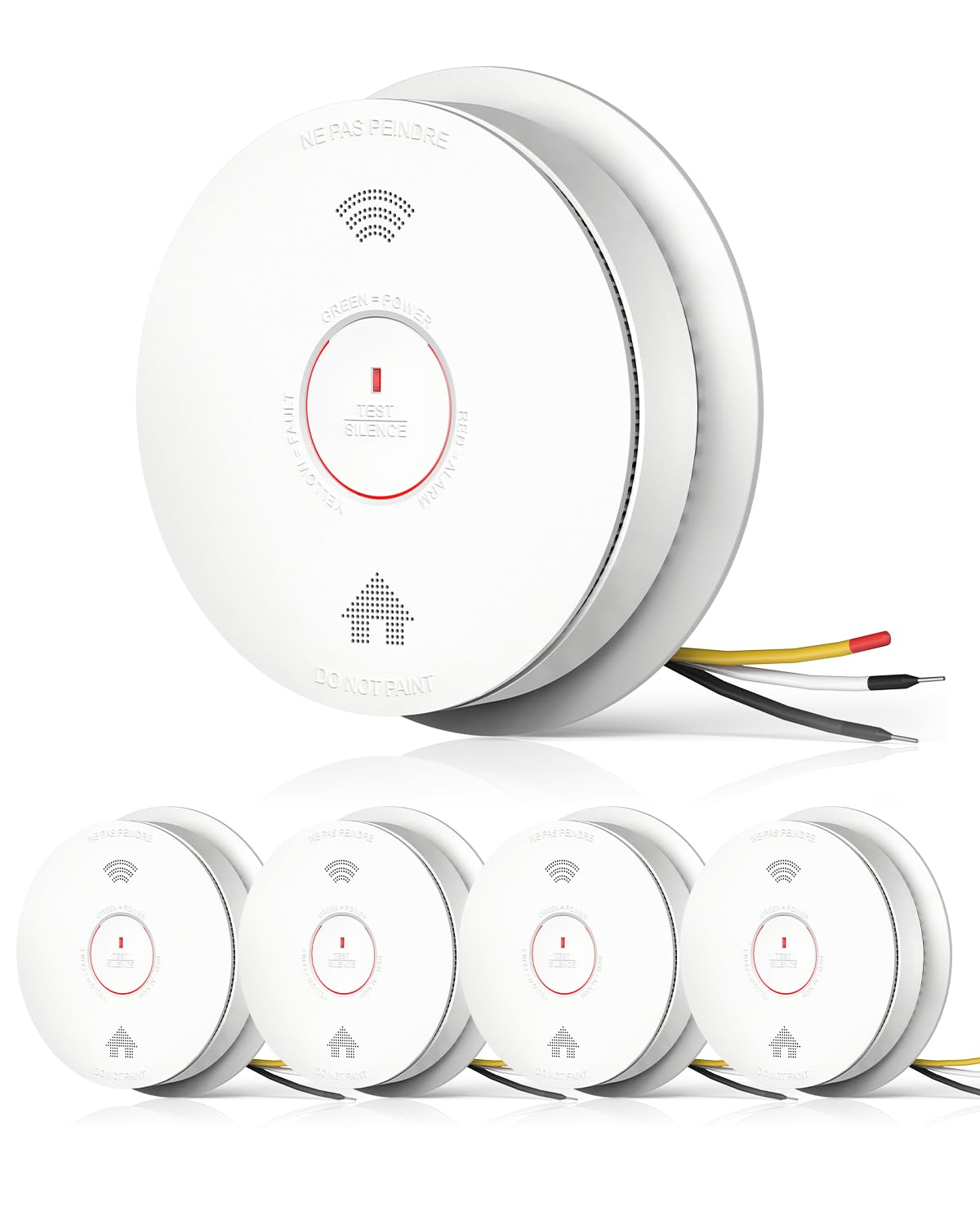
The SITERWELL GS886F is a hardwired interconnectable detector with a unique self-check function that replaces manual testing: if any sensor or electronic component fails, the unit alerts you automatically. This is a practical feature for commercial properties where manual monthly testing across multiple units can be overlooked.
Each detector supports both hardwired interconnection (up to 12 units) and wireless RF linking, giving you hybrid flexibility for mixed new-build and retrofit scenarios. The 85 dB voice alert announces whether the threat is smoke or carbon monoxide, and the backup power comes from two standard AA batteries — easy to replace at end-of-life.
Several buyers reported that one or more units failed within the first two months, though the seller was responsive in shipping replacements. A recurring complaint is that the green standby LED stops working after the unit detects smoke, leaving no power indicator. The self-check feature is genuinely useful, but reliability concerns from multiple verified buyers suggest you may need to budget for replacements over the 10-year sensor life.
Why it’s great
- Self-check automatically flags sensor or component failures
- Hybrid wired + wireless interconnect capability
- Voice alert differentiates smoke from CO
Good to know
- Multiple reports of early unit failure within months
- Green standby LED fails after smoke detection event
7. Sensaphone 400 Monitoring System

The Sensaphone 400 is not a traditional fire alarm — it is a remote environmental monitoring system that reports temperature, power loss, and external sensor inputs over standard telephone landlines. For commercial property managers who need to monitor unoccupied buildings, vacation rentals, or server rooms for freeze risk or HVAC failure, this unit fills a role that no smoke/CO detector can.
It accepts up to four external sensors (temperature, humidity, water leak, door contact) and calls up to four phone numbers with a voice message when a threshold is exceeded. The temperature sensor covers -20°F to 150°F, and the built-in battery backup keeps reporting during power outages. Verified users with vacation homes and greenhouses rely on its daily check-in call as a virtual house sitter.
The critical limitation is that it requires an analog landline — digital VoIP or cable-based phone services are not compatible. The unit is also more complicated to program than a standard smoke alarm, and the speaker volume is fixed with no adjustment. It also does not detect smoke or CO natively; you must add external sensors for that. For its specific function — remote environmental alarming over POTS — it has no direct competitor at this price tier.
Why it’s great
- Monitors temperature, power, and external sensors remotely
- Battery backup keeps call functionality during outages
- No internet connection or subscription required
Good to know
- Requires analog landline; incompatible with VoIP
- Does not detect smoke or CO without external add-on sensors
FAQ
Can I mix hardwired and battery-only detectors in the same commercial system?
What does a voice alert detector say when it detects carbon monoxide?
How long does a 10-year sealed lithium battery actually last in a real commercial environment?
Do commercial fire alarm systems require professional installation?
Final Thoughts: The Verdict
For most users, the best commercial fire alarm systems winner is the First Alert SMCO100V-AC because it combines Precision Detection, room-location voice alerts, and hardwired interconnect in a 6-pack that covers medium-sized commercial floors. If you need wireless flexibility without pulling cable, grab the X-Sense SC01-W. And for remote monitoring of temperature and power in vacant buildings, nothing beats the Sensaphone 400.

Mo Maruf
I created WellFizz to bridge the gap between vague wellness advice and actionable solutions. My mission is simple: to decode the research and give you practical tools you can actually use.
Beyond the data, I am a passionate traveler. I believe that stepping away from the screen to explore new environments is essential for mental clarity and physical vitality.