Our readers keep the lights on and my smoothie glass nicely filled. As an Amazon Associate, I earn from qualifying purchases.
Specs are compiled from manufacturer listings and verified buyer reviews and can change over time — please confirm the key details on the product page before buying.
If your yard is covered in wet, matted leaves, you don’t just need another leaf blower — you need one that actually makes that heap move without a gas engine’s noise and fumes. That is the real job of a battery-powered commercial-grade blower: to deliver enough force to stand in for a 27cc or 28cc gas machine while staying lightweight enough to swing one-handed for an hour. This guide breaks down the nine most capable electric options, comparing their peak air volume (CFM), top speed (MPH), battery life, and real-world trade-offs so you can match the right amount of power to your property.
I’m Mohammad Maruf — the founder and writer behind WellFizz. This guide is built by comparing the manufacturers’ published specifications and the patterns across verified customer reviews, so you get each pick’s real strengths and trade-offs instead of marketing spin.
You are about to see which models deliver true gas-equivalent force, how much runtime you actually get from different battery sizes, and why one blower’s “Turbo” button might drain your battery in minutes. Here is the best commercial electric leaf blower guide, built from specs and real owner experiences so you can pick the right tool for the heavy work.
Our Picks at a Glance


How To Choose The Best Commercial Electric Leaf Blower
Picking a commercial-grade electric blower is less about brand loyalty and more about matching three key numbers — CFM, MPH, and battery amp-hours — to the size of your property and the kind of debris you move. Here is what those numbers actually mean for your daily cleanup.
Air Volume (CFM) vs. Air Speed (MPH)
CFM (cubic feet per minute) measures how much air the blower moves — think of it as the volume of a river. MPH (miles per hour) measures how fast that air is traveling — think of it as the river’s current. For wet, heavy leaves and deep piles, high CFM matters more because you need volume to lift and push a large mass. For blasting stuck-on mud from a driveway or pine needles from between pavers, higher MPH is better. A commercial blower usually pairs at least 600 CFM with 160+ MPH to handle both jobs well.
Battery Voltage and Amp-Hours (Ah)
Voltage determines the raw power potential — 40V, 56V, and 80V are the most common for commercial-level cordless blowers. Higher voltage generally means the motor can spin a bigger fan, but amp-hours (Ah) is what determines how long you can run before the battery dies. A 4.0Ah battery at 56V holds more total energy (watt-hours) than a 4.0Ah battery at 40V. The real-world rule: if you plan to run the blower on Turbo for 15-20 minutes straight, you need at least 4.0Ah and preferably two batteries in the box.
Turbo Mode: On-Demand vs. Toggle Switch
A momentary Turbo button (you have to hold it down) is great for short bursts of power without draining the battery accidentally. A toggle-style Turbo switch stays on until you flip it back — which is convenient for long stretches but can eat through a full battery charge in under 10 minutes. Check which type your model uses; the trade-off is finger fatigue vs. battery discipline.
Quick Comparison
| Model | Best For | Max CFM | Max MPH | Battery (Ah) | Amazon |
|---|---|---|---|---|---|
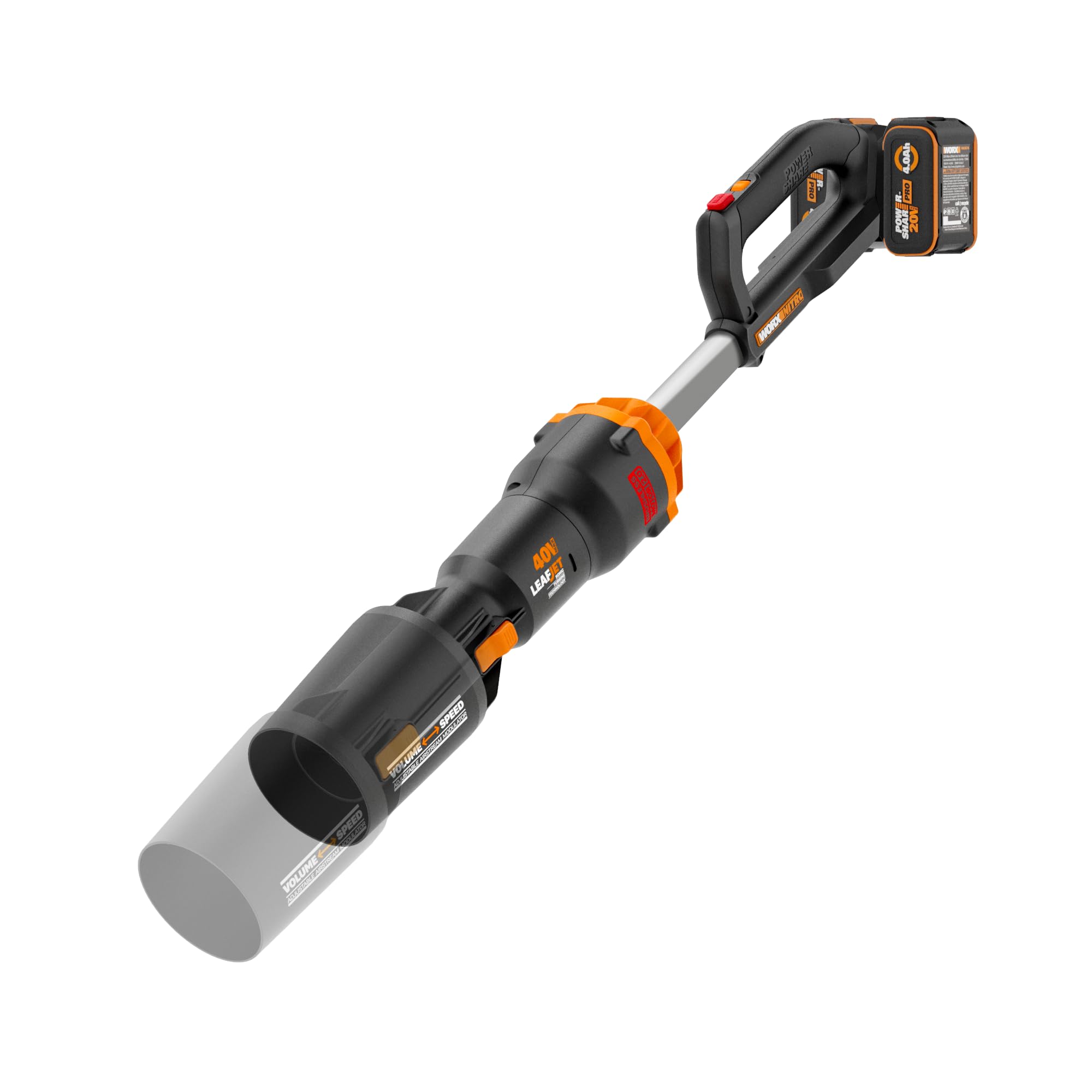
| WORX Nitro WG585★ Best Overall | Lightweight Versatility | 620 | 165 | 2 x 4.0 | Amazon |
| Husqvarna 350iBAlso Great | Heavy-Duty Clearing | 800 | 200 | 7.5 | Amazon |
| EGO Power+ LB8803-2Premium Powerhouse | Extreme Force | 880 | 200 | 2 x 4.0 | Amazon |
| Greenworks 80V (770 CFM) | Long Runtime | 770 | 190 | 4.0 | Amazon |
| Greenworks 80V (700 CFM) | Gas Replacement | 700 | 170 | 2.5 | Amazon |
| EGO Power+ LB6703 | Balanced Power | 670 | 180 | 4.0 | Amazon |
| Milwaukee M18 Dual Battery | Built-In Power System | 600 | — | Not Included | Amazon |
| SKIL PWR CORE 40 | Budget Entry | 530 | — | 2.5 | Amazon |
| SEESII 40V | Best Value | 650 | 160 | 2 x 5.2 | Amazon |
In‑Depth Reviews
1. WORX Nitro WG585
Our pick — over 4★ from 900+ verified ratings; the strongest balance of quality and price.
At 6.8 pounds with two 4.0Ah batteries, it clears a large lot without wearing out your arm.
The WORX Nitro WG585 is the lightest premium blower in this test at 6.8 pounds, yet it still delivers 620 CFM and 165 MPH — enough to move wet leaves and heavy debris without tiring your arm. It uses two 20V 4.0Ah PowerShare Pro batteries (wired in series for 40V output), and the kit includes a 4A dual quick-charger. Three speed levels plus a momentary Turbo button give you control: volume mode (620 CFM) for big areas, and speed mode (165 MPH) for stubborn debris.
Buyers report it is “lightweight after finding correct grip; powerful but not loud; clears large lot quickly; also works for light snow.” The sonic turbine fan pulls in more air to create a 14N (newtons, a measure of force) jet stream. The PowerShare Pro batteries are designed to stay cool and resist damage. One buyer mentioned the batteries don’t last long enough for a very large yard, but the dual battery setup helps extend runtime compared to a single-pack blower. The same batteries work with 140+ WORX PowerShare tools.
Strong Points
- Lightest premium blower at 6.8 lbs — 4.8 lbs lighter than the EGO LB6703.
- Dual 4.0Ah batteries provide more runtime than single-pack competitors in the same price tier.
- Works with 140+ WORX tools on the same PowerShare platform.
Limitations
- At 620 CFM it trails the Husqvarna (800 CFM) and EGO 880 CFM on raw air volume.
- Turbo mode drains batteries faster, so extra packs are useful for large yards.
Best for: buyers who want the lightest possible commercial-grade blower with enough power for medium-to-large yards and the convenience of shared batteries across a broad tool platform.
pass on it if: you need the absolute highest CFM on the market — the Husqvarna 350iB or EGO 880 CFM deliver more force.
2. Husqvarna 350iB
Gas-level force that actually pushes wet leaves across a whole lot in one charge.
You get the highest air volume of any handheld electric blower in this lineup — 800 CFM (cubic feet per minute, a measure of how much air it pushes) and 200 MPH (miles per hour, how fast that air moves) — so you can shift heavy, rain-soaked leaves and debris without stopping to rake. The Husqvarna 350iB uses a brushless motor (a more efficient, longer-lasting motor type) paired with a 7.5Ah (amp-hour, a measure of battery capacity) battery, the largest single-pack capacity on this list. Buyers report it clears a large lot with pine trees and wood decking almost entirely on one charge at normal speed.
Its Power Boost mode delivers extra power when you need it, and the built-in debris scraper at the nozzle tip helps loosen sticky leaves without bending down. Owners mention it is not a lightweight machine — at 10 pounds it has heft — but the cruise control on the keypad saves your finger from holding a trigger for twenty minutes. The 40V lithium-ion battery is compatible across all Husqvarna handheld tools, so if you already own their trimmer or chainsaw, the same battery swaps in.
True gas replacement: beats a gas Stihl in real-world testing according to reviewers, and at 200 MPH it can push your arm back in turbo mode. The single catch is battery life on full boost — owners say a backup battery is needed for the heaviest wet-leaf days, and extra 40V Husqvarna batteries do not come cheap.
Reach for this if: your property is large and you want one charger, one platform, and the highest CFM-per-dollar in a single-battery package that actually finishes the job.
Look elsewhere if: you need a lightweight blower for quick sidewalk sweeps and your main priority is holding it in one hand for 30 minutes.
3. EGO Power+ LB8803-2
An 880 CFM carbon-fiber body that nearly throws you backward the moment you hit Turbo.
The EGO LB8803-2 is the absolute peak of handheld electric blower power at 880 CFM and 200 MPH, and it packs a digital display so you can monitor battery charge, cruise lock, and performance in real time. The carbon fiber body keeps the weight down for a machine with this much force, and the included shoulder strap and secondary grip zones make two-handed operation comfortable.
EGO ships it with two 4.0Ah batteries instead of one, which is a serious buying advantage — no other brand in this list includes a second battery off the shelf at this power tier. Customers note they get about 45 minutes of runtime per battery at moderate speed, and Turbo mode at 880 CFM requires at least a 4.0Ah pack (a 5.0Ah is recommended for longer runs). The charger is fast but loud, and one reviewer noted a plasticky smell during the first charge that fades over time.
The raw-force king: at 200 MPH velocity, one owner said it nearly throws the user backward. The honest trade-off is that Turbo chews through a 4.0Ah battery quickly — having two batteries in the box is essential, and you will use both on a big yard.
Best for: anyone who demands the absolute highest CFM available in a cordless handheld and does not mind spending a premium to get a second battery included.
skip it if: you work in noise-sensitive areas — at full power it is loud enough that hearing protection is strongly recommended by owners.
4. Greenworks 80V (770 CFM)

80 minutes of runtime from one 4.0Ah battery, plus a 770 CFM blast to match 28cc gas blowers.
The Greenworks 80V 770 CFM model is the mid-range runner that combines high-volume air with the longest stated runtime on this list — 80 minutes per charge at a 50% load. That 4.0Ah battery delivers 320 Wh max, and the brushless motor runs at 74 dB. It pushes 770 CFM and 190 MPH, landing between the standard Greenworks 700 CFM blower and the Husqvarna 350iB on raw power. The variable speed trigger and cruise control let you dial down to 20 MPH for gentle patio dusting or lock in full speed for driveway clearing.
Reviewers point out it is more powerful than a Stihl BG 50 gas blower and cleared a pavement and backyard in 19 minutes. However, those same owners point out that the blower weighs 11.5 pounds with the battery on it — the 5-pound pack is a large chunk of that. The charger is described as loud (like a hair dryer) and takes under 50 minutes for a full charge. At 110 dB on Turbo, you definitely want ear protection.
What Owners Love
- 80-minute runtime (50% load) covers two full yard uses on a single charge.
- Variable speed dial goes from 20 to 190 MPH with a twist trigger that saves finger strain.
- Faster than a corded blower and way more convenient than gas, according to buyers.
The Catch
- Weighs 11.5 lbs with the 5 lb battery — noticeably heavier than the Skil at 6.4 lbs.
- Turbo mode runs at 110 dB; hearing protection is a must.
Reach for this if: you want one battery to cover a full property cleanup and the 770 CFM to handle wet leaves without buying a second pack.
Consider the lighter version if: 11.5 pounds feels heavy for your use case — the Greenworks 700 CFM model weighs 5.84 lbs and is easier to one-hand.
5. Greenworks 80V (700 CFM)
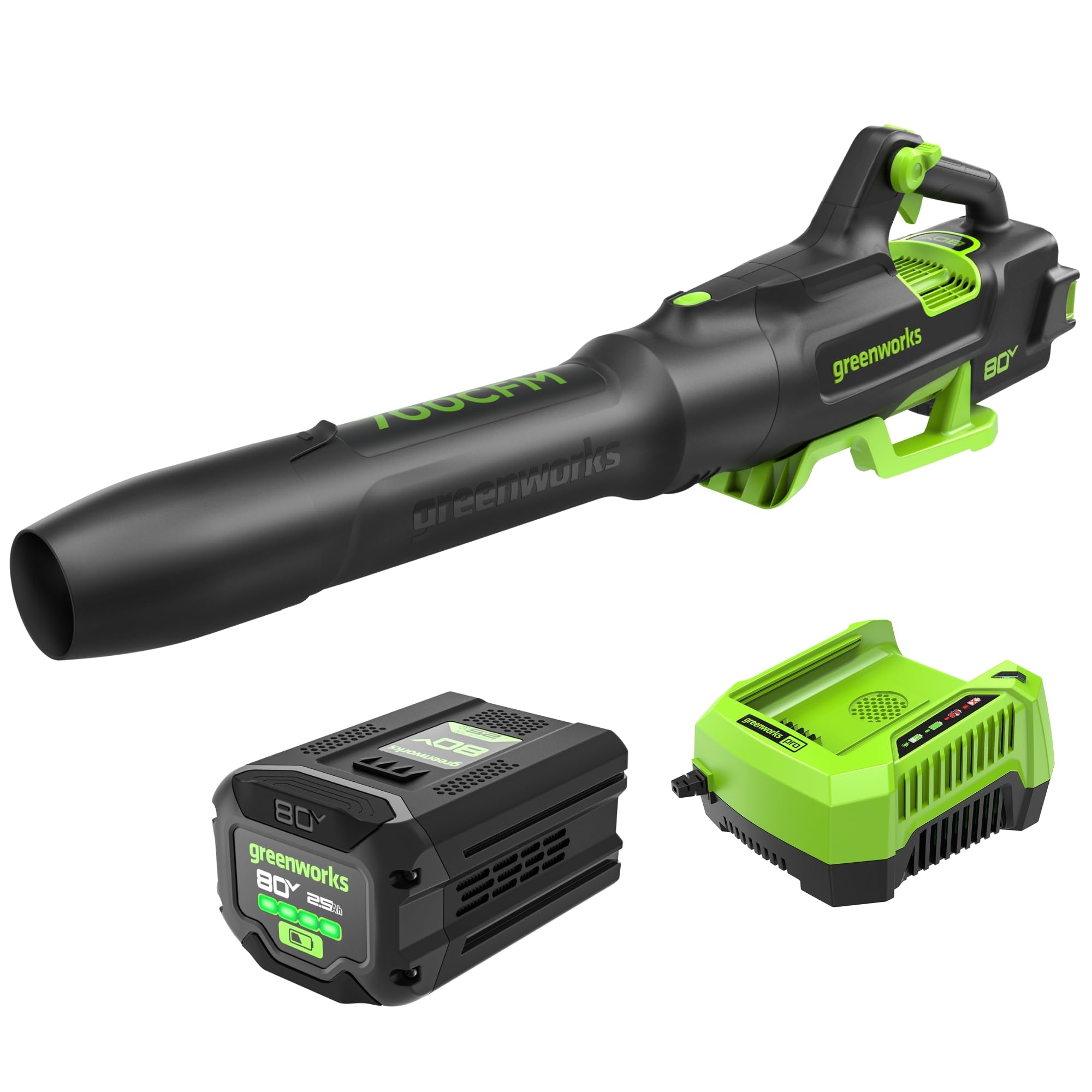
True 27cc gas-equivalent performance at 700 CFM, but at a featherweight 5.84 pounds.
At 5.84 pounds, the Greenworks 80V 700 CFM blower is one of the lightest commercial-grade blowers you can swing one-handed. It is the lighter sibling of the 770 model. The brushless motor runs at 74 dB (decibels, about as loud as a vacuum cleaner). The turbo toggle switch stays on until you turn it off — convenient for long stretches but it can drain the 2.5Ah battery quickly.
Shoppers say it is quieter and lower-pitched than the 60V Greenworks model, and one owner reported moving heavy magnolia berries on turf efficiently. The 2.5Ah battery gives about 200 Wh max, so on Turbo expect about 8-12 minutes of full-throttle runtime. The charger is very loud — one reviewer described it as sounding like a hair dryer running for 75 minutes.
Performance-to-weight standout: delivers 700 CFM at a 5.84 lb weight, making it much lighter than the 770 CFM model (5.84 lbs vs 11.5 lbs). The trade-off is a smaller 2.5Ah battery that will need recharging for larger yards.
Best for: homeowners who want gas-equivalent power in a lightweight package and have a small-to-medium yard that a single 2.5Ah charge can cover.
Look elsewhere if: your property demands more than 15 minutes of continuous Turbo use — grab the 770 CFM version with the 4.0Ah battery instead.
6. EGO Power+ LB6703

670 CFM with a 4.0Ah battery that promises up to 80 minutes — but weight is the real story here.
The EGO LB6703 is the handheld that set the standard for the 56V platform: 670 CFM of airflow with a top speed of 180 MPH, paired with a 4.0Ah ARC Lithium battery. The variable speed trigger gives you a range from 225 to 530 CFM before you hit Turbo, and the lock-on dial lets you cruise without holding the trigger. The high-efficiency brushless motor is designed for long runtime and low vibration, and the IPX4 weather resistance means it can handle light rain or wet grass without worry.
At 11.68 pounds, this is the heaviest blower in this roundup — a full 4.8 pounds heavier than the WORX at 6.8 pounds and 5.28 pounds heavier than the Greenworks 700 CFM. Reviewers consistently call it powerful and long-lasting (over 20 minutes on Turbo according to one owner), but several mention it is heavy and wish it came with a shoulder strap. It is compatible with all EGO 56V batteries, so upgrading to a larger pack later is an option.
Power + compatibility: delivers 670 CFM at 180 MPH with up to 80 minutes of runtime, and the battery works across EGO’s entire 56V tool line. The honest knock is the weight — at 11.68 lbs, it is harder to hold one-handed for an extended session than lighter competition.
Reach for this if: you already own EGO 56V tools and want a powerful blower that shares batteries, or you prioritize runtime over absolute CFM numbers.
Consider the Greenworks 700 CFM instead if: weight is your primary concern — at 5.84 lbs it is half the weight with similar CFM output.
7. Milwaukee M18 Fuel Dual Battery Blower
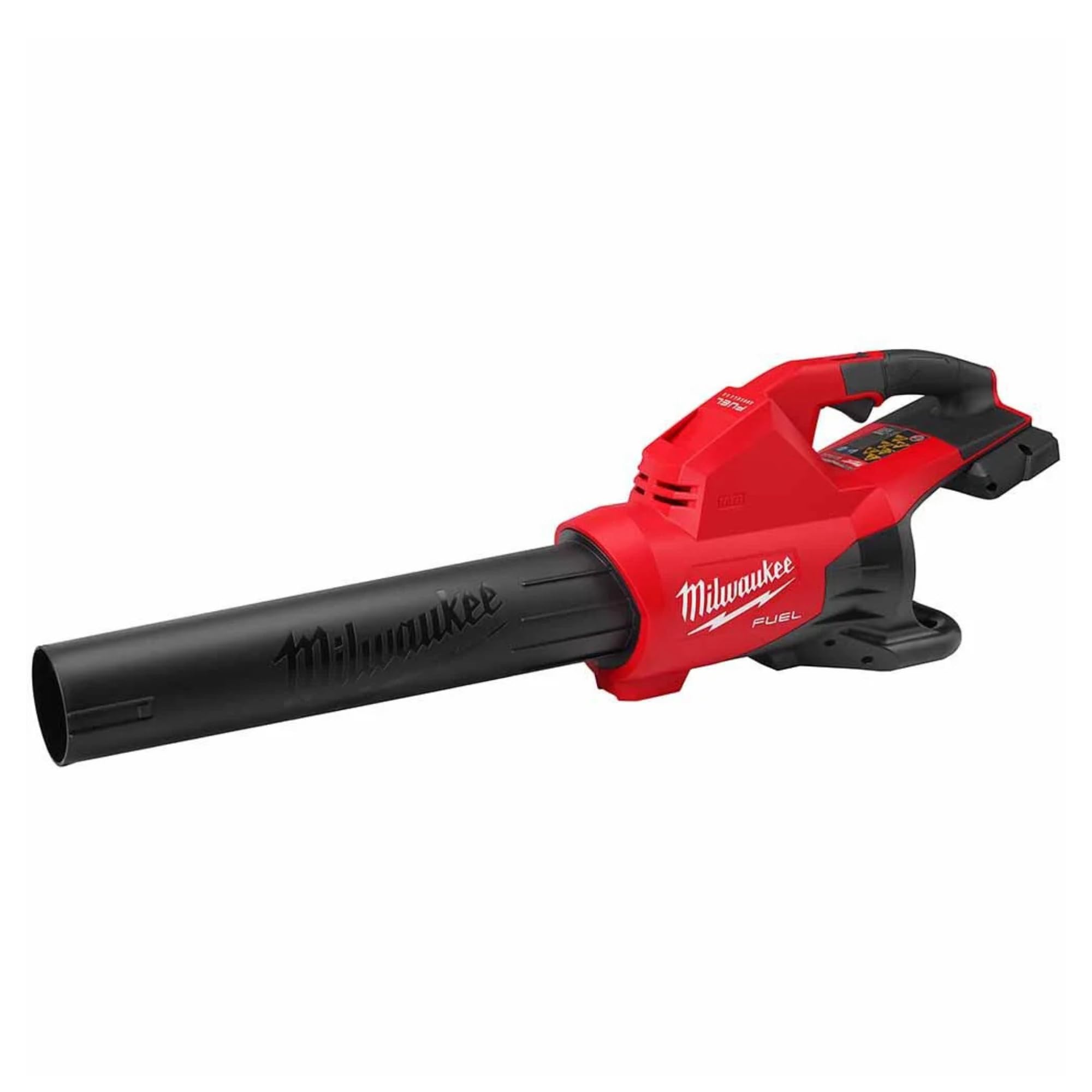
Dual M18 batteries feed a brushless motor that reaches full throttle in under one second.
The Milwaukee 2824-20 is a tool-only unit (no battery or charger included) that requires two M18 batteries to run, making it a natural fit if you already have a stack of Milwaukee M18 packs. It delivers 600 CFM from that dual-battery setup, and the REDLINK PLUS intelligence system communicates between the tool and batteries to maintain constant power even as the pack discharges. That means you do not feel a power fade halfway through a job — the blower runs at full speed until the batteries are empty.
Reviewers confirm it matches a gas Stihl in raw power and is excellent for porches, pool decks, and driveways. The catch: with two M18 8.0Ah batteries attached, the blower weighs about 10.8 pounds (5.1 kg) and lacks a shoulder strap. Users note that high power drains batteries quickly — expect 15-20 minutes on a pair of 8.0Ah packs — and there is a slight power drop when the gauge hits 2 bars. This blower is best for Milwaukee fans who already own high-capacity M18 batteries.
Platform-dependent power: the 600 CFM output is respectable but not class-leading, and the real value comes from using batteries you already own. The lack of included batteries and the heavy weight with two large packs make it less attractive for someone starting fresh in a battery system.
Reach for this if: you are already deep in the Milwaukee M18 ecosystem and want a blower that shares your existing high-capacity batteries without needing a separate charger and packs.
Look elsewhere if: you do not own Milwaukee M18 batteries — the tool-only price plus two large batteries makes it more expensive than many complete kits from other brands.
8. SEESII 40V with 2 x 5.2Ah Batteries
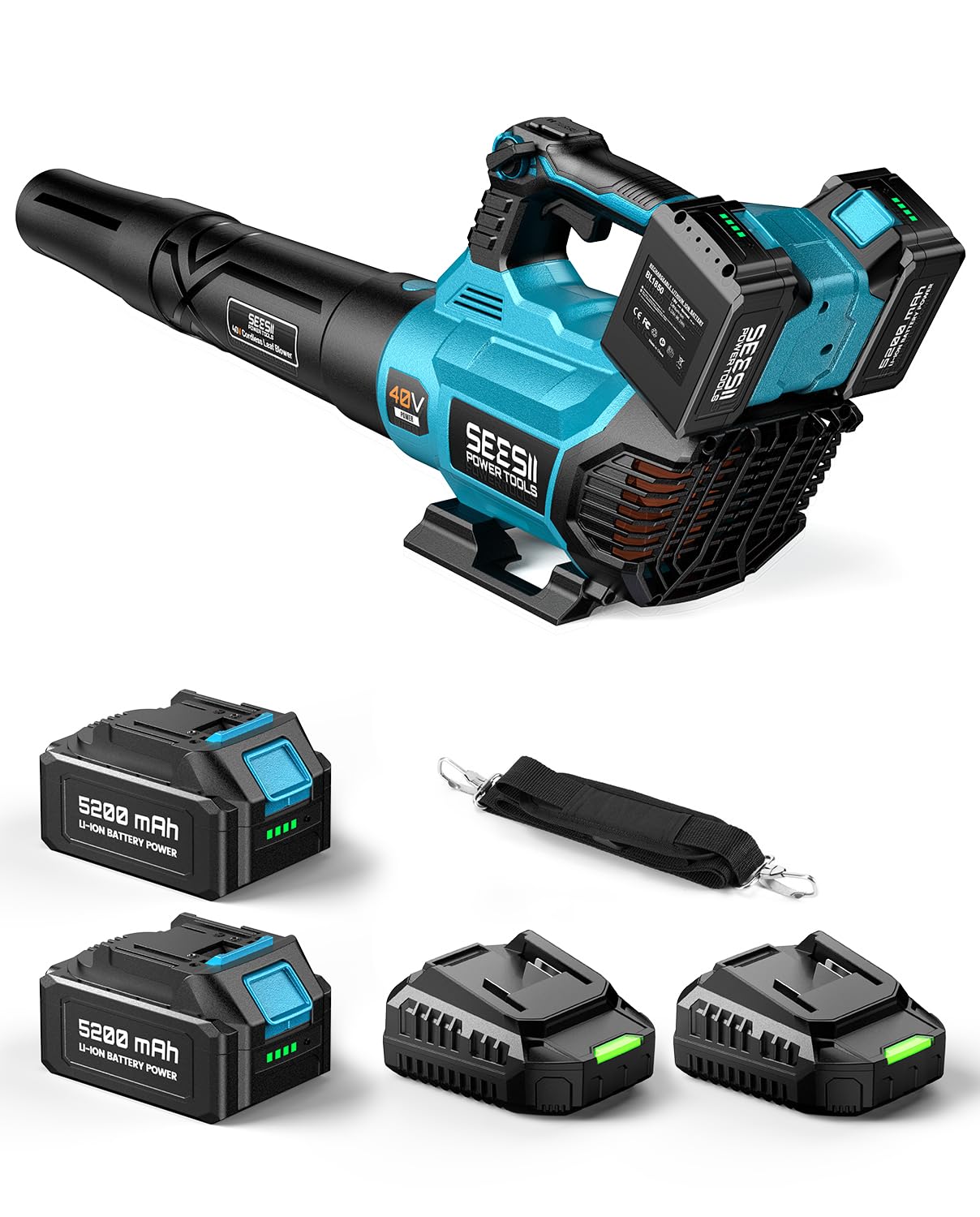
Two 5.2Ah batteries in the box for 650 CFM and up to 90 minutes of runtime at a budget-friendly price.
The SEESII 40V blower is the value champion of this list, delivering 650 CFM and 160 MPH from a brushless motor while including two 5.2Ah batteries and two chargers. That battery capacity is substantial — 10.4Ah total — and the maker claims up to 90 minutes of runtime on low settings. For comparison, the Skil 530 CFM model comes with a single 2.5Ah battery, meaning the SEESII has a total capacity of 10.4Ah (two 5.2Ah batteries) versus the Skil’s 2.5Ah battery. At only 4.6 pounds, it is the lightest blower in this entire roundup, making it comfortable for one-handed operation.
The variable speed trigger and one-touch Turbo mode give you 650 CFM on demand for heavy wet leaves or small stones. An adjustable shoulder strap is included to reduce arm fatigue during longer sessions. Owners mention it is “light weight for easy use. Keeper,” and “works great. I like the variable speed trigger and lots of power when it’s needed.” However, the blower requires both 20V batteries installed together to operate (they connect in series for 40V), so you cannot run it on a single pack if one dies — you always need two.
Blows away the value competition: 650 CFM, 4.6 lbs, and two 5.2Ah batteries make this the best budget-to-performance ratio in the group. The trade-off is the SEESII battery platform is less widely supported than WORX, EGO, or Greenworks, so expanding your tool collection on the same batteries is harder.
Best for: buyers who want maximum runtime and power at the lowest entry cost, and do not mind a platform that is less common than the big brands.
Consider EGO or Greenworks instead if: you plan to buy more cordless outdoor tools later and want to stay within a single, widely available battery system.
9. SKIL PWR CORE 40

A lightweight, powerful 530 CFM blower with a 15-minute quick charge that gets you back to work fast.
The SKIL PWR CORE 40 is the entry-level blower in this commercial group, but it brings a smart charging trick that separates it: the Auto PWR JUMP charger takes the 2.5Ah battery from 0 to 30% in just 15 minutes. That means even with its smaller battery capacity, a quick break gets you back to clearing. The brushless digital motor delivers 530 CFM of clearing power — enough for typical leaf cleanup around a medium yard — and the variable speed trigger plus cruise lever with Power Boost gives you control from flower beds to heavy debris piles. At 6.4 pounds, it is only 0.4 lbs lighter than the WORX but still comfortable for one-handed use.
Reviewers call it “lightweight, powerful, variable speed” and note it is a great value for homeowners. The honest limitation is battery runtime: customers note about 10 minutes on high speed and 15-20 minutes total before needing a recharge. Unlike the SEESII or WORX, this kit ships with only one battery, and buying an extra 2.5Ah pack is costly enough that several reviewers wished for a two-battery bundle. The IPX4 water resistance adds durability in wet grass or light rain.
What Works
- 15-minute jump charge to 30% means short breaks, not long waits.
- Lightweight at 6.4 lbs and well-balanced; cruise lever saves finger strain.
- Clears a garage in 25 seconds according to a reviewer.
The Shortfalls
- Only one 2.5Ah battery included — runtime is 10-15 minutes at full power.
- Battery management warns against leaving it on the charger for more than 24 hours (no trickle charge).
Best for: homeowners on a budget who need a capable blower for quick daily cleanups (driveways, patios, light leaves) and appreciate the fast-charge feature over raw runtime.
Look elsewhere if: you have a large yard with heavy debris — the SEESII with two 5.2Ah batteries costs less and delivers more runtime and higher CFM.
Understanding the Specs
CFM vs. MPH — What Moves Leaves?
CFM (cubic feet per minute) tells you the volume of air the blower moves — the higher the number, the more debris you can push in one sweep. MPH (miles per hour) tells you the speed of that air — the higher the number, the more force it applies to stuck-on debris. For wet, heavy leaves, prioritize CFM (look for 600+). For blowing mud off concrete or needles from pavers, prioritize MPH (160+ is a good target).
Battery Amp-Hours (Ah) and Voltage
Amp-hours (Ah) is the fuel tank size of the battery. A 5.2Ah battery (5.2Ah) runs longer before needing a charge than a 2.5Ah battery (2.5Ah). Voltage (40V, 56V, 80V) is the power potential — higher voltage can spin a bigger fan and deliver higher CFM. The real-world rule: total watt-hours (Volts x Ah) is the number that matters for runtime. A 56V 4.0Ah battery (224 Wh) will outlast a 40V 4.0Ah battery (160 Wh) under the same load.
Brushless Motors vs. Brushed
A brushless motor uses electronic control instead of physical brushes to deliver power, which means less friction, less heat, and longer life. Most commercial-grade blowers on this list use brushless motors because they are more efficient (claimed 50% longer lifespan vs. brushed) and run quieter. If a blower has a brushed motor, it is likely not a “commercial” model.
Turbo Mode and Cruise Control
Turbo mode is a temporary power boost that pushes CFM and MPH to the maximum rating — great for heavy wet piles or stuck debris. Cruise control (or lock-on) lets you set a steady speed without holding the trigger, which reduces finger fatigue during long sessions. Some blowers use a momentary button for Turbo (you hold it), while others use a toggle that stays on until you switch it off — the latter is more convenient but drains the battery faster.
FAQ
How much CFM do I need for a large yard with wet leaves?
Will a 40V blower have enough power compared to an 80V model?
Can I use a leaf blower for light snow removal?
What does IPX4 water resistance mean for a leaf blower?
How long does a leaf blower battery last on a full charge?
Is a cordless electric leaf blower as powerful as a gas model?
What is the difference between a momentary Turbo button and a toggle Turbo switch?
Can I use a leaf blower to clean gutters?
How heavy is too heavy for a handheld leaf blower?
What should I do if my leaf blower battery stops holding a charge?
Final Thoughts: The Verdict
If you want one dependable pick, the best commercial electric leaf blower winner is the Husqvarna 350iB because it delivers the highest single-battery CFM (800 CFM) and MPH (200 MPH) in a package that fits a standard 40V platform while actually finishing a large lot on one charge. If you want the absolute highest air volume on the market and are willing to carry two batteries, the EGO Power+ LB8803-2 with its 880 CFM and carbon fiber body is your power-hungry pick. And for the best value-to-performance ratio with the lightest weight and longest total runtime from included batteries, the SEESII 40V with 2 x 5.2Ah batteries is the smart-buy champion for anyone who wants 650 CFM at 4.6 pounds and a sub-premium price.
How We Picked
We do not accept paid placement. Every pick is matched to a real buyer and a real use-case; we do not hands-on test units.
Sources & Methodology
Specifications: manufacturer listings and product documentation. Review insights: verified customer reviews, as of July 2026. Pricing: not shown on this page (it changes often); check the current price via the retailer link.
As an Amazon Associate, WellFizz earns from qualifying purchases. This does not affect which products we feature.
Related Guides

Mo Maruf
I created WellFizz to bridge the gap between vague wellness advice and actionable solutions. My mission is simple: to decode the research and give you practical tools you can actually use.
Beyond the data, I am a passionate traveler. I believe that stepping away from the screen to explore new environments is essential for mental clarity and physical vitality.