Our readers keep the lights on and my smoothie glass nicely filled. As an Amazon Associate, I earn from qualifying purchases.
Specs are compiled from manufacturer listings and verified buyer reviews and can change over time — please confirm the key details on the product page before buying.
A corded shop vac pins you to an outlet. On a job site, in a warehouse, or cleaning out a fleet of work vans, that tether is the single biggest drag on your time. A commercial cordless vacuum changes the math entirely — you carry the power with you, not the extension cord. The challenge is picking a model with enough suction, runtime, and tank capacity for real commercial work.
I’m Mohammad Maruf — the founder and writer behind WellFizz. This guide is built by comparing the manufacturers’ published specifications and the patterns across verified customer reviews, so you get each pick’s real strengths and trade-offs instead of marketing spin.
Every model here is battery-powered, built for repeated daily use, and comes from brands that back their gear with real warranties. What follows is a straight-shooting look at the best commercial cordless vacuum options for 2025, ranked by real-world owner feedback and measurable performance.
Our Picks at a Glance

How To Choose The Best Commercial Cordless Vacuum
The right commercial cordless vac depends on debris volume, runtime needs, and whether the job is wet, dry, or both.
Suction Power — Look at CFM, Not Motor Size
Cubic feet per minute (CFM) tells you how much air the vacuum moves. Higher CFM means it grabs larger debris and covers floor area faster. The water lift rating (inches of lift) matters for deep-cleaning carpets or pulling moisture out of soaked surfaces. A shop vac with 110 CFM, for example, will clear a worksite noticeably quicker than one at 70 CFM — that is a real daily time savings.
Battery Life and Compatibility
Battery amp-hours (Ah) determine run time between charges. A 5.0Ah battery will typically run a cordless vac on a medium setting for about 30 to 60 minutes. If you already own tools from a brand like EGO or Makita, buying a bare tool (no battery or charger) saves a lot upfront — just make sure the vacuum is compatible with your existing battery platform. For heavy commercial use, factoring in a second battery means zero downtime while one charges.
Capacity and Form Factor
Backpack vacuums (like the Makita and ProTeam models) keep your hands free and are ideal for stairs, furniture, and multi-floor cleaning over long shifts. Canister or tank-style vacs hold more debris — 9 gallons versus 1.6 gallons — and handle wet pickup, making them the right choice for workshops, garages, and vehicle interiors. Your actual space dictates the form factor: do you need to carry the vac on your back all day, or roll it across a concrete floor?
Filtration Matters for Indoor Air
A HEPA filter captures 99.97% of particles down to 0.3 microns. That is critical for drywall dust, concrete dust, or any fine particulate that would otherwise recirculate into the air. If you are using the vac indoors on a regular basis, a two-stage HEPA system (like the ones on the Makita backpacks) keeps the workspace healthier and extends the life of the primary filter.
Quick Comparison
| Model | Best For | Suction (CFM) | Max Run Time | Tank Size | Amazon |
|---|---|---|---|---|---|
| EGO WDV0900 (Tool Only)★ Best Overall | Heavy wet/dry with max power | 110 CFM | 60 min (ECO) | 9 gal | Amazon |
| EGO WDV0904 (Kit)Best Value Kit | Out-of-box convenience | 110 CFM | 60 min (ECO) | 9 gal | Amazon |
| Makita XCV09Z Backpack | Lightweight daily carry | 70 CFM | 116 min (low) | 0.5 gal bag | Amazon |
| Makita XCV17Z Backpack | Extended run on a harness | 78 CFM | 139 min (low) | 1.6 gal bag | Amazon |
| ProTeam GoFit 3 | Ultra-light professional wear | — | 51 min (low) | 3 qt bag | Amazon |
In‑Depth Reviews
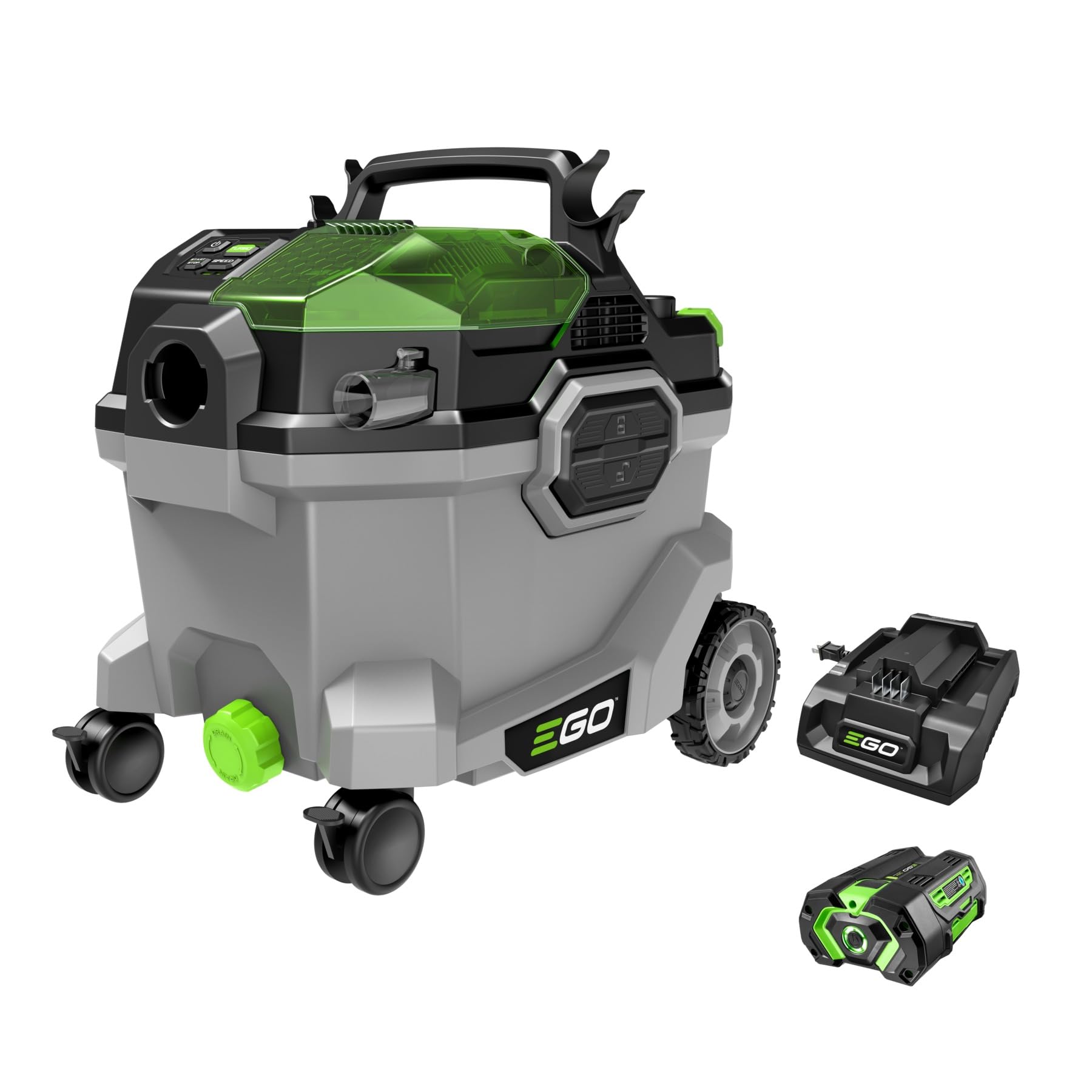
1. EGO Power+ WDV0900 (Tool Only)
Our pick — over 4.5★ from 250+ verified ratings; the strongest balance of quality and price.
The rolling 9-gallon monster that delivers 110 CFM without a cord in sight.
The defining spec here is 110 CFM — that is genuine corded-level airflow in a battery-powered canister. You scrub every surface faster because the suction does not taper off as the battery drains, and at 100 inches of lift, it handles everything from sawdust piles to standing water in a flooded car floor. Three power modes (ECO, High, Turbo) let you stretch runtime or max out power as the job demands. On ECO it runs up to 60 minutes; on Turbo buyers report it chews through a 2.5Ah battery in about one car cleanup.
The onboard storage is a real timesaver — every nozzle, extension, and the 1-7/8-inch hose clicks into place on the tank so nothing gets left behind. A wireless remote with a rechargeable battery means you can start and stop the vac from across the room or the other side of a vehicle. Owners consistently call it “a monster” and praise how rubber wheels roll smoothly over rough concrete. The catch is that batteries and charger are sold separately — this is the bare tool, so budget for two 6.0Ah ARC Lithium batteries if you are not already in the EGO ecosystem. Buyers also warn that the suction bypass collar on the hose can accidentally open and kill suction mid-sweep; a small design quirk to watch for.
The crowd favorite across 250+ owners puts this at a stellar 4.7 stars. It is also noticeably quieter than a comparable corded shop vac — a welcome relief on a long job. Battery life on Turbo is only about 20 minutes, but the trade-off is that you get raw power that rivals, and in some runs beats, a corded Ridgid. For a busy site where the cord is your biggest slowdown, this EGO is the unanimous pick.
What Owners Cheer
- 110 CFM suction that genuinely matches corded shop vacs
- Onboard storage for every component — nothing rolls away
- Wireless remote with its own rechargeable battery
- Runs on all EGO 56V ARC Lithium batteries (no new platform needed if you already own EGO tools)
The Fine Print
- Battery and charger sold separately; cost adds up fast if starting fresh
- Suction bypass collar on the hose can be knocked open accidentally
- Turbo mode drains a battery in about 20 minutes under heavy load
- Squeegee attachment does not store on the unit
Reach for this if: You need corded-level power without the cord, and you either own EGO batteries already or are ready to invest in the platform for a 5-year tool warranty.
Think twice if: Your jobs are mostly fine dry dusting in tight spaces — the 9-gallon tank is bulky, and a backpack would be more maneuverable for stairs.
2. EGO Power+ WDV0904 (Kit with Battery & Charger)
The same 9-gallon beast, now with a battery and charger in the box.
This is the identical 110 CFM canister as the WDV0900 above, but it ships with a 5.0Ah ARC Lithium battery and the rapid charger. That inclusion eliminates the biggest friction point of the tool-only version — you are ready to roll straight from the start. The tank holds 9 gallons of wet or dry debris, and the brushless motor delivers the same 100-inch water lift and three power modes (ECO, High, Turbo). On ECO you get up to 60 minutes of run time; on Turbo, expect about 20 minutes of intense suction.
Quality is the single most-praised aspect, mentioned by 26 owners. The suction rating is second, with 15 buyers specifically calling it “incredible” and noting that it outperforms corded DeWalt shop vacs they have used. The wireless remote earns consistent praise (11 mentions) — the ability to start and stop the vac from the other side of a car or room genuinely changes how you move through a job. Owners mention using it to clear AC pan clogs, suck water out of spas, and clean grills, all without dragging a cord. The trade-off is the upfront cost — buyers who call it “pricey but worth it” outnumber anyone disappointed. The 5.0Ah battery in the kit is strong, but for extended all-day use, a second 6.0Ah battery is worth considering.
This kit version earns a 4.8-star average across 111 ratings, making it the top pick if you do not already own EGO batteries. You get a 5-year tool warranty and a 3-year battery warranty, so daily commercial use feels less risky. Several owners describe the build quality as “indestructible,” and the rubberized wheels roll easily over gravel and extension cords. If you are buying your first cordless shop vac, this kit removes all the guesswork.
What Wins People Over
- Same 110 CFM / 100-inch lift as the tool-only version
- Includes 5.0Ah battery and rapid charger — no extra purchases needed to start using it
- Quality and suction are the two most-praised aspects (26 and 15 mentions)
- Wireless remote with a light on the nozzle for dark spaces
The Fine Print
- Premium entry price; the kit costs considerably more than the tool-only version
- Turbo mode still drains a 5.0Ah battery in roughly 20 minutes
- Attachments are sized more for workshop floor than tight car interiors
- Suction bypass collar on the hose can be bumped open accidentally
Reach for this if: You want the best-rated cordless shop vac and prefer one-box convenience — battery and charger are included, no separate shopping.
Think twice if: You already own EGO 56V batteries and a charger; the tool-only WDV0900 is the smarter buy and saves significant money.
3. Makita XCV09Z Backpack Vacuum (Tool Only)

The 12.8-pound backpack that frees your hands for a full shift of detail work.
This dry-only backpack vac suits you if you move through buildings or tight spaces all day. Its BL Brushless motor runs on two 18V LXT 5.0Ah batteries (sold separately) and delivers 70 CFM (cubic feet per minute of airflow) with 44 inches of water lift (a measure of suction strength). That is at 70 CFM versus the EGO canister’s 110 CFM — a real gap when clearing larger debris fast — but the trade-off is 116 minutes of continuous run time on the normal setting. For a cleaner covering an entire office floor or hotel wing, that single-charge endurance is the headline feature.
The two-stage HEPA filter captures 99.97% of particulates down to 0.3 microns, which matters enormously for drywall dust or fine concrete dust on indoor job sites. The harness distributes weight well, and the telescoping wand with a low-profile pivoting head reaches under furniture easily. Where the Makita stumbles is in bag capacity: the disposable filter dust bag holds only about a half-gallon, and owners say it “fills fast” — especially with demolition debris. When the bag gets full, suction drops noticeably, so this vac demands frequent bag changes. Buyers also note that the batteries die within about an hour in real use (closer to 60 minutes than the 116-minute spec) and a few find the suction “not all that great” for heavy construction pickup. The honest read is that this is a finishing tool, not a primary debris hog.
With a 4.0-star average across 51 ratings, the XCV09Z has a mixed reputation — owners who use it for fine dust and pet hair on hardwood floors love it, but those expecting a primary construction vac are often disappointed. If you are already deep in the Makita 18V LXT battery system, this tool-only price makes sense as a specialist addition for light, all-day dry cleaning. But against the 110 CFM of the EGO, the suction gap is real and noticeable.
Best for fine indoor dusting: The HEPA filtration and long normal-mode runtime make it suited for daily commercial cleaning of finished spaces — offices, showrooms, low-pile carpet.
The honest trade-off: At 70 CFM it falls short for heavy construction debris, and the half-gallon bag needs frequent swaps. This is a specialist, not a generalist.
Grab this for: All-day dry vacuuming where cord-free hands are more valuable than raw power — think hotel housekeeping, janitorial routes, or drywall sanding cleanup.
skip it if: You need a single do-everything shop vac for wet pickup, large debris, or heavy construction site work. The EGO canister is the stronger all-rounder.
4. Makita XCV17Z Backpack Vacuum (Tool Only)
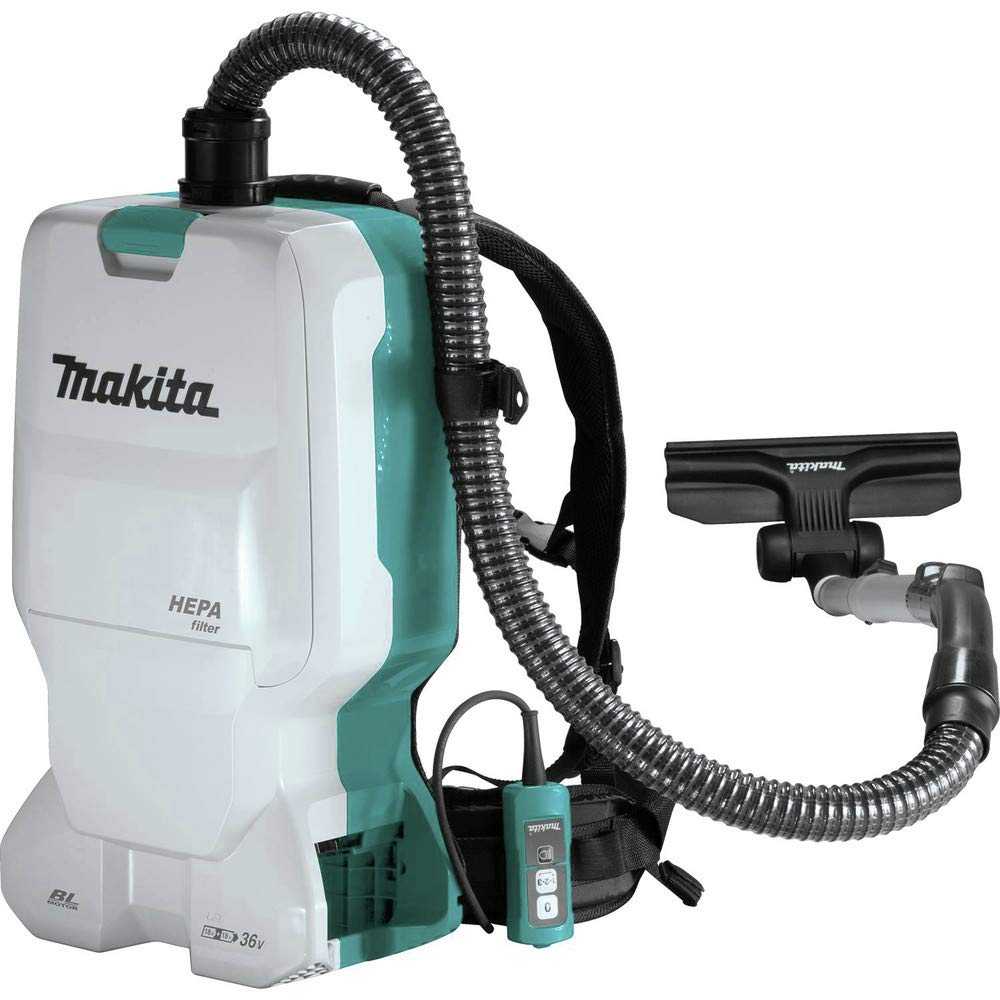
The bigger brother that runs 139 minutes on low — a full-shift vac for large properties.
This is the higher-capacity evolution of the XCV09Z. It uses two 18V LXT 6.0Ah batteries (sold separately) to push run time to an impressive 139 minutes on the normal setting and 40 minutes on max. The brushless motor delivers 78 CFM and 44 inches of water lift, an improvement from the XCV09Z’s 70 CFM to 78 CFM but still well short of the 110 CFM the EGO canister provides. The real advantage here is endurance — for a cleaner assigned to a large school, a hotel, or a multi-floor office building, this vacuum keeps running through an entire shift without a battery swap.
Effectiveness is the top praised aspect (mentioned by 5 owners), and the pack is notably quiet at 60 to 67 dB — quiet enough to use during business hours without disturbing occupants. The side-loading batteries are a smart design touch: you swap them without taking the pack off your back. Owners say the XCV17 handles low-pile carpet, hardwood, and concrete well, and the comfortable harness makes a full day on your feet manageable. The catch, mentioned repeatedly, is that suction feels less powerful than some owners expected — one buyer called it “not real strong” for construction work, and another returned it because the suction did not match the rating. It also lacks a motorized brush head, so deep-pile carpet cleaning is off the table. And at roughly 1.6 gallons, the dust bag is bigger than the XCV09Z but still small compared to a tank-style vac.
This Makita sits at 4.1 stars from 44 ratings — respectable but not outstanding. The biggest buyer divide is between those who prize runtime and quiet operation (they love it) and those who need raw suction power (they find it lacking). For a commercial cleaning route where noise complaints and shift-long battery life matter more than brute force, the XCV17 is a solid specialist. But it cannot match the EGO canister for pure pickup power.
Why a pro picks it: Nearly 2.5 hours of runtime on low means zero mid-shift charging breaks, and the 60-67 dB noise level is office-friendly even during work hours.
Where it falls short: The suction at 78 CFM is noticeably behind the best corded and cordless canister vacs, and the lack of a motorized brush makes deep carpet a struggle.
Reach for this if: You need a full-shift cordless backpack for daily dry cleaning of hard floors and low-pile carpet in a noise-sensitive environment.
Choose something else if: Your primary need is heavy wet/dry pickup, construction debris, or high-pile carpet — the EGO canister is the stronger choice for all three.
5. ProTeam GoFit 3 Cordless Backpack Vacuum
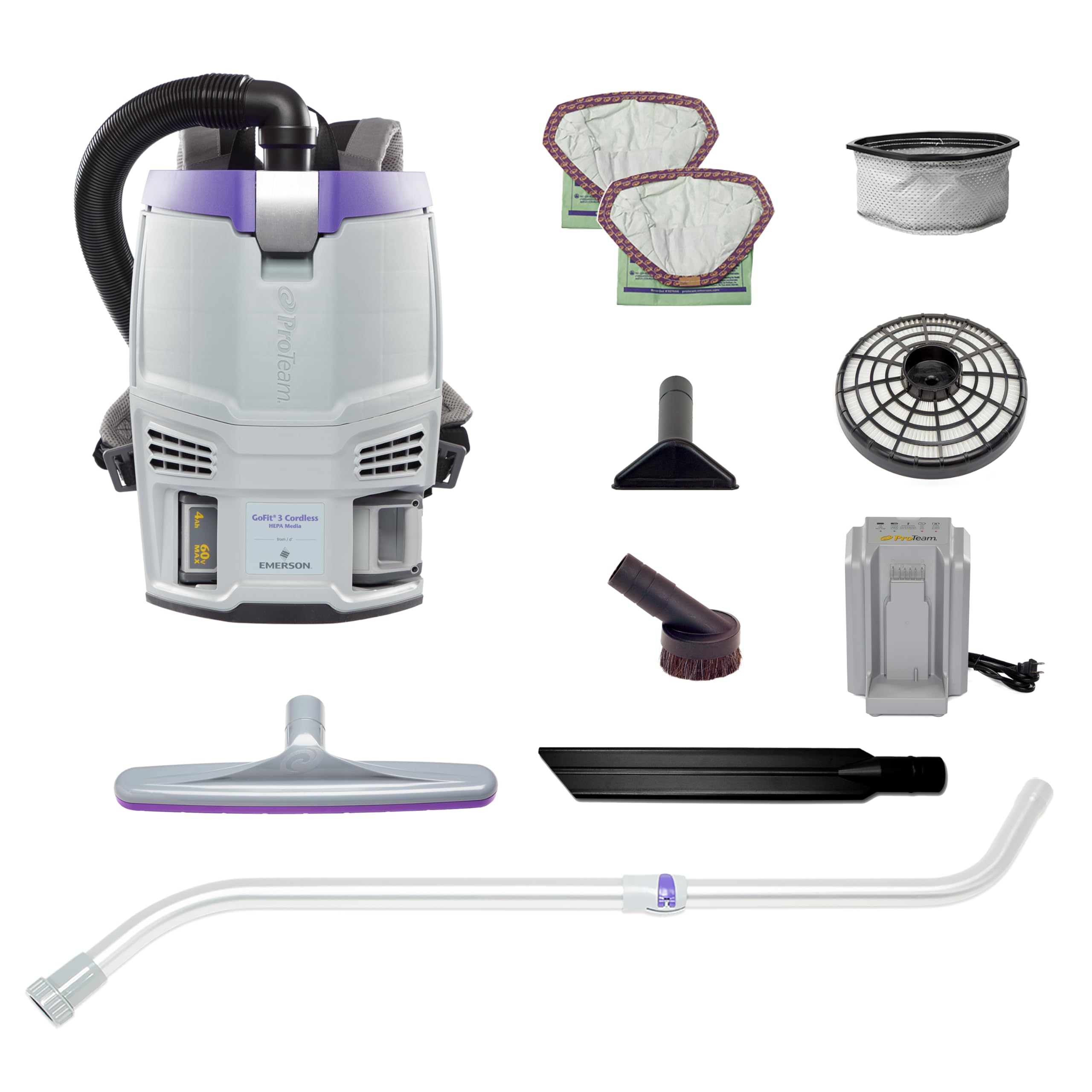
The 12.8-pound cordless backpack built for cleaners with smaller frames or tight schedules.
ProTeam is a major name in professional cleaning, and the GoFit 3 is their lightest cordless backpack at just 12.8 pounds with the 4Ah battery installed. The 4-step quick-adjust harness fits a wide range of body types without tools, and the vacuum is designed to let you clean faster than a corded backpack because you are not managing a power cord. Run time is 51 minutes on low and 39 minutes on high — enough for a standard office route or a multi-room home, but compared to the Makita backpacks’ 116 and 139 minutes. The battery recharges in approximately 61 minutes, which is quick enough to get back on the floor within a lunch break.
The ProLevel Filtration System uses a HEPA filter (a high-efficiency filter that traps fine particles), and ProTeam is a partner of the American Lung Association. Owners praise the comfort and the fact that attachments store right on the waistband — no hunting for accessories. One buyer with a 6-bedroom house reported that a single charge cleaned the whole home with power to spare, and called the cordless convenience “a.” However, suction is a persistent complaint. Multiple owners find it “weaker than corded models,” and a professional user noted that the corded version of the same vac provides significantly better draw. The battery also has a tendency to fall off if bumped hard, which is a reliability concern for daily commercial use.
At 3.2 stars from 29 ratings, the GoFit 3 has the lowest satisfaction score in this lineup. The core tension is clear: it is the lightest, most comfortable backpack on the list, but the suction just does not match corded performance expectations. For light-duty indoor cleaning on hard floors where weight and mobility are the priority, it works. For heavy commercial vacuuming, the Makita backpacks or the EGO canister deliver meaningfully more power.
Why It Stands Out
- Lightest cordless backpack at 12.8 lb — genuine relief for all-day wear
- Tool-free 4-step harness adjusts to a wide range of body sizes
- Attachments live on the waistband; no extra tool kit to carry
- Fast 61-minute recharge keeps downtime short
The Trade-Offs
- Suction is measurably weaker than corded equivalents — a recurring owner sentiment
- Battery can detach if the pack is jostled or bumped hard
- Only 39 to 51 minutes of runtime; falls short of the Makita backpacks on endurance
- No motorized brush for deep carpet cleaning
Best suited for: Light daily cleaning of hard floors and low-pile carpet where weight and comfort matter more than raw suction — think residential cleaners, small offices, or hotel guest rooms.
Not the best choice for: Any job site with heavy debris, wet pickup, or deep carpet — the Makita backpacks or EGO canister hit harder.
Understanding the Specs
CFM — Cubic Feet per Minute
CFM (cubic feet per minute) tells you how fast the vacuum moves air. A higher CFM means it picks up larger debris and covers floor area faster. For a commercial cordless vacuum, 70 CFM is adequate for light dry dusting, while 110 CFM is the balance for matching corded shop vacs. If you are cleaning construction debris or heavy dirt, prioritize models in the 100+ CFM range.
Water Lift — Inches of Lift
This measures how strongly the vacuum can pull against a sealed surface. It matters most for deep-cleaning carpets (pulling embedded dirt out) and for picking up standing water. Most cordless commercial vacs range from 44 inches to 100 inches. Higher lift means better deep-pile carpet cleaning and faster water removal.
Amp-Hours (Ah) and Runtime
The battery amp-hour rating tells you the energy capacity. A 5.0Ah battery on a shop vac typically runs 30 to 60 minutes on a medium setting, depending on motor draw. The runtime spec manufacturers give (e.g. “60 minutes on ECO”) is usually on the lowest power setting. In real use on high or turbo, expect roughly half that time. If you need continuous runtime through a full workday, plan for two batteries — one running, one charging.
HEPA Filtration
HEPA stands for High-Efficiency Particulate Air. A true HEPA filter captures 99.97% of particles down to 0.3 microns — that includes fine dust, pollen, and mold spores. For indoor commercial use (offices, hotels, schools), HEPA filtration is critical to avoid blowing fine dust back into the air. The Makita backpacks use a two-stage HEPA system that extends filter life by catching larger particles in a pre-stage before the main HEPA layer.
FAQ
Can a cordless commercial vacuum really replace a corded shop vac?
How long does a battery last on a cordless shop vac in real use?
Do I need a HEPA filter on a commercial cordless vacuum?
Backpack or canister — which form factor is better?
Can I use my existing power tool batteries with a commercial cordless vacuum?
What is the difference between CFM and water lift?
Are cordless commercial vacuums quieter than corded ones?
How long do the filters and dust bags last?
Can a cordless shop vacuum pick up water?
Is the ProTeam GoFit 3 worth the premium price?
Final Thoughts: The Verdict
For most buyers, the best commercial cordless vacuum is the EGO Power+ WDV0900 (tool only) because it delivers genuine corded-level suction at 110 CFM in a 9-gallon rolling canister that handles both wet and dry debris. If you do not already own EGO batteries, the WDV0904 kit with the 5.0Ah battery and charger is the all-in-one convenience play that removes the only real friction. For a professional cleaner who spends entire shifts on their feet in dry indoor spaces, the Makita XCV17Z offers exceptional 139-minute runtime and whisper-quiet operation. And if weight and maneuverability are your top priorities — especially for smaller-framed operators — the ProTeam GoFit 3 is the lightest cordless backpack option, albeit with real trade-offs in suction power.
How We Picked
We do not accept paid placement. Every pick is matched to a real buyer and a real use-case; we do not hands-on test units.
Sources & Methodology
Specifications: manufacturer listings and product documentation. Review insights: verified customer reviews, as of July 2026. Pricing: not shown on this page (it changes often); check the current price via the retailer link.
As an Amazon Associate, WellFizz earns from qualifying purchases. This does not affect which products we feature.
Related Guides

Mo Maruf
I created WellFizz to bridge the gap between vague wellness advice and actionable solutions. My mission is simple: to decode the research and give you practical tools you can actually use.
Beyond the data, I am a passionate traveler. I believe that stepping away from the screen to explore new environments is essential for mental clarity and physical vitality.