Our readers keep the lights on and my smoothie glass nicely filled. As an Amazon Associate, I earn from qualifying purchases.
Specs are compiled from manufacturer listings and verified buyer reviews and can change over time — please confirm the key details on the product page before buying.
Your restaurant or convenience store needs a chest freezer that can handle a ton of frozen food without breaking down or letting temperatures drift. Pick the wrong one, and you risk spoiled inventory and failed health inspections. This guide compares published specs and real buyer experiences for four top models, so you can see exactly which trade-offs make sense for your business.
I’m Mohammad Maruf, founder of WellFizz. I built this guide by matching manufacturer specs with patterns from customer reviews, so each pick shows real strengths and weaknesses — not marketing claims.
Choosing the right commercial chest freezer means matching capacity, durability, and temperature performance to your daily workflow.
Our Picks at a Glance
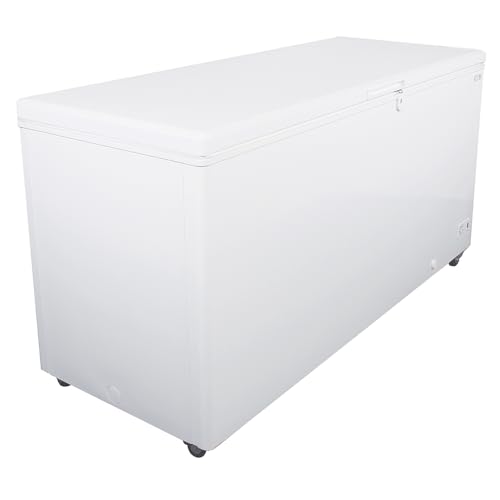
How To Choose The Best Commercial Chest Freezer
Choosing a commercial chest freezer is about more than just the price tag. You need to match cubic footage (the interior volume, measured in cubic feet) to how much frozen stock you store, confirm that the compressor can hold steady sub-zero temperatures (temperatures below 32°F), and check that the materials and certifications can handle daily business use. Focus on these areas before you buy.
Capacity and physical footprint
First, measure your floor space. A 20 cubic foot chest freezer usually measures between 70 and 76 inches wide and 27 to 30 inches deep. Leave a few inches behind the unit for airflow around the condenser coil (the part that releases heat). Also check the weight — a fully loaded 20-cubic-foot freezer can easily exceed 200 pounds, so make sure your floor can support it.
Compressor type and refrigerant
Look at the refrigerant (the cooling chemical inside): R290 (propane) is newer and more energy-efficient than older R600a, but both are eco-friendly. The key is that the compressor has enough power to recover quickly after you open the lid in a busy kitchen.
Certifications and compliance
For commercial use, you need NSF-7 certification (a standard that confirms the freezer keeps food at a safe temperature). UL 471 certification (a safety standard for electrical equipment) covers electrical safety. Both are usually required for health inspections — check the product data explicitly mentions them before you buy.
Quick Comparison
| Model | Best For | Capacity | Weight | Width | Amazon |
|---|---|---|---|---|---|
| Kelvinator KCCF210WH★ Best Overall | Heavy-duty bulk storage | 20.9 cu ft | 240 lbs | 70.88″ | Amazon |
| Duura DDFC21 | Retail ice cream display | 21.2 cu ft | — | 71.7″ | Amazon |
| KoolMore SCF-20C | Restaurant backup freezer | 20 cu ft | 165.3 lbs | 75.98″ | Amazon |
| VEVOR BD-600 | Budget-friendly large capacity | 19.8 cu ft | 158.7 lbs | 76″ | Amazon |
In‑Depth Reviews
1. Kelvinator KCCF210WH 20.9 Cu Ft Commercial Chest Freezer
Our pick — 4.5★ from 30+ verified ratings; the strongest balance of quality and price.
The 240-pound workhorse built for kitchens that freeze hard and often.
The real clue to this freezer’s toughness is its weight. At 240 pounds, versus the VEVOR BD-600 at 158.7 pounds, which means thicker steel and more insulation mass. That extra mass helps hold the cold when the lid opens frequently in a busy kitchen.
It runs on a 1/5 HP compressor (the standard motor size for consistent commercial freezing) with simple mechanical controls and an internal temperature display. It keeps the cabinet between -15°F and 10°F. That sub-zero floor of -15°F is noticeably colder than the KoolMore’s range of 0°F to -8°F, giving you a deeper safety margin for ice cream or frozen seafood. The textured painted steel exterior and painted steel interior are built to take dings from carts and trays without showing every scuff.
The locking lid and key give you security for high-cost inventory. An included basket helps separate smaller items from the bulk below. Reviewers report that the heavy-duty locking casters make repositioning straightforward, even when the freezer is stocked — a key detail for kitchens that rearrange their layout seasonally.
Built for durability
- NSF certified for commercial compliance
- 20.9 cu ft capacity with a locked lid
- Sub-zero temp range goes down to -15°F
Consider before buying
- 240 lbs means you need a dolly and two people to move it
- Only one basket included — you may need to buy more for organization
Heavy lifter for serious volumes: Reach for this if your kitchen processes high turnover of frozen goods and you need NSF certification to pass health inspections.
Space and setup note: At 29.31 inches deep and 70.88 inches wide, measure your doorway and aisle clearance before ordering — this unit is a tight fit in narrow corridors.
2. Duura Commercial Mobile Ice Cream Display Chest Freezer DDFC21

The glass-top showcase that pulls double duty as a freezer and a sales tool.
This is the only model here with a curved glass top, which turns your frozen stock into a visual display — ideal for an ice cream shop, cafe, or convenience store where customers choose by sight. The 21.2 cubic feet of capacity is the largest here, compared to the KoolMore SCF-20C at 20 cu ft, so you can fit more product varieties without crowding. The unit holds a sub-zero temperature range from -18°F to 10°F, shown on an exterior digital dial so staff can check without lifting the lid.
The exterior is white painted steel, and the interior is corrosion-resistant aluminum. Aluminum is easier to clean than painted steel after ice cream drips and flavor spills. A heated frame around the glass lid prevents frost buildup — a common headache with display freezers — so the seal stays clear and the lid opens without resistance.
Buyers mention that the removable bumper guards on the front and back help avoid scratches when the unit is positioned against a wall or near other equipment. It is certified to UL 471 and NSF-7 commercial standards, and uses R290 refrigerant, which buyers report is energy-efficient and eco-friendly.
Display advantage
- Curved glass top lets customers see products without opening
- Eight removable baskets for organized storage
- Sub-zero temps down to -18°F
Display trade-off
- Glass lid is not as secure as a solid steel lid for high-traffic kitchens
- Manual defrost required when frost builds up
Merchandising freezer: Grab this if you want frozen goods to be a point-of-sale attraction — the glass top and eight baskets make it a natural fit for retail.
Not for rough kitchens: skip it if your crew tends to drop heavy trays or you need maximum lid security, because the glass top is more vulnerable than steel.
3. KoolMore SCF-20C Chest Freezer, 20 cu. Ft, White

A lighter commercial freezer that still locks down tight for a restaurant backup.
At 165.3 pounds, the KoolMore SCF-20C is lighter than the Kelvinator KCCF210WH (240 lbs). That makes it a realistic choice for a kitchen with a wood or tile floor that cannot support extreme weight — a key difference if floor load is a concern. The 20 cubic foot capacity is close enough to the Kelvinator’s 20.9 cubic feet that you are not losing much bulk storage. The dual-lid design with a built-in lock and key gives you security without adding much weight. The freezer uses a 1/5 HP compressor and R600a refrigerant (an eco-friendly coolant), maintaining temperatures between 0°F and -8°F.
It is ETL certified to NSF-7 standards, so it meets commercial food safety requirements — you can use it in a restaurant or deli without worrying about a health inspector flagging it. The two included wire baskets help separate smaller items, though you get fewer baskets than the Duura or VEVOR models. Smooth-rolling caster wheels make repositioning easy, even when partially loaded.
One area where specs differ is the door material. KoolMore lists stainless steel for the lids, which is more rust-resistant than the painted steel on the Kelvinator — a plus if your kitchen has high humidity. The overall dimensions are 75.98 inches wide by 27.95 inches deep, making it slightly wider than the Kelvinator but shallower in depth, which can help in tighter kitchen floor plans.
Balanced choice
- ETL certified to NSF-7 for commercial compliance
- Lighter weight at 165.3 lbs makes floor setup easier
- Stainless steel lids resist rust in humid kitchens
Know before you buy
- Temperature range starts at 0°F, not as low as the Kelvinator’s -15°F
- Two baskets may not be enough if you store many small items
Restaurant backup pick: Choose this for a secondary freezer that needs commercial certification but does not have to support the entire walk-in’s weight.
Colder storage limit: If your menu relies on items that must stay below -10°F, the Kelvinator or Duura offer deeper sub-zero range better suited to that need.
4. VEVOR Chest Freezer BD-600, 19.8 Cu.ft / 561 L

A value-driven 19.8 cu ft freezer that keeps energy use low at 2.11 kWh per day.
The VEVOR BD-600 comes in at 158.7 pounds, the lightest unit here — compared to the Kelvinator KCCF210WH at 240 pounds. That weight savings does not cost you much capacity: the VEVOR’s 19.8 cubic feet versus the Kelvinator’s 21.0 cubic feet. The split-top double locking lids let you open one side without disturbing the other, which reduces cold air loss when you need just one bin of items. Balanced hinge-style doors hold open at angles from 45 to 90 degrees, giving you hands-free access — a feature owners mention is especially useful in tight storage rooms.
The 7-level adjustable thermostat lets you dial in temperatures from -18.4°F to 10.4°F for the freezer section. It also has a separate range of 32°F to 50°F that effectively turns part of the unit into a refrigerator for prepared foods or drinks. The LED light inside is a practical touch, especially in dim storage rooms. Customers note that the four included baskets help organize smaller items better than the Kelvinator’s single basket.
It runs on R290 refrigerant (propane) and consumes only 2.11 kWh per day, an energy-efficiency figure that none of the other products disclose in their data, making it the cheapest to run. The six casters include locking wheels, so the unit stays put once positioned. Reviewers point out that the included manual is basic, but the split-lid design and mobility make setup straightforward.
Smart value
- Lowest energy consumption at 2.11 kWh per day
- Four baskets and split lids improve organization
- 6 casters for easy mobility
Value trade-offs
- Cold-rolled steel exterior is less durable than painted steel long-term
- No commercial certification listed in the data — verify with local health codes
Budget-friendly large freezer: Pick this if you need big capacity with low upfront cost and energy bills are a concern — the 2.11 kWh/day power draw is a real advantage over the other models.
Commercial compliance missing: If your business requires NSF or UL certification for health inspections, confirm with VEVOR directly, because the product data does not mention those standards.
Understanding the Specs
Cubic Feet vs Usable Capacity
Cubic footage (a measure of interior volume) is the standard for freezer space, but not all of it is usable because compressors and evaporators take up some room. A 20 cubic foot freezer typically holds about 600 to 700 pounds of frozen food. Pay attention to the stated capacity number, but also check the number of baskets included — more baskets mean better utilization of that space because you can separate small items from bulk stacks. The Kelvinator includes one basket, the KoolMore includes two, the Duura includes eight, and the VEVOR includes four, so you get immediate organization differences even at similar total cubic footage.
Compressor Power and Temperature Range
The standard for commercial chest freezers is a 1/5 HP (horsepower) compressor. This rating is enough to pull the internal temperature down to sub-zero levels (below 32°F) and recover quickly after the lid is opened. The temperature range tells you the lowest and highest settings the unit can maintain. The Kelvinator goes from -15°F to 10°F, the Duura from -18°F to 10°F, the KoolMore from 0°F to -8°F, and the VEVOR from -18.4°F to 50°F (with a separate refrigerator range). A wider sub-zero range is better for ice cream and seafood, while a narrower 0°F range is fine for standard frozen meats and vegetables.
FAQ
What is the difference between a residential and a commercial chest freezer?
Do I need NSF certification for my commercial chest freezer?
Can I use a commercial chest freezer in my home garage?
How do I move a heavy commercial chest freezer?
Which refrigerant is better — R290 or R600a?
How much food can I fit in a 20 cubic foot chest freezer?
Do these freezers have a manual defrost or auto defrost?
What is the warranty on these commercial chest freezers?
Will a 20 cubic foot chest freezer fit through a standard doorway?
Final Thoughts: The Verdict
For most kitchens, the commercial chest freezer that works best is the Kelvinator KCCF210WH. It combines the largest sub-zero temperature range down to -15°F with NSF certification, a heavy 240-pound build for durability, and a locking solid lid for security — everything a kitchen needs for reliable bulk storage. If you want a glass-top display that turns frozen goods into a visual sales tool, grab the Duura DDFC21 with its 21.2 cubic foot capacity and eight baskets. For a budget-friendly large freezer that uses just 2.11 kWh per day, the VEVOR BD-600 gives you 19.8 cubic feet and split locking lids without a heavy price tag.
How We Picked
We do not accept paid placement. Every pick is matched to a real buyer and a real use-case; we do not hands-on test units.
Sources & Methodology
Specifications: manufacturer listings and product documentation. Review insights: verified customer reviews, as of July 2026. Pricing: not shown on this page (it changes often); check the current price via the retailer link.
As an Amazon Associate, WellFizz earns from qualifying purchases. This does not affect which products we feature.
Related Guides

Mo Maruf
I created WellFizz to bridge the gap between vague wellness advice and actionable solutions. My mission is simple: to decode the research and give you practical tools you can actually use.
Beyond the data, I am a passionate traveler. I believe that stepping away from the screen to explore new environments is essential for mental clarity and physical vitality.