Our readers keep the lights on and my smoothie glass nicely filled. As an Amazon Associate, I earn from qualifying purchases.
Specs are compiled from manufacturer listings and verified buyer reviews and can change over time — please confirm the key details on the product page before buying.
A commercial camera is a production tool that delivers broadcast-ready footage for hours straight — for a corporate interview, a live event, or a documentary. The real difference from a consumer model depends on three things: reliable video codecs (the method the camera uses to compress video data), professional connectors like SDI or XLR audio inputs (the professional three-pin microphone connector that rejects electrical interference), and a body that handles long recording sessions without overheating.
I’m Mohammad Maruf — the founder and writer behind WellFizz. This guide is built by comparing the manufacturers’ published specifications and the patterns across verified customer reviews, so you get each pick’s real strengths and trade-offs instead of marketing spin.
The choices below cover the key options in the commercial camera space, from broadcast-specific models to action-ready mirrorless bodies.
Quick Picks
- Sony Alpha FX3 ILME-FX3 — Best Overall
- Canon EOS R3 — Action Ready
- Panasonic HC-X2 — Documentary Workhorse
- Canon EOS 5D Mark IV — Photo-First Hybrid
- Blackmagic Micro Studio Camera 4K G2 — Budget Broadcast
How To Choose The Best Commercial Camera
Picking a commercial camera means matching it to your specific production setup — not just picking the highest resolution. Here are the three specs that define a true commercial camera and separate it from a consumer model.
Connections that match your workflow (SDI vs. HDMI)
A commercial camera for live production often benefits from SDI output, which lets you run video over long distances through a single coaxial cable to a video switcher or recording deck. HDMI works for short runs to a monitor but is less reliable for long cable runs and studio environments. If your shoot involves a multi-camera setup with an ATEM or Blackmagic switcher, SDI connectivity — like the Blackmagic Micro Studio Camera 4K G2 and Panasonic HC-X2 offer — can be a major advantage for clean feeds and studio integration.
Frame rates, bit depth, and codec (4:2:2 vs. 4:2:0 color sampling)
A commercial camera records at 4K 60p or higher, and the bit depth determines color fidelity. A 10-bit 4:2:2 recording (like the Sony FX3 offers at 4K 60fps) captures twice the color information of 8-bit 4:2:0, giving you far more flexibility to grade the footage in post-production without introducing banding in skies or skin tones. For high-end broadcast and film projects, some cameras shoot a raw codec — Blackmagic RAW or Cinema RAW Light — which stores the uncompressed sensor data for maximum editing latitude, but requires more storage and a faster computer to handle.
Cooling system for reliable long recording
Unlike consumer cameras that may overheat and shut down after 15-30 minutes of 4K recording, a commercial camera has active or passive cooling. The Sony FX3 includes an in-body cooling fan that allows uninterrupted 4K 60p recording for hours without overheating. If you are recording long interviews or live events, check whether the camera has an internal fan or a larger heat sink — it makes the difference between a reliable workhorse and a camera that forces you to take breaks to cool down.
Quick Comparison
On smaller screens, swipe sideways to see the full table.
| Model | Best For | Sensor Size | Max Video Resolution | Video Output Connectors | Amazon |
|---|---|---|---|---|---|
| Sony Alpha FX3 | Cinematic commercial & streaming | Full-frame | 4K 120p 10-bit 4:2:2 | HDMI, XLR handle | Amazon |
| Canon EOS R3 | Sports & action commercial shoots | Full-frame 24.1 MP | 6K 60p RAW / 4K 120p | HDMI, hotshoe | Amazon |
| Panasonic HC-X2 | News, events & corporate video | 1.0-inch MOS | 4K 60p | SDI, HDMI, XLR, Ethernet | Amazon |
| Canon 5D Mark IV | Photo-first commercial work & hybrid stills | Full-frame 30.4 MP | 4K 30p Motion JPEG | HDMI | Amazon |
| Blackmagic Micro Studio 4K G2 | ATEM-based multi-camera broadcast | Four Thirds (MFT) | 4K 25,600 ISO Blackmagic RAW | 12G-SDI, HDMI, USB-C 3.1 | Amazon |
In‑Depth Reviews
1. Sony Alpha FX3 ILME-FX3

The full-frame cinema camera that keeps running while others overheat and stop.
The Sony FX3 is built around a full-frame sensor with a 15+ stop dynamic range, meaning you can recover detail in very bright windows and very dark shadows in the same shot — a huge advantage for commercial interiors and interviews. It records up to 4K 120p in 10-bit 4:2:2 with full pixel readout (no crop), so slow-motion shots stay sharp and wide. An in-body cooling fan lets you record uninterrupted 4K 60p for as long as the shoot requires, solving the overheating problem that plagues many mirrorless cameras.
Buyers report the autofocus is excellent across all recording modes, using 627 phase-detection points versus the 61 autofocus points of the Canon 5D Mark IV for reliable tracking of a moving subject. Another reviewer notes it is “Netflix approved” and delivers a “great out-of-camera picture.” The XLR handle on top gives you professional audio inputs, meaning one less adapter to carry.
The main trade-off is the lack of a built-in neutral density (ND) filter. Reviewers point out that at this price, you would expect internal ND to cut light without swapping lenses, and you will need to carry external ND filters or a matte box for bright outdoor shoots.
Cinema-Grade Specs
- Records 4K 120p 10-bit 4:2:2 with no crop
- Built-in cooling fan enables unlimited recording time
- S-Cinetone delivers professional color from the start
Two Key Gaps
- No built-in ND filter — you must carry external NDs for daylight shoots
- Autofocus can struggle with third-party Sigma lenses, per some owners
Reach for it if: you need a full-frame cinema camera that records 4K 120p without overheating and delivers a polished color grade with minimal effort.
Look elsewhere if: you rely on internal ND filters for fast outdoor shooting or need SDI output for a multi-camera broadcast setup.
2. Canon EOS R3

The action commercial camera that tracks a speeding athlete by your gaze alone.
The Canon EOS R3 is designed for sports and action commercial work where speed defines the shot. Its stacked 24.1-megapixel full-frame sensor fires off up to 30 frames per second with the electronic shutter, so you never miss the peak of a jump or a sprint. The standout feature is Eye Control AF — you simply look at a subject through the viewfinder, and the camera moves the focus point to where your eye is looking, which is remarkably fast for tracking unpredictable movement.
Video matches that speed: the R3 records 6K 60p RAW and 4K 120p (with firmware 1.2.0 or higher), giving you high-resolution flexibility for commercial deliverables. It features a Panning Assist mode (firmware 1.4.0) that detects and corrects motion blur during a pan, so you get sharp shots of a moving car or runner at slower shutter speeds — a specific tool that the Sony FX3 does not offer. Buyers describe the autofocus as “amongst the fastest in the industry,” and the build feels like a tank — one reviewer notes its “tank build” while adding the grip feels slightly cramped if you are used to Canon’s 1-series bodies.
The price is high, and at 24.1 megapixels, you trade resolution compared to the 30.4-megapixel Canon 5D Mark IV or higher-resolution sensors from competitors. However, commercial owners mention that 24MP saves card space and speeds up file transfer versus larger files.
Decisive speed tool: the R3’s Eye Control AF and 30fps burst are class-leading in this list for capturing fast-moving commercial subjects — a feature video-centric cameras like the Panasonic HC-X2 cannot offer.
Compact-body trade-off: the grip is shorter than Canon’s professional 1D-series, which may feel cramped during long shoots with a heavy telephoto lens.
Best suited for: commercial photographers and videographers shooting sports, automotive, or any fast-action scene where subject tracking speed is the priority.
skip it if: you need a built-in ND filter, SDI output, or a lower price point for general corporate or interview work.
3. Panasonic HC-X2

The all-in-one camcorder with a 20x zoom lens so sharp customers note it rivals 90x optical.
Unlike the interchangeable-lens Sony FX3 or Canon R3, the Panasonic HC-X2 arrives with a 24.5mm wide-angle lens that zooms to 20x optical — no lens swapping, no dust on the sensor, and no extra glass to pack. That makes it the fastest camera to deploy for a news interview or a corporate event. It records 4K 60p in 4:2:2 10-bit and includes both an SDI output and an HDMI output that work simultaneously, so you can feed a live switcher and a monitor at the same time.
Reviewers point out the “clear, sharp zoom rivals 90x optical” quality, while the 5-axis hybrid optical image stabilization keeps the shot steady when you are shooting handheld at the long end of the zoom. The built-in Ethernet port lets you livestream directly to a network, and the dual XLR inputs accept professional microphones without an external audio adapter — a combination that saves time on a multi-camera setup. One reviewer notes the “excellent build and video quality” for documentaries, events, and corporate filming.
The catch compared to the Sony FX3 is the smaller 1.0-inch sensor — you get less shallow depth-of-field separation and less low-light performance than a full-frame sensor. The battery is not included, unlike the Sony FX3 and Canon R3 which ship with a battery. Reviewers also note that the auto shutter can darken in strong light, requiring a manual fix.
All-in-one efficiency: the built-in 20x zoom, SDI/HDMI outputs, and XLR audio mean you can walk in with just the camera and a microphone and be ready for a professional shoot — no rigging required.
Smaller sensor limitation: the 1.0-inch sensor cannot match the full-frame shallow depth-of-field or low-light performance of the Sony FX3, which matters for cinematic commercial work.
Great choice if: you shoot news, events, interviews, or documentaries where fast setup, a built-in zoom, and simultaneous SDI/HDMI output are more important than sensor size.
Not ideal for: cinematic commercial work where you need that shallow depth-of-field look or very low-light performance.
4. Canon EOS 5D Mark IV
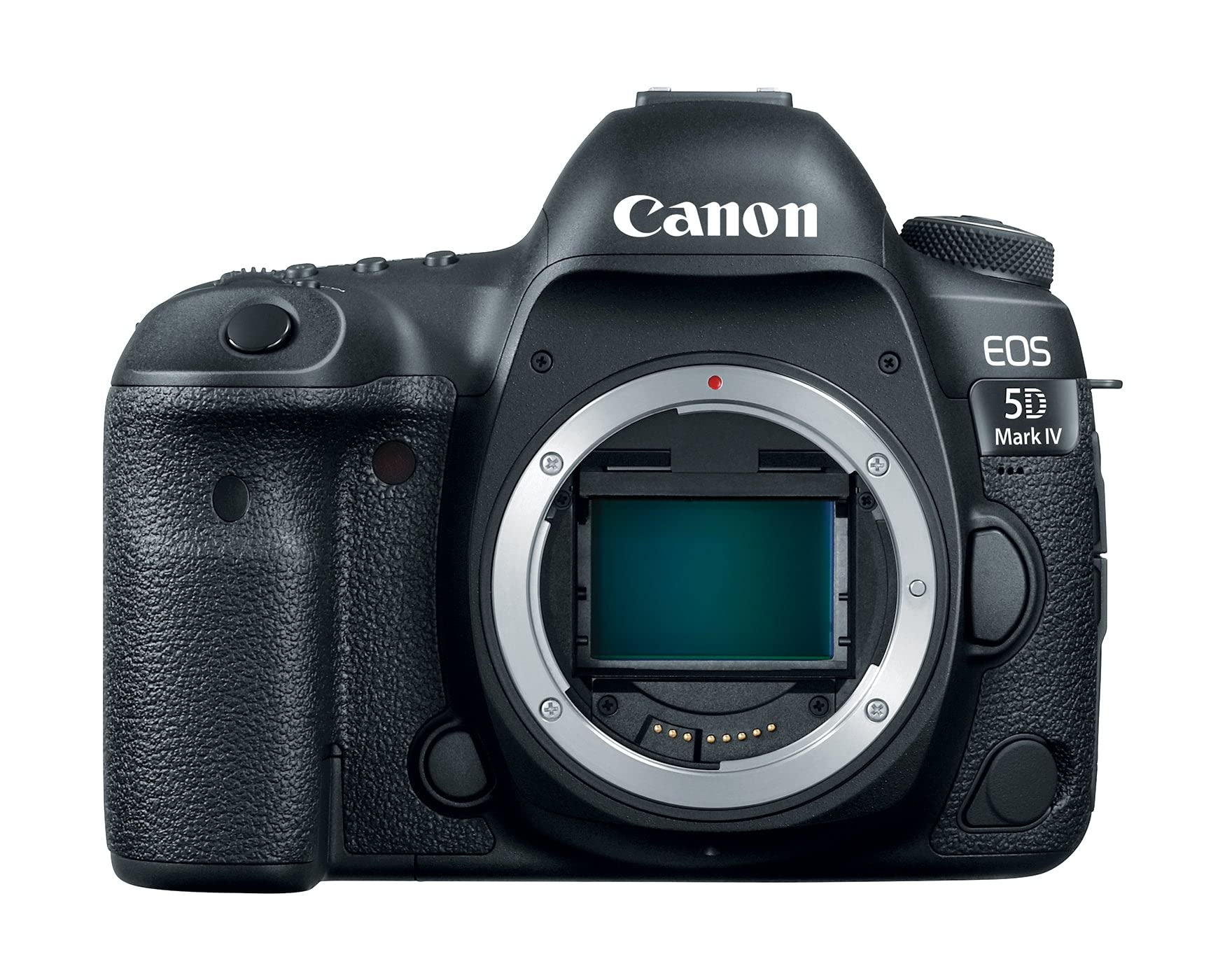
The 30.4-megapixel DSLR that remains a studio workhorse for stills-first commercial shoots.
The Canon 5D Mark IV is a different breed from the three cameras above — it is a DSLR built around still photography, with 30.4 megapixels that give you more resolution for product shots and portraits than the 24.1-megapixel Canon EOS R3. Its 61-point autofocus system is reliable and fast for studio and event photography, and shoppers say that with L-series lenses, the image quality is sharp and the dynamic range is excellent. One reviewer notes “battery lasts days on standby, one battery for a full day” — a real advantage over mirrorless cameras that drain power from the electronic viewfinder and sensor.
For video, it records 4K 30p in Motion JPEG format, which produces huge file sizes. It lacks the 10-bit color depth and high frame rates that the Sony FX3 and Canon R3 offer, so it is not a primary video camera for modern commercial production. Buyers mention it is a “professional workhorse” and “reliable for every shoot,” but they note it misses a fold-out screen for different shooting angles.
If your commercial work is mainly still photography (headshots, product catalog, architectural) with occasional video, the 5D Mark IV is a proven, reliable choice. But if video is the primary revenue driver, the Sony FX3 or Panasonic HC-X2 will serve you better.
Still photography specialist: 30.4 megapixels and a huge lens library make the 5D Mark IV the best pure photo choice on this list, but its 4K Motion JPEG video is outdated compared to modern cameras.
Battery endurance standout: buyers consistently report a single battery lasts a full day of shooting — a significant advantage over mirrorless cameras that may need multiple battery swaps during a long commercial shoot.
Ideal for: commercial photographers who shoot mostly stills and need a reliable, high-resolution full-frame body with excellent battery life and access to Canon’s EF lens ecosystem.
Not the pick if: video is your primary output — you will be better served by the Sony FX3 (4K 120p, 10-bit color) or the Panasonic HC-X2 (studio connectivity).
5. Blackmagic Micro Studio Camera 4K G2

The ultra-compact broadcast camera that records 12-bit RAW in a body small enough for a drone mount.
This is the most specialized camera in the list — a tiny studio camera designed to live on a tripod or rig next to an ATEM video switcher. It records Blackmagic RAW internally to a USB-C 3.1 drive, giving you 12-bit color depth for maximum grading flexibility in post, and its dual native ISO (400 and 3200) means usable low-light performance in a very small package. The 12G-SDI input and output let you daisy-chain multiple cameras and receive a clean return feed from the switcher, a feature the Sony FX3 and Canon R3 lack entirely.
Reviewers report the compact size is the key advantage — it fits in car mounts, concert rigs, and drone setups where no other full-size camera fits. But the trade-offs are significant: the camera lacks a built-in screen entirely, and one buyer warns “menu position, USB webcam, and LP-E6N battery lasts under 30 minutes.” Without an external monitor, you cannot see what you are shooting. The camera only supports MFT (Micro Four Thirds) lenses, which means a smaller sensor than the full-frame Sony FX3 or Canon R3, and the Micro SDI cables are specialized and cost extra.
Buyers also note “color mismatch with other Blackmagic cameras” and intermittent freezing during operation. This is a niche tool for a specific workflow, not a general-purpose commercial camera. If you already own an ATEM switcher and need a small, RAW-recording studio camera for a multi-camera rig, it is a budget-friendly entry. But for most commercial shooters, the Panasonic HC-X2 or Sony FX3 will be more practical.
RAW in a tiny body: records 12-bit Blackmagic RAW footage to a USB-C drive — a capability that typically costs twice as much — in a body that fits in a drone mount.
Heavy reliance on external gear: you need an external monitor, a separate microphone, a more powerful battery solution, and a Micro SDI cable just to make it functional for most shoots.
Best for: existing Blackmagic ATEM users who need an ultra-compact, RAW-recording crash cam for a multi-camera broadcast setup.
pass on it if: you need a self-contained commercial camera with a built-in screen, good battery life, or general-purpose video capabilities — the Panasonic HC-X2 is more practical for most professional users.
Understanding the Specs
Bit Depth (8-bit vs 10-bit vs 12-bit)
Bit depth determines how many shades of each color your camera records. An 8-bit video file records 256 shades per color channel (red, green, blue), which can show visible banding in skies or skin tones when you adjust the colors in editing. A 10-bit video records 1,024 shades per channel, giving you four times more color information and a much smoother gradient — essential for commercial work where you will color grade the footage. 12-bit (found on the Blackmagic Micro Studio 4K G2 in RAW mode) records 4,096 shades per channel, offering maximum flexibility but requiring very fast storage and a powerful computer to edit.
SDI vs HDMI Connectors
SDI (Serial Digital Interface) is the professional broadcast standard for sending video over long distances using a single coaxial cable. A 12G-SDI connection can carry 4K 60p video up to 100 meters without signal degradation. HDMI is common on consumer and prosumer cameras but is less reliable for long cable runs and studio environments because the connector is less secure and the signal degrades over longer distances. A commercial camera with both SDI and HDMI (like the Panasonic HC-X2) is the most versatile — SDI for the broadcast chain, HDMI for a confidence monitor close to the camera.
FAQ
Can I use a normal consumer mirrorless camera for commercial work?
What does 12G-SDI mean and do I need it?
Is the Canon EOS 5D Mark IV good for video or just photos?
How important is XLR audio input for a commercial camera?
Can the Blackmagic Micro Studio 4K G2 be used as a normal camera?
Which camera has the best autofocus for moving subjects?
Do I need a full-frame sensor for commercial video?
What is Blackmagic RAW and why would I use it over standard video codecs?
Can the Panasonic HC-X2 livestream directly?
Which commercial camera should I buy for a multi-camera live production setup?
Final Thoughts: The Verdict
If you want one dependable pick, the commercial camera winner is the Sony Alpha FX3 because it combines a full-frame sensor, 15+ stops of dynamic range, 4K 120p 10-bit 4:2:2 video, and the XLR audio handle in a compact body with reliable active cooling. If you want a lens built in and professional broadcast connectors for corporate or event work without swapping lenses, grab the Panasonic HC-X2. And for action commercial shoots where subject-tracking speed is everything, the Canon EOS R3 with its Eye Control AF and 30fps burst shooting is the clear specialist.
How We Picked
We do not accept paid placement, and we did not hands-on test every unit. Instead, we match each pick to a real buyer and use-case by comparing the manufacturers’ published specifications against the patterns in verified customer reviews — so you get each pick’s real strengths and trade-offs instead of marketing copy.
Sources & Methodology
Specifications: manufacturer listings and product documentation. Review insights: verified customer reviews, as of July 2026. Pricing: not shown on this page (it changes often); check the current price via the retailer link.
As an Amazon Associate, WellFizz earns from qualifying purchases. This does not affect which products we feature.

Mo Maruf
I created WellFizz to bridge the gap between vague wellness advice and actionable solutions. My mission is simple: to decode the research and give you practical tools you can actually use.
Beyond the data, I am a passionate traveler. I believe that stepping away from the screen to explore new environments is essential for mental clarity and physical vitality.