Our readers keep the lights on and my smoothie glass nicely filled. As an Amazon Associate, I earn from qualifying purchases.
Specs are compiled from manufacturer listings and verified buyer reviews and can change over time — please confirm the key details on the product page before buying.
A commercial waffle maker is built for high-volume output, not occasional home use. The wrong model burns breakfast or fails mid-service; the right one delivers consistent, high-volume output. This guide compares four top models by output speed, build quality, and temperature control to match your rush.
I’m Mohammad Maruf — the founder and writer behind WellFizz. This guide is built by comparing the manufacturers’ published specifications and the patterns across verified customer reviews, so you get each pick’s real strengths and trade-offs instead of marketing spin.
Whether you run a hotel buffet, a brunch cafe, or a catering operation, the right commercial belgian waffle maker is the difference between a smooth service and a pile of wasted batter — this guide matches each one to the specific workload it can actually handle.
Quick Picks
- Commercial Belgian Waffle Maker – Rotating Double (HTTSICHI) — Best Overall
- Waring Commercial WW250 (50 Waffle/Hr) — Premium Pick
- Waring Commercial WW200 (50 Waffle/Hr, Vertical) — Space Saver
- Waring Commercial WW180X (25 Waffle/Hr) — Classic Pick
How To Choose The Best Commercial Belgian Waffle Maker
Buying a commercial waffle maker requires matching output, heat recovery, and footprint to your menu volume.
Waffles Per Hour And Heat Recovery
The rated waffles-per-hour number is only achievable if the machine recovers heat quickly between cycles. A machine with a higher wattage (2400W versus 1400W) heats the plates back up faster, so you are not waiting for the ready light before pouring the next round. If your menu serves more than 30 covers in a breakfast window, aim for 50 waffles per hour.
Temperature Control And Browning Consistency
A wide temperature range (e.g., 122°F to 572°F) lets you dial in doneness from soft to crisp. The more settings (look for 6 on a dial), the finer the control. A rotary feature spreads batter evenly across both surfaces so you get a consistent color edge to edge.
Build Quality And Cleaning
Commercial kitchens need stainless steel bodies that resist corrosion and denting from daily use. Triple-coated nonstick plates let you release waffles without prying or spraying oil every batch. A removable drip tray (dishwasher-safe is a bonus) saves minutes between rushes. Skip any model that relies on plastic housing — it won’t hold up under steam and heat.
Quick Comparison
| Model | Best For | Waffles/Hour | Wattage | Item Weight | Amazon |
|---|---|---|---|---|---|
| HTTSICHI Dual Round | High-Volume Flexibility | 50 | 2400W | 17.5 lbs | Amazon |
| Waring WW180X | Single-Serving Perfection | 25 | 1200W | 14.3 lbs | Amazon |
| Waring WW200 | Space-Saving Duo | 50 | 1400W | 15.8 lbs | Amazon |
| Waring WW250 | Heavy-Duty Side-by-Side | 50 | 1400W | 21.48 lbs | Amazon |
In‑Depth Reviews
1. Commercial Belgian Waffle Maker – Rotating Double (HTTSICHI)
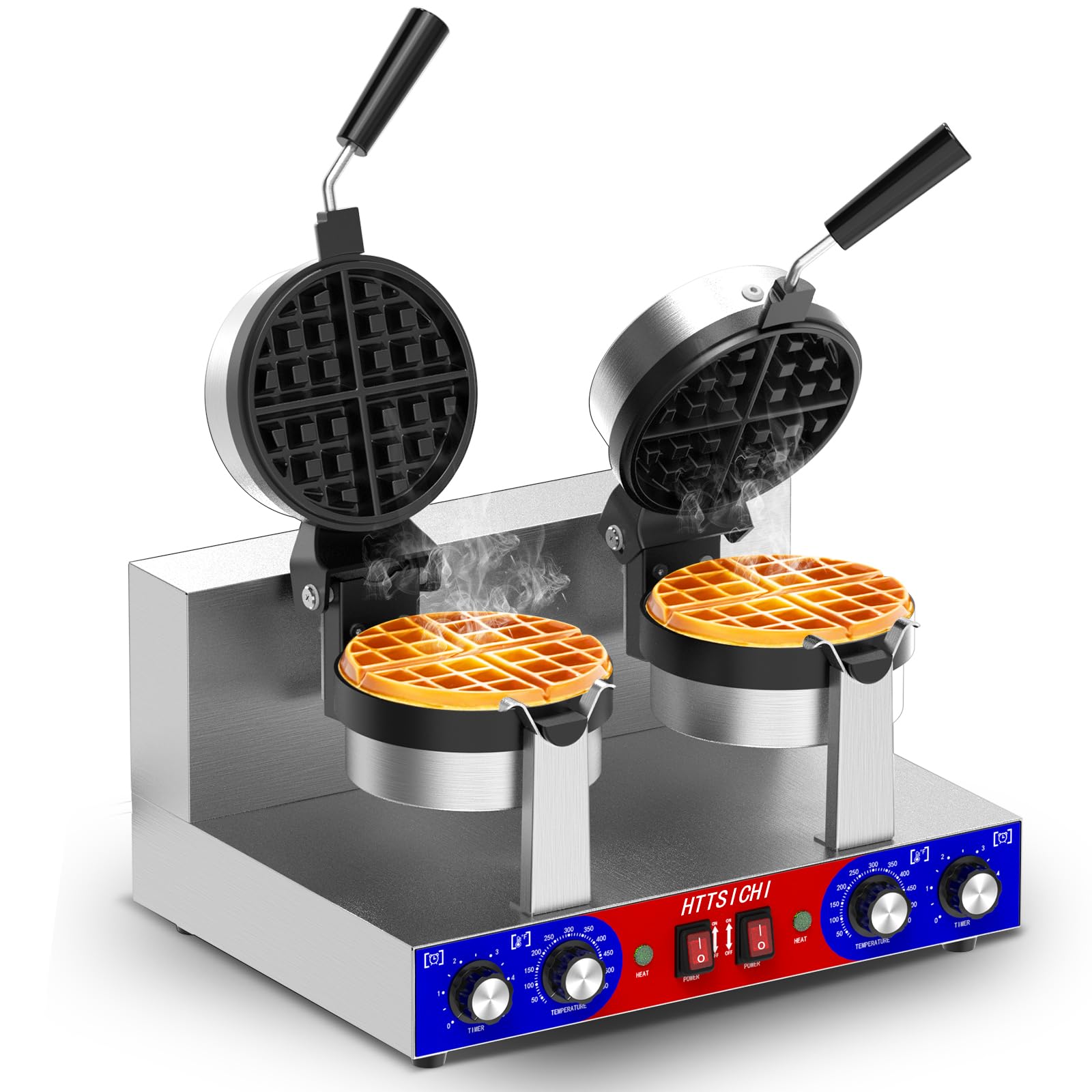
Twin independent heads that let you cook two styles of waffle at the same time.
This HTTSICHI machine puts out up to 50 waffles per hour, with each 1.2-inch-thick round Belgian waffle measuring 7.5 inches across. The real trick is the dual control panels — you can set one head to 122°F for a soft, cake-like waffle and the other to 550°F for a crispy golden-brown batch and run them simultaneously. That flexibility is rare in commercial units. The stainless steel body and double-layer Teflon coating rated for 50,000 cycles mean you are not scrubbing burnt batter between rounds.
At 2400W versus the Waring WW200’s 1400W, you get faster heat recovery and denser browning on the first waffle after a cold start. Buyers report excellent results at “400°F for 3 min (add 30 sec for crispier),” which gives you a repeatable baseline for a consistent menu item. It is a large unit, with dimensions of 20.4 inches deep by 14.9 inches wide by 22.8 inches high, so measure your counter space before ordering.
One reviewer noted the first unit failed early, but the manufacturer replaced it without hassle — suggesting the after-sale support is solid if you hit a defect. Compared to the WW250, which weighs 21.48 pounds, this HTTSICHI comes in at 17.5 pounds, still hefty enough to stay planted but easier to move during deep cleaning.
Why it earns the top spot
- Dual independent heads with separate temperature and timer controls for customized batches
- 2400W delivers noticeably faster heat recovery between waffles
- Nonstick coating rated for 50,000 cycles reduces cleanup friction
One honest trade-off
- Large footprint (20.4″D x 14.9″W) needs dedicated counter space in a busy kitchen
Your best bet if: you serve 50+ waffles an hour and want the flexibility to make soft and crispy waffles side by side.
Reconsider if: your kitchen counter is tight — this unit takes up substantial real estate.
2. Waring Commercial WW250 (50 Waffle/Hr)
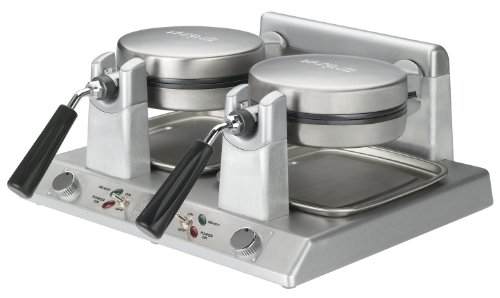
A heavy-duty side-by-side rotary machine built for nonstop restaurant volume.
The Waring WW250 is the tank of this lineup. Weighing 21.48 pounds with a stainless steel body, it is built to sit on a counter and stay there. It runs two waffle irons side by side with a rotary flip feature that spreads batter evenly — this is the same mechanism you see in professional hotel kitchens. Each head has triple-coated nonstick plates and embedded heating elements for precise temperature control, and the removable drip tray slides out for a quick rinse in the dishwasher.
At 50 waffles per hour, the volume matches the HTTSICHI above, but the WW250’s rotary design creates a more uniform thickness and browning because the batter levels itself under gravity. Owners mention it “work[s] great an fast” in a busy cafe setting. However, a significant warning came from one small cafe owner: the top heating element failed after four months of daily use, costing them a “hard to come by” investment. That is a durability red flag for a machine at this price point, and it echoes a similar theme across the Waring lineup.
Compared to the HTTSICHI, the WW250 has 6 settings (the HTTSICHI has 2) and a more refined rotary action, but it also carries the higher failure risk based on real owner accounts. If you need to push 50 waffles per hour and prefer the rotary system for consistency, the build quality is there — but budget for a backup plan if you run it daily.
Rotary advantage
- Rotary flip spreads batter evenly for consistent thickness and color
- Dishwasher-safe drip tray simplifies post-service cleanup
- Dual side-by-side design doubles output without awkward stacking
Durability concern
- Multiple buyer reports of heating element failure within months of daily commercial use
Reach for this if: you need the rotary system for perfectly flat, evenly browned waffles at 50 per hour.
Look elsewhere if: your cafe serves 100+ covers daily and you need a machine with a longer documented lifespan.
3. Waring Commercial WW200 (50 Waffle/Hr, Vertical)

Two waffle irons stacked vertically in the footprint of a single machine.
The Waring WW200 is the model you pick when counter space is the bottleneck. Its vertical design stacks two independent waffle plates one above the other so you get two 7-inch Belgian waffles at once — 50 per hour — while taking up just 17 inches deep by 10.45 inches wide by 9.5 inches high on the counter. That is a shallower footprint than the HTTSICHI at 17 inches deep versus 20.4 inches deep. Each plate has its own ready light and audio beep signal, so you know exactly when to pour and when to pull.
The lower wattage means a longer recovery time between batches, which matters if you stack three or four rounds back to back during a rush. Setup has a quirk buyers flagged: seasoning the plates with vegetable oil the first time creates sticky gunk — one reviewer recommends using butter or bacon fat instead and spreading the batter with a spatula to fill the grid evenly. The measuring cup is also slightly undersized; the same reviewer found 3/4 cup per waffle yields the best result.
On the durability side, the news is mixed. One long-time owner reports the version with a one-piece upright has lasted for years with sourdough waffles and chaffles. But another buyer reported their machine “stopped heating completely after 2 months of daily use” — a failure pattern that matches the WW250. Compared to the Waring WW180X, which also has 6 settings but outputs only 25 waffles per hour, the WW200 doubles the speed in a similar footprint, but you give up some long-term dependability.
Countertop champion
- Vertical design cooks two waffles in the floor space of a single unit
- 6 heat settings give fine-grained browning control
- Ready and done audio beeps keep workflow on track during a rush
The compromise
- At 1400W, heat recovery is slower than dual-head 2400W competitors
Choose it when: every inch of counter matters and you still need 50 waffles per hour.
Not for you if: your kitchen runs continuous back-to-back batches where fast heat recovery is critical.
4. Waring Commercial WW180X (25 Waffle/Hr)

The single-plate rotary machine that makes one perfect waffle at a time — beautifully.
The Waring WW180X is a single Belgian waffle maker that produces 25 waffles per hour with a rotary flip design — no dual heads, no vertical stacking. The rotary action helps the batter spread evenly across the 1-inch-thick grid, giving you that deep-pocketed Belgian waffle shape with a consistent golden-brown crust. It runs on 1200W, the lowest wattage of this group, which means it needs more recovery time between waffles.
At 14.3 pounds versus the 21.48-pound WW250, it is the lightest machine here, making it easy to move or store. The triple-coated nonstick plates release waffles cleanly, and buyers love that “the non-stick works without oil,” so you skip the spraying step. One long-term owner calls this “the ultimate Best waffle maker ever,” noting the crisp browning without burning. However, a significant minority of customers note the opposite experience: “high heat barely browns waffles” and the beeping for temp regulation never stops, making the unit feel unreliable. This split in reviews is the biggest risk of the WW180X — you might get a perfect unit or a frustrating one.
Compared to the HTTSICHI, the WW180X has 6 heat settings (the HTTSICHI has 2), giving you finer control over doneness, but at 25 waffles per hour you cannot keep pace with a busy brunch rush. The new model does offer replaceable plates, which is a smart improvement for extending the machine’s life. If you run a small cafe or a bed-and-breakfast where volume stays low but quality matters, this rotary machine delivers presentation-grade waffles — just have a backup plan if the thermostat acts up.
Rotary quality
- Rotary flip produces even browning and a consistent 1-inch thick waffle
- Replaceable plates add longevity to the investment
- Triple-coated nonstick works without oil for healthier cooking
Speed and reliability risk
- At 25 waffles per hour, it cannot handle a high-volume breakfast rush
- Mixed buyer reports of poor browning and endless beeping on some units
Ideal for: low-to-medium volume kitchens that want individual, perfectly browned Belgian waffles.
Not for: any business that needs to push more than 25 waffles in a single busy hour.
Understanding the Specs
Waffles Per Hour And Wattage
This spec tells you the practical output a machine can sustain during a breakfast rush. A machine rated for 50 waffles per hour with 2400W will recover heat faster between cycles than a 1400W unit with the same rating, so you spend less time waiting for the ready light. For a cafe serving 30 covers in a two-hour window, 25 per hour is enough; for a hotel buffet, aim for 50.
Rotary Flip Design
Some commercial waffle makers use a rotary flip mechanism where the entire head rotates after you pour the batter. This spreads the batter evenly across both plates under gravity, producing a waffle with consistent thickness and no bald spots. Non-rotary or stationary models require you to spread the batter manually with a spatula, which leaves more room for uneven cooking.
FAQ
How long does a commercial waffle maker last with daily use?
Is a higher wattage always better for a commercial waffle maker?
What temperature should I set for a crispy Belgian waffle?
Can I use a commercial waffle maker at home?
What does a rotary flip feature do for waffle quality?
Are nonstick coatings safe for commercial use?
How do I clean a commercial waffle maker between services?
Can I use a commercial waffle maker for keto or gluten-free batter?
What is the difference between a dual-head and a vertical waffle maker?
How many waffles per hour does a commercial machine actually produce?
Final Thoughts: The Verdict
For most people, the commercial belgian waffle maker winner is the HTTSICHI Dual Round because it delivers 50 waffles per hour with independent dual-head controls and the highest wattage (2400W) for fast heat recovery between batches. If you need the rotary flip for perfectly uniform browning, grab the Waring WW250. And for a tight countertop where every inch counts, the Waring WW200 vertical machine cooks two waffles at once in a single-unit footprint.
How We Picked
We do not accept paid placement. Every pick is matched to a real buyer and a real use-case; we do not hands-on test units.
Sources & Methodology
Specifications: manufacturer listings and product documentation. Review insights: verified customer reviews, as of July 2026. Pricing: not shown on this page (it changes often); check the current price via the retailer link.
As an Amazon Associate, WellFizz earns from qualifying purchases. This does not affect which products we feature.

Mo Maruf
I created WellFizz to bridge the gap between vague wellness advice and actionable solutions. My mission is simple: to decode the research and give you practical tools you can actually use.
Beyond the data, I am a passionate traveler. I believe that stepping away from the screen to explore new environments is essential for mental clarity and physical vitality.