Our readers keep the lights on and my smoothie glass nicely filled. As an Amazon Associate, I earn from qualifying purchases.
Specs are compiled from manufacturer listings and verified buyer reviews and can change over time — please confirm the key details on the product page before buying.
A dead battery on a job site needs raw amperage, not fancy screens. The right commercial charger separates a ten-minute jump from a half-day wait.
I’m Mohammad Maruf — the founder and writer behind WellFizz. This guide is built by comparing the manufacturers’ published specifications and the patterns across verified customer reviews, so you get each pick’s real strengths and trade-offs instead of marketing spin.
This is the guide to finding a commercial battery charger that actually delivers its rated amps, survives years of shop-floor abuse, and gets your equipment running again without guesswork.
Quick Picks
- Associated Equipments 6002B 6/12/18/24V — Best Overall
- AIMS 12V 24V Smart Battery Charger AC Converter — Fastest Charge
- Schumacher Electric Wheeled Manual 10A Car — Best Value
- Associated Equipment US20 6/12 Volt Value — Made in USA
- CRAFTSMAN Wheeled Manual 6A Car Battery Charger — Budget Champion
How To Choose The Best Commercial Battery Charger
Not every workhorse-looking charger delivers. Commercial buyers need to focus on three things: the charging technology (transformer vs. smart charger), the amp rating and how it matches your battery size, and the voltage range your fleet demands. Get these right to avoid a charger that won’t wake a dead battery or one that cooks it overnight.
Manual vs. Automatic (Smart) Charging
Manual chargers use a heavy transformer and a timer. They don’t have microprocessors, so they don’t get confused by a fully dead battery that reads zero volts — they just push current. Automatic smart chargers are excellent for maintenance and for batteries that still hold some voltage, but many refuse to start if they sense zero voltage. For a shop that regularly sees deeply discharged batteries, a manual or switchable charger is the safer bet.
Amp Rating and Battery Bank Size
A charger’s amperage rating tells you how fast it replenishes a battery. Aim for a charger that delivers 10–20% of your battery’s amp-hour capacity. A 75-amp charger brings a 100Ah battery to 90% in under an hour. For a 1000Ah bank, choose a high-amperage unit to avoid waiting all day. Engine-start amps are a short burst for the starter motor, not continuous charging current.
Voltage Range and Battery Chemistry
Most shops need 12V charging, but if you work with older 6V equipment or heavy-duty 24V systems, a multi-voltage charger saves you from owning multiple units. Also check compatibility with battery types: flooded lead-acid, AGM, gel, and LiFePO4 each want a different charging profile. A smart charger with selectable chemistry modes gives you flexibility, while a manual unit with fixed voltage steps (like a low ~13.5V and a high ~16V setting) lets you match the battery’s needs yourself.
Quick Comparison
| Model | Best For | Max Charge Amps | Engine Start Amps | Weight | Amazon |
|---|---|---|---|---|---|
| Associated Equipments 6002B | Heavy Fleet / 24V Systems | 80A continuous / 100A max | 400A (725A MFR boost) | 68.3 lbs | Amazon |
| AIMS Power CON120AC1224DC | Large Bank Charging | 75A | — | — | Amazon |
| Schumacher SC1446 | Versatile Shop Charger | 10A | 200A | 29.86 lbs | Amazon |
| CRAFTSMAN CMXCESM274 | Manual Budget-Friendly | 6A | 175A | — | Amazon |
| Associated Equipment US20 | Farm / Made in USA | 40A | 200A | 37 lbs | Amazon |
In‑Depth Reviews
1. Associated Equipments 6002B 6/12/18/24V 100/80/50/40 Amp 400 Amp Charger Cranking Assist with Wheels
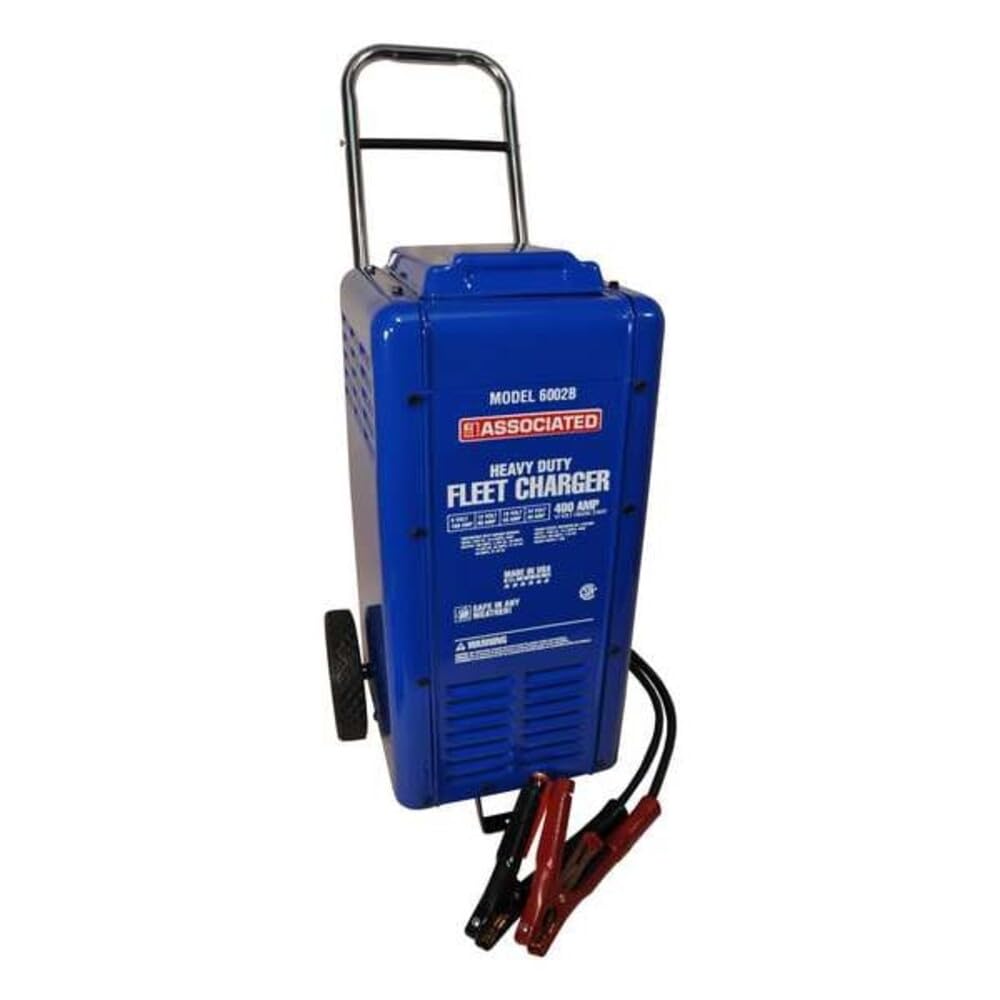
A 68.3-pound brute that handles 24V fleets and cranks dead diesels without hesitation.
This is the charger you buy when you are done replacing consumer-grade units every two years. The 6002B delivers up to 80 amps continuous and a 400-amp cranking assist (the maker rates the boost at 725 amps), and it handles 6V, 12V, 18V, and 24V systems — so a single machine covers your whole shop. Buyers report “these are heavy duty and don’t have all of the electronics in them to go haywire like the new junk chargers,” which is exactly the point: the fan-cooled transformer design is CSA listed and built to run daily without motherboard failures.
The 6002B weighs 68.3 pounds, while the Schumacher SC1446 weighs 29.86 pounds; that weight tells you where the copper lives. The trade-off is obvious: it costs significantly more and arrives without wheels despite the listing, according to one buyer who had to use a hand truck. But if your shop demands 400 amps of starting power and 24V capability, there is no substitute.
What Powers It
- Four voltage ranges (6/12/18/24V) cover fleet, farm, and heavy equipment
- 400-amp cranking assist with a 725-amp boost rating for big diesels
- Buyers confirm the simple transformer design “just works every time”
What Holds It Back
- Some units ship with missing wheels per buyer reports
- Premium price puts it out of reach for light-use shops
Reach for it if: you manage a fleet of 24V trucks or heavy equipment and need a buy-it-for-life charger that doesn’t rely on finicky electronics.
Think twice if: you only charge small 12V car batteries and don’t need 400-amp starting power — you’ll pay for capability you won’t use.
2. AIMS 12V 24V Smart Battery Charger AC Converter 75A ETL CON120AC1224DC
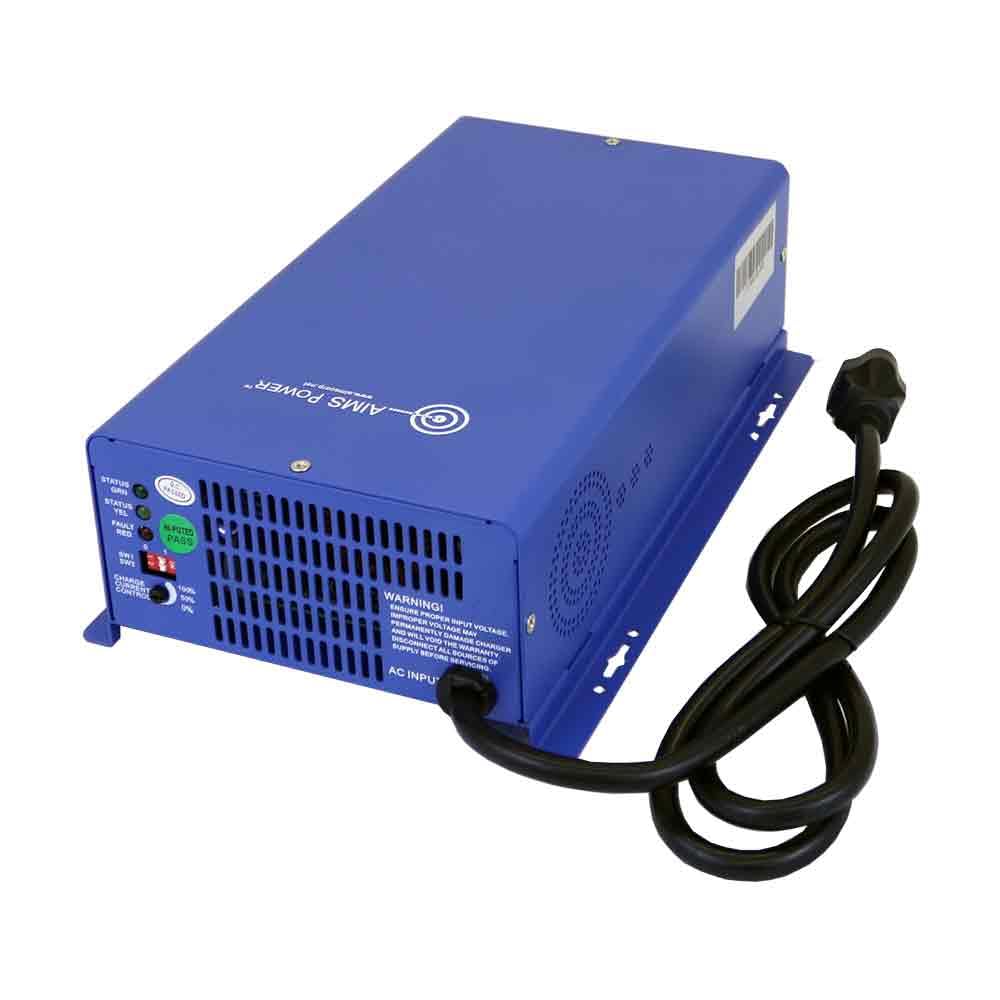
An 83%-efficient smart charger that pushes 75 amps into large battery banks in minutes, not hours.
Unlike the manual chargers above, the AIMS Power unit uses a three-stage smart algorithm (bulk, absorption, float) to tune charging for open lead-acid, AGM, GEL, and LiFePO4 batteries. With active power factor correction, one reviewer measured 740W output at 83% efficiency — meaning it draws 35-40% less from a small generator than a conventional unit. One reviewer noted it “charges 1000Ah bank to 90% in 1 hour,” which is remarkable speed for that size bank.
The catch is that this is an automatic charger, so it may refuse to start on a truly dead battery (owners mention it needs a BMS bypass on some LiFePO4 setups). It also has a parasitic DC drain of 1.5-3.2W when the switch is off, so you should disconnect it between uses. But for a shop that services large solar banks or RV systems with multiple chemistries, the 75-amp output and auto-detect 12V/24V capability make it the fastest top-off you can plug in.
Bulk charging beast: The 75-amp continuous rating and multi-chemistry support (including LiFePO4) let you recharge a deeply cycled bank faster than any transformer unit in this list — if your battery is not stone dead.
Grab this if: you recharge large battery banks (1000Ah+), need LiFePO4 compatibility, and want the fastest possible charge times for solar or RV systems.
Look elsewhere if: you primarily deal with totally dead batteries that read zero volts — an automatic smart charger may refuse to wake them up.
3. Schumacher Electric Wheeled Manual 10A Car Battery Charger and 200A Engine Starter, SC1446

A proven 29.86-pound manual charger that brings diesel batteries back to life at 10A without computer confusion.
The SC1446 is the workhorse that spans the gap between a cheap consumer unit and a fleet charger. With a 200-amp engine start, a 40-amp boost, and a 10-amp continuous charge rate, it handles everything from a lawn tractor to a twin-battery diesel — one reviewer confirmed it “successfully started twin battery diesel; can charge at 10A all day.” The 135-minute timer gives you precision control, and the analog ammeter lets you watch the current draw visually.
At 29.86 pounds, it is genuinely wheel-around-the-shop portable; the Associated 6002B weighs 68.3 pounds. Customers note the clamps are on the small side for large battery terminals and the analog gauge is vague — but for, you get a manual transformer charger that beats the CRAFTSMAN CMXCESM274 by offering 200 amps of starting power versus 175 amps, plus 6V and 12V support versus 12V only.
Why It Works
- 200-amp engine start with 40-amp boost wakes deeply discharged batteries
- Manual timer control eliminates auto-charger dead-battery confusion
- Compact wheels and handle make it easy to move at 29.86 lbs
Where It Stumbles
- Clamps are too small for some large battery post terminals
- Analog ammeter offers only a vague reading, not a digital display
Best for: the shop that wants a manual charger with genuine 200-amp starting power for 6V and 12V batteries without spending premium prices.
skip it if: you need 24V charging or are maintaining sensitive LiFePO4 batteries that require a smart algorithm — this is a transformer charger, not a multistage smart unit.
4. Associated Equipment US20 6/12 Volt Value Battery Charger Blue 24 Inch

A 37-pound American-made dial charger that delivers 40 amps of fast, simple charging and has survived actual farm use.
The US20 strips away anything unnecessary — no digital screens, no smartphone apps, just a dial for charge rate and a timer. It puts out 40 amps on the high rate and includes a 200-amp cranking assist. One buyer described it as a “simple, powerful dial-type charger” that survived years on a farm until it was accidentally destroyed. Another measured the output at “12V low charges at ~13.5V, 12V high at ~16V” and noted the manual mentions a desulfation function, useful for reviving neglected lead-acid batteries.
At 30 inches deep, this is a big unit — the footprint is noticeably larger than the Schumacher SC1446. The 40-amp continuous rate also means it sits between the budget 6-amp CRAFTSMAN and the serious 80-amp 6002B. Buyer reports mention the metal case can arrive bent from shipping, and it only handles 6V and 12V (no 24V). But the “Made in US” quality and buy-once durability make it a strong pick for farms and small shops that just need it to work every time.
Real-world charging: With 40 amps and an honest 200-amp start, the US20 jumps most vehicles, though reviewers point out it may struggle with very large engines — the 6002B’s 400-amp start is the step up for heavy diesel tractors.
Reach for this if: you want a straightforward, USA-made charger that handles 6V and 12V farm batteries with no electronic fuss and you have the shelf depth for its 30-inch frame.
Look elsewhere if: you need 24V charging or must start very large diesel engines daily — you will want the 6002B’s higher cranking assist instead.
5. CRAFTSMAN Wheeled Manual 6A Car Battery Charger and 175A Engine Starter, CMXCESM274
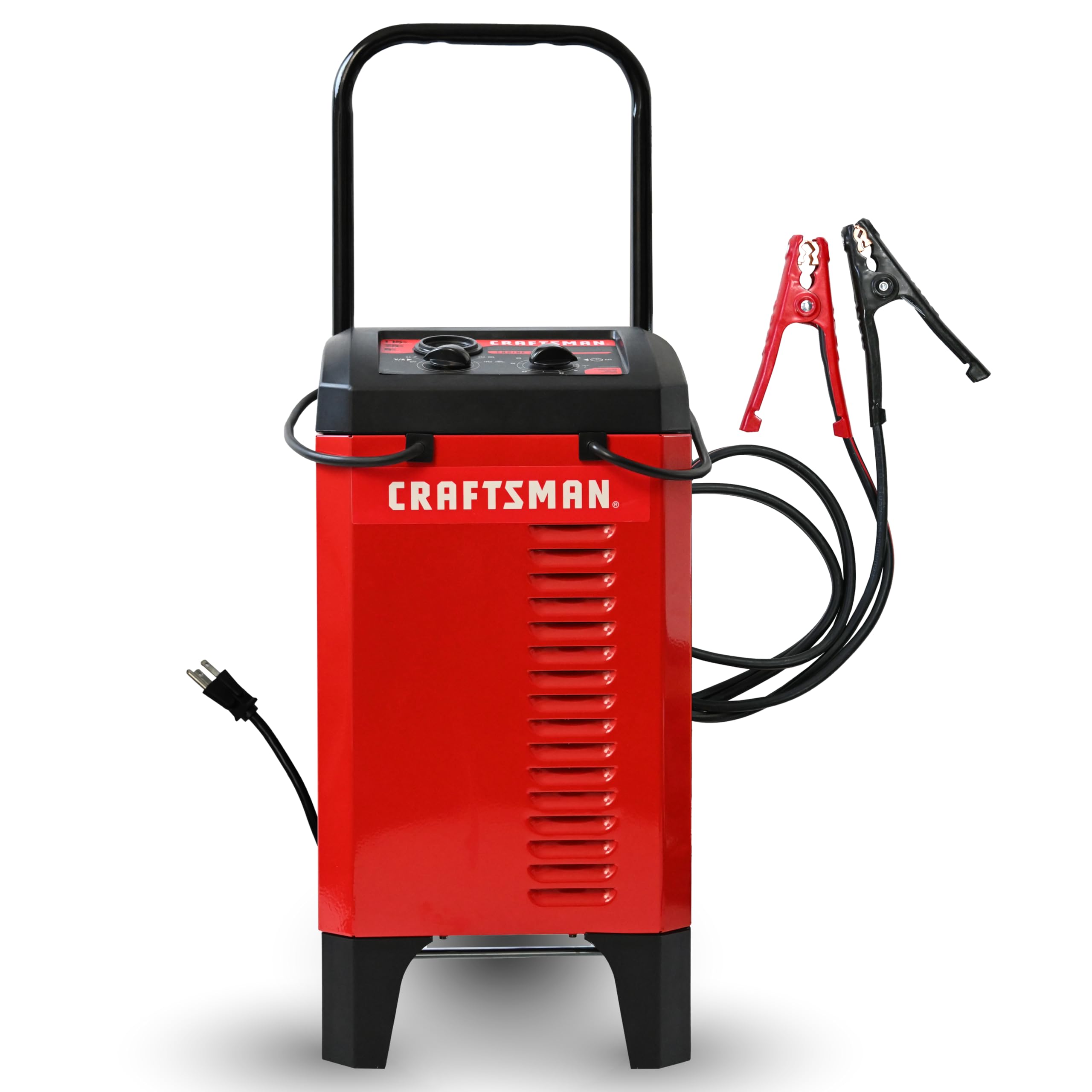
A 12V-only manual charger with 6-amp trickle and 175-amp engine start that buyers call “good, no issues.”
CRAFTSMAN’s entry-level wheeled charger offers the same 135-minute manual timer found on the Schumacher SC1446 but with lower peak output: 175 amps of starting power versus 200, and a 6-amp charge rate versus 10. It also lacks 6V support — this unit works with 12V standard, AGM, gel, and deep-cycle batteries only. One buyer mentioned, “Works good, i was needed a manual charger that put out the 6amps, timer function a great selling point, no issues,” which captures the straightforward appeal.
The 25-amp boost charge is a useful middle ground for adding some life to a dead battery before attempting the 175-amp start. At its price point, this is the most affordable way to get a wheeled manual charger with a timer. You do give up the Schumacher’s higher starting power and 6V compatibility — and the build, while sturdy with a steel case, does not match the heft of the Associated units. But for a home garage or light shop that only charges 12V car and truck batteries, it gets the job done while staying affordable.
Good Points
- Manual timer gives you full control over charge duration — no dead-battery lockout
- 175-amp start and 25-amp boost handle most 12V car and truck batteries
- Wheeled steel design with retractable handle is easy to maneuver
Trade-Offs
- No 6V support — only charges 12V batteries
- 6-amp charge rate is slower than the Schumacher’s 10-amp or the Associated’s 40-amp
Best for: the budget-conscious home garage that needs a manual charger for occasional 12V car batteries and wants the timer control to avoid overcharging.
Not for: anyone charging 6V batteries, running a busy shop that needs faster 10A+ charging, or requiring 24V capability — you will outgrow this unit quickly.
Understanding the Specs
Charge Amps vs. Engine Start Amps
Charge amps (like 6A, 10A, 40A, or 75A) tell you how fast the charger replenishes a battery over time — think filling a water tank. Engine start amps (like 175A, 200A, or 400A) are a short, high-current burst to turn the starter motor, not continuous charging. A charger with high start amps but low charge amps can jump a dead truck but takes hours to fully recharge the battery. Check both numbers against your actual use: big diesel start requires 400A+; daily top-offs need 10A+.
Manual Timer vs. Automatic Smart Charging
Manual chargers use a physical timer (typically 135 minutes) that you set — when time runs out, charging stops. These are essential for deeply discharged batteries that read zero volts, because automatic chargers often refuse to start when they see no voltage. Smart chargers use microprocessors to detect battery voltage and chemistry, then adjust bulk, absorption, and float stages automatically — ideal for maintenance and for AGM/LiFePO4 batteries. If you regularly revive dead batteries, get a manual or a charger with a manual override mode.
Voltage and Chemistry Compatibility
Most cars use 12V, but older tractors and motorcycles may use 6V, and heavy trucks often run 24V systems. A multi-voltage charger (6/12/18/24V) saves you from buying separate units. Battery chemistry matters too: flooded lead-acid wants a higher absorption voltage (~14.4-14.8V), AGM needs a lower voltage (~14.2-14.4V), and LiFePO4 typically requires a different algorithm entirely (often 14.4-14.6V). Smart chargers handle multiple chemistries automatically; manual chargers give you fixed voltage steps (like ~13.5V low and ~16V high) that you match manually.
Transformer Weight and Build Quality
A heavy charger (68.3 pounds like the Associated 6002B) is heavy because it contains a large copper-wound transformer — that means real, sustained current output and years of reliable service. A lighter unit (29.86 pounds for the Schumacher SC1446) is more portable but uses a smaller transformer, limiting continuous charge amperage. In a commercial setting where the charger rolls around a concrete shop floor daily, the steel case and wheel quality matter as much as the electronics — look for retractable handles, solid rubber wheels, and fully insulated clamps rated for 500 amps.
FAQ
Can I use a 12V-only charger on a 24V battery system?
Why won’t my automatic smart charger start charging a dead battery?
How many amps do I need to charge a 100Ah battery?
What does desulfation mean on a battery charger?
Can I leave a manual charger connected overnight?
Will a commercial charger work with LiFePO4 batteries?
How do I know if my battery is AGM or flooded lead-acid?
What does CSA certification mean on a battery charger?
Why is the Associated 6002B so much heavier than other chargers?
Can I use these chargers in wet or outdoor conditions?
Final Thoughts: The Verdict
For most buyers, the best commercial battery charger is the Schumacher SC1446 because it delivers a genuine 200-amp start with manual timer control at a mid-range price, covering 6V and 12V batteries without the confusion of automatic electronics. If you manage a large fleet including 24V trucks, the Associated 6002B is the buy-it-for-life choice with 400-amp cranking assist and rugged transformer build. And for the fastest top-off of large LiFePO4 banks, the AIMS Power 75A recharges 1000Ah to 90% in an hour — just be ready for its smart-charger quirks on fully dead batteries.
How We Picked
We do not accept paid placement. Every pick is matched to a real buyer and a real use-case; we do not hands-on test units.
Sources & Methodology
Specifications: manufacturer listings and product documentation. Review insights: verified customer reviews, as of July 2026. Pricing: not shown on this page (it changes often); check the current price via the retailer link.
As an Amazon Associate, WellFizz earns from qualifying purchases. This does not affect which products we feature.
Related Guides

Mo Maruf
I created WellFizz to bridge the gap between vague wellness advice and actionable solutions. My mission is simple: to decode the research and give you practical tools you can actually use.
Beyond the data, I am a passionate traveler. I believe that stepping away from the screen to explore new environments is essential for mental clarity and physical vitality.