Our readers keep the lights on and my smoothie glass nicely filled. As an Amazon Associate, I earn from qualifying purchases.
Specs are compiled from manufacturer listings and verified buyer reviews and can change over time — please confirm the key details on the product page before buying.
An air compressor that can’t keep up with your tools is nothing but a noisy paperweight. if you need a unit for a busy auto shop, a cabinet-making workshop, or framing on a construction site, the right commercial machine delivers enough pressure and volume so your impact wrench, paint sprayer, or nailer never has to wait for the tank to catch up. The problem is that compressor specs (CFM, PSI, horsepower, tank size) are easy to throw around, but they mean very different things depending on how you use them. This guide walks you through the real differences between oil-lubricated pumps and oil-free pumps, single-stage versus two-stage designs, and how to match tank capacity to your actual work patterns.
I’m Mohammad Maruf — the founder and writer behind WellFizz. This guide is built by comparing the manufacturers’ published specifications and the patterns across verified customer reviews, so you get each pick’s real strengths and trade-offs instead of marketing spin.
After examining over a dozen top-rated options, one thing is clear: the best commercial air compressor for your shop depends on matching the critical specs (horsepower, CFM at 90 PSI, and tank size) to the demands of your most-used tool and the number of people working from it.
Our Picks at a Glance

How To Choose The Best Commercial Air Compressor
Picking a compressor for commercial use is different from buying a small pancake unit for a few trim nails. You are matching a stationary (or semi-portable) power plant to a known set of air tools. Get the CFM and tank size wrong, and your framing nailer will stall mid-wall. Here are the key decisions.
Match CFM to Your Tool, Not the Other Way
The number that matters most is cubic feet per minute (CFM) at 90 PSI. Every air tool lists its own CFM requirement. A framing nailer needs around 2.2 CFM at 90 PSI, while a 1/2-inch impact wrench needs around 5 CFM, and a continuous-use DA sander can draw over 8 CFM. A grinder or sandblaster may require 10 CFM or more. If the compressor’s output at 90 PSI is lower than your tool’s requirement, the tool starves and the tank never catches up. Choose a compressor that delivers at least 1.5 times the CFM of your highest-consumption tool.
Choose Single-Stage or Two-Stage
A single-stage compressor fills the tank in one stroke per revolution to around 135 PSI. It is ideal for intermittent work (nail guns, impact wrenches, tire inflation) in small to mid-size shops. A two-stage compressor compresses the air in two steps, cooling it between stages, and typically runs up to 175 PSI. The higher pressure and better efficiency make two-stage units essential for continuous-use applications like sandblasting, production spray painting, or running multiple tools simultaneously. Two-stage pumps also tend to last longer — some rated over 15,000 hours of use.
Tank Size Determines Your Run Time
A bigger tank stores more reserve air, which means the pump does not need to cycle on and off as often. A small 20-gallon tank works for a nail gun or impact wrench in a home garage, but a commercial shop running large tools will benefit from a 60-gallon or 80-gallon tank. The added volume gives you a longer burst of high-pressure air before the motor kicks in to refill, and it smooths out the supply for tools like spray guns that need a steady flow.
Quick Comparison
| Model | Best For | CFM @ 90 PSI | Tank Size | Horsepower | Amazon |
|---|---|---|---|---|---|
| Makita MAC5200★ Best Overall | Small shop / portability | 6.5 CFM | 5.2 gal | 3.0 HP | Amazon |
| CA Air Tools 20015HPQuiet Operator | Noise-sensitive shops | 3.80 CFM | 20 gal | 1.5 HP | Amazon |
| Klutch 60-GallonBest Value | Value / medium shop | 9.3 CFM | 60 gal | 3.7 HP | Amazon |
| DEWALT 25-Gallon | High PSI applications | — | 25 gal | 2.0 HP | Amazon |
| Ingersoll Rand SS3L3 | Durable 60-gal stationary | 10.3 CFM | 60 gal | 3.0 HP | Amazon |
| Metabo HPT EC2510E | Job sites without power | — | 8 gal | Gas (Honda GX) | Amazon |
| VEVOR 80 Gallon | Industrial / oil-free quiet | 15.5 SCFM | 80 gal | 6.5 HP | Amazon |
| NorthStar 20-Gal Gas | Remote / field work | 13.7 CFM | 20 gal | 5.5 HP | Amazon |
| CA Air Tools 60040CAD | Quiet 60-gal shop | 10.60 CFM | 60 gal | 4.0 HP | Amazon |
| NorthStar 30-Gal GX390 | Heavy truck / field repair | 24.4 CFM | 30 gal | — | Amazon |
| Ingersoll Rand 2475N7.5 | Continuous pro industrial | 24 CFM | 80 gal | 7.5 HP | Amazon |
In‑Depth Reviews
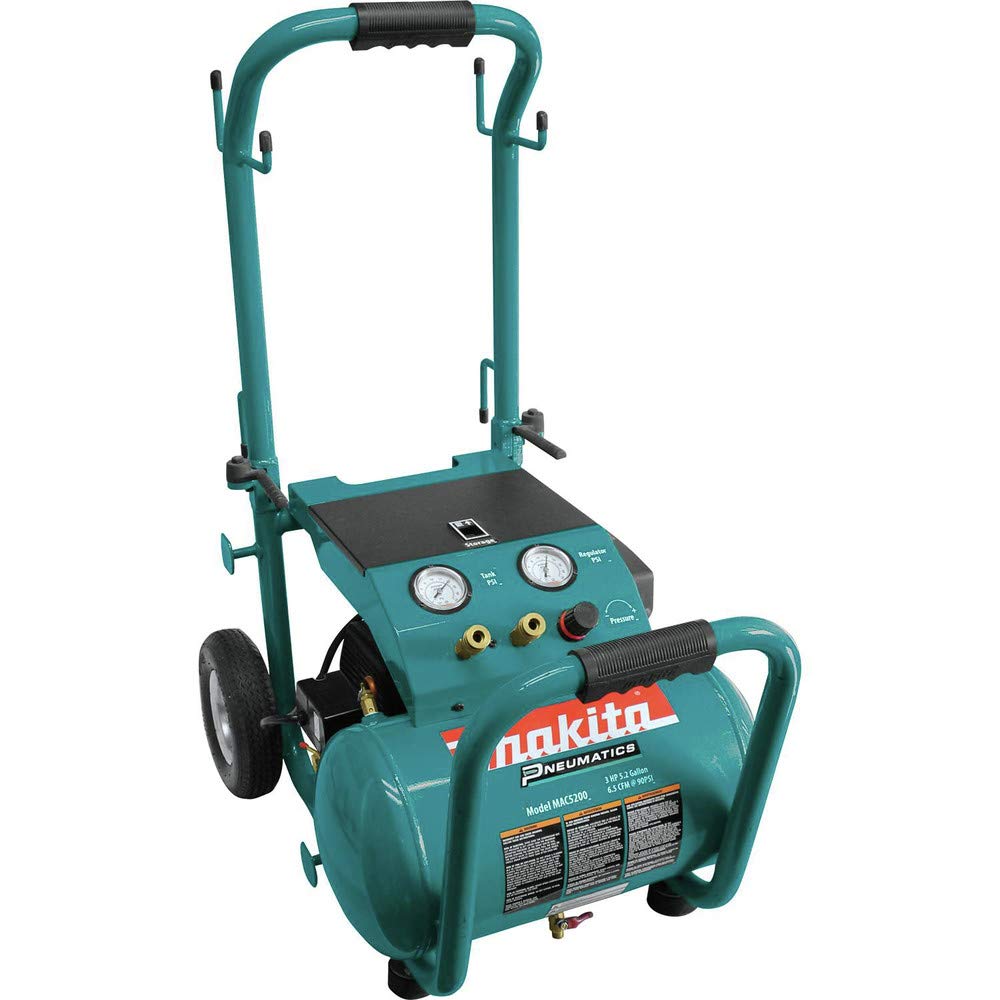
1. Makita MAC5200 3.0 HP Big Bore Air Compressor
Our pick — 4.5★ from 900+ verified ratings; the strongest balance of quality and price.
This compact portable delivers 6.5 CFM at 90 PSI from a 3.0 HP motor, enough for framing nailers and impact wrenches.
This Makita delivers 6.5 CFM at 90 PSI from a 3.0 HP motor, which is enough to run framing nailers, impact wrenches, and even light sandblasting without the tank running empty every 30 seconds. The cast iron pump with a Big Bore cylinder is oil-lubricated, so it runs cooler and suffers less wear than the oil-less units you find in smaller portable compressors. As buyers report, it “charges tank to 120 PSI in 1 min 17 sec” — recovery that puts many larger tanks to shame.
At 75 pounds with a folding handle and pneumatic wheels, this is genuinely portable. It is noticeably heavier than a pancake compressor but far lighter than the 60-gallon monsters that dominate this list — a 2.9x weight gap compared to the Klutch 60-gallon below. The modest 5.2-gallon tank means you get a shorter run time before the pump kicks on, but the fast recovery mostly makes up for it. If you are moving between job sites, want to store it under a bench, or run a small shop that needs one solid all-rounder, this is the crowd favorite on Amazon for a reason.
The noise level is the one area where opinions split. Some owners find it quieter than an oil-less compressor because the sound is a deeper, lower pitch. Others say it is just as loud as the cheaper models. The grain of truth: the sound is less irritating, but it is not “quiet.”
The makita edge
- Cast iron pump with Big Bore cylinder for faster recovery
- Oil-lubricated pump runs cooler and lasts longer than oil-free
- Pneumatic wheels and folding handle for real job-site portability
- Drives a 1/2-inch impact wrench well enough to remove lug nuts
The honest trade-off
- Small 5.2-gallon tank means shorter run times between cycles
- Noise is polarizing — some find it quiet, others find it loud
Reach for it if: you need a single versatile compressor for a small shop, and portability (75 lbs with wheels) matters more than a big reserve tank.
Look elsewhere if: your work demands continuous high-volume air (like sandblasting or dual-tool operation) — the 5.2-gallon tank will cycle too often for that.
2. California Air Tools 20015HP 1.5 HP Ultra Quiet Air Compressor
This 20-gallon unit operates at just 70 dB, quiet enough for noise-sensitive shops.
This California Air Tools model is built for the shop where noise is a real problem — think a garage under a bedroom, a medical office, a print shop, or a small studio. It operates at just 70 dB, which is quieter than a normal conversation. The oil-free dual-piston pump is rated for over 3,000 hours of life, and the 1.5 HP motor spins at a slow 1750 RPM to reduce both sound and wear. Owners mention “I can bring it up to 170 lbs of pressure in a few minutes,” which is impressive for a 1.5 HP unit.
The catch is the CFM. At 3.80 CFM at 90 PSI, this machine is a 2.4x gap behind the Klutch 60-gallon and won’t keep up with high-consumption tools like a DA sander or a sandblaster. It works well for an impact wrench, blowout jobs, and nail guns. The 20-gallon tank helps compensate for the lower output by storing reserve air, but if you need continuous high flow, this is not the pick. The reliability score from owners is mixed — a few early failures with the pressure control valve appear in the data.
For small shops where noise is the top priority, this unit is class-leading at its price tier.
Why it wins for quiet shops
- 70 dB noise level — genuinely quiet enough to hold a conversation near
- Oil-free pump eliminates oil changes and messy maintenance
- 20-gallon tank provides decent air reserve despite the low CFM
- Pulls only 12 amps, so it works on standard 110V circuits
The output trade-off
- 3.80 CFM @ 90 PSI is too low for continuous tools like sanders or grinders
- Mixed reliability reports — some units have control valve issues
Best suited for: noise-sensitive shops (sign shops, small garages near living spaces) where the primary tools are nail guns and impact wrenches.
Not the right fit for: production work that demands high CFM (sandblasting, spray painting, running multiple tools at once).
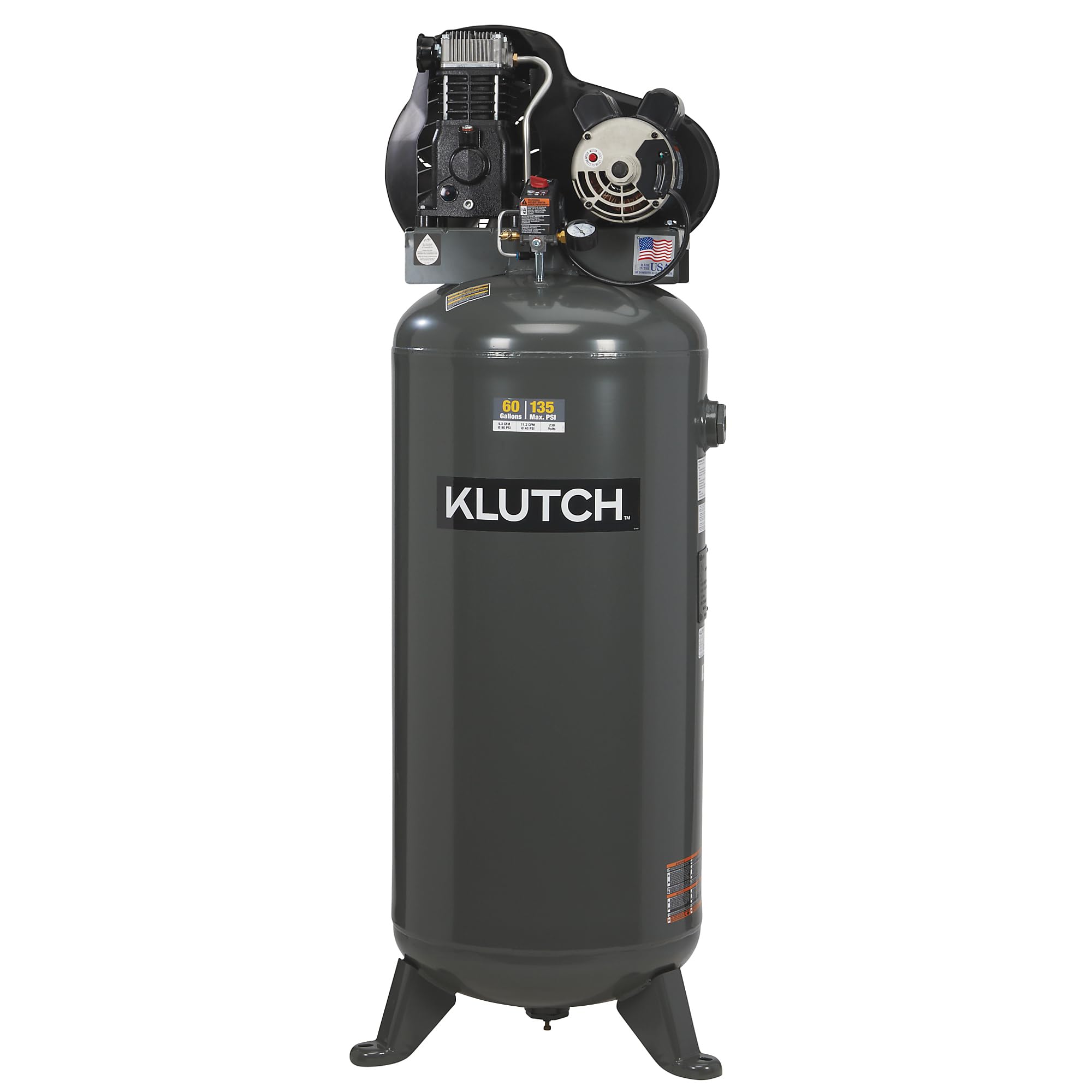
3. Klutch 60-Gallon Vertical Air Compressor, Single-Stage, 3.7 HP
This 60-gallon unit delivers 9.3 CFM at 90 PSI from a 3.7 HP motor at a competitive price.
This Klutch delivers 9.3 CFM at 90 PSI from a 3.7 HP motor, paired with a 60-gallon vertical tank — a 11.5x capacity jump over the Makita MAC5200 above. The splash oil-lubricated cast iron twin-cylinder pump with stainless steel valves is the same architecture used by brands costing twice as much. Owners consistently call it reliable for daily shop use, with one noting it “holds air well” and builds pressure quickly. The vertical footprint is a space-saver too: you don’t lose floor area the way a horizontal tank does.
At 220 pounds, this is a stationary unit. The wheels help you shift it for cleaning, but do not plan on loading it into a truck bed every day. The single-stage pump takes it to a maximum of 135 PSI, which is standard for single-stage units. If you need 175 PSI for high-pressure applications, a two-stage unit is the better path. The pressure buildup does receive mixed feedback — some owners wish it built pressure faster, but for the price this is a hard value to beat.
The belt-driven design keeps noise lower than direct-drive units of similar power, and the oil sight gauge makes checking the level easy. This is a smart buy for a mid-size shop that needs constant air volume without the budget for a premium brand.
Why it stands out
- 9.3 CFM @ 90 PSI from a 3.7 HP motor — strong mid-range output
- 60-gallon vertical tank provides long run times for demanding tools
- Cast iron oil-lubricated pump with stainless steel valves for durability
- Excellent value-to-performance ratio for a 60-gallon unit
The trade-offs
- Single-stage limits max pressure to 135 PSI — not ideal for 175 PSI applications
- At 220 pounds, this is a stationary shop unit, not portable
- Some owners note the pressure buildup could be faster
Best for: the shop owner who wants a 60-gallon tank and strong CFM on a tighter budget, for intermittent-to-moderate use with impact tools and nailers.
Skip if: you require 175 PSI for high-pressure tools or need a portable unit — the weight and single-stage spec rule both out.
4. DEWALT 25 Gallon Vertical Air Compressor, 200 Max PSI

This DEWALT model reaches 200 PSI, 65 PSI higher than standard single-stage units.
This DEWALT model delivers a maximum pressure of 200 PSI, which is 65 PSI higher than the standard 135 PSI on a typical single-stage unit. That extra pressure is important for tools like air lifts, high-pressure blow guns, and some industrial cleaning equipment. The 2 HP motor runs a belt-driven oil-lubricated pump, and the aluminum flywheel is designed for better heat dissipation and lower startup amps. The 10-inch pneumatic wheels and 25-gallon tank make it a genuine portable option for a job site with high-pressure needs.
The reality check: with only 30 ratings on Amazon, the review pool is thin. The ratings are polarized — most owners love it, but a small minority report quality control issues like dirty filters, leaking release valves, and low oil at delivery. The DEWALT brand name carries weight for handheld tools, but the larger compressor line is a different story for some buyers. The CFM at 90 PSI is not published in the data, which is an unusual omission for a unit in this tier.
If you specifically need the 200 PSI ceiling and trust the brand, this is one of the few options. For general shop use, a unit with published CFM specs is a safer bet.
The 200 PSI edge: No other unit on this list reaches 200 PSI — if you need that ceiling for air lifts or specialty tools, this DEWALT is the clear choice. The thin data: Without published CFM at 90 PSI, you can’t verify it keeps up with your tools. The small sample of owner experiences also makes it a riskier blind buy.
Reach for this if: your primary requirement is high peak pressure (200 PSI) for non-continuous tools in a portable format with a trusted national brand.
Proceed with caution if: you need to match a specific CFM requirement — the missing spec makes that impossible without additional research.
5. Ingersoll Rand SS3L3 3HP 60-Gal Single-Stage Compressor

This Ingersoll Rand pump delivers 10.3 CFM at 90 PSI and is designed for over 5,000 hours of use.
Ingersoll Rand is the brand that mechanics and shop owners recommend when they want a compressor that will outlast the building. This SS3L3 delivers 10.3 CFM at 90 PSI from a 3 HP motor and a 60-gallon ASME-certified tank. The cast iron construction is durable to the point that the pump is designed for over 5,000 hours of use. The synthetic lubricant extends service intervals to 2,000 hours — four times longer than petroleum-based oils. Owners say it is “great for sandblasting, nail guns, air wrenches” and very quiet for a shop compressor of this size.
The unit is rated for 100% continuous duty, meaning you can run tools nonstop without worrying about overheating the pump. The single-stage design limits maximum pressure to 135 PSI, but at 10.3 CFM, the volume is there for most heavy-consumption tools. Repeat buyers are common — owners who buy one for a 17-year lifecycle come back for another.
At 60 gallons and a stationary format, this is a low-maintenance shop anchor. It is not portable. The auto start/stop switch and oil sight gauge keep the daily interaction simple.
5,000-hour pump life: Ingersoll Rand designs this for over 5,000 hours of trouble-free use — in a daily-use shop, that is many years of service. Continuous 100% duty cycle: you can let the tools run all day. The one misstep: the intake filter on some units has been reported to melt during continuous use, so a heat-shield mod is a cheap preventative measure.
Best for: the owner-operator who wants a single long-term compressor for a 60-gallon shop setup, with the build quality to last through a career.
Consider the two-stage unit below if: you need 175 PSI or work with sandblasters and production sprayers — the single-stage ceiling is 135 PSI.
6. Metabo HPT Gas Powered Wheeled Air Compressor, 8 Gallon, Honda GX Engine

This gas-powered Metabo HPT uses a Honda GX engine and cast iron pump for off-grid operation.
This Metabo HPT is the one to grab when you are roofing a house with no power, framing a shed in a field, or working roadside repair where there is no 110V outlet in sight. The professional-grade Honda GX engine is the same power plant trusted on construction sites worldwide. The cast iron cylinder provides consistent compression and low oil carryover, which extends the life of your air tools. The baseplate integrated control panel keeps the gauge and regulator protected from job-site knocks.
The 8-gallon tank cycles from 116 PSI to a maximum of 145 PSI, which is enough for framing nailers, roofing guns, and impact wrenches. Owners describe it as a “well made” machine that “does the job and then some.” One repeat buyer purchased a second unit, which is a strong endorsement. The caveat: a few customers note quality issues with the oil seal on units that sat unused for long periods, and the baseplate construction is not all cast iron as some expected.
At 144 pounds with wheelbarrow-style handles, it is portable enough to roll across a job site but too heavy to lift into a truck bed without a ramp.
The Honda GX advantage: this engine is the gold standard for small engines — it starts, runs forever, and parts are available everywhere. Job-site freedom: gas power means you are never tethered to an outlet. The concern reported: a small number of units have blown oil out on first use after storage, so the pre-delivery prep matters.
Best for: professional roofers, framers, and roadside mechanics who need compressed air where there is no electricity — the Honda GX engine is the right answer for that world.
Not for: indoor shops where electric power is available — you will pay a premium for the gas engine and deal with exhaust fumes, fuel, and more maintenance.
7. VEVOR 80 Gallon Air Compressor, 6.5 HP, 145 PSI, Oil-Free

This VEVOR 80-gallon unit delivers 15.5 SCFM at 90 PSI for continuous production work.
VEVOR enters the industrial tier with an 80-gallon tank and a 6.5 HP motor that pushes 15.5 SCFM at 90 PSI. That is more than double the output of the 60-gallon units above, and it fills a tank this size in about 6 minutes. The oil-free design means you skip the oil changes entirely, which is a real maintenance time-saver in a busy shop. The noise level is rated at 86 dB, which is quieter than most belt-driven units of equivalent power — “low-noise” is a relative term here, but it beats the typical industrial scream.
Owners have used this unit to paint an entire car without the tank pressure dropping below 120 PSI, which is a serious endorsement for continuous-spray applications. The high-strength cold-rolled steel tank is built for durability in harsh environments. On the downside, the compressor ships without a regulator, power cord, or foot padding — you will need to supply those separately. The drain valve is mounted above the bottom of the tank, which prevents it from draining all condensation, and the manual instructs you to tip the tank to drain (impossible if bolted down).
This is a powerful value proposition for an 80-gallon industrial unit, but the cost-saving measures in the design are visible.
The power story
- 15.5 SCFM @ 90 PSI — enough for sandblasting, production painting, and high-consumption tools
- Oil-free operation means no oil changes and cleaner air output
- 80-gallon tank provides long run times for industrial applications
- 86 dB is relatively quiet for a 6.5 HP industrial compressor
The corners cut
- Ships without a regulator, power cord, or foot padding — expect extra purchases
- Drain valve position prevents full condensation drainage when bolted to the floor
- Quality control issues reported — a few units arrive with tank weld leaks
Best for: the budget-conscious shop that needs 80-gallon capacity and high SCFM for industrial painting or continuous work, and is comfortable sourcing ancillary parts.
Think twice if: you want a plug-and-play package with full accessories — this unit requires planning for the missing components and workarounds for the drain design.
8. NorthStar Portable Gas-Powered Air Compressor, 20-Gal, Honda GX160

This NorthStar gas-powered unit delivers 13.7 CFM at 90 PSI with a Honda GX160 engine.
This NorthStar combines a Honda GX160 OHV engine (the same trusted engine from generators and pumps) with a full cast iron pump that delivers 13.7 CFM at 90 PSI. The V-style cylinder design provides superior cooling during extended run times. The floating-type Swedish steel valves are designed for long valve life — this is a pump built to be rebuilt, not thrown away. Owners consistently call it “reliable” and say the Honda engine “starts first crank” even after sitting.
At 217 pounds with a 20-gallon horizontal tank, this is portable only on the wheel kit — you roll it, you do not carry it. Semi-truck mechanics use it to remove truck wheels, and sealcoat contractors run it for hours without a hitch. The low-oil shutdown on the Honda engine protects the compressor from the most common cause of field engine failure. The cast iron pump head (FC35 Grade) is a heavy-duty detail that separates this from cheaper gas compressors.
The downside: a few reviewers point out assembly quality issues — fitting not fully seated, throttle linkage clip installed upside down. These are small fixes, but they suggest the final assembly quality could be higher for the price.
Honda GX160 power: the reliability of this engine is the main event — it starts easily and runs for years with basic maintenance. 13.7 CFM from a gas portable: this is high output for a non-electric unit, enough for impact wrenches, nailers, and blowout work. The small fix up front: check the throttle linkage and fittings on delivery — most are fine, but some need a simple adjustment.
Best for: contractors and field service pros who need a reliable gas compressor for remote work — tire repair, sealcoating, framing without power.
Look at the electric options if: you are always near an outlet — you get a larger tank and quieter operation for the same money.
9. California Air Tools CAT-60040CAD 4.0 HP Ultra Quiet, 60-Gallon

Two quiet 2.0 HP motors and a 60-gallon tank — 10.6 CFM at only 75 dB.
This is the big brother of the 20-gallon California Air Tools unit above, and it delivers the same signature quiet operation in a 60-gallon format. Twin 2.0 HP motors run at just 1680 RPM, producing 10.60 CFM at 90 PSI at only 75 dB. That is roughly the volume of a normal conversation — you can talk on the phone next to this compressor while it runs. The oil-free dual piston pump is rated for over 3,000 hours of life and eliminates oil-related maintenance entirely.
The 60-gallon ASME steel tank provides the reserve volume a real shop needs. The factory-installed auto drain valve handles moisture removal automatically, which is a genuine time-saver. Owners who have run this unit for 6 years (2-3 days per week) report it is reliable for tires, tools, and cleaning. At 213 pounds, it is on the lighter end for a 60-gallon unit, which helps if you need to move it around a shop floor once in a while.
The mixed feedback on reliability and performance in the data is worth noting. A small number of owners had units that did not work on arrival or stopped working after a few minutes. When these units work, they are excellent. The defect rate, while a small percentage, is higher than what you see on the Ingersoll Rand units below.
75 dB in a 60-gallon: no other 60-gallon unit comes close to this noise level — it is a genuine standout for a shop near living spaces or offices. Auto drain standard: the factory-installed auto drain valve is a rare and welcome feature at this tier. Reliability is split: most owners are thrilled, but a minority report defects on delivery.
Best for: the serious home shop or small commercial shop where noise is a real constraint and 60-gallon capacity is required — the quietest option at this tank size by a wide margin.
Not the right pick if: you cannot risk a defect on delivery — the data shows a higher-than-average failure rate on initial units, so budget for the possibility of a return.
10. NorthStar Portable Gas Powered Air Compressor, 30-Gal, Honda GX390

24.4 CFM from a Honda GX390 — the portable that runs a 1/2-inch impact all day on truck repairs.
This NorthStar is the most powerful gas-powered compressor on this list. The Honda GX390 engine with electric start (plus recoil backup) and a full cast iron pump produces 24.4 CFM at 90 PSI — more than enough to run a 1/2-inch impact wrench continuously on heavy truck repairs without ever running out of reserve air. The 30-gallon horizontal tank provides the volume to support that flow. Owners who do heavy truck repair say it “never runs out of reserve air” and describe it as the best compressor they have ever owned.
The pump is pure cast iron with V-style cylinder cooling and FC35 grade cast iron pump head. The electric start with battery charging circuit (battery not included) makes it easy to fire up on a cold morning. At 490 pounds, this is a dolly-mounted unit, not a lift-into-the-truck unit. Repeat buyers are common — one owner is on their fourth unit. The main negative appears in shipping: the unit arrives on a pallet, and a few owners have had issues with damaged throttle linkages or missing parts.
If you need gas-powered high CFM for production work in the field, this is the clear pick in this range.
24.4 CFM in a gas portable: nothing else at this price point comes close — this is production-grade air volume for the field. Honda GX390 electric start: the big-block Honda engine with push-button starting is a huge convenience on a cold jobsite. Heavy, but built for it: 490 pounds is serious weight, but the cast iron build is exactly why owners buy a fourth unit.
Best for: professional heavy truck repair, fleet maintenance, and industrial field service where 24+ CFM is required off-grid — the repeat-buyer rate says it all.
Overkill for: small contractors who only run nail guns — the Makita gas unit above will save you about a thousand dollars.
11. Ingersoll Rand 2475N7.5 7.5HP 2-Stage Air Compressor, 80-Gallon

The 7.5 HP, 175 PSI two-stage endgame — engineered for 15,000 hours of continuous industrial duty.
This is the compressor you buy once and forget about for a decade. The Ingersoll Rand 2475N7.5 is a 7.5 HP, two-stage, 80-gallon behemoth that delivers 24 CFM at 175 PSI. The pump is designed for over 15,000 hours of trouble-free use — three times the lifespan of the SS3L3 single-stage above. The two-stage design means air is compressed in the first cylinder, cooled, then compressed again in the second cylinder, producing 175 PSI with less heat and moisture than a single-stage unit. Owners describe it simply: “even a medium-sized shop will never run out of air.”
The individually cast cylinders and overhung crankshaft make maintenance straightforward. The synthetic lubricant (All Season Select) delivers 2,000 hours between changeouts, four times longer than standard oil. At 611 pounds and 70 inches tall, this is a stationary installation that requires a concrete pad and a 230V circuit. The CFM here is virtually identical to the NorthStar GX390 above (24 CFM vs 24.4 CFM), but the Ingersoll Rand operates on 100% continuous duty at 175 PSI with electric power — no gas, no fumes, no fuel.
Some units arrive with cosmetic dents from freight shipping, and the factory oil change is expensive. But no one who owns this compressor regrets the purchase.
The industrial standard
- 15,000-hour pump life — designed for daily production use for many years
- 24 CFM @ 175 PSI from a 7.5 HP two-stage pump — the real deal for continuous heavy use
- 100% continuous duty cycle — run it all day, every day, no cooldown breaks needed
- 80-gallon ASME tank provides massive air reserve for multiple tools at once
The commitment required
- 611 pounds — requires professional installation or a forklift to position
- Requires a dedicated 230V circuit and concrete floor mounting
- Factory synthetic oil is expensive, though intervals are long (2,000 hours)
The one for: the serious industrial shop, auto body shop, or manufacturing facility where the compressor runs 8+ hours a day and downtime is not acceptable — built to last 15,000 hours.
Too much if: you have a small to medium shop — the single-stage IR above (SS3L3) gives you the same brand reputation and 10.3 CFM at half the price and weight.
Understanding the Specs
CFM at 90 PSI (Cubic Feet per Minute)
This is the single most important number for matching a compressor to your tools. CFM measures the volume of air the pump can deliver at a specific pressure — almost always measured at 90 PSI for commercial compressors. Every air tool lists its own CFM requirement. A framing nailer might need 2.2 CFM, a 1/2-inch impact wrench needs around 5CFM, and a DA sander or sandblaster can demand 8 to 15 CFM. If your compressor’s CFM at 90 PSI is lower than what your tool requires, the tool will not run at full power — or at all — and the tank will take too long to recover. The rule of thumb for commercial shops is to choose a compressor that delivers at least 1.5 times the highest CFM requirement from any tool you plan to run. The data sheet always lists two numbers: CFM at 40 PSI (higher, less useful) and CFM at 90 PSI (the real-world number to compare).
Single-Stage vs. Two-Stage Pump
A single-stage compressor compresses air in one stroke per revolution and typically fills the tank to between 120 and 135 PSI. It is simpler, cheaper, and perfectly adequate for most intermittent work — nail guns, impact wrenches, tire inflation, blow guns. A two-stage compressor compresses air in the first cylinder, passes it through an intercooler, and then compresses it again in a second cylinder to reach 175 PSI or higher. The two-stage design generates less heat and moisture in the air, runs more efficiently, and the pump itself usually lasts longer (some are rated for over 15,000 hours of use). Two-stage units are the standard for continuous-use applications like sandblasting, production spray painting, and shops running multiple tools simultaneously. The trade-off is a higher upfront cost and usually a larger, heavier unit.
Duty Cycle
Duty cycle describes how long a compressor can run in a given period before it needs to cool down. A 100% continuous duty compressor can run all day without stopping — the pump is built to handle the heat and stress of constant operation. A 50% duty cycle means the pump should run for 1 minute and rest for 1 minute. For commercial or industrial use, look for 100% continuous duty or at least a high-duty-cycle rating. Compressors with oil-lubricated cast iron pumps typically carry higher duty cycles than oil-free units because the oil absorbs and dissipates heat more effectively.
Oil-Lubricated vs. Oil-Free Pump
An oil-lubricated pump uses a reservoir of oil to reduce friction, carry away heat, and seal the piston rings. These pumps run cooler, last longer (often tens of thousands of hours), and are the standard for commercial and industrial compressors. They require regular oil changes and are typically heavier and more expensive. An oil-free pump uses permanently lubricated bearings and advanced piston ring materials (such as Teflon) to run without oil. They require less maintenance, produce cleaner air (no oil mist), and are generally lighter and quieter. However, oil-free pumps usually have a shorter lifespan — typically 1,000 to 3,000 hours — and are best suited for intermittent use or noise-sensitive environments where the lower maintenance is worth the shorter service life. For a commercial shop running tools daily, an oil-lubricated pump is almost always the better investment.
FAQ
How do I choose between a single-stage and two-stage commercial air compressor?
What size air compressor do I need for a commercial auto repair shop?
Can I run a sandblaster with a 20-gallon air compressor?
Is an oil-free air compressor good for commercial use?
How many CFM do I need for an impact wrench?
What is the difference between CFM and SCFM?
How long does a commercial air compressor last?
Can I use a 60-gallon air compressor on a standard 110V outlet?
How often should I drain my commercial air compressor tank?
What is the quietest large commercial air compressor?
Final Thoughts: The Verdict
If you want one dependable pick, the commercial air compressor winner is the Makita MAC5200 because it hits the balance of genuine portability (75 pounds with wheels), an output of 6.5 CFM at 90 PSI that covers nailers and impact wrenches, and the durability of an oil-lubricated cast iron pump. It is the crowd favorite on Amazon for a reason. If you want the quietest large-tank setup, grab the California Air Tools CAT-60040CAD — 10.6 CFM at only 75 dB is unheard of in a 60-gallon unit. And for industrial continuous operation where downtime is not an option, the Ingersoll Rand 2475N7.5 is the one to reach for; with 24 CFM, 175 PSI, and a pump rated for 15,000 hours, it will likely outlast every other piece of equipment in your shop.
How We Picked
We do not accept paid placement. Every pick is matched to a real buyer and a real use-case; we do not hands-on test units.
Sources & Methodology
Specifications: manufacturer listings and product documentation. Review insights: verified customer reviews, as of July 2026. Pricing: not shown on this page (it changes often); check the current price via the retailer link.
As an Amazon Associate, WellFizz earns from qualifying purchases. This does not affect which products we feature.
Related Guides

Mo Maruf
I created WellFizz to bridge the gap between vague wellness advice and actionable solutions. My mission is simple: to decode the research and give you practical tools you can actually use.
Beyond the data, I am a passionate traveler. I believe that stepping away from the screen to explore new environments is essential for mental clarity and physical vitality.