Our readers keep the lights on and my smoothie glass nicely filled. As an Amazon Associate, I earn from qualifying purchases.
Walking into a game night with a Commander precon that sputters while your opponent’s board state snowballs is a uniquely frustrating way to spend an evening. The difference between a deck that feels like a pile of cards and one that hums with mechanical weight comes down to raw synergy density — how many of the 100 cards actually advance a single, focused game plan.
I’m Mohammad Maruf — the founder and writer behind WellFizz. I spend hundreds of hours analyzing card lists, parsing player-testing data, and cross-referencing the real-world consistency of preconstructed Commander decks across multiple Magic: The Gathering releases.
Whether you’re new to the format or an old hand looking for a strong foundation, finding the best commander precons means sorting through dozens of options with wildly different power levels and upgrade paths. This guide breaks down the top performers by their out-of-the-box strength, long-term value, and strategic identity.
How To Choose The Best Commander Precons
Not all preconstructed Commander decks are created equal. Some are designed as entry-level teaching tools, while others pack enough raw synergy to hang with moderately tuned casual tables. The key is matching the deck’s mechanical identity to your playstyle and your local meta’s power level.
Synergy Density vs. Value Chaff
The single most important metric for a precon is what experienced players call “synergy density” — the percentage of the 100 cards that directly interact with your commander’s activated or triggered abilities. A deck where 60% of the non-land cards point in the same direction will play infinitely smoother than one where a quarter of the cards are generically good but mechanically orphaned.
Upgrade Path and Reprint Value
A strong precon earns its keep in two ways: it plays well immediately, and its most expensive reprints can be sold or traded to fund future upgrades. When scanning a deck’s card list, look for format staples, rare land cycles, and utility artifacts whose prices hold independent of the deck’s theme.
Quick Comparison
On smaller screens, swipe sideways to see the full table.
| Model | Category | Best For | Key Spec | Amazon |
|---|---|---|---|---|
| Chaos Incarnate | Starter | New players on a budget | 100-card Black-Red agro deck | Amazon |
| Counter Intelligence | Control | Players who love counterspells | Blue-Red-White artifact proliferate | Amazon |
| Revival Trance (FFVI) | Theme | Final Fantasy fans / Reanimator | Red-White-Black graveyard recursion | Amazon |
| Food and Fellowship (LOTR) | Premium | Lore lovers / Casual tables | White-Black-Green food synergy | Amazon |
| Arcane Maelstrom | High-End | Spell-copying enthusiasts | 4 foil legendary creatures | Amazon |
| Planar Portal (D&D) | Collector | Dungeons & Dragons crossover fans | Red-Black dice-rolling / chaos | Amazon |
| Forces of The Imperium (WH40K) | Flagship | Warhammer fans / Token swarm | White-Blue-Black token generation | Amazon |
In‑Depth Reviews
1. Arcane Maelstrom Ikoria Commander Deck

Arcane Maelstrom stands out as the most mechanically dense precon in the Temur (Blue-Red-Green) color space. The deck offers four legendary creatures — Kalamax, Xyris, Haldan, and Pako — giving you multiple viable commanders in one box. Kalamax’s spell-copying ability turns every instant into a potential blowout, and the deck comes loaded with cheap cantrips and combat tricks that trigger that copy mechanic reliably.
The inclusion of Deflecting Swat alone covers a significant portion of the deck’s value. Beyond that single staple, the 100-card list includes solid ramp spells, card-draw engines, and interaction pieces that form a real skeleton for upgrading. This is one of the few precons where you can swap ten cards and have a deck that challenges tuned casual tables.
Where this deck shows its age is in the mana base — the tapped dual lands slow down the early turns compared to premium offerings from 2023 onward. The keyword counter card and life wheel are nice touches, but the deck box is flimsy and will need replacement if you sleeve your cards. Veteran players will immediately notice the chaff cards that exist solely to pad the 100-count.
Why it’s great
- Four viable commanders in one box with wildly different play patterns
- Deflecting Swat and other high-value reprints pay for the deck
- Spell-copying mechanic scales well with upgrades
Good to know
- Mana base relies heavily on tapped lands, hurting turn-one tempo
- Original deck box is too small for sleeved cards
- Contains several filler cards with low synergy density
2. Forces of The Imperium (Warhammer 40,000)

Forces of the Imperium is widely considered one of the strongest preconstructed Commander decks ever printed. The White-Blue-Black color identity supports Marneus Calgar, a commander who generates card advantage every time you create a token — and this deck creates tokens constantly. Between the Space Marine squad cards, Imperial Guard swarms, and various artifact token generators, the board state goes wide faster than most precons can answer.
The 42 cards new to Magic are not reprints from existing Warhammer universes but mechanically original designs that fit the token-go-wide archetype perfectly. Foil-etched display commanders and full-art treatments give this deck collector appeal, but the real draw is the gameplay loop: play a creature, make a token, draw a card. It’s elegant, powerful, and immediately satisfying.
The primary knock against this deck is its unfocused sub-themes. While the token engine is strong, some cards reference vehicles, equipments, or other Imperium-flavored mechanics that don’t directly advance Marneus’s game plan. In an eight-player pod, the deck performs well, but in competitive 1v1 Commander it struggles against faster combo finishes. The price point also restricts this to dedicated hobbyists rather than casual buyers.
Why it’s great
- Marneus Calgar creates one of the smoothest card-draw engines precons offer
- 42 new-to-Magic cards with unique Warhammer-themed mechanics
- High-quality foil treatments and premium packaging
Good to know
- Sub-themes dilute the primary token strategy slightly
- Premium price puts it out of range for casual buyers
- Lacks fast mana that competitive pods expect
3. Planar Portal Red-Black (Dungeons & Dragons)

Planar Portal leans hard into the Dungeons & Dragons crossover identity with a Red-Black theme centered on dice rolling, chaos effects, and big mana plays. The deck comes with two traditional foil legendary creatures and a foil-etched display commander, and every card is adorned with D&D-style artwork that feels pulled straight from a monster manual. The reduced-plastic packaging is a welcome environmentally conscious touch.
Out of the box, this deck has more strategic depth than a typical smash-face precon. The primary game loop involves hitting land drops, using mana to activate value engines like the various dragon-templated creatures, and overwhelming opponents with incremental resource advantages. Experienced players will appreciate that it requires real sequencing decisions rather than just turning creatures sideways.
The downside is that the dice-rolling mechanics introduce variance that can feel frustrating in close games. When you roll low on a crucial turn, the deck can sputter against more consistent strategies. Additionally, because this set is now out of print, prices have risen above the original retail point, making it harder to justify as a budget option.
Why it’s great
- Rich D&D theme with bespoke art on every card
- Requires real sequencing skill, rewarding experienced players
- Foil-etched display commander and premium accessories
Good to know
- Dice-rolling variance can lead to frustrating non-games
- Out of print, so secondary market prices are elevated
- Not the most beginner-friendly strategy
4. Food and Fellowship (The Lord of the Rings)
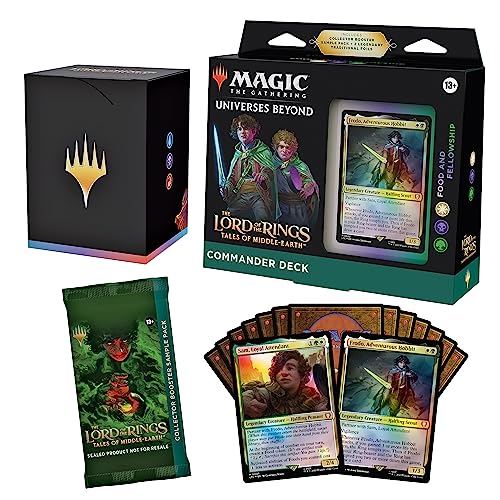
Food and Fellowship captures the spirit of Tolkien’s story about fellowship, rest, and perseverance by centering the deck around the Food token mechanic. The White-Black-Green color identity gives you access to powerful lifegain synergies, and the deck comes packed with iconic Middle-earth characters like Frodo, Sam, and Merry. The foil-etched display commander and life wheel accessory make the unboxing experience feel special.
This deck plays best in multiplayer pods where you have time to establish your Food engine. The primary win condition involves generating massive amounts of life and then leveraging that life total into card draw or direct damage effects. The Food tokens also synergize with sacrifice outlets, giving you multiple pathways to advantage. The 2-card Collector Booster Sample Pack adds a small lottery element that collectors appreciate.
Where this deck falls short is raw power level. The Food mechanic, while flavorful, is slower than aggressive or combo-oriented precons. Against decks that can establish a fast board presence, you’ll spend your early turns making Food while your opponents build threats. The mana base also lacks some key dual lands that would smooth out the three-color requirements, leading to occasional color-screw games.
Why it’s great
- Thematically perfect for Lord of the Rings fans with gorgeous artwork
- Food token engine provides consistent lifegain and card advantage
- Foil-etched display commander and premium accessories
Good to know
- Slower than most aggressive precons out of the box
- Three-color mana base needs immediate upgrade for consistency
- Food mechanic can feel underwhelming against combo finishes
5. Counter Intelligence (Edge of Eternities)

Counter Intelligence introduces the Edge of Eternities set’s artifact-proliferate theme in a Blue-Red-White shell. The deck’s two foil borderless commanders — Inspirit and Kilo — enable a game plan that rewards you for boosting artifacts and spreading counters across your board. The 12 never-before-seen Commander cards in this deck give it a high novelty factor for collectors who want new mechanical space to explore.
The core strategy involves playing cheap artifacts, using proliferate effects to stack charge counters on them, and then converting those counters into card draw or direct damage. This creates a satisfying engine where every artifact that stays on the battlefield becomes a compounding resource. The inclusion of a 2-card Collector Booster Sample Pack with potential mythic rares adds extra value for those who enjoy opening packs.
The catch is that this deck’s complexity makes it a poor choice for absolute beginners. Understanding the stack, timing of proliferate triggers, and artifact synergy chains requires a firm grasp of game mechanics. The mana curve also leans slightly high, meaning you’ll have frustrating games where your hand is full of four- and five-drops with no acceleration.
Why it’s great
- 12 brand-new Commander cards with unique mechanical designs
- Proliferate engine creates compounding value over long games
- Foil borderless commanders look stunning in a sleeve
Good to know
- High complexity isn’t suitable for new players
- Mana curve can lead to slow starts without ramp
- Artifact theme is fragile against mass artifact removal
6. Revival Trance (Final Fantasy VI)

Revival Trance brings the world of Final Fantasy VI into Magic with a Red-White-Black reanimator strategy. Terra, Herald of Hope leads the deck with a graveyard recursion ability that lets you return fallen creatures directly to the battlefield. The 25 new Commander cards and all-new art on every card make this a must-buy for Final Fantasy fans who also play Magic.
The gameplay loop revolves around filling your graveyard through self-mill or discard effects and then using your commander or other reanimation spells to cheat high-cost creatures into play ahead of curve. Cards like Anger, which gives your creatures haste from the graveyard, add meaningful synergy that experienced reanimator players will recognize and exploit. The deck’s creature base includes iconic Final Fantasy VI characters with abilities that reward you for having a full graveyard.
The deck’s main weakness is inconsistency. Reanimator strategies live and die by their ability to consistently fill the graveyard and find their reanimation spells. This precon lacks the redundant tutors and efficient mill engines that tuned reanimator decks rely on. Against aggressive opponents, you may find yourself with a hand full of expensive creatures and no way to put them in the graveyard.
Why it’s great
- 25 new Commander cards exclusive to Final Fantasy VI theme
- All-new artwork on every card is gorgeous and faithful to the source
- Reanimator strategy provides explosive potential high-roll games
Good to know
- Inconsistent without dedicated tutor and mill upgrades
- Expensive creatures in hand with no graveyard access lead to stalled games
- Not competitive out of the box against synergistic precons
7. Chaos Incarnate Starter Commander Deck

Chaos Incarnate is the most approachable entry point in the Starter Commander lineup, built for players who have never touched a Commander deck. The Black-Red color pair is intentionally straightforward: play creatures, force opponents to attack each other with Kardur, Doomscourge, and then finish the game with overwhelming combat damage. The deck comes with a foil-etched legendary creature, a deck box, and punchout counters that help new players track creature buffs.
The deck’s primary strength is its clarity of purpose. Every card in the 100-card list supports the forced-combat game plan or provides mana to execute it. New players will understand their objective from the first turn: drop Kardur, protect your life total, and let your opponents kill each other while you build an army. The included reference card and strategy tips make the learning curve shallow, which is exactly what a true starter deck should offer.
The ceiling here is low. This deck is not designed to compete with premium precons or upgraded casual decks. Upgrade potential is limited because many of the cards are intentionally low-power to keep the price point accessible. Players who catch the Commander bug will outgrow this deck within a few game nights, but as a teaching tool and entry-level product, it serves its purpose perfectly.
Why it’s great
- Lowest barrier to entry for absolute beginners
- Clear, singular game plan that’s easy to understand
- Includes strategy tips, reference card, and punchout counters
Good to know
- Power level is too low for established casual tables
- Limited upgrade path without replacing many core cards
- Deck box is basic and won’t accommodate sleeved cards well
FAQ
Are Commander precons worth buying if I already own a custom deck?
How many lands should I add or remove from a precon?
Which precon has the best reprint value for collectors?
Final Thoughts: The Verdict
For most users, the best commander precons winner is the Arcane Maelstrom because its multiple commander options and high-value reprints give you the most flexibility per dollar spent. If you want a Warhammer 40,000-themed token engine with unmatched synergy, grab the Forces of the Imperium. And for absolute beginners who need a simple, guided entry into the format, nothing beats the Chaos Incarnate starter deck.

Mo Maruf
I created WellFizz to bridge the gap between vague wellness advice and actionable solutions. My mission is simple: to decode the research and give you practical tools you can actually use.
Beyond the data, I am a passionate traveler. I believe that stepping away from the screen to explore new environments is essential for mental clarity and physical vitality.