Our readers keep the lights on and my smoothie glass nicely filled. As an Amazon Associate, I earn from qualifying purchases.
Specs are compiled from manufacturer listings and verified buyer reviews and can change over time — please confirm the key details on the product page before buying.
A comfort fan should cool you without a roar that keeps you awake. But most either whisper too softly or blast too loudly. This guide cuts through the marketing to help you find one that is quiet enough for sleep, strong enough to cool a room, and has the settings to dial in your perfect breeze.
I’m Mohammad Maruf — the founder and writer behind WellFizz. This guide is built by comparing the manufacturers’ published specifications and the patterns across verified customer reviews, so you get each pick’s real strengths and trade-offs instead of marketing spin.
You need to match a fan’s airflow, noise level, and controls to where you use it, not just pick the most popular model. After reviewing the specs and real buyer experiences, these six models define the modern comfort fan landscape right now.
Quick Picks
- DREO Tower Fan for Bedroom (2026 Upgraded) — Best Overall
- PELONIS Pedestal Fan, Air Circulator — Most Versatile
- GoveeLife 42” Tower Fan — Premium Pick
- Honeywell QuietSet Whole Room Tower Fan HYF260 — Best Value
- Lasko Oscillating Tower Fan T42951 — Compact Comfort
- Comfort Zone 32-Inch Oscillating Tower Fan — Budget Champion
How To Choose The Best Comfort Fan
A comfort fan is not just about moving air—it is about moving the right amount of air at the right noise level for your space. Start by thinking about where the fan will live: a bedroom needs whisper-quiet operation and a sleep-friendly mode, while a living room may prioritize raw airflow and wide oscillation.
Airflow Capacity (CFM) and Motor Type
The number that tells you how much air a fan pushes is Cubic Feet per Minute (CFM, the volume of air the fan moves each minute). A higher CFM means stronger cooling over a larger area. Look for a DC motor (a brushless electric motor that is more efficient and quieter) over an AC motor—DC models, like the DREO and GoveeLife, use less power and run significantly quieter than traditional AC fans.
Noise Level and Speeds
Noise is measured in decibels (dB, a unit for sound intensity). A fan rated at 20–27 dB is roughly as loud as a whisper in a quiet library, making it fine for sleep. The number of speed settings also matters: more speeds (8 or 12 settings) let you fine-tune the airflow so it is never “too strong” or “too weak.”
Oscillation and Smart Features
Oscillation (the side-to-side sweep of the fan head) spreads air across a room instead of blasting one spot. Look for at least 90° of sweep for a bedroom or office. Wider ranges, like the GoveeLife’s adjustable 30°–150°, let you direct the breeze exactly where you need it. If you want to control the fan without leaving the couch, check for a remote, an app, or voice control via Alexa or Google Assistant.
Quick Comparison
| Model | Best For | Airflow (CFM) | Noise Level | Speeds & Modes | Amazon |
|---|---|---|---|---|---|
| DREO Tower Fan | Powerful & Quiet Bedroom Cooling | 1158 CFM | 20 dB | 8 Speeds + 4 Modes | Amazon |
| PELONIS Pedestal Fan | 3D Whole-Room Air Circulation | 900 CFM | 26 dB | 3 Speeds | Amazon |
| GoveeLife 42” Tower Fan | Smart App & Voice Control | 1515 CFM | 27 dB | 12 Speeds + 5 Modes | Amazon |
| Honeywell QuietSet HYF260 | Budget-Friendly Whole-Room Cooling | 253 Cubic Meters Per Hour | — | 5 Speeds | Amazon |
| Lasko Oscillating Tower Fan | Quiet Nighttime Cooling with Dimmer | 262 CFM | — | 3 Speeds | Amazon |
| Comfort Zone 32-Inch Tower Fan | Ultra-Slim Budget Pick | — | — | 3 Speeds | Amazon |
In-Depth Reviews
1. DREO Tower Fan for Bedroom (2026 Upgraded)

It delivers 1158 CFM (Cubic Feet per Minute) at just 20 dB (decibels) — so you get powerful, quiet airflow that cools a whole room without disturbing sleep.
The DREO pushes 1158 CFM of air, versus the Lasko Wind Curve’s 262 CFM. That means in a hot bedroom, you actually feel a strong breeze rather than a faint puff. The upgraded brushless DC motor (a type of electric motor that runs more efficiently and quietly) generates wind speeds up to 28 ft/s (feet per second) and projects the stream up to 34 feet, so even the far corner of your room cools down.
Noise matters just as much for a bedroom fan. The DREO runs as low as 20 dB (quieter than a library whisper, which is typically 30–40 dB). Its 8 speed settings plus 4 modes—Normal, Natural, Sleep, and Auto—let you dial in exactly the airflow you want. The Sleep Mode progressively lowers the speed overnight so you do not wake up shivering. Buyers report that the 90° oscillation (the side-to-side sweep) covers the whole room effectively, and the removable rear grille makes cleaning the impeller surprisingly easy.
It is also ETL certified (a safety standard from a testing lab), has a pinch-proof grille, and a fused plug for extra protection. For the price, you get a class-leading combination of raw CFM, ultra-low noise, and enough speed options to handle a hot afternoon and a cool night.
What You Get
- Ultra-powerful airflow (1158 CFM) crushes the competition.
- Near-silent 20 dB operation works perfectly for sleep.
- 8 speeds + 4 modes offer exceptional control.
- ETL certified with safety grille and fused plug.
The Trade-Offs
- Black finish may show dust more than lighter colors.
- No smart home or app connectivity.
Grab it if: you want the strongest quiet fan for a bedroom—the one that actually moves air across the room without keeping you awake.
Look elsewhere if: you need voice control or a Wi-Fi-connected fan for your smart home setup.
2. PELONIS Pedestal Fan, Air Circulator

A pedestal fan that moves air in every direction instead of just one plane, with 135° horizontal and 90° vertical oscillation.
Unlike most tower fans that swing side to side, the PELONIS uses OmniFlow Auto-Oscillation Technology to combine 135° of horizontal sweep with 90° of vertical sweep automatically. That means it pushes air up toward the ceiling and down toward the floor at the same time it rotates left and right—a capability that turns it into a room circulator rather than just a spot-cooler. It pushes 900 CFM (Cubic Feet per Minute, the volume of air moved each minute), which is strong but not quite as powerful as the DREO’s 1158 CFM.
The height adjusts from a low 23.2 inches (perfect for a child’s room or a desktop) up to 42.5 inches. Compared to the fixed-height 32-inch Comfort Zone tower fan, that adjustable 23.2-inch to 42.5-inch range means it fits more scenarios. The Bionic Butterfly-Blade design is engineered to deliver a soft, draft-free breeze, and it runs at a library-quiet 26 dB. It also has a 7-hour timer and a Memory Function that recalls your speed and mode settings if the power flickers, so you do not have to re-program it.
Between the 3D oscillation, adjustable height, and quiet operation, this fan is a strong choice for a living room or an open-plan space where you need air to circulate, not just blow in one direction.
Why It Stands Out
- 3D auto-oscillation (135° horizontal + 90° vertical) truly circulates a whole room.
- Height adjusts from 23.2″ to 42.5″ to fit any room setup.
- Very quiet at 26 dB and still moves 900 CFM.
Consider This First
- Only 3 speed settings, so less fine-tuning than fans with 8+ speeds.
- Takes up more floor space than a slim tower fan.
Reach for this if: you want air circulation, not just a blast—great for a living room with high ceilings or a home office where you share the space.
skip it if: you need a simple, space-saving tower for a cramped corner.
3. GoveeLife 42” Tower Fan

The smartest fan here—it links to your thermostat and takes voice commands, all while pushing a massive 1515 CFM.
The GoveeLife tops the airflow charts at 1515 CFM (Cubic Feet per Minute), blowing past the DREO’s 1158 CFM and the Lasko’s 262 CFM by a wide margin. But raw power is only part of the story. This fan connects to the GoveeLife app and works with Alexa, Google Assistant, and Siri, so you can turn it on, adjust speeds, or switch oscillation from across the room or even from another building. It supports 12 wind speeds and 5 modes, giving you more granular control than any other fan on this list.
The cleverest feature is the Smart Thermostat function. Pair it with a compatible GoveeLife thermo-hygrometer (a device that measures temperature and humidity), and the fan can automatically adjust its speed based on the room’s temperature. That means you set your desired comfort level, and the fan handles the rest—no waking up to manually change settings. It also has an adjustable oscillation range from 30° to 150°, letting you cover a narrow hallway or a wide living room.
Noise is rated at a low 27 dB, so it is still quiet enough for a bedroom. The removable grill and impeller wheel make cleaning simple, and there is even an aromatherapy box where you can add a few drops of your favorite essential oil. It is ETL certified for safety, but note that it does not support 5G Wi-Fi, so you will need a 2.4 GHz network.
Why It Is Worth It
- Highest airflow in this lineup at 1515 CFM.
- Smart thermostat integration with GoveeLife hygrometers auto-adjusts speed.
- Works with Alexa, Google, and Siri for hands-free control.
- Aromatherapy box adds a relaxing scent while you sleep.
Things to Keep in Mind
- Requires a 2.4 GHz Wi-Fi network (5 GHz is not supported).
- Premium price tag may be overkill if you just want a basic bedside fan.
Choose this when: you want a connected, automated setup—the fan that works with your smart home, senses the room temperature, and adjusts itself.
Look past it if: you just need a quiet fan for sleep and do not care about apps or voice commands.
4. Honeywell QuietSet Whole Room Tower Fan HYF260

A reliable, quiet tower fan that does the basics well—5 speeds, a dimmable display, and a remote—without the fancy frills.
The Honeywell QuietSet is a no-nonsense tower fan focused on quiet cooling at a mid-range price. It has 5 speed settings that let you balance sound level against cooling power—on the lowest setting it is nearly silent, making it a solid choice for a nursery or a light sleeper. The oscillating function (the fan head rotates side to side) provides whole-room coverage, and the included remote lets you adjust speeds, oscillation, and a programmable auto shut-off timer without leaving your seat.
One unique feature is the panel dimming system: the LED display can be set to 100%, 75%, 50%, 25%, or completely off. That is a small touch, but it matters a lot in a dark bedroom where a bright LED panel can be distracting. The airflow capacity is specified at 253 Cubic Meters Per Hour, which is moderate compared to the high-CFM leaders, so this fan is best suited for a small to medium-sized bedroom rather than a large living room.
The build is simple and the plastic finish is easy to clean. There is no smart connectivity or 3D oscillation here, but for someone who just wants a quiet, effective fan with a remote and a dimmable display, this Honeywell is a straightforward pick.
What Works
- Quiet operation across 5 speed settings works in a bedroom.
- Panel dimming with 5 light options (100% to off) is great for dark rooms.
- Remote control adds convenient couch or bed operation.
The Limitations
- Airflow is moderate compared to the DREO or GoveeLife.
- No smart home or app connectivity.
Best for: a bedroom where you need quiet operation, a dimmable display, and a remote—without paying for smart features you will not use.
Not for: a large living room or open-plan space that demands high CFM.
5. Lasko Oscillating Tower Fan T42951
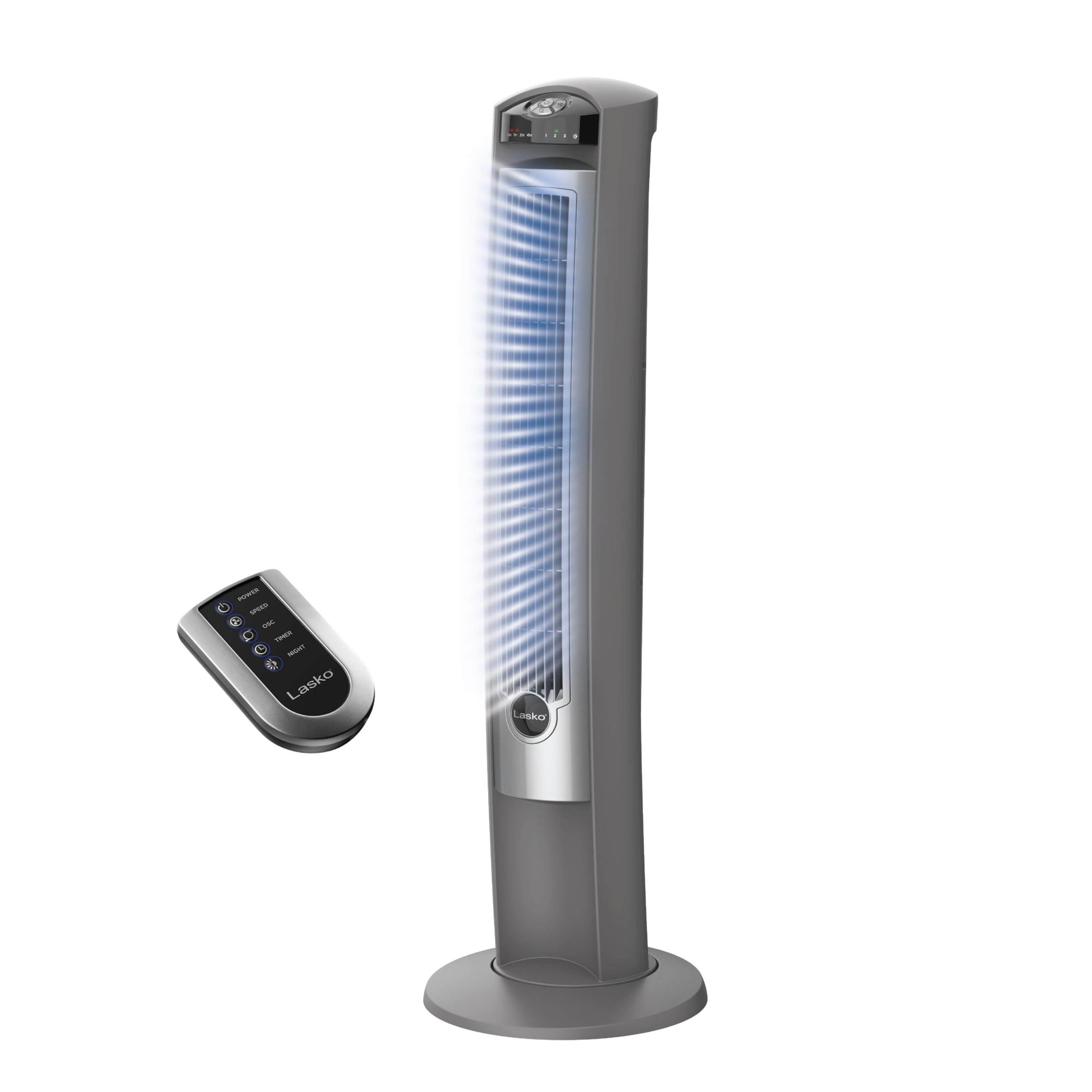
A slim, portable tower that focuses on quiet nighttime cooling with a smart dimmer, delivering 262 CFM.
The Lasko Wind Curve is among the most recognizable tower fans on the market, and for good reason: it is simple, quiet, and portable. At 42 inches tall, it is a full-height tower, but its slim profile and built-in carry handle make it easy to move from room to room. The air flow capacity is 262 CFM (Cubic Feet per Minute), which is markedly lower than the DREO’s 1158 CFM—so this fan is for personal cooling in a small to medium bedroom, not for blasting a whole living room.
The Nighttime Setting is the standout feature here. It automatically dims the LED controls and lowers the fan speed, so you can fall asleep without a bright light or an overcooled room. The 7.5-hour programmable timer means you can set it to run all night and shut off automatically in the morning. The 60° oscillation (the side-to-side sweep) ensures the air covers a decent area, and the remote handles power, speeds, oscillation, timer, and the nighttime setting.
If you are looking for sheer CFM, this fan is not your pick. But if you want a portable, reliable fan with a great sleep-friendly mode and a proven track record—Lasko has been making fans since 1906—this is a dependable option.
Good Points
- Nighttime setting dims lights and lowers speed automatically.
- Lightweight with a carry handle for easy room-to-room movement.
- 7.5-hour timer gives you flexibility for overnight use.
Weak Points
- Lowest CFM (262) on this list—not for large rooms or high heat.
- Only 3 speed settings limit fine-tuning control.
Pick it for: a portable, sleep-friendly tower that dims itself and shuts off on a timer—perfect for a small bedroom or a dorm room.
Leave it for: a large master bedroom or living room where you need serious airflow.
6. Comfort Zone 32-Inch Oscillating Tower Fan
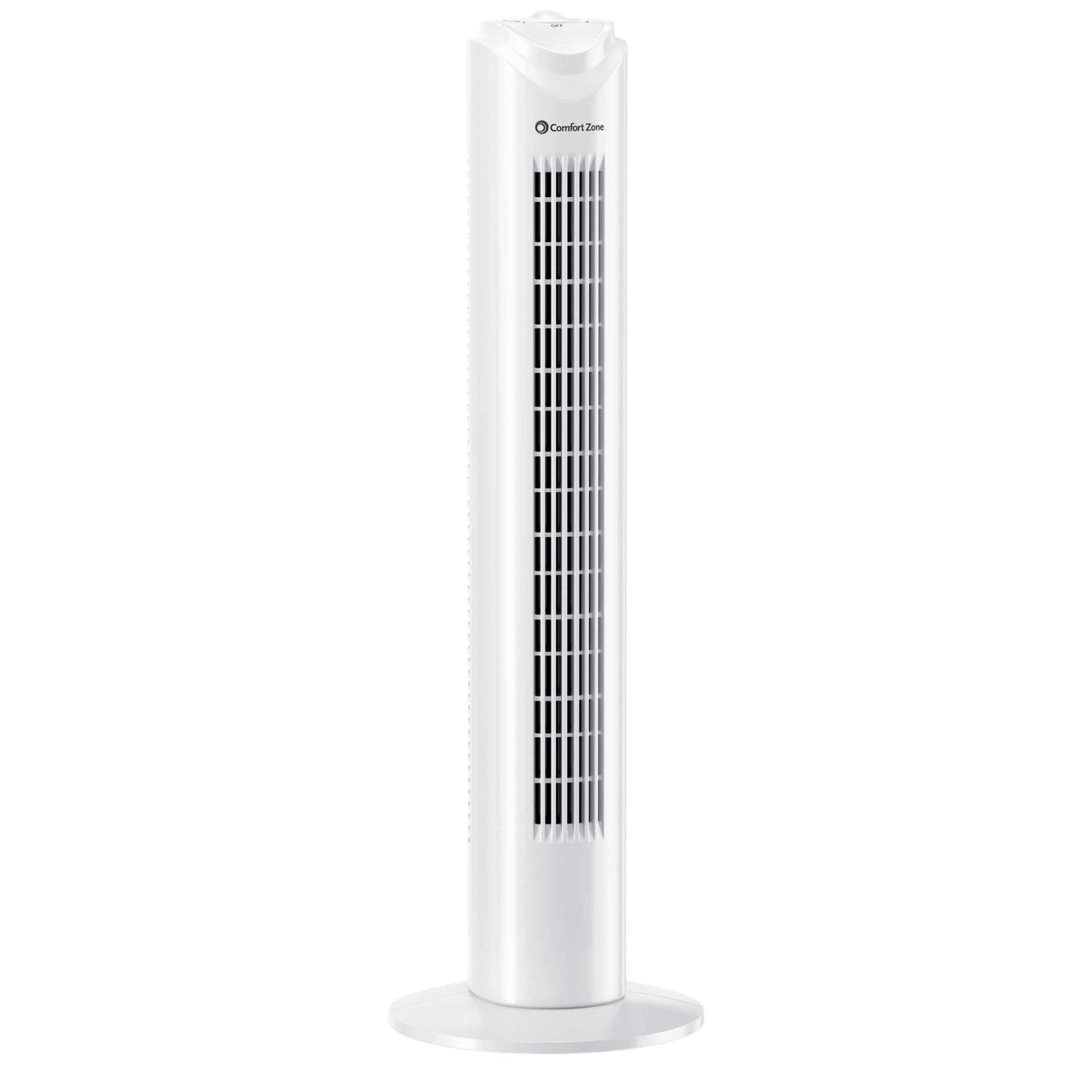
A 32-inch, ultra-slim tower that fits tiny spaces and costs very little—3 speed settings and a 90° oscillation in a bladeless design.
The Comfort Zone tower fan is the most compact and budget-friendly option here, standing at 32 inches tall with a footprint of just 8 by 8 inches. Compared with the PELONIS pedestal fan’s adjustable 23.2-inch to 42.5-inch height range, it fits easily between a nightstand and a wall or in a cramped office corner. The bladeless design (a smooth grille with no spinning blades exposed) makes it a safe choice for homes with kids or pets.
It has 3 speed settings (Low, Medium, High) and a 90° oscillation range. A simple knob control adjusts the settings—no remote, no app, just a turn of the dial. Buyers consistently report that it is “really quiet and does a great job,” though one reviewer noted that the airflow is weak even on the highest setting and does not spread out to the sides. At this slim size and price, that trade-off is expected: you get a whisper-quiet personal fan, not a room-circulator.
It is ETL certified for safety, has a built-in carry handle, and is backed by a 1-year manufacturer warranty. The assembly is straightforward, though no instructions are included. For a budget-friendly fan that disappears into the corner of a small room, this is a solid, no-risk pick.
Pros
- Very narrow 8″ x 8″ footprint fits tight spaces.
- Bladeless and safety grille design protect kids and pets.
- ETL certified with a 1-year warranty for confidence.
Cons
- Airflow is weak and narrow on highest setting per some buyers.
- Only 3 speeds—less control than mid-range options.
Ideal for: a small nursery, a dorm room desk, or a cramped workspace where silence and safety matter more than raw cooling power.
Not for: anyone who needs to cool a medium or large bedroom from across the room.
Understanding the Specs
Airflow: CFM (Cubic Feet per Minute)
CFM measures how much air the fan pushes each minute. A higher number means more cooling over a larger area. A personal desk fan might manage 200–300 CFM, while a powerful tower like the DREO hits 1158 CFM. For a standard bedroom, look for at least 800–1000 CFM so you actually feel the breeze. The Lasko’s 262 CFM is fine for a tiny space, but will struggle in a 12×12-foot room.
Noise: dB (Decibels)
Decibels measure sound intensity. A fan at 20–27 dB is quieter than a library (which is roughly 30–40 dB), making it fine for sleep. Fans in the 30–40 dB range are still acceptable for background noise during the day. Anything above 40 dB may be distracting in a bedroom. The DREO’s 20 dB and the PELONIS’s 26 dB are excellent for nighttime use.
Motor: DC vs. AC
DC motors (brushless direct current) are more efficient, quieter, and offer more speed options than traditional AC motors (alternating current). Nearly all modern comfort fans in the premium and mid-range tiers use DC motors. An AC motor is cheaper to produce but typically louder and less efficient—you will find them on budget models like the Comfort Zone fan.
Oscillation Angle
Oscillation is the side-to-side sweep of the fan. A 90° oscillation covers a wide area, while non-oscillating fans blow only in one direction. Some fans, like the PELONIS, also tilt up and down (vertical oscillation) for 3D air circulation. For a bedroom, 90° is the minimum you want; for a living room, look for 120° or wider.
FAQ
How much CFM do I need for a bedroom?
What decibel level is best for sleeping?
Should I get a DC motor or an AC motor fan?
Does a tower fan cool the whole room like a pedestal fan?
What does oscillation angle mean and why does it matter?
Can I control a comfort fan with my phone or voice?
Is a bladeless fan safer for kids and pets?
How loud is a typical comfort fan compared to a window air conditioner?
Do comfort fans need cleaning and how?
Final Thoughts: The Verdict
For most people, the DREO Tower Fan wins because it delivers a huge 1158 CFM of airflow at a whisper-quiet 20 dB, with 8 speeds and 4 modes for total control at a mid-range price. If you want the smartest setup with app, voice, and thermostat integration, grab the GoveeLife 42” Tower Fan. And for a budget-friendly, ultra-slim fan that fits into a tiny corner, the Comfort Zone 32-Inch Tower Fan is a solid pick.
How We Picked
We do not accept paid placement. Every pick is matched to a real buyer and a real use-case; we do not hands-on test units.
Sources & Methodology
Specifications: manufacturer listings and product documentation. Review insights: verified customer reviews, as of July 2026. Pricing: not shown on this page (it changes often); check the current price via the retailer link.
As an Amazon Associate, WellFizz earns from qualifying purchases. This does not affect which products we feature.

Mo Maruf
I created WellFizz to bridge the gap between vague wellness advice and actionable solutions. My mission is simple: to decode the research and give you practical tools you can actually use.
Beyond the data, I am a passionate traveler. I believe that stepping away from the screen to explore new environments is essential for mental clarity and physical vitality.