Our readers keep the lights on and my smoothie glass nicely filled. As an Amazon Associate, I earn from qualifying purchases.
A heating system that looks fine from the outside can still be burning fuel inefficiently, leaking carbon monoxide, or slowly destroying its own heat exchanger. The only way to know for sure is to measure what’s actually coming out of the flue — the oxygen level, the CO concentration, the stack temperature, and the draft pressure. That’s exactly what a combustion analyzer does, and without one, you’re working blind on every furnace, boiler, or water heater you touch.
I’m Mohammad Maruf — the founder and writer behind WellFizz. I specialize in deep market research and technical spec analysis for HVAC diagnostic and safety instruments, evaluating sensor accuracy, measurement range, app integration, and real-world field reliability across hundreds of user reports.
Whether you service residential furnaces, commission commercial boilers, or perform confined space entry testing, the data you collect determines the safety of your next step. This guide breaks down the top models and the key specs that separate a trustworthy tool from a false sense of security, giving you a clear path to the best combustion analyzer for the jobs you actually run.
How To Choose The Best Combustion Analyzer
Choosing a combustion analyzer comes down to the gas sensors you need, the measurement range for your typical jobs, and whether you require data logging or app connectivity. Not every model measures the same parameters, and a cheap unit that misses CO spikes can be worse than no tool at all.
Sensor Selection: O2, CO, and Beyond
The core of any combustion analyzer is its electrochemical oxygen sensor. O2 percentage tells you how much excess air is in the flue, which directly drives efficiency and CO2 calculations. A CO sensor with hydrogen compensation prevents false high readings when hydrogen is present in the flue gas, which is common in natural gas appliances. For multi-gas safety monitors, you also need H2S and LEL sensors for combustible gas detection in confined spaces.
Measurement Range and Resolution
Residential furnace work typically requires O2 readings from 0 to 21% and CO up to 4,000 ppm. Commercial and industrial applications demand higher CO ranges (up to 50,000 ppm or more) and the ability to measure draft pressure in inches of water column. Always check the upper limit of the CO sensor — an analyzer that maxes out at 2,000 ppm is useless for troubleshooting a blocked heat exchanger.
Field Serviceability and Calibration
A combustion analyzer with a field-replaceable oxygen sensor saves you weeks of downtime and avoids the cost of shipping the unit back to the manufacturer for recalibration. Some premium models store calibration data directly on the sensor module, letting you swap it in seconds. For gas monitors used in confined space entry, NIST traceable calibration certificates and easy recalibration procedures are non-negotiable for compliance with OSHA standards.
Quick Comparison
On smaller screens, swipe sideways to see the full table.
| Model | Category | Best For | Key Spec | Amazon |
|---|---|---|---|---|
| testo 310 II | Combustion | Flue gas efficiency & CO safety | O2, CO (H2-compensated), draft, efficiency | Amazon |
| testo 310 I Kit | Combustion | Residential furnace commissioning | O2, CO2, ambient CO, draft, pressure | Amazon |
| Fieldpiece DRX3 | Leak Detector | A2L/A3 refrigerant & gas leak pinpointing | Heated diode sensor, A2L/A3/A1 detection | Amazon |
| Fieldpiece SOX3 | Combustion | O2 flue measurement, efficiency check | O2 sensor, auto pump, field-replaceable sensor | Amazon |
| Forensics FD-600-4GAS | Multi-Gas | Confined space entry, 4-gas monitoring | O2, CO, H2S, LEL with pump & color display | Amazon |
| BW Technologies MC2-XWHM-Y-NA | Multi-Gas | Personal 4-gas safety monitor | O2, CO, H2S, LEL, audible/vibration alarm | Amazon |
| Forensics FD-4S-PUMP | Multi-Gas | Pre-entry confined space testing | 4 sensors, pump probe, NIST calibration | Amazon |
| Nuvair O2 Quickstick | O2 Analyzer | Diving gas mix verification | Replaceable O2 sensor & battery, 0-100% O2 | Amazon |
| INFICON D-TEK Stratus | Leak Detector | Refrigerant leak pinpointing (all types) | Infrared sensor, 0.03 oz/yr sensitivity | Amazon |
In‑Depth Reviews
1. testo 310 II Combustion Analyzer
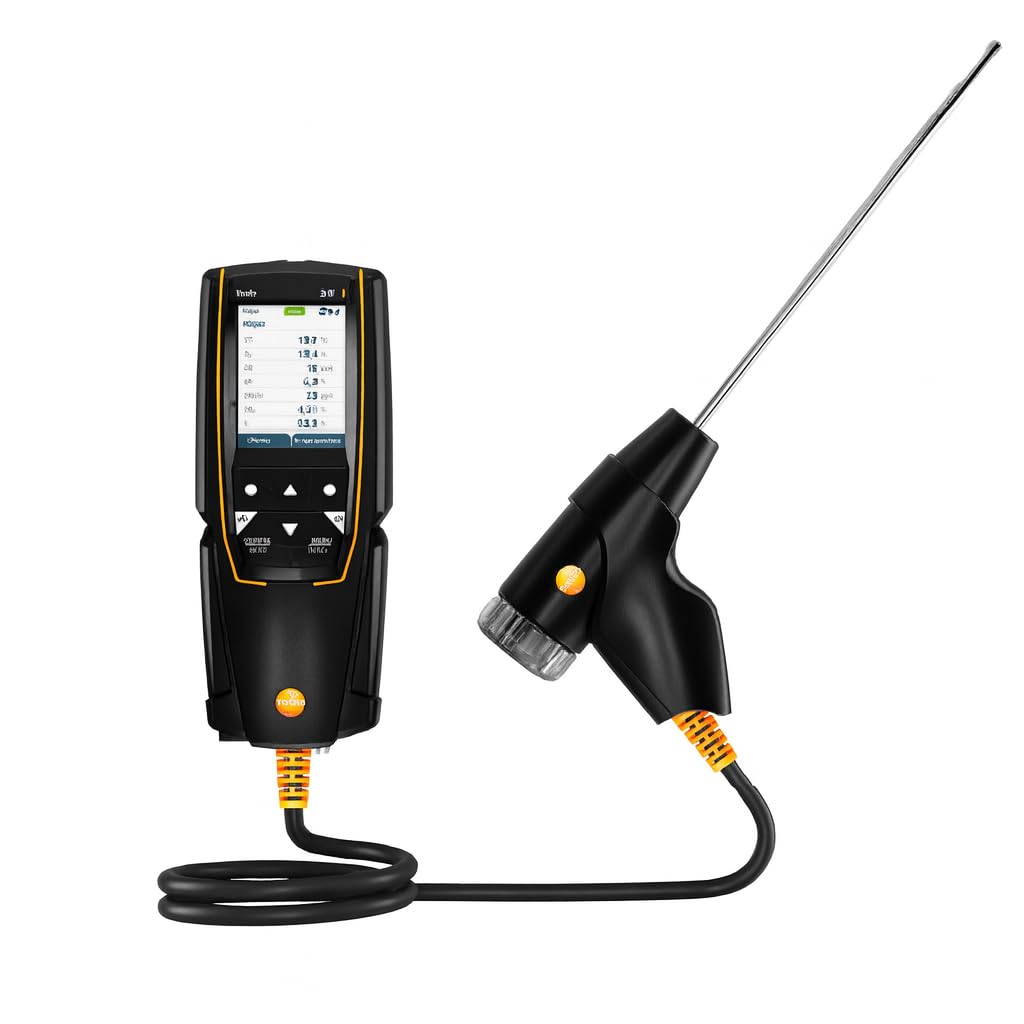
The testo 310 II is the benchmark for residential and light commercial combustion analysis, packing O2, CO with hydrogen compensation, draft pressure, and flue loss calculation into a rugged, app-connected package. The hydrogen-compensated CO sensor is a critical distinction — it prevents false high CO readings when hydrogen is present in natural gas flue products, which is a problem for cheaper analyzers that lack this compensation. The smart app integration lets you generate PDF reports on the spot, which is invaluable for providing proof of combustion efficiency to homeowners or inspectors.
Field performance is excellent: the backlit display is easy to read in dark basements, the integrated condensation trap protects the sensors, and the included probe with cone reaches deep into flue pipes. Users consistently report that it tunes furnaces and boilers to the ideal AFUE range quickly, and the magnetic backplate lets you mount it hands-free on the unit while making adjustments. The kit includes the rechargeable battery, a hard-shell case, spare particle filters, and a calibration protocol certificate.
On the downside, a small number of units have arrived with sensor calibration issues, and some users note that the temperature probe can be slow to stabilize when measuring delta-T across the system. If you want to print readings on-site, you need to buy the kit that includes a printer, as the base kit omits it. Overall, this is the most complete combustion analyzer for HVAC professionals doing furnace and boiler service day in and day out.
Why it’s great
- Hydrogen-compensated CO sensor prevents false high readings
- Smart app with PDF report generation for customer proof
- Measures O2, CO, draft, pressure, efficiency, and ambient CO
Good to know
- Printer sold separately from the base kit
- Some units have arrived with calibration errors
2. testo 310 I Residential Combustion Analyzer Kit

The testo 310 I is the slightly simpler sibling of the 310 II, designed specifically for residential heating system analysis without the app connectivity. It still measures O2, CO2, ambient CO, draft pressure, and combustion efficiency, and it includes the same robust housing with a kink-resistant hose and integrated condensation trap. The key difference is the lack of Bluetooth app integration and hydrogen compensation — for most residential work, this unit still delivers accurate, reliable readings that let you confirm a cracked heat exchanger or set combustion to the manufacturer’s spec.
The quick-start menu makes it easy to begin a flue gas test within seconds of turning it on, and the magnetic mount works well for hands-free operation on metal furnace panels. Users who service 80% AFUE furnaces regularly report dialing in efficiency between 83-86% with this meter, and the ability to measure static pressure alongside combustion parameters makes it a true all-in-one diagnostic tool for residential calls. The kit comes with a probe with cone, extra hoses, particulate filters, a pressure plug, and a hard-shell carrying case.
The main drawbacks are that it lacks the hydrogen-compensated CO sensor of the 310 II, so it may read slightly higher CO in flue gas with significant hydrogen content, and there is no printer option for generating on-site reports without purchasing a separate kit. For HVAC techs who primarily work on single-family homes and don’t need app-based reporting, this is a reliable workhorse that has proven its durability over years of field use.
Why it’s great
- Complete flue gas analysis for residential systems
- Rugged housing with integrated condensation trap and magnet
- Measures O2, CO2, ambient CO, draft, and static pressure
Good to know
- No hydrogen compensation for CO readings
- No Bluetooth app or printer included
3. Fieldpiece DRX3 Refrigerant & Combustible Gas Leak Detector
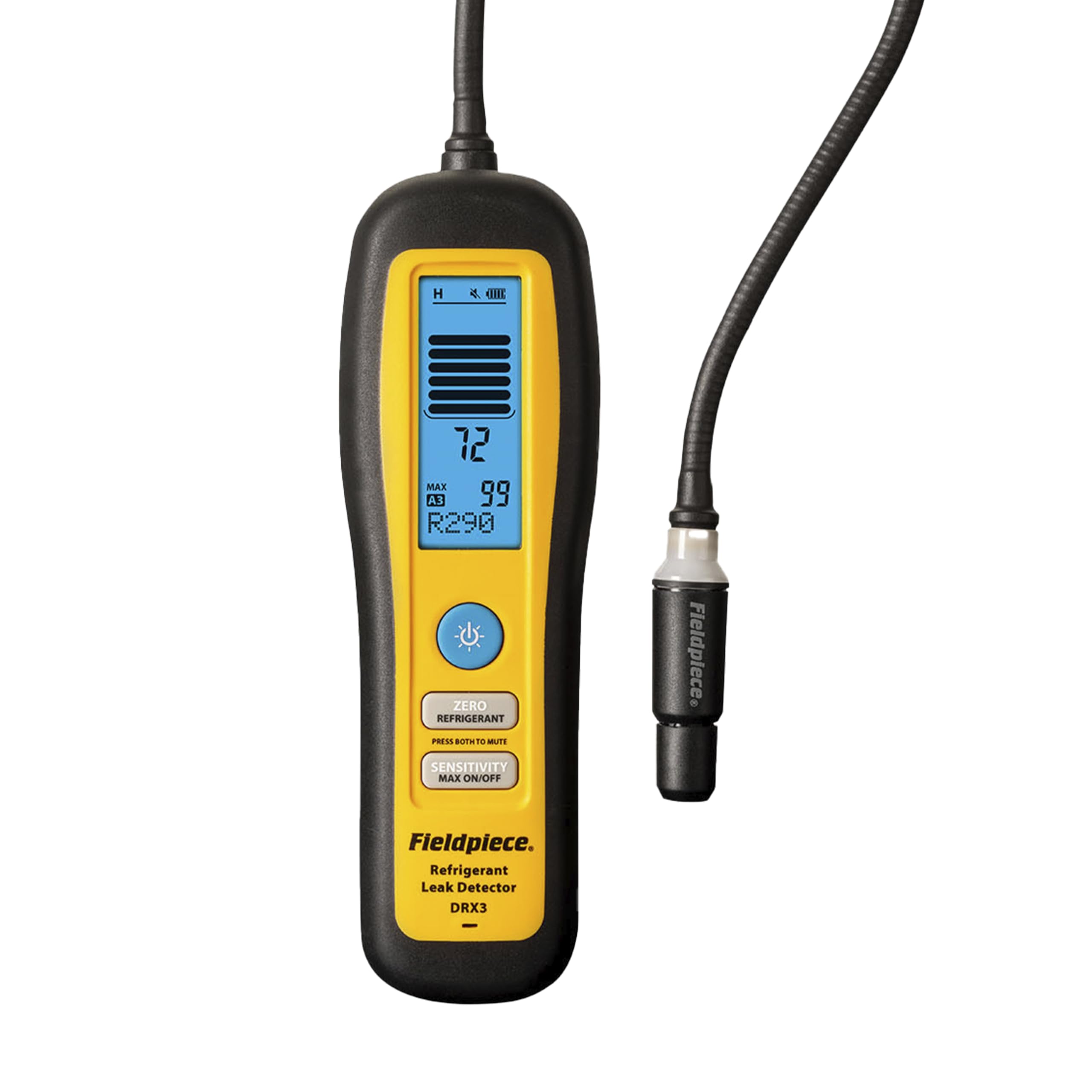
The Fieldpiece DRX3 is a specialty tool for HVAC technicians who need to detect both traditional CFC, HCFC, and HFC refrigerants as well as the newer A2L and A3 flammable refrigerants and combustible heating gases. Its heated diode sensor is field-replaceable and highly sensitive, with three sensitivity settings (high, medium, low) and both auto and manual zero modes to adjust for background contamination. The ability to detect A2L refrigerants like R-32 and R-454B makes this unit particularly relevant as the HVAC industry transitions away from higher-GWP refrigerants.
The DRX3 also connects to the Job Link System app for data sharing, though the primary user experience is the real-time audio and visual feedback that changes intensity as you approach a leak. The unit runs on four AA batteries, which are included, and it comes in a blow-molded case for transport. Users who work with multiple refrigerant types find it invaluable for its wide detection range and sensitivity, with many reporting it picks up leaks that other detectors missed entirely.
Critically, some users have experienced sensor failure within the first hour of use, and others report false triggering from background contaminants like cleaning solvents or even breath. The five-pound weight is also significantly heavier than dedicated refrigerant leak detectors. For technicians who need a single tool that covers both combustion gas leak detection and refrigerant leak pinpointing across A1, A2L, and A3 classifications, the DRX3 is a versatile option, but it’s not the best choice if you only work with standard refrigerants.
Why it’s great
- Detects A1, A2L, and A3 refrigerants plus combustible gases
- Field-replaceable heated diode sensor with three sensitivity levels
- Job Link System app connectivity for data sharing
Good to know
- Risk of sensor failure early in use for some units
- Prone to false triggering from background contaminants
4. Fieldpiece SOX3 Combustion Check

The Fieldpiece SOX3 is a focused tool: it measures oxygen percentage in the flue, then calculates CO2 percentage, excess air, and combustion efficiency based on the fuel type you select. It does not measure CO, draft, or pressure — making it a specialist for technicians who only need to confirm oxygen levels and efficiency on existing systems. The automatic electric pump with pause functionality draws a flue sample without hand pumping, and the pause feature saves battery life when you’re not actively sampling.
The standout feature is the field-replaceable oxygen sensor. The calibration data is stored on the sensor module itself, so you can swap a new sensor in seconds without sending the whole instrument back for recalibration. Users report that this capability alone makes the SOX3 more practical over time than analyzers that require factory service. The unit runs on a single 9V battery, and the included hard case keeps everything organized.
Field performance is praised for accuracy, with users stating it outperforms Bacharach meters in side-by-side comparisons. However, the lack of a CO sensor means you cannot verify burner safety — you only get the efficiency number. Several users also note the instructions are difficult to follow, and the unit does not come with a combustion efficiency chart, requiring you to source one separately. A small but significant number of units have failed shortly after the return window, and Fieldpiece customer support has been criticized for being unresponsive in those cases.
Why it’s great
- Field-replaceable oxygen sensor with onboard calibration data
- Automatic pump with pause feature to save battery
- Accurate O2 reading and combustion efficiency calculation
Good to know
- No CO sensor, so you cannot measure burner safety
- Units have failed after short use; limited support response
5. Forensics FD-600-4GAS Multi Gas Monitor

The Forensics FD-600-4GAS is a purpose-built four-gas monitor for confined space entry, measuring oxygen, carbon monoxide, hydrogen sulfide, and combustible LEL. Its built-in pump with a four-foot probe draws air from the bottom of a tank or pit before you enter, which is mandatory for OSHA-compliant pre-entry testing. The color display with graphing functions makes it easy to see real-time trends, and the data logging capability — storing up to 1,200 alarm records — is essential for documentation requirements.
The unit uses UK-manufactured electrochemical sensors with NIST traceable calibration performed in the USA, and it arrives with a calibration certificate and QA paperwork. The robust ABS housing with anti-slip rubber grip is waterproof, dustproof, and explosion-proof, which is necessary for the harsh environments where confined space monitoring happens. Users consistently praise the customer support, reporting that the company responds to technical questions on weekends and assists with calibration gas purchases.
One issue is that the H2S sensor may read only in full integer values rather than tenths as implied in some product descriptions, and one user noted the vendor swapped a sensor component and refunded the difference without clear communication. Additionally, the operating humidity limit of 85% RH NC max means it’s not ideal for extremely humid environments without careful management. For confined space entry and multi-gas spot checking, this unit delivers reliable performance with genuine after-sale support.
Why it’s great
- Built-in pump with 4-foot probe for pre-entry testing
- Color display with graphing and 1,200 alarm record logging
- Excellent customer support with quick, knowledgeable responses
Good to know
- H2S sensor may read only integer values
- Operating humidity limited to 85% RH NC max
6. BW Technologies MC2-XWHM-Y-NA GasAlertMicroClip XT

The BW Technologies GasAlertMicroClip XT is a compact, four-gas personal monitor that clips to your belt and provides continuous protection against oxygen deficiency, carbon monoxide, hydrogen sulfide, and combustible gas (LEL). It features audible, visual, and vibration alarms, making it suitable for high-noise environments where an audible alarm alone might be missed. The unit is designed for simplicity — there is a single-button operation for turning it on, checking readings, and performing calibration.
The MicroClip XT is lightweight and durable, with a glass-reinforced enclosure that withstands drops and rough handling common on construction and industrial sites. It comes with a calibration hose and clip for field calibration, and the battery is designed for long life between charges. Professionals who perform confined space entry or work in potentially hazardous atmospheres rely on this monitor for its proven reliability across thousands of field hours.
The biggest problem with current stock is that many units ship with oxygen sensors that are already over a year old from the manufacturing date, meaning they are out of calibration upon arrival and require immediate recalibration. Several users report receiving units that are defective out of the box — showing calibration errors or sensor failure within days of use — and BW customer service has been described as unresponsive, with no exchange or return options for damaged units. For a safety device costing nearly , this inconsistency is unacceptable and forces the buyer to immediately budget for sensor replacement or calibration service.
Why it’s great
- Compact personal monitor with audible, visual, and vibration alarms
- Single-button operation for simple calibration and use
- Proven reliability in industrial safety applications
Good to know
- Frequent reports of sensors already out of calibration at delivery
- Poor customer service response for defective units
7. Forensics FD-4S-PUMP 4 Gas Monitor

The Forensics FD-4S-PUMP is the more affordable option in Forensics’ four-gas lineup, offering the same core sensor suite (O2, CO, H2S, LEL) with a built-in pump and probe for confined space entry testing. Its ABS housing with anti-slip grip rubber is waterproof, dustproof, and explosion-proof, and it arrives pre-calibrated with a NIST traceable certificate. The unit is ready to operate out of the box, and the pump probe makes pre-entry testing in tanks and pits straightforward.
User reports indicate it works well for finding large emissions leaks and for general confined space air testing. One user who was an engine emissions control engineer found it accurate enough to locate a large natural gas leak from an industrial oven. The 1-year limited warranty and quality verification performed in the USA provide some peace of mind, and the company offers support via phone and email.
The critical limitation is that the O2 sensor in this unit only measures up to 30%, which means it cannot be used for applications like oxygen concentrator verification or for measuring oxygen in high-purity environments. The maximum CO range is also unknown but appears insufficient for high-CO flue gas testing (above 2,000 ppm). Additionally, one user received the wrong product variant and found the resolution to be limited to integer values rather than decimal places. This monitor is best suited for entry-level confined space safety checks where ultra-fine gas concentration readings are not required.
Why it’s great
- Built-in pump with probe for confined space pre-entry
- NIST traceable calibration and QA certificate included
- Rugged waterproof, dustproof, explosion-proof housing
Good to know
- O2 sensor limited to 30% max reading
- Readings may be limited to integer values only
8. Nuvair O2 Quickstick Oxygen Analyzer

The Nuvair O2 Quickstick is a dedicated oxygen analyzer built for a specific vertical — dive shops and divers who need to verify the oxygen fraction in nitrox and trimix breathing gas blends. Its marine-grade anodized aluminum body is corrosion-resistant in saltwater environments, and the water-resistant housing protects the electronics from the occasional splash. The user-replaceable battery and sensor mean you can keep the analyzer in service for years without sending it back to the factory, which is critical for a tool that lives in a dive bag between charters.
Calibration is straightforward: set the zero with pure nitrogen, then calibrate to 100% oxygen with clean O2. Users report that the response time is quick, and readings stabilize within seconds. The display is large and easy to read on a bouncing boat, and there is no auto-off feature, which is actually a deliberate design choice — you will not lose your reading while you fumble for a pen. Many dive professionals consider it the industry standard for onboard gas analysis, and it is commonly found on liveaboard dive boats.
The Quickstick is bulky, measuring 10 inches long and 2 inches wide, which makes it awkward to store in a standard gear bag. A few units have arrived defective, stuck at 21% and uncalibratable, with unhelpful manufacturer support during holiday periods. For divers who need a phone-linked alternative, the Dive Soft unit offers a screen-free approach, but the Quickstick remains the most trusted dedicated O2 analyzer in the diving community for its reliability and serviceable design.
Why it’s great
- Marine-grade aluminum body resists corrosion in saltwater
- User-replaceable sensor and battery for long service life
- Industry standard for dive boat nitrox analysis
Good to know
- Bulky form factor — 10 x 2 inches
- No auto-off — must remember to shut it down manually
9. INFICON D-TEK Stratus Refrigerant Leak Detector

The INFICON D-TEK Stratus is the flagship refrigerant leak detector, using a redesigned infrared sensor that delivers a sensitivity of 0.03 ounces per year and maintains that sensitivity over the longest sensor life in the industry. It detects all CFCs, HCFCs, HFCs, HFOs, and CO2 (with a separate CO2 sensor), and it offers two distinct modes: Cloud Hunter for locating the general area of a leak and Pinpoint for zeroing in on the exact source. Having two detectors in one tool reduces the cost and toolbag weight for commercial HVAC and refrigeration technicians.
The lithium-ion battery provides up to 9 hours of runtime and is USB rechargeable, eliminating the need to carry spare batteries. The completely field-replaceable sensor, battery, filter, and probe mean the Stratus can be kept in service for years without factory involvement. Users report it sniffing out leaks on evaporator coils, condensers, and large chilled water rooms that other detectors missed completely, often without requiring disassembly. The extra-long probe and earbuds are included, helping you hear changes in beep frequency in noisy mechanical rooms.
There have been quality control concerns: some units shipped with defective audio jacks that make the beep volume too low to hear in loud environments, and the buttons require firm pressure to activate. A small number of units failed to detect known refrigerant leaks, which for a tool in this premium tier is a critical failure. Additionally, the price point puts it in professional-only territory. For technicians who perform leak detection as a primary service and need the most sensitive, long-lasting infrared sensor available, the Stratus is the tool to beat — but check the audio and sensor function immediately upon receipt.
Why it’s great
- Infrared sensor with 0.03 oz/yr sensitivity and longest sensor life
- Cloud Hunter and Pinpoint modes = two detectors in one
- Fully field-replaceable battery, sensor, filter, and probe
Good to know
- Some units have low beep volume due to defective audio jack
- Premium price that only makes sense for daily professional use
FAQ
What is the difference between a combustion analyzer and a four-gas monitor?
How often does a combustion analyzer need to be recalibrated?
Can I use a combustion analyzer to measure ambient CO in a home?
Final Thoughts: The Verdict
For most users, the best combustion analyzer winner is the testo 310 II because it combines a hydrogen-compensated CO sensor, draft measurement, efficiency calculation, and app-based reporting in a single rugged package that covers both residential and light commercial work. If you want a simpler, budget-friendly alternative for pure O2 and efficiency measurement without CO or draft, grab the Fieldpiece SOX3. And for confined space entry testing where you need O2, CO, H2S, and LEL readings with a pump probe, nothing beats the Forensics FD-600-4GAS.

Mo Maruf
I created WellFizz to bridge the gap between vague wellness advice and actionable solutions. My mission is simple: to decode the research and give you practical tools you can actually use.
Beyond the data, I am a passionate traveler. I believe that stepping away from the screen to explore new environments is essential for mental clarity and physical vitality.