Our readers keep the lights on and my smoothie glass nicely filled. As an Amazon Associate, I earn from qualifying purchases.
Specs are compiled from manufacturer listings and verified buyer reviews and can change over time — please confirm the key details on the product page before buying.
The difference between a frustrating, wobbly square and one that locks tight and stays true for decades often depends on the head construction and the blade material. This guide sorts through the real specs — from hardened steel blades to magnetic locks and built-in scribes — so you pick a square that actually improves your joinery, scribing, and measuring precision, not one that needs constant recalibration.
I’m Mohammad Maruf — the founder and writer behind WellFizz. This guide is built by comparing the manufacturers’ published specifications and the patterns across verified customer reviews, so you get each pick’s real strengths and trade-offs instead of marketing spin.
Each square here was chosen for a specific real workshop need, from a hardened steel blade that resists wear to an integrated spirit level (a bubble vial that shows if a surface is level or plumb) and a magnetic lock head. Read on to find the right combination square for woodworking for your daily layout tasks.
Our Picks at a Glance

How To Choose The Best Combination Square For Woodworking
The combination square you pick determines whether your layout lines are dead-nuts parallel or just close enough to waste wood. Focus on the blade material, the head construction, the locking mechanism, and the built-in extras before you decide.
Blade Material and Markings
The blade takes the most abuse — it slides along boards, gets knocked against tools, and carries the numbers you trust. A hardened steel blade resists bending and keeps its edge longer than standard stainless. The graduation range (the finest measurement printed on the ruler) matters too: a ruler marked in 8ths, 16ths, 32nds, and 64ths lets you work in finer increments without guessing. Some blades also carry metric markings alongside imperial for projects that require both.
Head Construction and Locking
The head is where a square earns its accuracy or loses it. A cast iron head offers weight and stability when you slide it along a board. Finely milled sides on the head mean the tool registers a true 90-degree and 45-degree angle every time. The locking mechanism — whether a traditional reversible lock bolt or a magnetic lock — determines how easily you reset the blade. A magnetic lock lets you push the blade through the head’s magnetic field without turning a bolt, which speeds up repeated transfers.
Built-In Layout Features
Many squares now integrate a bubble vial for checking level and plumb (vertical alignment), a scribe for marking lines without a separate pencil, and a belt holster for quick access. An integrated scribing tool saves you fumbling for a marking knife, while a belt holster keeps the square within reach on a job site. Decide if you want these extras built in, or if you prefer a simple head-and-blade setup and carry separate tools.
Quick Comparison
| Model | Best For | Blade Material | Graduation Range | Lock Mechanism | Amazon |
|---|---|---|---|---|---|
| Starrett C11H-12-4R★ Best Overall | Precision joinery with fine increments | Hardened Steel | 1/64 Inches | Reversible Lock Bolt | Amazon |
| TRACER ACSQ300 | Speed and versatility with built-in level | — | — | Adjustable square | Amazon |
| Kapro 325M | Frequent transfers with magnetic lock | Stainless Steel | — | Magnetic Lock | Amazon |
In‑Depth Reviews
1. Starrett Steel Combination Square C11H-12-4R
Our pick — over 4.5★ from 550+ verified ratings; the strongest balance of quality and price.
The workshop heirloom that survives harsh conditions and keeps its accuracy for a lifetime.
The hardened steel blade on the Starrett C11H-12-4R resists bending and wear, so your layout lines stay accurate even after rough daily use. The maker states the blade is able to withstand even the harshest environments and is designed to last a lifetime. The 4R graduation type marks the 12-inch ruler in 8ths, 16ths, quick reading 32nds, and 64ths — that lets you mark precise joinery cuts down to 1/64 of an inch. At 1.2 pounds and with dimensions of 12.7 inches long by 6.65 inches wide, the Starrett has a noticeably more substantial physical presence than the Kapro’s 9.02-inch by 0.98-inch dimensions, giving it a grounded, stable feel on the workpiece.
The cast iron head is reversible and serves multiple layout functions — the maker notes it can scribe right angles and parallel lines, measure, tri-square (checking a 45-degree angle), miter, gauge depth and height, and level. A reversible lock bolt secures the blade, and a scriber is built into the head. Reviewers give it a 4.8 out of 5 stars from 579 ratings, praising its consistent accuracy. The catch is the premium build comes at a higher entry point, so this is a tool that suits someone who does precise joinery daily and wants a single square that covers nearly every layout task.
Accuracy Benchmarks
- Hardened steel blade for wear resistance under rough usage and high-impact pressure
- Graduates down to 1/64-inch for fine measurements
- Cast iron head with reversible lock bolt for stability in scribing and mitering
Trade-Offs to Consider
- Heavier build than other options, less suited for a quick belt-carry on a job site
- No magnetic lock — requires turning a bolt to adjust the blade
Ideal for precision-oriented woodworkers: If your daily work involves fine joinery, repeated scribing of parallel lines, and you want a square that the maker states is designed to last a lifetime, the Starrett is the one to reach for.
Not your best fit if: You need a lighter, faster-to-adjust square for quick repeated transfers on a construction site.
2. TRACER 12 Inch Combination Square ACSQ300
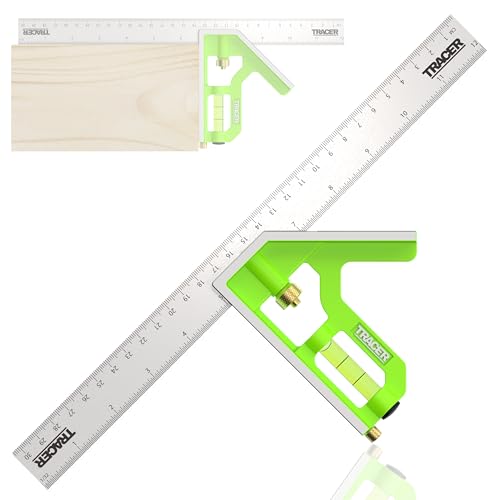
The all-in-one square that packs a spirit level and a scribe into one hand.
The TRACER ACSQ300 combines several layout tools in one body, which is handy if you work across carpentry and metalworking tasks and want fewer separate tools. The 12-inch ruler carries both imperial and metric scales on a stainless steel ruler, so switching measurement systems is straightforward. A built-in spirit level is integrated into the zinc cast head — the maker states the square with level design makes layout work faster and more reliable for horizontal and vertical alignment. An integrated scribing tool is also built into the square, which the maker notes eliminates the need for a separate marking instrument. The adjustable square mechanism allows for quick positioning.
Buyers rate it 4.6 out of 5 stars from 88 ratings. The key difference from the Kapro below is the locking mechanism — TRACER uses an adjustable square lock rather than a magnetic field. With dimensions of 12.2 inches long by 5.51 inches wide, it is long enough for typical cabinet-work but feels lighter in head mass than the Starrett. One reviewer noted the built-in scribe is handy for marking cut lines without reaching for a pencil. This combination square best suits a carpenter or woodworker who wants an integrated scribe and level in one tool and needs to switch between metric and imperial scales. You would want to skip it if you primarily need a heavy-duty square for repeated high-impact job site use and prefer a hardened steel blade over an aluminum ruler.
Built-In Convenience
- Dual scale (imperial and metric) on a durable stainless steel ruler
- Integrated spirit level for horizontal and vertical checks
- Built-in scribe tool for one-handed layout marking
Trade-Offs to Consider
- No hardened steel blade — the material type listed is aluminum, not hardened steel
- Adjustable lock mechanism is not as fast as a magnetic lock for repeated transfers
Who gets the most out of it: A carpenter or woodworker who wants an integrated scribe and level in one tool and needs to switch between metric and imperial scales.
Who should look past it: Anyone who primarily needs a heavy-duty square for repeated high-impact job site use and prefers a hardened steel blade over an aluminum ruler.
3. Kapro 325M Magnetic Lock Combination Square

The magnetic head that lets you slide and lock without twisting a bolt.
Strong magnets in the head of the Kapro 325M hold the stainless steel ruler in place, so the maker explains you simply push and pull the rule through the square head’s magnetic field — no lock bolt to turn. The stainless steel ruler is permanently etched in inches and centimeters, and the head provides 5 finely milled sides for accuracy. At 1.06 pounds and dimensions of 9.02 inches long by 0.98 inches wide, it is a lighter form factor than the Starrett’s 1.2 pounds and 12.7-inch length, making it easier to carry on a belt with the included holster.
The square comes with a belt holster and an easy-grip magnet-held stainless steel scribe. The maker positions it for carpentry, drywall, and construction projects. Buyers give it a 4.4 out of 5 stars from 371 ratings. One reviewer notes the magnetic lock makes transferring a measurement from a board to a blade, or from board to board, noticeably faster because you do not fiddle with a lock bolt — this is its main advantage over the Starrett’s traditional lock bolt. The trade-off is that the magnetic lock can make fine micro-adjustments slightly trickier compared to a traditional lock bolt, and the overall weight is lighter than the Starrett, which some users prefer for speed over stability. If you are moving between boards, framing walls, or doing drywall and want to transfer measurements repeatedly without turning a bolt, the Kapro’s magnetic lock and belt holster are the right call. You would choose the Starrett instead if you need the heft of a hardened steel blade and cast iron head for precision joinery, or if you prefer the tactile control of a lock bolt for small adjustments.
Speed Features
- Magnetic lock — push the blade through the head’s magnetic field for quick adjustments
- 5 finely milled sides for accuracy in multiple orientations
- Includes belt holster and stainless steel scribe for on-the-go layout
Trade-Offs to Consider
- Blade is stainless steel, not hardened steel, so it is less resistant to high-impact wear
- Magnetic field lock can make tiny precision adjustments less intuitive than a reversible lock bolt
Best for the active job site: If you are moving between boards, framing walls, or doing drywall and want to transfer measurements repeatedly without turning a bolt, the Kapro’s magnetic lock and belt holster are the right call.
pass on it if: You need the heft of a hardened steel blade and cast iron head for precision joinery, or if you prefer the tactile control of a lock bolt for small adjustments.
Understanding the Specs
Hardened Steel vs Standard Stainless Steel
A blade made of hardened steel is treated to resist bending, denting, and wear from rough usage and high-impact pressure. Standard stainless steel is corrosion-resistant but not as tough under repeated hard use. The Starrett uses hardened steel; the Kapro uses stainless steel. If your square sees heavy daily work on a job site, hardened steel holds its calibration longer.
Lock Mechanism: Lock Bolt vs Magnetic Lock
A reversible lock bolt uses a threaded lever that clamps the blade firmly in place, which gives you fine control over exact positioning before you tighten. A magnetic lock uses magnets inside the head to hold the stainless steel blade; you push or pull the blade through the magnetic field without turning a bolt. The magnetic lock is faster for repeated transfers but can be less precise for tiny adjustments when you need to set a specific increment.
FAQ
Is a hardened steel blade always better than stainless steel for a combination square?
Will a magnetic lock square work with all blade materials?
What does “4R graduation type” mean on a Starrett square?
How many finely milled sides does a square head need for accuracy?
Can a combination square replace a separate level?
What is the difference between a reversible lock bolt and a magnetic lock?
Is a heavier combination square more accurate?
Can I use a combination square for both woodworking and metalworking?
Final Thoughts: The Verdict
For most woodworkers, the combination square for woodworking that balances accuracy and durability is the Starrett C11H-12-4R because its hardened steel blade and cast iron head are built for a lifetime of precise joinery. If you want a magnetic lock for faster repeated transfers on a job site, grab the Kapro 325M. And for a value-focused square that packs a built-in level and scribe in one tool, the TRACER ACSQ300 is a solid pick for everyday layout across both wood and metal.
How We Picked
We do not accept paid placement. Every pick is matched to a real buyer and a real use-case; we do not hands-on test units.
Sources & Methodology
Specifications: manufacturer listings and product documentation. Review insights: verified customer reviews, as of July 2026. Pricing: not shown on this page (it changes often); check the current price via the retailer link.
As an Amazon Associate, WellFizz earns from qualifying purchases. This does not affect which products we feature.
Related Guides

Mo Maruf
I created WellFizz to bridge the gap between vague wellness advice and actionable solutions. My mission is simple: to decode the research and give you practical tools you can actually use.
Beyond the data, I am a passionate traveler. I believe that stepping away from the screen to explore new environments is essential for mental clarity and physical vitality.