Our readers keep the lights on and my smoothie glass nicely filled. As an Amazon Associate, I earn from qualifying purchases.
Specs are compiled from manufacturer listings and verified buyer reviews and can change over time — please confirm the key details on the product page before buying.
Your counter space is precious, and a combination microwave toaster oven packs a microwave, a full convection oven, and an air fryer into one machine. The real question is whether a single appliance can do all three jobs without cutting corners, or if you get a machine that is mediocre at everything. After looking at each model’s published specs and patterns in verified buyer reviews, the short answer is: yes — but only the right ones.
I’m Mohammad Maruf — the founder and writer behind WellFizz. This guide is built by comparing the manufacturers’ published specifications and the patterns across verified customer reviews, so you get each pick’s real strengths and trade-offs instead of marketing spin.
Here is what matters: the cooking wattage, the interior capacity, and whether the microwave uses inverter technology — a system that delivers steady power instead of pulsing heat on and off. These three specs separate a useful combo from a frustrating one.
Quick Picks
- Breville Combi Wave 3-in-1 Microwave, Air Fryer and Convection Oven — Top Performer
- Panasonic HomeChef 4-in-1 Countertop Microwave Air Fryer Combo — Best Overall
- TOSHIBA OptiChef PRO MAX Air Fryer Combo Microwave Oven — Generous Capacity
- TOSHIBA 6-in-1 Inverter Countertop Microwave Oven Healthy Air Fryer Combo — Quiet Power
- Midea 4-in-1 Inverter Microwave Oven, 0.9 Cu Ft — Unique Steamer
- FRIGIDAIRE 1.2 cu ft Microwave, Digital Air Fryer, Convection Oven, Combo-Fry — Budget Champion
- BLACK+DECKER 5-in-1 Microwave Oven with Air Fry, Combi, Bake, Roast — Compact Starter
How To Choose The Best Combination Microwave Toaster Oven
Before you click “buy”, the three specs that really separate a useful combo machine from a frustrating one are the actual cooking wattage, the internal capacity, and whether it uses inverter technology for the microwave function. Skip these and you might end up with an underpowered oven that takes forever to preheat or a microwave that scorches the edges of your leftovers.
Microwave Wattage and Inverter vs Standard Power
Microwave power, measured in watts, determines how fast your food heats. Most combo ovens sit between 900W and 1100W for the microwave mode. A standard microwave pulses power on and off to reduce heat — inverter technology instead delivers a steady stream of low-level power, which means you can defrost a piece of salmon without cooking the edges. For a combo machine that also bakes and air fries, an inverter microwave is a strong upgrade because it treats delicate foods better.
Convection Oven and Air Fryer Performance
These two functions rely on a heating element and a fan that circulates hot air inside the cavity. The key numbers here are the convection wattage (typically 1400W to 1800W) and the maximum temperature (look for 425°F to 450°F). A higher convection wattage means the oven preheats faster and recovers heat quickly when you open the door. The air fryer function is essentially the same convection fan running at high speed — models with a top-mounted heating element (like the ChefFry Plus on the premium Toshiba) tend to crisp food more evenly than rear-fan designs.
Capacity and Physical Footprint
Capacity is measured in cubic feet (or liters) — typical combos range from 0.9 cu ft to 1.3 cu ft. A larger cavity lets you fit a 13-inch pizza or a whole chicken, but the outer dimensions also grow. Check the depth, width, and height of your counter space before buying. Some models with a turntable (like the Panasonic at 14.2 inches) need extra clearance, while others with a flat-floor design offer more usable interior space without a spinning plate.
Interface and Smart Features
The control panel is where you interact with all those cooking modes every day. Touchscreen models (Midea, Toshiba OptiChef) feel modern but can be slower to navigate, while dial-and-button combos (Breville, Panasonic) usually offer faster manual adjustments. Some units sync with smartphone apps for guided recipes — the Panasonic Kitchen+ app integration is the most polished here, letting you send cooking instructions from your phone. Child-lock settings and mute buttons for end-of-cycle beeps are small details that matter in daily use.
Quick Comparison
On smaller screens, swipe sideways to see the full table.
| Model | Best For | Microwave Power | Capacity | Convection Power | Amazon |
|---|---|---|---|---|---|
| Breville Combi Wave 3-in-1 | Premium all-round performance | Inverter — 1200W | 1.1 cu ft | 1400W | Amazon |
| Panasonic HomeChef 4-in-1 | App-smart guided cooking | Inverter — 1000W | 1.2 cu ft | — | Amazon |
| TOSHIBA OptiChef PRO MAX | Large capacity + color screen | Inverter — 1100W | 1.3 cu ft | — | Amazon |
| TOSHIBA 6-in-1 Inverter | Quiet inverter versatility | Inverter — 1000W | 0.95 cu ft | 1800W | Amazon |
| Midea 4-in-1 | Steam cooking + touchscreen | Inverter — 900W | 0.9 cu ft | — | Amazon |
| FRIGIDAIRE 1.2 cu ft Combo-Fry | Budget-friendly 5-in-1 | Standard — 900W | 1.2 cu ft | 1500W | Amazon |
| BLACK+DECKER 5-in-1 | Compact entry-level value | Standard — 900W | 0.9 cu ft | — | Amazon |
In‑Depth Reviews
1. Breville Combi Wave 3-in-1 Microwave, Air Fryer and Convection Oven

The combo appliance that actually nails each cooking mode without compromise.
The Breville Combi Wave 3-in-1 combines an inverter microwave, a convection oven, and an air fryer — and what separates it from models like the Frigidaire below is Breville’s Element IQ system. This is a set of smart algorithms that steer power where and when it is needed inside the cavity. The microwave runs at 1200W with a Power Smoothing inverter (a technology that automatically adjusts intensity so you do not blast delicate foods with full heat). Convection runs at 1400W input, and a separate grill element adds 1100W for browning.
The Fast Combi function pairs convection, grilling, and microwave energy together to cook dishes faster than a standard oven. Buyers consistently praise the controls — one reviewer called them “the best controls of any microwave ever,” specifically the time dial and the “a bit more” button that adds percentage-based time. The soft-close door is 80% quieter than a standard microwave door, and the overall operation is 50% quieter, which matters in an open-plan kitchen.
The catch is price: this is a premium investment. A few buyers report the soft-close mechanism can fail over time, especially with heavy air-fry use. The 1.1 cu ft capacity is enough for a single person or couple, but a family that regularly cooks large roasts will find the cavity tight.
Why it earns the top spot
- Element IQ steering delivers even, tailored heat across all cooking modes
- Quiet soft-close door and 50% quieter operation than typical microwaves
- Inverter technology provides smooth, adjustable power for defrosting and reheating without hot edges
- “A bit more” button and intuitive jog dial make manual control fast
The trade-offs
- Premium price — the most expensive pick on this list
- Some owners mention the soft-close door mechanism failing over time
- 1.1 cu ft capacity limits large roasting pans or multiple dishes
Best suited for: The cook who values precision, quiet operation, and wants one appliance that genuinely replaces three separate machines without skimping on any function.
Reconsider if: You regularly cook for 4+ people and need a bigger cavity — the 1.1 cu ft will feel cramped for large casseroles or whole chickens.
2. Panasonic HomeChef 4-in-1 Countertop Microwave Air Fryer Combo
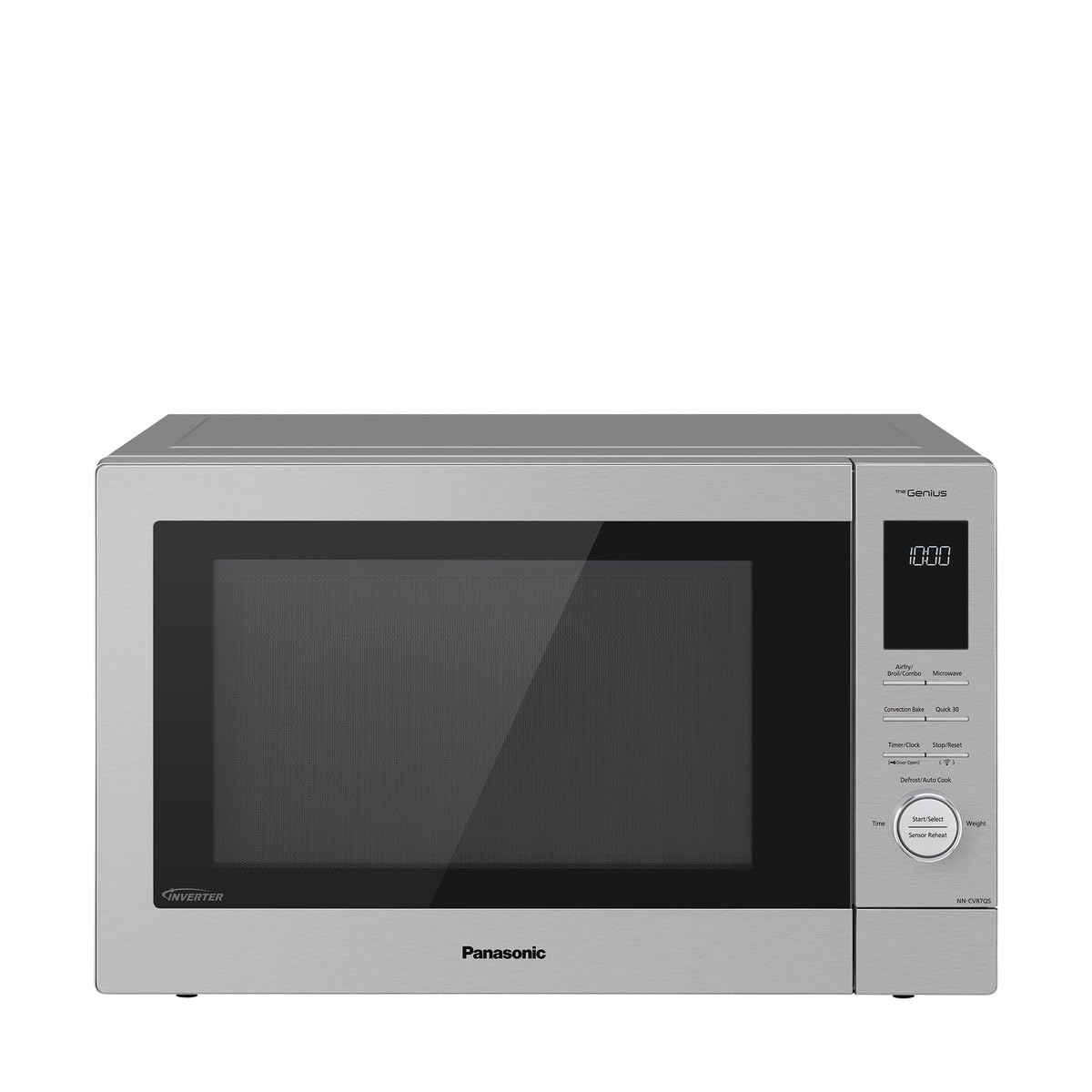
A smart four-in-one that brings app-powered recipes to your countertop.
The Panasonic HomeChef pairs a 1000W inverter microwave with air fryer, broiler, and convection oven modes in a single 1.2 cu ft package. Its standout feature is the Panasonic Kitchen+ app integration: you pick a recipe on your phone, pair it with the oven, and the unit automatically sets the correct combination of microwave, convection, and air fry cycles. The overall footprint is 22 inches wide by 17.7 inches deep, which is surprisingly compact for a machine that can fit a 13-inch tray.
Reviewers report the inverter technology delivers “even heating” and makes delicate tasks like defrosting fish work well without hot spots. The air fryer produces crispy food — buyers mention fries, nuggets, and wings come out evenly browned. One owner noted the air fryer offers only three temperature choices (400°F to 425°F), which limits flexibility for recipes that call for a lower air-fry temp. Compared to the Breville above, the Panasonic is less powerful on the microwave side (1000W vs 1200W) but offers a larger 1.2 cu ft interior and the app-guided cooking that takes the complexity out of combo modes.
Strengths that stand out
- Kitchen+ app integration sends perfect cooking cycles to the oven hands-free
- Inverter tech ensures even reheating and defrosting without overcooking edges
- Spacious 1.2 cu ft cavity fits a full-size tray while keeping a modest counter footprint
- Air fryer and convection produce genuinely crispy, evenly browned food
Where it falls short
- Air fryer offers only three temperature settings — less flexible than competitors
- Touchscreen interface has a learning curve; some buyers find it non-intuitive
- Child lock default setting can be annoying after a power reset
Ideal for: Tech-friendly cooks who want app-guided combos and a larger interior without giving up counter space. The inverter microwave alone justifies this pick for anyone who defrosts or reheats delicate foods daily.
Not for: Anyone who needs full manual temperature control on the air fryer — the three-temperature limitation is a real constraint for recipe experimentation.
3. TOSHIBA OptiChef PRO MAX Air Fryer Combo Microwave Oven

The biggest cavity in this lineup, paired with a vivid color touchscreen.
With 1.3 cubic feet of interior space, this Toshiba OptiChef PRO MAX holds a full 13-inch pizza or a whole chicken comfortably — compared with the 0.9 cu ft BLACK+DECKER in this list. It delivers 1100W of microwave output through Toshiba’s Origin Inverter technology (which provides steady, even power rather than pulsing heat). The 2.4-inch color screen is the control hub, and it feels more responsive than most touchscreen combos, making the ChefFry Plus air fry function easy to start with a couple of taps.
The unit includes an intuitive humidity sensor (a sensor that detects moisture in the food) that adjusts cooking time based on moisture levels, which helps prevent dried-out reheats. It is also compatible with Alexa for voice control. However, some customers note the microwave output feels weaker than the rated 1100W — one reviewer noted “same times leave food undercooked,” suggesting you may need to add 20-30 seconds to standard microwave cycles. At 21.8 inches wide and 19.4 inches deep, this is a large appliance; measure your counter carefully. Compared to the Frigidaire below, the Toshiba OptiChef measures 21.8 inches wide and 19.4 inches deep, and adds the inverter benefits, smart sensor, and Alexa compatibility that the Frigidaire lacks.
What makes it worth considering
- Largest capacity in the group at 1.3 cu ft — fits a whole chicken or 13-inch pizza
- Origin Inverter provides even, continuous microwave power for delicate foods
- Humidity sensor prevents overcooking by adjusting time based on moisture
- Ceramic enamel interior resists stains and is easy to clean
Watch out for
- Some owners feel the 1100W microwave output is weaker than expected, leaving food undercooked at standard times
- Large footprint — at 21.8 inches wide it demands significant counter space
- Initial Wi-Fi and Alexa setup can be finicky according to buyer feedback
Grab this if: You need the biggest possible cavity for whole chickens and large pizzas, and you want a bright color touchscreen that makes navigating cooking modes genuinely pleasant.
Look elsewhere if: Your counter space is at a premium — this is a wide machine — or if you expect the full 1100W to feel as punchy as a standard countertop microwave of the same rating.
4. TOSHIBA 6-in-1 Inverter Countertop Microwave Oven Healthy Air Fryer Combo

Inverter precision at a mid-range price point with exceptionally quiet operation.
This Toshiba Master Series unit brings six cooking modes (microwave, air fryer, convection oven, broiler, defroster, and Speedy-Combi) with convection power at 1800W up to 425°F — significantly more convection wattage than most competitors. The 1000W grill element and inverter microwave work together in Speedy-Combi mode to produce dishes with crispy browned outsides and tender interiors in less time than standard cooking. Buyers consistently call it “extremely quiet” at a claimed 50dB working noise level (decibels, a measure of sound), a genuine benefit if your kitchen is open to the living room.
The 26.93-quart capacity is smaller than the Frigidaire’s 1.2 cu ft below, but the inverter technology is the differentiator here — it distributes heat evenly for better defrosting and reheating. Among the 27 preset menus are 11 auto menus, 10 air fry presets, and 6 defrost presets. The trade-off: a few owners reported the convection oven stopped working after the first year, with the temperature not exceeding 100°F, and the dial for setting time occasionally resets itself. Compared to the similarly-priced Frigidaire, this Toshiba uses 1800W convection energy versus the Frigidaire’s 1500W and includes inverter technology that the standard-pulse Frigidaire lacks.
Reasons to pick it
- Inverter technology delivers even heat distribution and gentle defrosting
- Extremely quiet at 50dB — buyers consistently mention this as a standout feature
- Speedy-Combi mode pairs microwave, convection, and grill for faster cooking with crispy results
- 27 preset menus make one-touch cooking easy for beginners
Heads-up
- Some reviewers point out the convection function failing within a year, which raises reliability questions
- 0.95 cu ft is smaller than average — tight for a full-size casserole dish
- Dial for setting cooking time can reset itself mid-use according to buyer feedback
Choose this for: The quietest kitchen companion in this category, especially if you often reheat or defrost delicate foods and want inverter precision. The 27 presets make it beginner-friendly.
skip it if: Long-term reliability is your top concern — the post-warranty failure reports are note — or you need the largest cavity for family-sized dishes.
5. Midea 4-in-1 Inverter Microwave Oven, 0.9 Cu Ft

The only combo here that adds a dedicated steam cooking function alongside air fry and convection.
Midea’s 4-in-1 pairs a 900W inverter microwave with a true steam mode that uses Dual Steam Tubes to reach high temperatures in just 30 seconds, so you can steam vegetables, fish, or even sterilize baby bottles without a separate steamer basket. The color touchscreen and SmartHome App control make this feel modern, and the 32 auto menus cover a broad range of dishes. The True 3D Graphene Air Fryer technology is designed to heat up instantly for crisp exteriors with little to no oil.
The cavity is compact at 0.9 cubic feet (23L), fitting a 10-inch pizza. Buyers warn the air fryer function does not always deliver crisp results — one buyer mentioned the “air fryer not crisp” and the defrost cycle tends to cook food instead of just defrosting it. The steam function is genuinely useful, with a few owners mentioning they bought it specifically for sourdough fermentation and RV use on an inverter. The 1600W energy consumption is higher than the 1000W Frigidaire, reflecting the heating elements required for steam and air fry modes. Compared to the Panasonic, the Midea trades about 100W of microwave power (900W vs 1000W) and loses the app recipe integration, but adds the steam function that no other unit here offers.
Unique advantages
- Dedicated steam cooking mode — not found on any other combo in this guide
- Color touchscreen and SmartHome App for remote or scheduled cooking
- Inverter technology provides steady power for even heating
- 32 auto menus cover a wide range of dishes
Known drawbacks
- Air fryer and defrost performance is inconsistent — some shoppers say food cooks rather than defrosts
- Small 0.9 cu ft capacity limits pizza size to 10 inches
- Steam function can cause condensation build-up inside the unit, requiring frequent wiping
Ideal for: Anyone who wants steam cooking (vegetables, fish, baby bottles) built right into their combo appliance and does not need a large interior. The steam mode is genuinely unique and useful daily.
Not ideal for: Air fryer enthusiasts who expect restaurant-level crisp — the graphene air fryer has mixed reviews on crispness — or households that cook for more than two people regularly.
6. FRIGIDAIRE 1.2 cu ft Microwave, Digital Air Fryer, Convection Oven, Combo-Fry
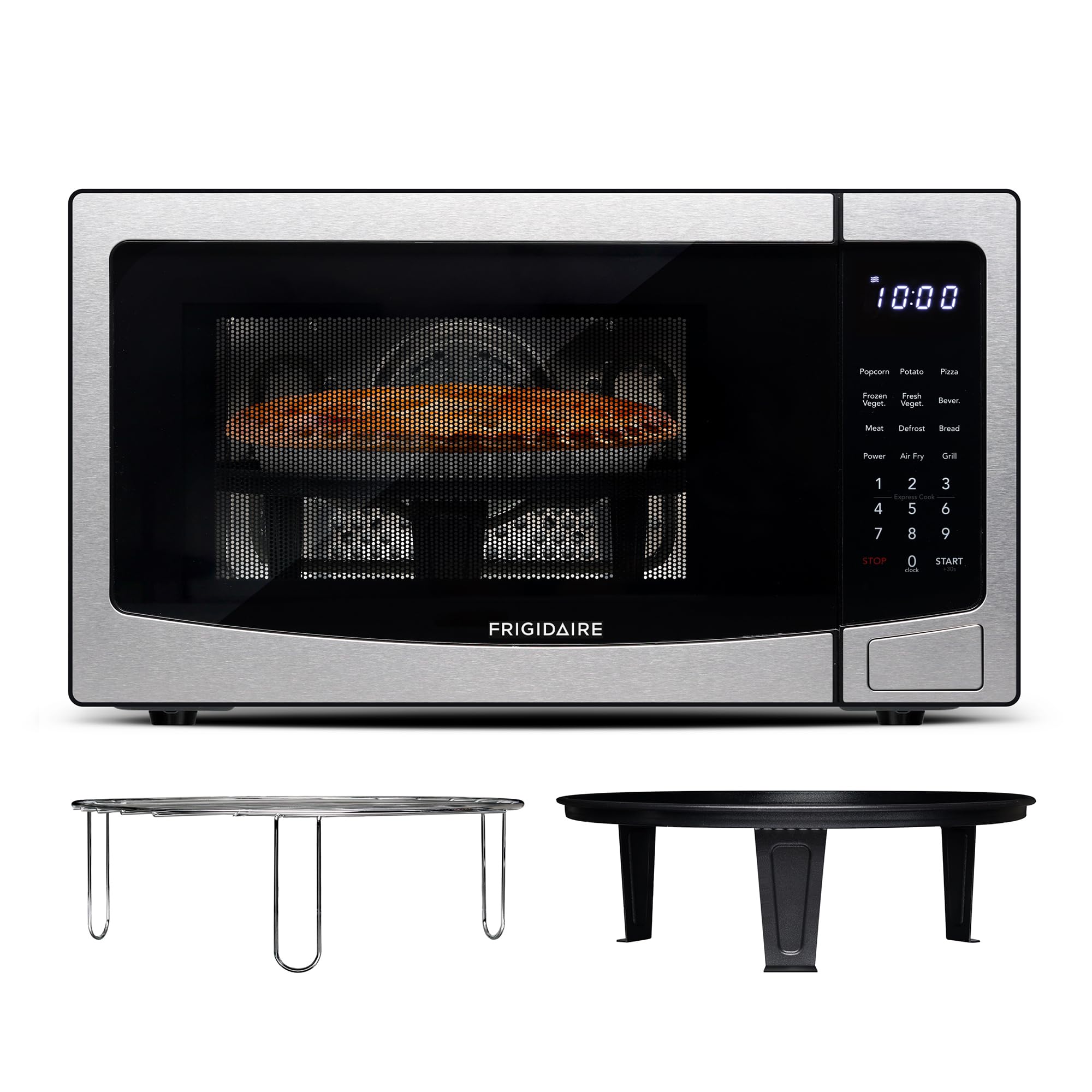
A 5-in-1 with a big 1.2 cu ft cavity at the most accessible price in this guide.
Frigidaire packs bake, roast, microwave, convection oven, and air fry functions into a 1.2 cu ft stainless steel body that is surprisingly spacious for a budget-tier combo. The microwave runs at 900W, the oven mode at 1000W, and convection at 1500W — so the convection power is noticeably stronger than the 900W microwave mode. It includes five one-touch cooking menus (potato, popcorn, beverage, reheat, frozen dinner) plus defrost by time or weight, so the basics are covered. The air fryer basket and bake plate are included in the box.
Buyers are mixed: several owners love the value and say it “works great” as a microwave and air fryer, while others report reliability issues — one reviewer says it “stopped working after 4 weeks, will not heat food up.” A few owners also note the microwave is “very noisy” compared to other units. The lack of inverter technology means power delivery is pulsed, which can result in uneven reheating of large plates. Compared to the Toshiba 6-in-1, this Frigidaire offers 1.2 cu ft of interior space versus the Toshiba’s 26.93 quarts, but less energy draw at 1000W versus the Toshiba’s 1800W, so expect slower preheat times on convection mode.
Value highlights
- Generous 1.2 cu ft interior at a budget-friendly price point
- Five one-touch menus for common tasks (popcorn, potato, beverage)
- Includes air fry basket and bake plate — no extra purchase needed
- Stainless steel interior and exterior are easy to clean
Watch out
- Several buyers report the unit stops heating within weeks or months
- Microwave is noticeably noisy during operation
- Standard pulsed microwave can cause uneven reheating — no inverter technology here
- Air fryer function is slow according to many buyers
Buy it for: The largest interior at the lowest price — if you are on a strict budget and need a big cavity for casseroles and frozen dinners, this is the most square footage per dollar.
Avoid it if: Reliability matters more than upfront cost — the failure reports are too frequent to ignore, and the noisy operation (noted in reviews) could be a deal-breaker in a small kitchen.
7. BLACK+DECKER 5-in-1 Microwave Oven with Air Fry, Combi, Bake, Roast

A lightweight, compact 5-in-1 that fits tight counter spaces without skimping on functions.
The BLACK+DECKER ES9P032NA is the smallest and lightest combo in this guide at 0.9 cu ft, and it measures 15.55 inches deep versus the Toshiba OptiChef PRO MAX at 19.4 inches deep. It still packs five cooking functions — microwave, air fry, combi (grill/convection), bake, and roast — along with 11 preset air fry menus and 7 auto microwave menus. The 900W microwave output is standard (no inverter), but the unit includes a child lock and a 30-second instant start button for quick reheating. Owners mention it “works great” with low noise and a sleek stainless steel look.
The main quirk buyers mention is the door: it opens differently from typical microwaves, causing you to pull the unit forward initially. Some also note the lower 900W power means “longer heating times” compared to 1000W+ machines. The compact exterior makes it a good fit for dorm rooms, RVs, or small apartments where every inch of counter space is precious. Unlike the Frigidaire above, the BLACK+DECKER runs on a standard pulsed microwave, so large plates may heat unevenly. At roughly 0.9 cu ft, its capacity is identical to the Midea, but the BLACK+DECKER does not include steam functions or a touchscreen — it is a more basic, more affordable entry point into combination cooking.
What makes it a good entry pick
- Compact footprint fits tight counter spaces — 15.55 inches deep, 19.49 inches wide
- 11 air fry presets make frozen foods (fries, nuggets, wings) easy to cook
- Child lock feature adds safety for households with young children
- Low noise operation — buyers consistently note it is quiet running
Limitations to note
- Unusual door opening mechanism — customers note they have to pull the unit forward initially
- 900W standard microwave is weaker than inverter models; heating times are longer
- Small 0.9 cu ft cavity limits what you can cook — no large casseroles or whole chickens
- No inverter technology means pulsed power delivery for microwave mode
Best fit for: A small kitchen, dorm, or RV where counter space is the limiting factor. The compact size and preset air fry menus make frozen meals convenient without taking over your kitchen.
Pass on this if: You need fast microwave heating or a spacious oven — at 0.9 cu ft and 900W, both speed and capacity are limited compared to larger combos.
Understanding the Specs
Inverter vs Standard Microwave Power
A standard microwave turns the magnetron (the part that creates microwaves) on and off in cycles to achieve lower power levels, so the food gets hit with bursts of full heat followed by pauses. Inverter technology delivers a continuous stream of energy at exactly the level you set — for example, 30% power is a steady low current, not a blast of 100% power for one-third of the time. This matters most when you defrost meat (no cooked edges) or reheat a leftover casserole (no hot spots). Every premium combo in this guide uses inverter tech, while the budget models (Frigidaire, BLACK+DECKER) use standard pulsed microwaves.
Convection Wattage and Air Fry Quality
The convection heating element and fan are what turn this appliance into a real oven. Higher convection wattage (1400W to 1800W) means faster preheat and better recovery when you open the door mid-cook. The air fry function is essentially the convection fan running at its highest speed. Models with a top-mounted heating element (like Toshiba’s ChefFry Plus) tend to produce more even browning than rear-fan designs. Look for a maximum temperature of 425°F or above if you plan to bake pizza or roast vegetables.
Capacity and Turntable vs Flat Floor
Capacity is measured in cubic feet (cu ft) or liters (L), and it directly impacts what dishes you can fit. A 0.9 cu ft unit holds a 10-inch pizza comfortably, while 1.2 to 1.3 cu ft fits a 13-inch pizza or a medium whole chicken. Some models use a glass turntable that spins food for even microwave heating, but this limits the usable height and prevents you from using rectangular baking dishes. Flat-floor models (available on some inverter units) give you more flexible interior space, though you may need to rotate dishes manually during convection cooking.
Interface: Touchscreen, Dial, or Buttons
The control interface is what you interact with every time you cook, so choose based on your patience level. Touchscreen models (Midea, Toshiba OptiChef) look sleek and allow for detailed menu navigation, but can feel slow compared to a physical dial. The Breville’s jog dial and “a bit more” button is widely praised for speed and precision. If you frequently adjust cooking time mid-cycle, a physical dial or dedicated +/- buttons will frustrate you less than tapping through a touchscreen menu hierarchy. Child lock settings are standard on most models and worth enabling if you have toddlers.
FAQ
Can this appliance really replace my microwave, toaster oven, and air fryer?
What is the difference between inverter and standard microwave power?
How much counter space do I need for a combo microwave toaster oven?
Will the air fryer function really make food crispy without oil?
How reliable are combination microwave toaster ovens?
Can I bake a cake in a combination microwave toaster oven?
Is it worth paying extra for an inverter model?
What accessories come with these combo ovens?
Can I use metal pans or aluminum foil in these combos?
How do I clean and maintain a combination microwave toaster oven?
Final Thoughts: The Verdict
For most of you, the best combination microwave toaster oven is the Breville Combi Wave 3-in-1 because its Element IQ technology and 1200W inverter deliver genuinely great microwave, convection, and air fry performance in one appliance with intuitive controls and quiet operation. If you want app-guided cooking and a larger 1.2 cu ft interior, pick the Panasonic HomeChef 4-in-1. For a truly spacious cavity (1.3 cu ft) with a vivid color touchscreen, the Toshiba OptiChef PRO MAX is the best choice.
How We Picked
We do not accept paid placement, and we did not hands-on test every unit. Instead, we match each pick to a real buyer and use-case by comparing the manufacturers’ published specifications against the patterns in verified customer reviews — so you get each pick’s real strengths and trade-offs instead of marketing copy.
Sources & Methodology
Specifications: manufacturer listings and product documentation. Review insights: verified customer reviews, as of July 2026. Pricing: not shown on this page (it changes often); check the current price via the retailer link.
As an Amazon Associate, WellFizz earns from qualifying purchases. This does not affect which products we feature.

Mo Maruf
I created WellFizz to bridge the gap between vague wellness advice and actionable solutions. My mission is simple: to decode the research and give you practical tools you can actually use.
Beyond the data, I am a passionate traveler. I believe that stepping away from the screen to explore new environments is essential for mental clarity and physical vitality.