Our readers keep the lights on and my smoothie glass nicely filled. As an Amazon Associate, I earn from qualifying purchases.
You step up, stripe your drive down the middle, and then walk to the fairway only to spend four minutes scanning the grass for a white orb that has vanished into the afternoon light. Color golf balls solve this by ditching camouflage white for high-contrast hues that pop against turf, rough, and treeline, saving you time, frustration, and strokes over eighteen holes.
I’m Mohammad Maruf — the founder and writer behind WellFizz. I’ve spent countless hours analyzing golf ball construction, dimple patterns, and visibility data to separate the color balls that genuinely perform from those that are just a novelty in a bright box.
Whether you fight a slice that sends your ball into the woods or simply want faster sight lines off the tee, finding the right color is not a gimmick — it is a real strategy for lower scores. This guide breaks down the best color golf balls across every tier so you can pick the shade that works as hard as your swing.
How To Choose The Best Color Golf Balls
Buying colored golf balls is not just about picking your favorite hue. The pigment is applied to a specific cover construction, and that cover dictates spin, durability, and feel. Understanding the trade-offs between cover material, compression, and dimple design helps you avoid a ball that looks great but plays poorly around the greens.
Cover Material: Urethane vs. Surlyn
Urethane covers are thin, soft, and deliver high spin for short-game control, making them the standard for three-piece tour balls. Surlyn covers are firmer, more durable, and less expensive, which is why most two-piece distance balls use them. Color retention also differs: urethane generally holds vivid saturation longer, while Surlyn can scuff and dull after several rounds of wedge shots.
Compression and Swing Speed
Low-compression balls (under 70) compress easily with slower swing speeds, producing more distance and a softer feel. Mid-compression (70–90) suits the average golfer, while high-compression (90+) rewards faster swings looking for penetrating flight. Color golf balls span this entire range, so match the compression to your driver speed, not just the shelf appeal.
Dimple Pattern and Aerodynamics
Not all colored balls dimple the same way. A high dimple count (over 330) typically improves lift and reduces drag, helping the ball hold its line in wind. Lower dimple counts may offer straighter flight for slower swings but sacrifice stability. Check the dimple number if you play in breezy conditions — it matters as much as the paint.
Quick Comparison
On smaller screens, swipe sideways to see the full table.
| Model | Category | Best For | Key Spec | Amazon |
|---|---|---|---|---|
| Srixon Q-Star Tour Divide | Three-Piece | Feel & spin around greens | 338 Speed Dimples | Amazon |
| Callaway Supersoft Pink Splatter | Hybrid Cover | Soft feel with high visibility | HyperElastic SoftFast Core | Amazon |
| TaylorMade Distance+ Yellow | Two-Piece | Maximum distance on a budget | React Speed Core | Amazon |
| Wilson Chaos Multicolors | Two-Piece | Budget bulk for beginners | 24 balls per box | Amazon |
| Nitro Crossfire 45 Orange | Two-Piece | High-volume value packs | 45 balls per pack | Amazon |
In‑Depth Reviews
1. Srixon Q-Star Tour Divide

The Srixon Q-Star Tour Divide represents a genuine step up in colored golf ball engineering. Its three-piece construction pairs a FastLayer Core — which transitions from soft at the center to firm at the edge — with an ultra-thin urethane cover that delivers high spin on wedge shots and a soft feel off the putter face. The 338 Speed Dimple pattern keeps flight stable even in crosswinds, making it a legitimate tour-level option for mid-to-low handicap players.
What sets the Divide apart is the two-tone cover that creates a strobe effect as the ball spins. This is not just cosmetic: the visual feedback helps you read spin direction on approach shots and putts. Reviewers consistently note that the red/yellow split is far easier to spot in the air and on the ground than any solid color. The seam-line alignment aid also makes putting setup more consistent.
Some players report slightly lower spin than the all-white version of the same ball, which is a trade-off for the two-tone paint. Swing speeds in the low-to-moderate range will appreciate the reformulated core compression, and the urethane cover holds its color well over multiple rounds. For golfers who want tour performance without losing visual track of their ball, this is the most complete package.
Why it’s great
- Urethane cover provides excellent spin and soft feel
- Two-tone strobe effect improves visibility mid-flight
- 338 dimples deliver stable, penetrating ball flight
Good to know
- Spin slightly less than the standard white Q-Star Tour
- Previous-generation model may be available at a discount
2. Callaway Supersoft Pink Splatter
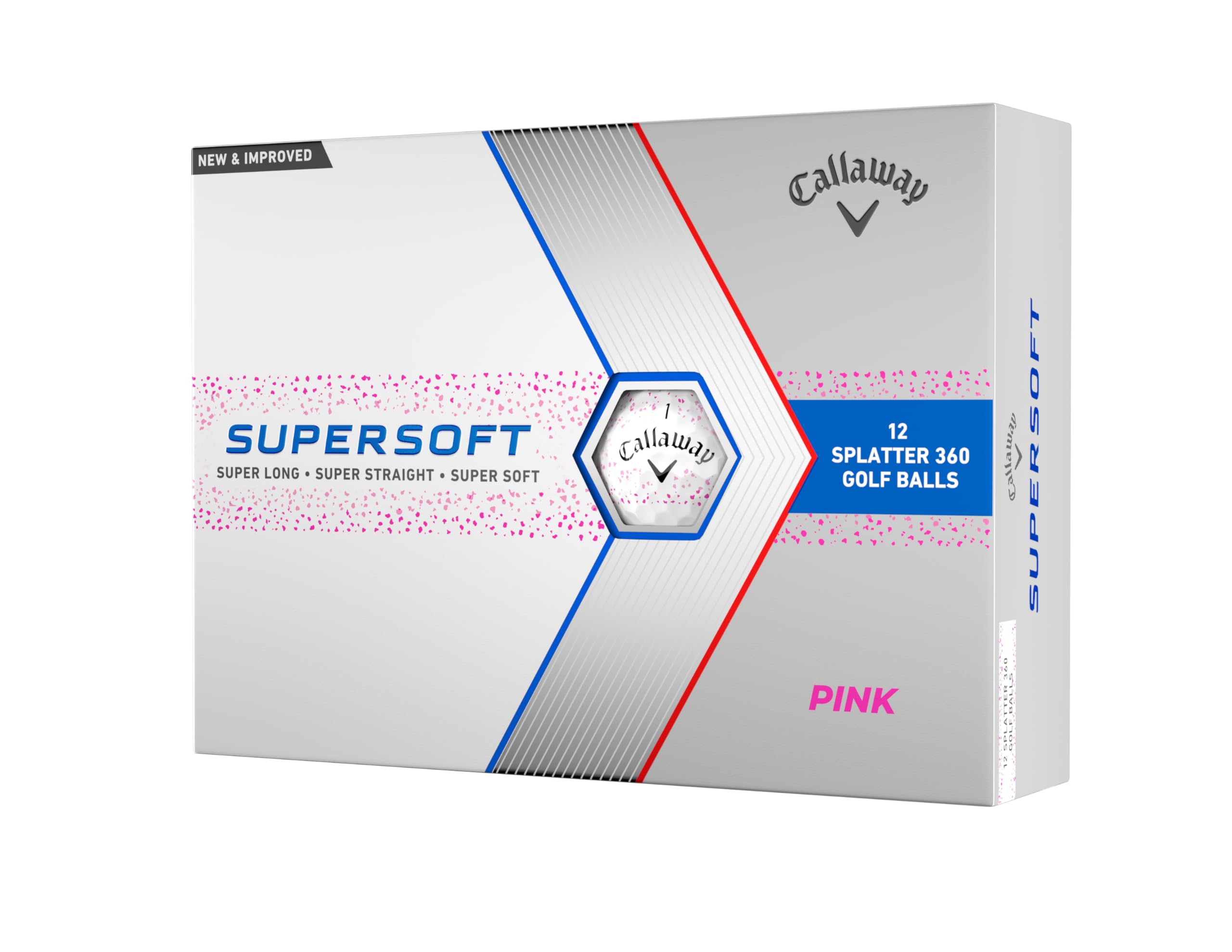
The Callaway Supersoft Pink Splatter builds on the legendary soft feel of the Supersoft line by adding a high-contrast 360-degree splatter pattern that stands out against every common background — fairway, rough, sand, and leaf litter. The HyperElastic SoftFast Core is designed to maximize ball speed off the driver while keeping compression low, so slower swing speeds get impressive carry without a hard feel.
This is a multi-layer ball with a hybrid cover that blends polyurethane characteristics for around-the-green control with added durability. Reviewers praise the soft, quiet sound off the putter and the way the ball holds greens on mid-iron approaches. The pink splatter does not wear off quickly; multiple testers reported the pattern staying vibrant through several full rounds with minimal scuffing on wedge strikes.
One real-world advantage of the splatter design is that you can track the ball’s spin axis as it flies, which helps you read shot shape without losing the ball in the sun. The trade-off is that this is not a high-spin tour ball — it prioritizes distance and softness over aggressive stopping power. For golfers who want a forgiving, easy-to-find ball that feels great in the short game, this is a top choice.
Why it’s great
- Extremely soft feel suited for slow-to-moderate swing speeds
- Pink splatter pattern highly visible in rough and trees
- Hybrid cover balances spin and durability well
Good to know
- Lower spin than premium urethane tour balls
- Splatter pattern may appear chaotic to some players
3. TaylorMade Distance+ Yellow
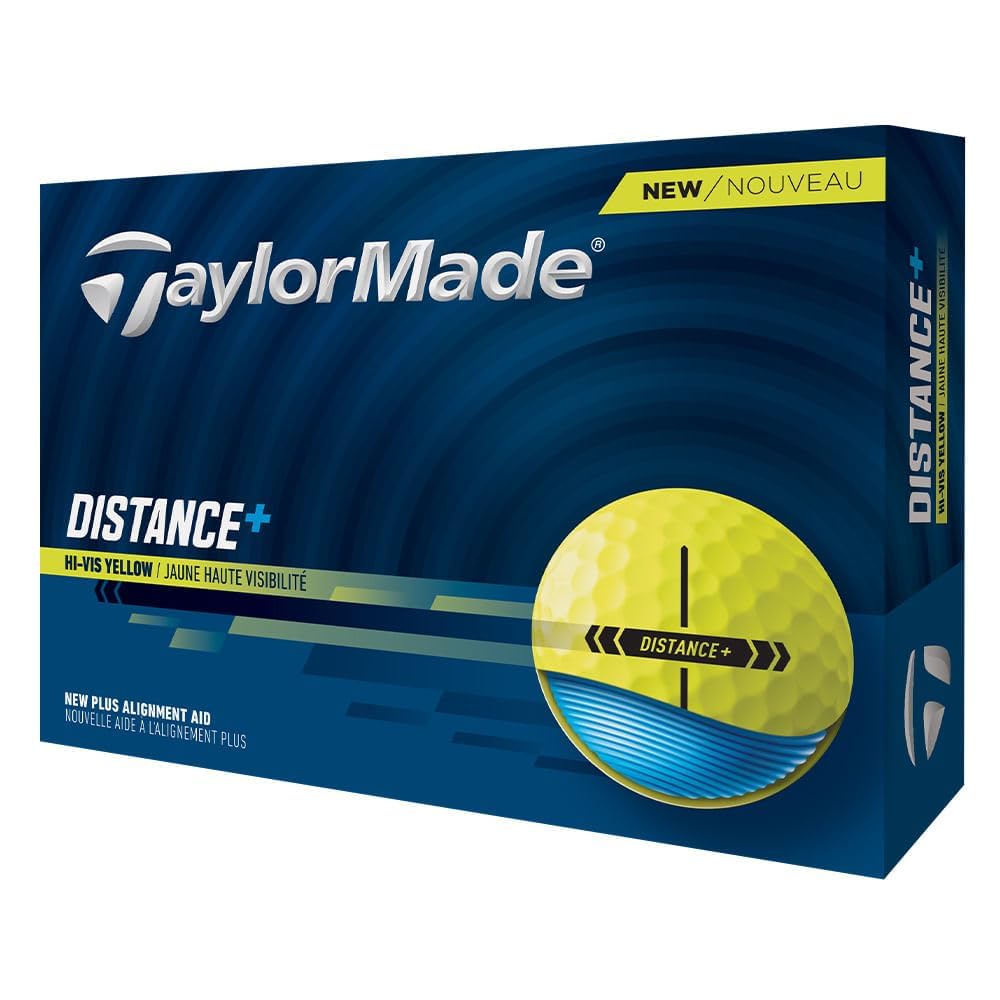
The TaylorMade Distance+ in yellow is engineered for one thing: maximizing length off the tee without breaking the bank. Its React Speed Core is a high-energy two-piece construction that produces a fast, mid-launch flight with a softer feel than you typically get from a pure distance ball. The Extended Flight Dimple Pattern reduces drag to keep the ball riding higher and longer on the carry.
Color visibility is a standout feature here. The pearlescent yellow finish is noticeably bright — it practically glows on overcast days and stays easy to track in the air. Reviewers specifically call out how well this yellow holds up in afternoon light compared to standard optic yellow or white. The new Plus Alignment Aid on the side makes putting alignment quicker without adding visual clutter.
The main criticism is the firmness: some players describe the feel as rock-like off the tee, which makes it less appealing for approach shots and putting. Low-compression fans who prefer a marshmallow-soft touch will find the Distance+ too rigid. However, for high-handicap players losing several balls per round, the distance performance and findability make this a smart, repeatable buy.
Why it’s great
- Pearlescent yellow is exceptionally visible in all light conditions
- React Speed Core delivers genuine distance gains
- Plus Alignment Aid speeds up putting setup
Good to know
- Firm feel off the tee may not suit soft-touch players
- Not ideal for high-spin short-game shots
4. Wilson Chaos Multicolors

The Wilson Chaos 24-ball pack is designed specifically for the golfer who loses more balls than they keep. The multicolor assortment — a mix of bright shades — makes each ball easy to identify as yours while also being straightforward to spot in the rough. The two-piece Surlyn cover construction keeps manufacturing cost low, which means you can stock your bag without guilt over every errant slice.
On performance, the Chaos delivers respectable distance for the price point. The Surlyn cover is durable and resists scuffing from wedge grooves, though it does lack the tackiness that urethane provides for spin. Reviewers note that the ball feels slightly brittle on iron strikes and does not hold greens as aggressively as more expensive options. The low-spin characteristic actually helps beginners keep drives straighter, since side-spin is minimized.
The main limitation is the ball’s ceiling: fast swing speeds will notice a drop in driver distance compared to higher-compression models, and the 7-iron carry hovers around 155 yards for average swings. For high-handicap players losing five or more balls per round, the Wilson Chaos offers unbeatable value per ball. It is less suitable for single-digit handicaps who need predictable spin into greens.
Why it’s great
- 24 balls per box at a very low per-ball cost
- Multicolor design helps identify your ball quickly
- Surlyn cover holds up well against wedge damage
Good to know
- Low spin reduces stopping power on approach shots
- Surlyn cover lacks the soft feel of urethane
5. Nitro Crossfire 45 Orange

The Nitro Crossfire 45 pack delivers 45 orange golf balls in one box, making it the highest-volume option in this lineup. The bright orange color is one of the most visible shades on the market — it stands out against green fairways, browned rough, and even in low-light conditions near dusk. Each ball uses a solid two-piece titanium core with a DuPont Lithium Surlyn cover for cut-proof durability.
Performance-wise, the Crossfire is built for distance. The titanium core maximizes energy transfer from the clubface, and the aerodynamic symmetrical dimple design reduces drag for a higher, longer ball flight. With an 85 compression rating, it hits a middle ground that works for a wide range of swing speeds — not too mushy, not too stiff. Reviewers consistently mention that the ball travels well and holds up for multiple rounds without splitting or losing color.
The trade-off is that the Nitro Crossfire is clearly an entry-level distance ball. Spin control around the greens is minimal, and the feel off wedges and the putter is firm rather than soft. Several reviewers note that while the value per ball is exceptional, this is not a ball for players focused on short-game precision. It is best suited for high-handicap golfers who want to limit losses and keep playing without restocking every week.
Why it’s great
- 45 balls per pack offers the lowest per-ball cost
- Orange color provides exceptional contrast on any surface
- Titanium core delivers reliable distance for average swings
Good to know
- Minimal spin makes greenside control difficult
- Firm feel off wedges and putter
FAQ
Do colored golf balls perform worse than white ones?
What color golf ball is easiest to see in the rough?
Are two-piece color golf balls good for beginners?
Final Thoughts: The Verdict
For most users, the best color golf balls winner is the Srixon Q-Star Tour Divide because it delivers genuine tour-level spin and feel while the two-tone cover makes it the most visible ball on the market. If you want a soft, forgiving feel with eye-catching splash visibility, grab the Callaway Supersoft Pink Splatter. And for high-handicap players who lose multiple balls per round, nothing beats the sheer volume and bright contrast of the Nitro Crossfire 45 Orange.

Mo Maruf
I created WellFizz to bridge the gap between vague wellness advice and actionable solutions. My mission is simple: to decode the research and give you practical tools you can actually use.
Beyond the data, I am a passionate traveler. I believe that stepping away from the screen to explore new environments is essential for mental clarity and physical vitality.