Our readers keep the lights on and my smoothie glass nicely filled. As an Amazon Associate, I earn from qualifying purchases.
Specs are compiled from manufacturer listings and verified buyer reviews and can change over time — please confirm the key details on the product page before buying.
You are tired of board games that end with someone sulking because they lost. Collaborative board games flip that: you win together or you lose together, and the only enemy is the game itself. This guide focuses on seven of the best cooperative experiences you can buy right now, from a lightning-fast 5-minute dungeon crawl to a tense 90-minute escape room adventure. Every pick here asks you to plan, talk, and trust your teammates — no take-backs, no grudges.
I’m Mohammad Maruf — the founder and writer behind WellFizz. This guide is built by comparing the manufacturers’ published specifications and the patterns across verified customer reviews, so you get each pick’s real strengths and trade-offs instead of marketing spin.
if you need something to play with your partner on a weeknight or a sprawling mythic quest for a full table of six, the best collaborative board games reward talking, thinking, and acting as one team — and these seven are the ones worth setting aside the phone for.
Our Picks at a Glance

How To Choose The Best Collaborative Board Games
Cooperative games ask you to put your heads together rather than compete, so the right choice depends heavily on who is at your table. The biggest factor is player count — some games sing with two players but feel chaotic at five, while others need a full group to shine. Playing time is equally important: a real-time 5-minute round works for a short attention span, while a deep 60-minute strategy session rewards players who like to plan every move. The difficulty climb matters too; a game that is too easy bores a veteran group, but one that is too hard frustrates a family night. Match the game’s style to what your group values: quick laughs, deep strategy, or rich storytelling.
Replayability and How It Keeps Your Table Fresh
A collaborative game can lose its magic once you have solved it — unless it is built to shuffle the challenge. Look for games that randomize the board, the monsters, or the puzzle elements each time you play. A tile-laying game where the maze changes every session or a deck-builder where you pick different heroes and bosses keeps every playthrough feeling new. A one-time escape room experience can be a memorable three-evening event, but if you want a game that will still be on your table months later, seek out variable scenarios and modular difficulty.
Communication: The Real Engine of Cooperative Play
Some games let you talk freely and plan every move, while others force you to communicate non-verbally or under a time crunch. A word-association game thrives on you sharing your thinking out loud, making it perfect for chatty groups. A dice-placement game where you place your pieces in silence tests how well you trust your partner. A real-time dungeon crawl demands shouting and fast hands, which is a thrill for some and pure stress for others. Align the communication style with your group’s personality to foster success and avoid arguments.
Quick Comparison
| Model | Best For | Playtime | Players | Age Range | Amazon |
|---|---|---|---|---|---|
| Asmodee So Clover!★ Best Overall | Word lovers and big groups | 30 Min | 3–6 | 10+ | Amazon |
| Ravensburger Horrified Greek MonstersMythic Strategy | Mythology fans and strategy players | 60 Min | 1–5 | 10+ | Amazon |
| Scorpion Masqué Sky Team | Two-player couples and duos | 20 Min | 2 | 12+ | Amazon |
| Hasbro D&D Bedlam in Neverwinter | D&D newcomers and puzzle fans | 90 Min per act | 2–6 | 12+ | Amazon |
| Wiggles 3D 5-Minute Dungeon | Fast-paced family chaos | 5 Min | 2–5 | 8+ | Amazon |
| The Night Cage | Atmospheric 2-player tension | 40 Min | 1–5 | 14+ | Amazon |
| Aeon’s End 2e | Deep deck-building duos | 60 Min | 1–4 | 14+ | Amazon |
In‑Depth Reviews
1. Asmodee So Clover! Party Game
Our pick — over 4.5★ from 950+ verified ratings; the strongest balance of quality and price.
You get creative joy, not competition: the whole team wins by guessing each other’s wild clues.
So Clover! does not feel like a typical board game — it feels like a conversation that got out of hand in the best way. Each player writes a single clue on their clover leaf that connects two seemingly unrelated keywords, then the whole team tries to guess which words the clues point to. The game flies by in about 30 minutes with 3 to 6 players, and since everyone is working toward the same score, there is never a moment where someone sits out feeling left behind. It includes 220 password cards, 6 clover boards, and dry-erase markers, so the box itself is essentially a portable party.
The real magic is how the game forces creative thinking. The keyword pairs are random, and your clue can be anything from a song lyric to a shared memory — the only rule is that it makes sense to your teammates. Buyers report they have “played countless hours and will do many more,” and the data backs that up: gameplay is the most-praised aspect by a wide margin. The game scores impressively high across nearly 1,000 ratings, with ease of use right behind gameplay as a top talking point. A few note that the soft cap of six players can be ignored entirely — you can team up and play with any group larger than two without missing a beat.
The crowd favorite — an exceptionally high rating across about 1,000 owners — confirms this is among the most universally loved word games on the market. The only real caveat is that players who dislike verbal thinking or who prefer competitive scoring might find the cooperative format too gentle. But for a family gathering, a camping trip, or a casual night with friends, this is the one you pull out first.
Pure creative energy: The clue-giving mechanic produces constant laughter and genuine surprise as players discover how others think. It is the kind of game that creates running jokes for years.
Light physical footprint: The box is roughly 9 by 6 inches, making it genuinely easy to toss into a suitcase for travel or a weekend visit.
Your table if: You love wordplay and want a game where everyone talks at once, scores together, and leaves the table smiling.
Think twice if: You prefer silent or competitive games — this one demands constant open chatter and has zero winners or losers.
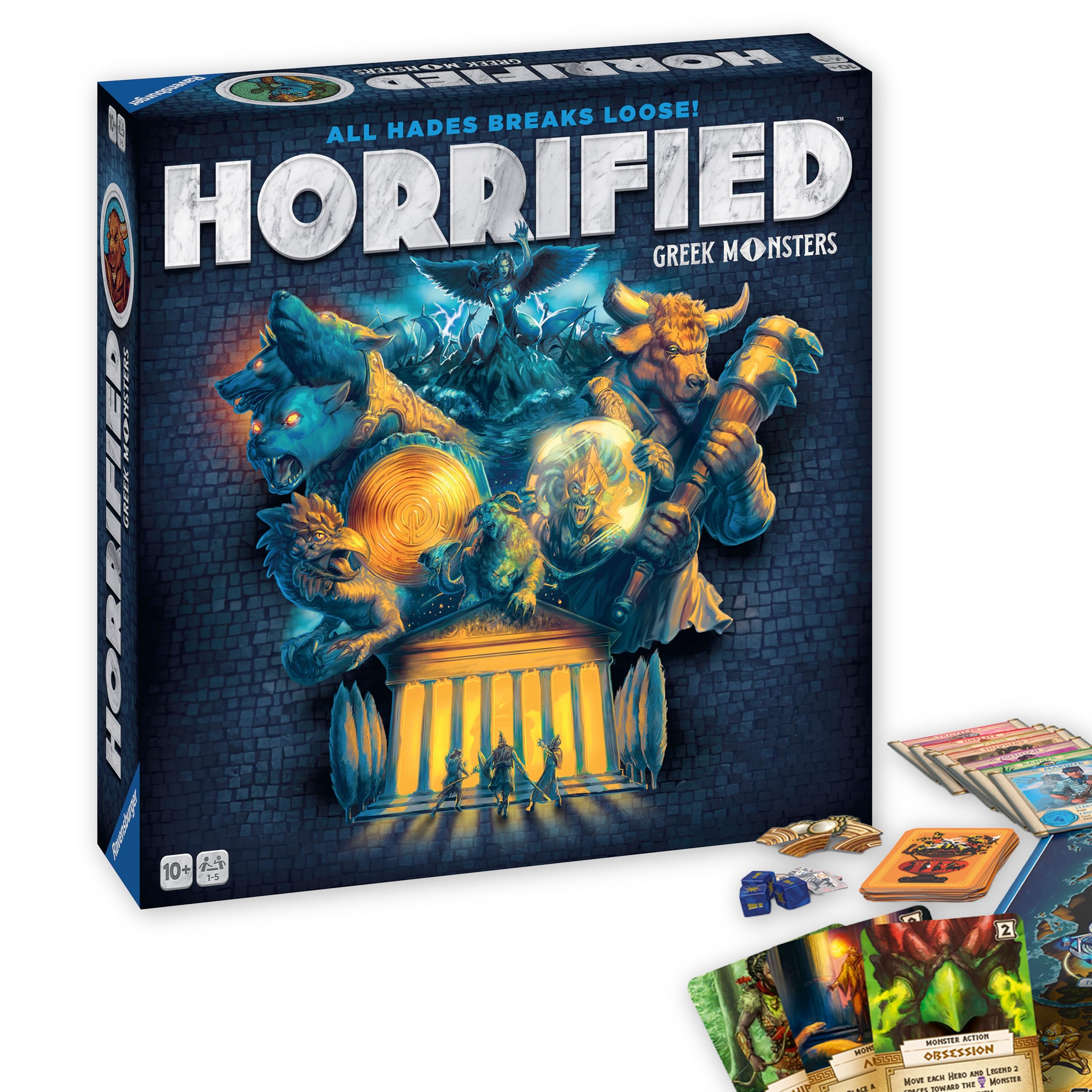
2. Ravensburger Horrified Greek Monsters
Defeat Medusa and Cerberus by working as a team, not by rolling dice at each other.
Horrified: Greek Monsters takes the cooperative horror formula and gives it a mythological coat of paint. You and up to four others pick heroes and work together to defeat six iconic monsters — Medusa, Cerberus, Chimera, and three more — using a pick-up-and-deliver mechanic combined with puzzle-solving. Each monster has a unique defeat condition, so you have to adapt your strategy on the fly rather than just grinding the same tactic. A session runs about 60 minutes, with the game board, monster mats, tokens, dice, and reference cards all packed into a sturdy box. Buyers describe it as having a “great pick up and deliver mechanic and puzzle solving to defeat each monster.”
The game shines brightest when you have a full table of players discussing the best moves, though it works just fine with two or even solo if you run multiple heroes. Gameplay and game quality are the two most-discussed positives. Some owners note that the new players should expect a moderate learning curve, and the monster mats are slightly flimsy compared to the thicker cardboard of earlier Horrified editions. But the variety is real: the Labyrinth, the Underworld Door, and six different monster encounters keep the board feeling fresh across multiple plays. At roughly 60 minutes, it hits the balance between a quick game and an evening commitment — a longer and more tactical alternative to the wordplay speed of So Clover!.
What wins people over
- Varied monster mechanics keep each game feeling different
- High-quality board and components, with thicker cardboard than prior editions
- Great middle ground for RPG fans and newcomers alike
A fair warning
- Font and background text on monster mats can be hard to read
- Solo play can feel slow when hunting for monster lairs
Best suited to: Groups that enjoy tactical discussion and Greek mythology vibes.
Not for: Players who want a casual 20-minute game or hate reading special rules for each monster.
3. Scorpion Masqué Sky Team

Two of you land the plane using only dice, silence, and trust — no quarterbacking allowed.
Sky Team is a two-player-only cooperative game that tasks you with landing an airplane safely, and it won Game of the Year 2024 for good reason. The core twist is that you place your dice silently on a shared control panel — you cannot tell your partner what you rolled, you can only trust that they will cover the part you cannot. Each round you adjust speed, level wings, clear air traffic, and hit the brakes at just the right moment. A single playthrough takes about 20 minutes, but with 20 different airport scenarios the replayability is substantial. The box holds a control panel, an airplane axis disc, 8 dice, player aid screens, tokens, markers, and more. Owners mention it is “on the level of Pandemic and the like, but faster.”
The silent dice placement is the real genius here. It eliminates the alpha-player problem — the bossy person who tells everyone what to do — because you literally cannot communicate your intended move. That forces real reliance and trust, which is exactly what a two-player cooperative game should do. Gameplay and cooperative game mechanics are the top two most-praised aspects, with ease of learning close behind. The difficulty ramps nicely across the scenarios, and optional modules add kerosene leaks or ice on the tarmac. The only real limitation is that it is strictly for two — you cannot add a third or fourth player. At about 20 minutes a round, it is easy to play multiple games in one sit-down. For a tighter, faster, and more intimate experience than the 60-minute Horrified, this is the duo’s pick.
Tension in a tiny box: The game is compact (roughly 10 x 7 x 2 inches) and sets up in minutes, making it perfect for coffee shop dates or travel.
No quarterbacking allowed: Because dice must be placed in silence, every player genuinely contributes. This is rare in cooperative games and a huge win for couples.
Grab this if: You play with one partner and want a tense, fast, endlessly replayable challenge.
Look elsewhere if: You often host three or more players — this is strictly a duo experience.
4. Hasbro Gaming Dungeons & Dragons: Bedlam in Neverwinter

A three-act escape room adventure in the D&D world, lasting about 90 minutes per act.
Bedlam in Neverwinter is an Amazon-exclusive board game that unfolds like a dungeon master-less D&D campaign in a box. You and up to five other players choose characters by combining race, class, and weapon cards, then dive into the city of Neverwinter to solve a mystery involving an evil mage and his cult. The game is split into three acts, each taking about 90 minutes, and the board builds and changes as you open up new locations. Combat uses a d20 and a d6, keeping the dice rolls familiar to RPG fans but approachable for newcomers. The box includes 6 plastic figures, 11 gameboards, 4 secret envelopes, 298 cards, and 43 cardboard tokens.
The puzzle design is the standout feature — you will encounter wordplay riddles and multi-card visual puzzles that require the whole team to hash out together. And because it is a one-time story (once you open the secret envelopes, you cannot reseal them), it functions best as a three-evening event rather than a pick-up-and-play staple. The most-praised aspects are the engaging story and the accessible introduction to D&D mechanics, though players note that the replay value is low once the puzzles are solved. The quality of the components and the clever numbered-card exploration system earn consistent praise. One group even said they were disappointed there are no other D&D versions like this one.
The pull
- Excellent story pacing across three acts with a satisfying conclusion
- Simple combat and skill checks that mirror D&D without overwhelming new players
The catch
- Low replayability — once you know the puzzles, the magic fades
- All character cards and miniatures depict female characters, which some noted
Best for: A D&D-curious group that wants three coordinated game nights with a real story.
Skip if: You want a game your group can pull off the shelf monthly — this is a finite experience.
5. Wiggles 3D 5-Minute Dungeon

A card-flinging dungeon crawl that lasts exactly 5 minutes per round — pure chaos.
5-Minute Dungeon is exactly what it sounds like: you have five minutes to race through a dungeon, matching your hero cards to the symbols on the dungeon deck, defeating bosses, and shouting at your teammates to play faster. The real-time (clock is running, everyone plays at once) element makes every round frantic — there are no slow turns, no analysis paralysis, just pure cooperative chaos. This edition includes 275 cards, 5 double-sided hero mats (10 heroes total), 3 double-sided boss mats (6 bosses total), and a free timer app with six themed narrators. The game plays 2 to 5 players aged 8 and up.
The overwhelming sentiment is that this is pure, loud fun. Gameplay and pacing are the two most-praised aspects, with ease of learning right behind. Customers note it is “super fast speedy game” and “perfect for families,” though the intensity is mixed — some people find the pressure stressful rather than thrilling. That is the trade-off: you get one of the fastest cooperative experiences on the market, but it demands quick hands and a tolerance for controlled panic. The companion app adds a layer of polish, and the artwork is cute enough to keep younger players engaged. At roughly 5 minutes per dungeon, you can easily play 5 or 6 rounds in a single evening. Unlike the 90-minute D&D adventure, this one is built for repeat play.
Instant tutorial: The game is teachable in under a minute — match symbols, play cards, beat the dungeon. Young kids pick it up immediately.
Physically loud: Expect shouting, slapping cards down, and laughing. This is not quiet tabletop gaming.
Grace your table with this if: Your group likes high-energy games and has short attention spans.
Leave it on the shelf if: Anyone in your group finds timed pressure stressful or dislikes chaotic card management.
6. The Night Cage by Smirk and Dagger

Your candle is the only light source in a tile-laying maze that vanishes behind you.
The Night Cage is a tile-laying labyrinth game where your candle is the only source of light. Players must collect keys, find the gate, and escape together before the maze collapses — but here is the twist: tiles you leave behind are swallowed by darkness and cannot be walked through again. The game is designed for 1 to 5 players aged 14 and up, and a full session runs about 40 minutes. It includes adjustable difficulty settings and an Advanced Game mode with new monsters and obstacles, adding long-term replay value. The award-winning design uses minimalist, eerie artwork that perfectly matches the tension of limited vision.
Gameplay and game quality are the top two most-praised aspects, and the difficulty earns mixed notes — some find it easy to learn, others find it very hard. The strategic depth comes from the fact that every tile placement matters: one wrong move can block off the entire team’s path. The recommended play style is in the dark with real candles and a themed Spotify playlist, which improve the atmosphere dramatically. The main critique is that at higher player counts (4 or 5), a single dominant player can steer the whole strategy, leaving quieter members as passengers. At 2 players, however, it shines as a tense, collaborative puzzle — more atmospheric than the loud rush of 5-Minute Dungeon.
Why it stands out
- Innovative tiles-vanish mechanic creates real tension every turn
- High replayability due to random tile draws and optional advanced rules
Know before you buy
- At 4+ players one person may dominate the strategy
- Rulebook clarity is a common sticking point for new players
Perfect for: Couples or small groups who want a moody, atmospheric challenge that rewards planning.
Not the pick for: Large loud groups who want a party atmosphere — the mood here is tense and quiet.
7. Aeon’s End 2e

A deck-builder where you never shuffle your deck — you plan each draw against a smart boss.
Aeon’s End 2nd Edition is a cooperative deck-building game that flips the genre on its head with one rule: you never shuffle your deck. Instead, you track the order of your cards, planning your draws carefully because the next card you see is the one you are getting. You and up to three other players defend the underground city of Gravehold, buying gems to transform into spells and weapons while fighting a Nemesis boss that has its own unique deck. The game is about 60 minutes per session, includes 8 mages, dozens of spells and relics, and 4 to 5 Nemeses, all packed into a box that sets up in about 3 to 5 minutes once you know the system.
The depth here is significant. Experienced deck-builders praise the high strategy and variability, noting that there is no dominant optimal strategy — each game requires you to adapt to the specific Nemesis and market cards available. The rulebook, however, is a sticking point: it is lengthy and complicated, and many owners recommend watching a YouTube tutorial before your first game. Once you are past that hurdle, the game delivers intense thinky sessions that work especially well for two players. The cooperative mechanic is genuinely cooperative — you need true teamwork because each mage, market, and Nemesis demands a different plan. A few call it the best 2-player co-op they have found, edging out even Sky Team for sheer strategic depth.
No alpha-player loophole: Because each player manages a separate card pool and turn order is variable, one person cannot command the whole table.
Time investment upfront: Be prepared for a 15-to-20-minute rules read or a YouTube session before your first game. It rewards the effort.
Pick this if: You and a partner love deep strategy, deck optimization, and a boss-battle feel that changes every time.
Pass on it if: You want a quick teach or a casual game night with non-gamers.
Understanding the Specs
Playtime and Player Count
The two numbers that make or break a collaborative game. Playtime tells you how long one session lasts — a 5-minute game fits an after-dinner quickie, while a 90-minute act is a planned evening event. Player count matters equally: some games are strictly two-player (Sky Team), others scale from 2 to 6 (So Clover!). A game that supports 5 players but really works best with 2 or 3 is a common hidden detail. Always check that your usual group size falls comfortably inside the range, not at the edge where the balance may wobble.
Replayability and Setup Time
Replayability is how different each session feels. Tile-laying games (The Night Cage) shuffle the board every time, deck-builders (Aeon’s End) swap heroes and bosses, and word games (So Clover!) rely on creative clues. Escape-room style games (Bedlam in Neverwinter) are finite once the puzzles are solved. Setup time is the unsung killer of fun — a 3-minute setup means you actually play; a 20-minute setup means the game may stay on the shelf. Check the components list: fewer unique card types and boards usually mean faster prep.
FAQ
Will a two-player cooperative board game still feel fun with just one partner?
How many sessions does a one-time escape room board game last?
What does “real-time” mean in a board game?
How do I avoid one player dominating the strategy in a cooperative game?
Are collaborative board games easier than competitive ones?
Can kids play these games, or are they only for adults?
Which game has the most replayability for a dedicated duo?
How does a deck-building cooperative game work if everyone shares the same goal?
What is the difference between a tile-laying game and a board-building game?
Can you play any of these games solo?
Final Thoughts: The Verdict
For most groups, the best collaborative board games winner is the Asmodee So Clover! because it works with almost any group size, teaches in under a minute, and creates genuine laughter through word association. If you play mostly with one partner, grab the Scorpion Masqué Sky Team for its tense 20-minute sessions and Game of the Year pedigree. And for a deep strategy night with a dedicated game partner, the Aeon’s End 2e is the one to reach for — just budget time for the rulebook. Across all seven picks, you win together or not at all—that is the core of cooperative play.
How We Picked
We do not accept paid placement. Every pick is matched to a real buyer and a real use-case; we do not hands-on test units.
Sources & Methodology
Specifications: manufacturer listings and product documentation. Review insights: verified customer reviews, as of July 2026. Pricing: not shown on this page (it changes often); check the current price via the retailer link.
As an Amazon Associate, WellFizz earns from qualifying purchases. This does not affect which products we feature.
Related Guides

Mo Maruf
I created WellFizz to bridge the gap between vague wellness advice and actionable solutions. My mission is simple: to decode the research and give you practical tools you can actually use.
Beyond the data, I am a passionate traveler. I believe that stepping away from the screen to explore new environments is essential for mental clarity and physical vitality.