Our readers keep the lights on and my smoothie glass nicely filled. As an Amazon Associate, I earn from qualifying purchases.
Specs are compiled from manufacturer listings and verified buyer reviews and can change over time — please confirm the key details on the product page before buying.
If you are cutting aluminum extrusions, brass trims, or copper pipes on your miter or table saw, a regular wood blade will grab, overheat, and leave jagged edges. A dedicated non-ferrous cold saw blade uses a negative hook angle and a high tooth count to shear through the metal instead of ripping it — giving you a smooth, burr-free finish on every cut. The catch is that not every blade labeled “aluminum” actually holds up to the job without chattering or losing teeth quickly.
I’m Mohammad Maruf — the founder and writer behind WellFizz. This guide is built by comparing the manufacturers’ published specifications and the patterns across verified customer reviews, so you get each pick’s real strengths and trade-offs instead of marketing spin.
Below we walk through the six best options, spanning budget-friendly to premium choices, to help you find the right cold saw blade non ferrous for your workshop and your typical material thickness.
Our Picks at a Glance


How To Choose The Best Cold Saw Blade Non Ferrous
The right blade stops you from ruining a piece of aluminum stock with a chattering, grabbing cut. Focus on three things: the tooth grind pattern, the number of teeth, and the maximum speed your saw can spin the blade.
Triple Chip Grind (TCG) vs. Alternate Top Bevel (ATB)
TCG is the standard for non-ferrous cutting. Each tooth has a flat top with a chamfer on one corner, so the blade does not snatch at the material. It leaves a clean, squared edge on aluminum extrusions and plate. ATB teeth are better for wood — they would grab and cause chatter on metal.
Teeth count and what it does for the cut
A 100-tooth or 120-tooth blade cuts slowly but leaves a smooth surface that needs almost no sanding or deburring. A 60-tooth blade cuts faster but may leave a rougher edge. For thin-walled tubing or trim profiles, a high tooth count prevents the blade from catching and pulling the workpiece.
Max RPM — do not exceed it
Non-ferrous blades have a lower max RPM than wood blades, typically around 4000-6000 RPM. Spinning them faster overheats the carbide tips and can throw a tooth. Check your saw’s no-load speed is at or below the blade’s rating. A 12-inch blade with a max of 4500 RPM needs a saw that does not exceed that speed.
Quick Comparison
| Model | Best For | Diameter | Teeth | Max RPM | Amazon |
|---|---|---|---|---|---|
| VORTEX DIAMOND 10″ 100T★ Best Overall | Budget-friendly entry for thin cuts | 10″ | 100 | 6000 | Amazon |
| Diablo D12120NPremium Pick | Premium all-round performance | 12″ | 120 | 5000 | Amazon |
| Benchmark Abrasives TCT 12″ 120T | High tooth count at a mid-range price | 12″ | 120 | — | Amazon |
| Norske Tools NCSBP257 10″ 100T | Precision miters for trim and extrusions | 10″ | 100 | — | Amazon |
| EXFEIN 12″ 100T TCG | Thick aluminum plate and budget buys | 12″ | 100 | 4500 | Amazon |
| FOXBC 12″ 96T TCG | Versatile mid-range for varied metal sizes | 12″ | 96 | — | Amazon |
In‑Depth Reviews
1. VORTEX DIAMOND 10″ 100-tooth Saw Blade
Our pick — over 4★ from 250+ verified ratings; the strongest balance of quality and price.
The light, affordable 10-inch blade that works on circular saws as well as miter saws.
If you need a 10-inch blade that fits a circular saw, table saw, miter saw, or radial arm saw, this VORTEX DIAMOND blade covers all four with a 5/8-inch arbor and a 6000 RPM max — the highest speed rating among the picks here, meaning it can safely spin on a standard circular saw that runs at 5000-6000 RPM. The 100 teeth use an ultra-sharp hard titanium carbide with a Triple Chip Tooth Grind, and the 3mm kerf is thicker than the FOXBC’s.094″ kerf, so it removes more material per pass.
Shoppers say it “used to cut 80/20 extrusions. No Issues clean, fast cuts.” One customer observed it worked well for cutting plastic garage floor tiles, and another used it on a DeWalt construction site saw for acrylic (running the blade backwards, which some users do for plastic). However, one reviewer had trouble cutting.125 aluminum, saying the blade “chattered and shook, but got the job done.” At 0.8 kilograms, it is significantly lighter than the EXFEIN 12-inch blade at 1.36 kilograms, which is a 70% gap — that light weight makes it easy to handle on a circular saw but may contribute to chatter on thicker material like 1/8″ plate.
Where it shines
- Compatible with four saw types — circular, miter, table, radial arm
- 6000 RPM max rating allows use on higher-speed circular saws
- Affordable entry to non-ferrous cutting with 100 teeth
Where it struggles
- May chatter on thin aluminum sheet (0.125″)
- Light weight (0.8 kg) offers less vibration dampening than heavier blades
Best for: occasional cutting of aluminum extrusions, acrylic, or PVC on a circular saw or miter saw where budget is the priority.
look elsewhere if: you regularly cut 1/8″ aluminum or thicker plate — the chatter may leave a rough edge that needs deburring.
2. Diablo D12120N 12″ 120-tooth Non-Ferrous Saw Blade
The blade that treats thin aluminum like softwood — smooth, quiet, and chip-free.
This 12-inch blade packs 120 teeth with a Triple Chip Grind (a tooth shape that shears metal instead of grabbing it), so you get burr-free finishes on aluminum up to 7/16″ thick, plus copper, brass, and plastics. Diablo uses TiCo Super-Density Micro-Grain Carbide, which means the carbide tips resist wear longer than standard grades. The Tri-Metal Shock Resistant Brazing absorbs impacts if you accidentally hit a screw or a thicker section, so the teeth stay on the blade.
Buyers report it “cuts amazingly well” on 1x1x1/8″ aluminum square tube and angle, noting the cut is “no louder than cutting wood.” The Perma-SHIELD Non-Stick Coating prevents gumming from resin in plastics and painted extrusions. It is heavier than the VORTEX DIAMOND 10-inch at 1 pound vs 0.8 kilograms, but the added mass contributes to a stable cut. The trade-off is the price sits at the high end of the category — you pay for the durability and the coating that keeps the blade slipping through material without loading up.
What you get: Smooth, accurate cuts on thin to medium aluminum with minimal burr. The stabilizer vents keep vibration down and accuracy up. Reviewers consistently praise the finish quality, with one saying “smooth cutting and no chapping.” For pros cutting extrusion, trim, or sheet metal daily, this is the longest-lasting option in this roundup.
The honest trade-off: You pay a premium, and the longevity on very thick plate is not proven in reviews — most users stick to material under 1/4″. If your main work is heavy-wall aluminum above 1/2″, a ferrous-metal blade with lubrication might serve you better.
Reach for this if: you cut thin-walled aluminum, extrusions, or brass every week and want the smoothest edge possible without deburring.
Look elsewhere if: your budget is tight or you rarely cut non-ferrous metal — a mid-range blade will do the job for occasional use.
3. Benchmark Abrasives TCT 12″ 120-tooth Saw Blade

120 teeth at a mid-range price — high-end tooth count without the high-end sticker.
With 120 teeth, the Benchmark Abrasives TCT matches the Diablo on tooth count for a noticeably lower cost, making it a strong choice if you need a fine finish on aluminum but cannot justify the premium. The teeth are tungsten carbide-tipped with a steel core, and the blade is compatible with Evolution, Dewalt, Milwaukee, Makita, Bosch, Metabo, Ryobi, Skil, and Big Foot 12-inch miter saws. That is wider brand compatibility than most picks here, which matters if you swap between job-site saws.
Owners mention this blade “cuts V-slot aluminum extrusion and wood with fine, smooth, super clean cuts,” though one notes the edge is sharp and may require smoothing on thin sheet. Another reviewer mentions it handled 1/8″ aluminum sheet with very little effort for uniform straight cuts. At 1.24 kilograms, it is slightly lighter than the EXFEIN 12-inch blade at 1.36 kilograms, which is fine for most miter saws but might feel less planted in a lightweight sliding saw. The shipping experience got a complaint, so factor that into your ordering timeline.
Edge it has over cheaper blades
- 120 teeth deliver a finer finish than the 96-tooth FOXBC
- Compatible with a wide range of miter saw brands
- Tungsten carbide tips hold up to repeated cuts on aluminum
One thing to watch
- Cuts on thin sheet leave a sharp edge that may need light deburring
Best for: the hobbyist or light professional who wants near-premium cut quality without paying a premium price tag.
skip it if: you need the absolute smoothest edge right off the saw — the Diablo’s coating and carbide grade produce a slightly cleaner finish on thin stock.
4. Norske Tools NCSBP257 10″ 100-tooth Saw Blade

The 10-inch miter-saw blade that treats aluminum angle like hard butter.
If your saw takes a 10-inch blade with a 5/8-inch bore, this Norske blade gives you 100 teeth with a triple chip grind and a 0-degree hook angle — zero hook means the blade does not self-feed or pull into the cut, which eliminates the grabbing and kickback that scare you when you are near a spinning blade. You get a laser-cut thin-kerf body with anti-vibration and expansion slots to keep the cut quiet and accurate even on long extrusions.
One reviewer with 65 years of experience called it “hands down, best saw blade I’ve ever used,” noting “precise cuts on aluminum angle with absolutely no grabbing or excess heating.” Another buyer praised it for cutting Schluter aluminum tile profiles perfectly and smoothly. At 0.88 kilograms, it is heavier than the VORTEX DIAMOND 10-inch at 0.8 kilograms, giving it a bit more mass for stability. It is designed for miter, sliding compound miter, and radial arm saws — not for table saws — so check your tool before ordering.
Why it stands out: The 0-degree hook angle and 100-tooth count deliver the most controlled, grab-free cut among the 10-inch options here. For tile profiles, aluminum angle, and extruded channels, buyers consistently report a smooth, burr-free edge with no overheating. The thin kerf reduces waste and requires less feed pressure.
Reach for this if: you cut thin aluminum trim, extrusions, or brass stock on a 10-inch miter saw and hate chatter and grabbing.
pass on it if: you need a 12-inch blade or use a table saw — this is designed specifically for miter/radial arm saws.
5. EXFEIN 12″ 100-tooth TCG Saw Blade
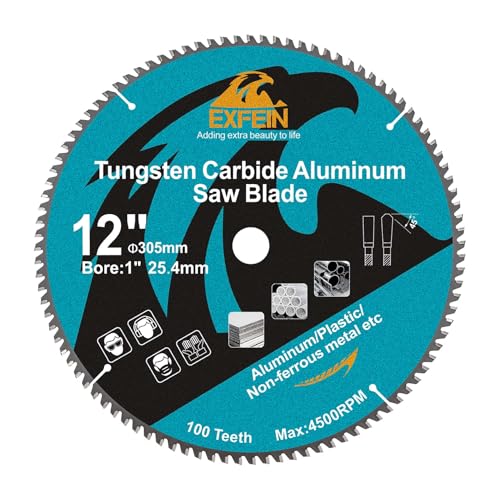
A 12-inch budget blade that cuts 1/4-inch plate cleanly while staying affordable.
At the same price as the FOXBC but with 100 teeth versus 96, the EXFEIN blade uses TCG (45-degree trapezoidal teeth) to produce a smoother cutting surface. The manufacturer specifies a max RPM of 4500 — lower than the VORTEX DIAMOND 10-inch’s 6000 RPM — so it is well-suited to a standard miter saw that runs around 3500-4000 RPM. Keep your saw speed under 4500 to protect the tungsten carbide teeth from heat damage.
Customers note this blade “cuts 1/4″ aluminum plate cleanly and quickly, half the time of woodworking carbide blades; no vibration or rough edges.” One reviewer noted the arbor hole was too small for their Skilsaw, so check that your saw’s arbor is 1 inch before ordering — this is a common issue with budget 12-inch blades. At 1.36 kilograms, it is the heaviest blade in the roundup, which helps dampen vibration on thicker cuts. The thin kerf design (2mm body thickness) generates less heat, so the blade stays cooler even on longer passes through aluminum plate.
What works well
- 100 teeth give a smoother finish than the 96-tooth FOXBC
- Heavy build (1.36 kg) reduces vibration on thick material
- Excellent value — reviewers call it “great value” for the cut quality
What to check before buying
- Arbor compatibility: one buyer mentioned the hole was too small for their Skilsaw
- Max RPM is 4500 — ensure your saw does not exceed that speed
Best for: cutting 1/4″ aluminum plate or thicker stock on a 12-inch miter saw where budget matters more than brand name.
it’s not for you if: you need a guaranteed arbor fit or cut mostly thin extrusions — the FOXBC may be a safer fit for varied thicknesses.
6. FOXBC 12″ 96-tooth TCG Saw Blade

96 teeth and a -5-degree hook angle make this blade a smooth operator on thin extrusions and railing.
The FOXBC blade is built to handle thin (up to 1/8″), medium (3/32″-1/4″), and thick (3/16″-7/16″) aluminum in one package, with a kerf of.094″ and a 1-inch arbor. The 96-tooth Triple Chip Grind with a -5-degree hook angle means the blade enters the cut even more gently than the Norske’s 0-degree hook, reducing the chance of snatching thin-walled tube or railing. Laser-cut stabilizer vents trap noise and keep vibration down, which translates to cleaner cuts on long extrusions.
Reviewers point out it “cuts aluminum railing like butter” and “cuts aluminum extrusion like butter.” One reviewer on a tight budget for a marching band props project reported it made “clean cuts on both aluminum, perfect for the poles, and plastic, for the ramps.” A small number of users mentioned a tooth breaking early — one owner reported a tooth broke off on the third cut through 20mm x 20mm aluminum extrusion, though the vendor replaced it free of charge. At 1.19 kilograms, it sits between the EXFEIN (1.36 kg) and the VORTEX DIAMOND (0.8 kg) in weight, offering a stable cut without being the heaviest.
What makes it worth considering: The -5-degree hook angle gives you the gentlest entry of any blade here, ideal for thin-walled aluminum angle and railing where grabbing would ruin the workpiece. The stabilizer vents and high-density FoxCarbide tips suggest decent longevity for a mid-range blade. Customer service reviews are positive — a defective blade was replaced next-day free of charge.
The honest catch: Early tooth breakage appears in a small number of reviews. While the vendor handles replacements well, it is a reliability question you would not get from the premium Diablo blade.
Reach for this if: you cut thin aluminum railing, extrusions, or mixed materials (aluminum and plastic) and value a gentle, non-grabbing cut.
Look elsewhere if: you need guaranteed durability for high-volume daily cutting — the Diablo or Benchmark Abrasives may hold up better over time.
Understanding the Specs
Tooth Count and Grind Pattern
A 100-tooth or 120-tooth blade with a Triple Chip Grind produces the smoothest edge on aluminum because the flat-top tooth shape shears the metal instead of prying it. Fewer teeth cut faster but leave a rougher edge. TCG is the standard for non-ferrous — avoid ATB (Alternate Top Bevel) blades unless they are marked for non-ferrous.
Max RPM and Arbor Size
Your saw’s no-load speed must stay below the blade’s max RPM rating. Exceeding that can overheat the carbide and throw a tooth. The arbor diameter (5/8″ for 10-inch blades, 1″ for most 12-inch blades) must match your saw’s arbor — check before buying. Some 12-inch blades have a 5/8″ arbor with a reducer ring; some require a 1-inch arbor.
Kerf and Plate Thickness
Kerf is the width of the cut made by the blade. A thin kerf (like the FOXBC’s.094″) removes less material, requires less feed pressure, and generates less heat — good for thin-walled extrusions. A thicker kerf (like the VORTEX DIAMOND’s 3mm) is more stable on thicker stock but produces more waste and heat.
Hook Angle
Non-ferrous blades use a negative hook angle (about -5 degrees) or a zero hook angle so the blade does not self-feed into the metal. A positive hook angle found on wood blades pulls the work into the cut too aggressively on aluminum, causing grabbing, kickback, and a rough edge.
FAQ
Can I use a regular wood-cutting blade for aluminum?
What happens if I spin a non-ferrous blade faster than its max RPM?
How do I know if a 12-inch blade fits my saw?
What is the difference between 96, 100, and 120 teeth?
Does a heavier blade cut better on aluminum?
What does “Triple Chip Grind” mean for cutting?
Will these blades cut copper or brass?
How long does a non-ferrous blade last compared to a wood blade?
Can I cut plastic with these blades?
What is the best blade for cutting Schluter tile trim?
Final Thoughts: The Verdict
For the majority of shoppers, the best cold saw blade non ferrous winner is the Diablo D12120N because its 120-tooth Triple Chip Grind, Perma-SHIELD coating, and TiCo carbide deliver the smoothest burr-free finish on thin aluminum with excellent durability. If you want a 10-inch blade for miter saw precision on extrusions and trim, grab the Norske Tools NCSBP257. And for a budget-friendly 12-inch option that handles 1/4″ aluminum plate, the standout is the EXFEIN 100-tooth TCG blade.
How We Picked
We do not accept paid placement. Every pick is matched to a real buyer and a real use-case; we do not hands-on test units.
Sources & Methodology
Specifications: manufacturer listings and product documentation. Review insights: verified customer reviews, as of July 2026. Pricing: not shown on this page (it changes often); check the current price via the retailer link.
As an Amazon Associate, WellFizz earns from qualifying purchases. This does not affect which products we feature.
Related Guides

Mo Maruf
I created WellFizz to bridge the gap between vague wellness advice and actionable solutions. My mission is simple: to decode the research and give you practical tools you can actually use.
Beyond the data, I am a passionate traveler. I believe that stepping away from the screen to explore new environments is essential for mental clarity and physical vitality.