Our readers keep the lights on and my smoothie glass nicely filled. As an Amazon Associate, I earn from qualifying purchases.
Specs are compiled from manufacturer listings and verified buyer reviews and can change over time — please confirm the key details on the product page before buying.
You are leaning over a worn 1900s penny. The date is barely there. A tiny mint mark could double its value, but your phone camera cannot get close enough. That is when a coin microscope earns its place on your desk. The difference between a good one and a frustrating one depends on three things: a screen big enough to see the whole coin, lights you can aim, and a stand that gives you room to work. This guide picks the models that actually deliver those, using the specs that the product listings often bury.
I’m Mohammad Maruf — the founder and writer behind WellFizz. This guide is built by comparing the manufacturers’ published specifications and the patterns across verified customer reviews, so you get each pick’s real strengths and trade-offs instead of marketing spin.
Whether you are checking your first buffalo nickel or cataloging a full collection, the right coin microscope saves you from squinting at tiny phone screens and missing the details that matter most.
Quick Picks
- TOMLOV TriL107 3-Lens Digital Microscope — Most Versatile
- TOMLOV DM10 10.1″ Digital Microscope — Best Display
- JL210 10.1” Digital Microscope by JOYALENS — Best Overall
- LM210 10.1” LCD Coin Microscope by LINKMICRO — Great Value
- Leipan 4.3″ Coin Microscope Digital Microscope for Collectors — Compact Pick
- SKYEAR 4.3″ Coin Microscope 1000X Magnification — Budget Champion
How To Choose The Best Coin Microscope
Picking a coin microscope depends on how you plan to use it. If you inspect error coins at your desk, a large screen and a metal stand matter most. If you travel to shows or flip through bags of loose coins, a portable handheld unit makes more sense. Here are the three specs that separate a usable tool from a frustrating one.
Screen Size and Viewing Experience
A bigger screen means you see the full surface of a silver dollar without moving the coin around. Tiny 4.3-inch screens force you to pan, which slows you down and makes it easier to miss small details like a clipped planchet (a coin missing a small piece of metal from its edge) or a doubled die (a coin with lettering that looks shadowed or split). A 10.1-inch screen shows the entire coin in one clear frame, which is the single biggest convenience upgrade for serious collectors.
Magnification vs Working Distance
High magnification numbers like 1000X or 2500X sell microscopes, but the real question is whether you can focus clearly at that level. Many budget units claim huge magnifications but require the lens to sit a few millimeters from the coin — impossible for soldering or examining thick coins. A solid mid-range scope with 260X to 1200X magnification paired with a 10-inch or taller stand gives you the actual working room you need.
Lighting Quality and Adjustability
The built-in LEDs (light-emitting diodes) are the difference between seeing fine strike details and staring at a washed-out glare. Proof coins (specially made coins with a mirror-like finish) reflect light harshly, and many scopes have lights that are too bright or fixed in position. Units with separate dimmable ring lights and flexible side goosenecks (adjustable, bendable lights) let you control shadows and reveal surface texture without blinding reflections.
Quick Comparison
| Model | Best For | Screen Size | Max Magnification | Stand Material | Amazon |
|---|---|---|---|---|---|
| TOMLOV TriL107 | Versatility, 3 lenses | 7 inch | 2500X | Aluminum Alloy | Amazon |
| TOMLOV DM10 | Premium all-rounder | 10.1 inch | 1200X | Aluminum Alloy | Amazon |
| JL210 by JOYALENS | Large coin inspection | 10.1 inch | 260X | Metal | Amazon |
| LM210 by LINKMICRO | Full coin view + soldering | 10.1 inch | 260X | Metal | Amazon |
| Leipan 4.3″ | Budget portable | 4.3 inch | 1000X | Plastic | Amazon |
| SKYEAR 4.3″ | Entry-level value | 4.3 inch | 1000X | Plastic | Amazon |
In‑Depth Reviews
1. TOMLOV TriL107 3-Lens Digital Microscope
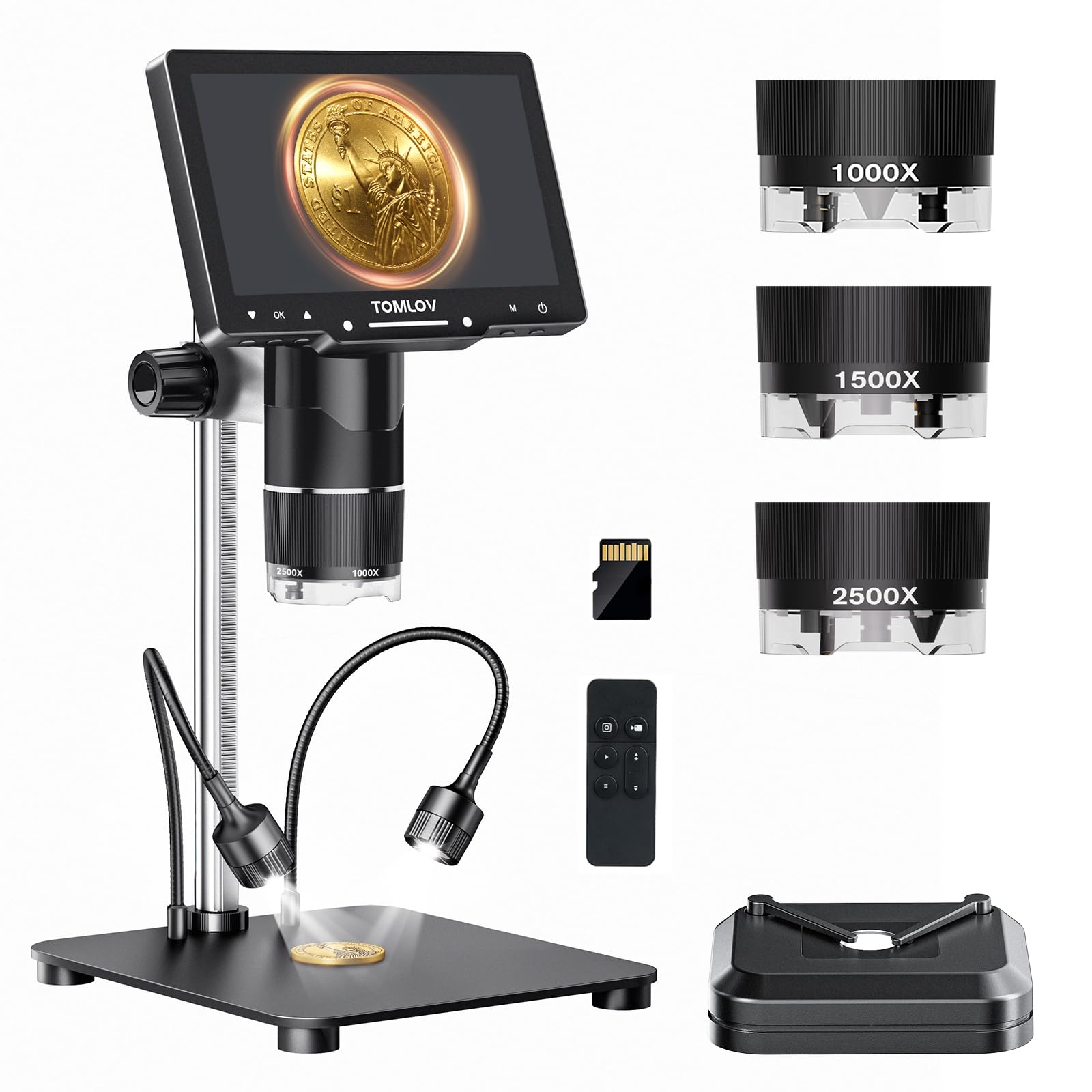
Three dedicated lenses on a rotating barrel mean you twist from coin inspection to soldering to biological slides — no swapping hardware.
This is the only pick that gives you three separate optical paths instead of a single fixed lens. The coin lens (1000X) captures the whole coin from a dime up to a silver dollar thanks to the 12.6-inch stand versus the compact 7.8-inch 4.3″ unit, which means you have real room to work. Switch to the soldering lens (1500X) for PCB (printed circuit board) work or the biological lens (2500X) for prepared slides, and the 7-inch IPS (in-plane switching) screen delivers 2K video so details stay sharp when you zoom in. Reviewers report the picture is crisp at all three magnifications and the stand is stable and easy to adjust.
The lighting system is its other standout feature: 12 built-in lens LEDs plus 2 flexible gooseneck side lights and a slide bottom light, all adjustable independently. One reviewer noted the cable management is a mess of USB cords, and at 7 inches the screen feels small compared to 10-inch units like the JL210. But connected via HDMI (High-Definition Multimedia Interface) to a larger monitor, it performs as advertised.
Why reach for this one
- Three lenses in a rotating head cover coins, soldering, and slides without changing hardware.
- 30MP (megapixel) photo and 2K video capture for high-resolution documentation.
- Rock-solid aluminum alloy stand with a 12.6-inch column for generous working space.
Trade-offs to know
- 7-inch screen is smaller than the 10.1-inch competition; best paired with an external monitor.
- Cable management is messy — multiple USB and power cords to wrangle.
- Height adjustment is coarse and not smooth; some reviewers mention the assembly can open up if loosened.
Your call if: you want one microscope that does coins, electronics, and biology without buying separate tools — especially if you already have a monitor to plug into.
The catch: the 7-inch screen on its own feels cramped for coin work; plan on using the HDMI output for a bigger view.
2. TOMLOV DM10 10.1″ Digital Microscope
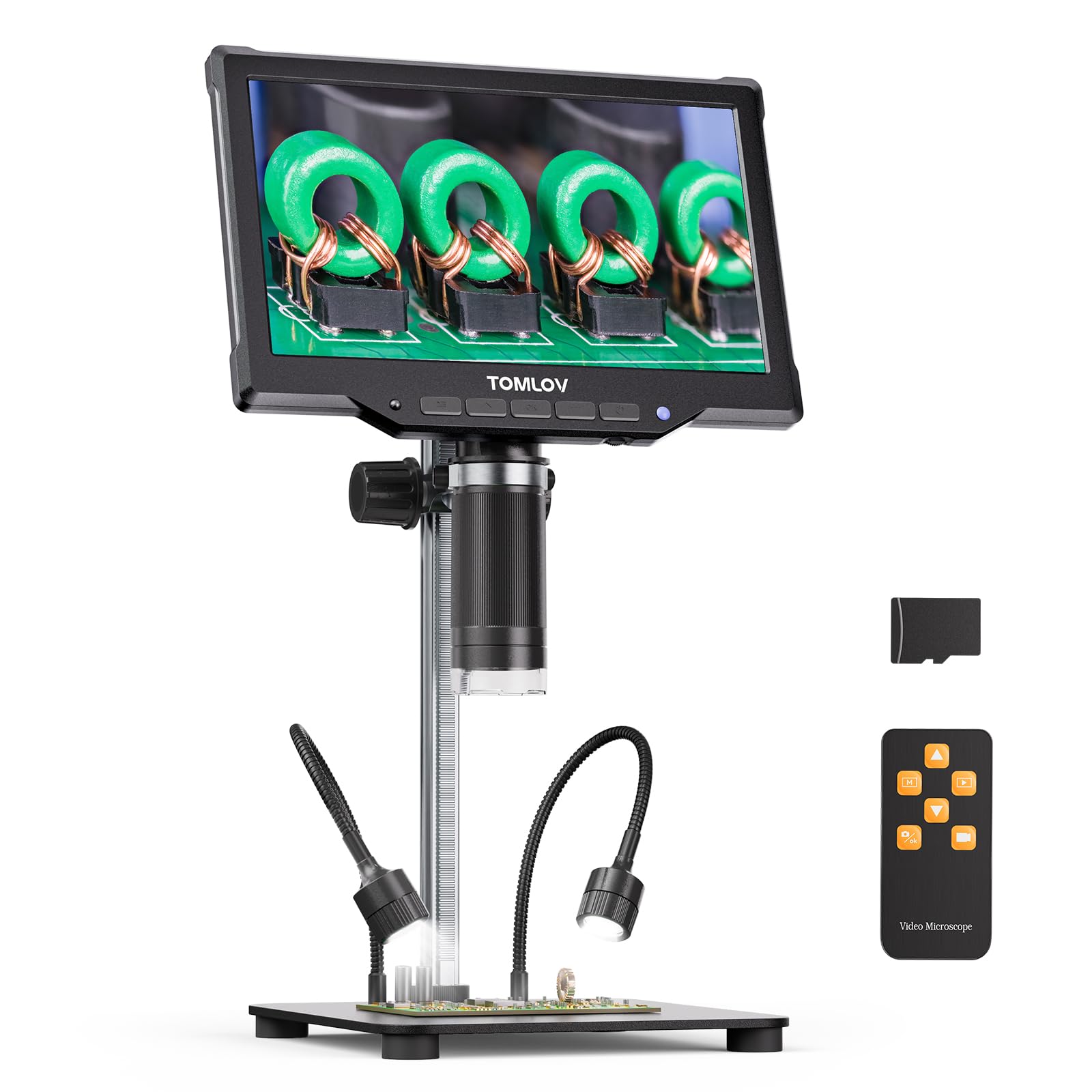
A large 10.1-inch IPS screen that shows a whole silver dollar without panning, paired with 1200X magnification that actually resolves detail at distance.
The DM10 leads on image quality among the full-size scopes here. Its 10.1-inch IPS display delivers a 178-degree viewing angle so you can sit comfortably without hunching, and the 16MP photo resolution (up to 4608×3456 pixels) means each coin scan doubles as a high-res record for your collection. Unlike smaller screens that require you to move the coin around, this one shows the full surface of a Morgan Dollar in a single frame — the main reason serious collectors prefer large-screen units over compact models.
The lighting setup uses 8 adjustable ring LEDs plus 2 flexible gooseneck side lights, all independently dimmable, so you can kill glare on proof coins without losing illumination on the details. The manufacturer claims the built-in battery supports up to 3 hours of use, making it practical for shows or relocating between workbenches. Reviewers consistently mention the sturdy build, smooth focus, and crisp picture, with one calling it one of the best scopes they have used. The trade-off is a learning curve on the on-screen menu system, and a few buyers noted lint inside the lens that arrived from the factory.
Highlights
- 10.1-inch tiltable IPS screen reduces eye strain during long inspection sessions.
- Up to 16MP photo resolution for capturing mint errors in publishable quality.
- Portable with a rechargeable battery that lasts up to 3 hours according to the manufacturer.
Downsides
- On-screen menu system takes time to learn; not immediately intuitive.
- Some units shipped with lint inside the lens — an assembly quality issue to check on arrival.
Go with this if: you want the largest clear display with a battery for desk and off-desk use, and you prioritize image capture quality over ultra-high magnification numbers.
Bear in mind: the menu interface is not plug-and-play — budget a few minutes to figure out the controls.
3. JL210 10.1” Digital Microscope by JOYALENS

The 12.6-inch metal stand gives you 10.2 inches of working distance — enough to capture an entire silver dollar without moving the coin and with room to solder.
This is the scope that solves the two biggest frustrations coin collectors have: not seeing the full coin and fighting poor lighting. The metal stand stands 7.1″L x 7.9″W x 12.6″H, giving you a large base and tall column that keeps the camera steady. At 260X magnification it is lower than the 1000X claims on smaller scopes, but in practice that number is more honest — you get a clear, usable image without the digital zoom artifacts that make tiny numbers blurry. The 12MP camera sensor captures 1080P HD video, and the included 32GB memory card and card reader let you store hundreds of coin photos. Compared to the TOMLOV DM10, the JL210 has a taller stand (12.6 inches vs. the DM10’s shorter base) and a more straightforward control interface.
The lighting package is the most complete at this price tier: 8 built-in ring LEDs, 2 gooseneck spotlights, and a bottom stage light for transparent specimens. Each light adjusts independently so you can light a proof quarter from the side to bring up die cracks without washing out the fields. One buyer mentioned they use it to help evaluate trading cards for grading. The main downsides are that the lights turn on automatically when you power up — and one owner reported a rolling shutter effect (where the image wobbles or distorts) when using a grinding pen nearby, so it is not ideal for heavy vibration environments.
What stands out
- 12.6-inch all-metal stand provides 10.2 inches of working distance — fits large coins and PCBs easily.
- Three separate light sources (ring, goosenecks, bottom) eliminate shadows on reflective surfaces.
- Complete kit from the start: 32GB SD card, wireless remote, metal clips, 5 prepared slides.
Limitations
- Lights turn on automatically at power-up with no way to shut them off independently.
- Fixed camera mount makes it tricky to inspect large PCBs like a motherboard.
Reach for this one when: you need a full-view coin microscope with solid metal build and versatile lighting for both coins and soldering — the best balanced pick for most collectors.
skip it if: you need portability or a battery — this unit stays plugged in on a desk.
4. LM210 10.1” LCD Coin Microscope by LINKMICRO

A fully-equipped 10.1-inch kit with dual side lights and a 32GB card that costs noticeably less than the name-brand competitors at this screen size.
The LM210 matches the JL210 almost spec-for-spec but at a slightly lower entry point. It uses the same 260X maximum magnification versus the 1000X claimed on 4.3-inch units, but with a far more usable 12.6-inch metal stand that holds the camera steady while you adjust fine-focus gears. The 10.1-inch IPS screen rotates so you can tilt it to a comfortable angle during long solder or coin sessions. Its 12MP sensor captures 1080P HD video, and the wireless remote lets you snap photos without touching the scope and shaking the image.
The standout here is the 3D lighting system: 8 adjustable top LEDs plus dual flexible side lights and a bottom-lit slide holder. This matters for coins because you can angle the side lights to hit the surface at a low angle, which brings up fine hairline scratches and die polish lines that top-down ring LEDs miss. Buyers report finding minute coin errors in 4 hours of use and using it for stamps as well. The main frustration is that picture mode Field of View (FOV) does not match what you see on screen — the full coin appears captured but shows up cut off in saved photos. A few reviewers also mention the instructions are hard to follow.
Strengths
- Rotatable 10.1-inch IPS screen reduces neck strain during extended use.
- Dual flexible side lights let you sculpt shadows to reveal surface details on coins.
- Complete kit includes 32GB SD card, wireless remote, and slide holder with bottom light.
Weak points
- Picture mode FOV does not match the live view — saved images cut off part of the coin.
- No external video output for PC or monitor connection.
Best for: collectors who want a large-screen microscope with advanced lighting control and do not need PC connectivity — the lighting system alone makes it worth it for error hunting.
Hold back if: you need to save full-coin photos that match the live view exactly; the FOV mismatch may frustrate documentation.
5. Leipan 4.3″ Coin Microscope Digital Microscope for Collectors
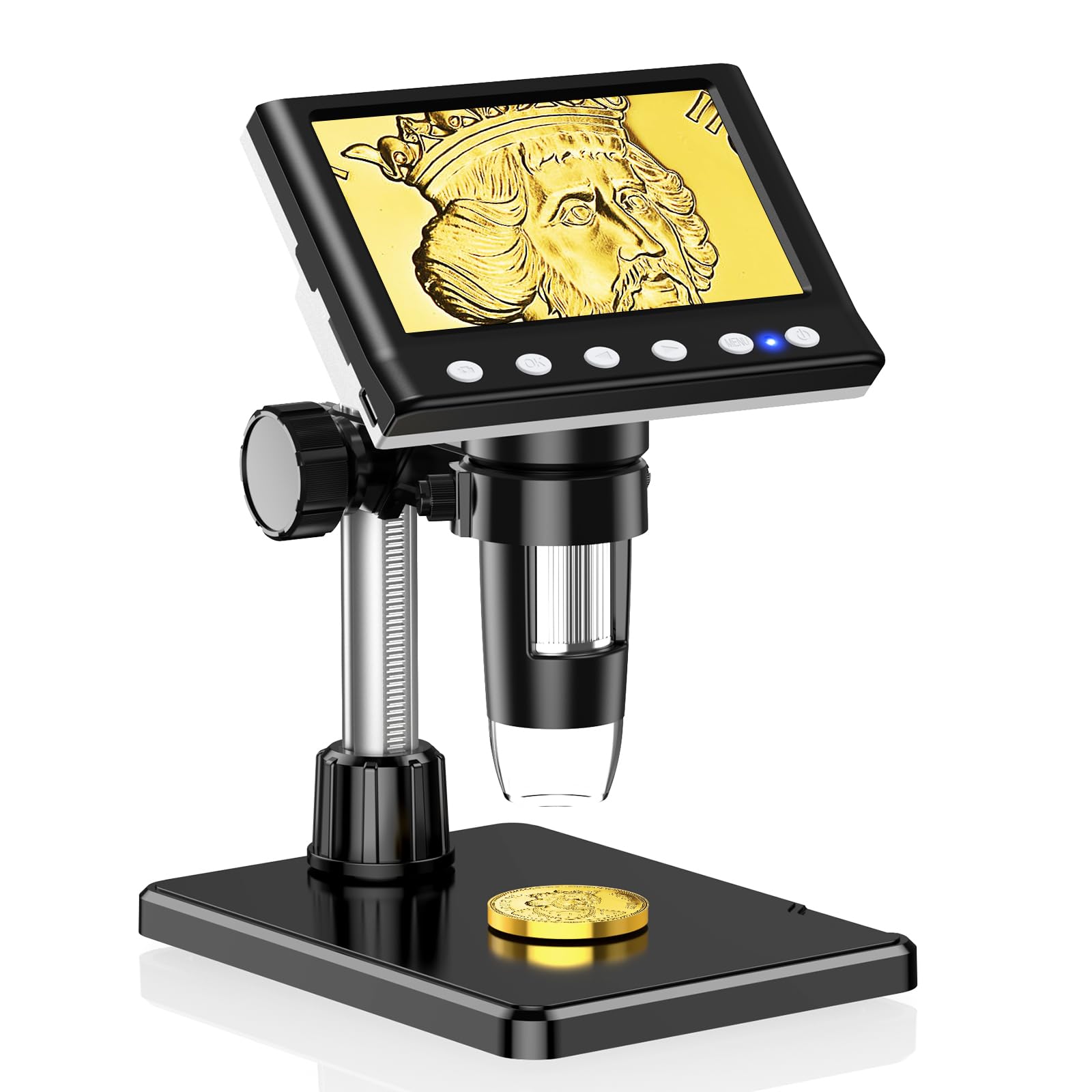
A rechargeable portable scope that fits in a bag and still delivers 1000X magnification with a 178-degree viewing angle — useful for travel.
The Leipan is the smallest pickup here — 5.98″L x 4.09″W x 7.8″H — compared with the taller 12.6-inch stand units, so it slides into a drawer or travel case without issue. The 4.3-inch IPS screen is small by full-size standards, but it shows crisp 1980P HD images with a 178-degree real angle of view, meaning you do not have to sit dead-center to see clearly. The magnification range goes from 50X to 1000X, controlled by adjusting the distance from the coin, and it is battery powered for longer sessions between charges. Compared to the SKYEAR, the Leipan has a higher-resolution screen (1980P vs. 720P on the SKYEAR) and a built-in battery, but it lacks the SKYEAR’s steplessly dimmable LEDs.
Buyers appreciate that it is great for bulk jewelry inspection and comes with a memory card for storing photos and videos. The rechargeable battery and good built-in light are frequently praised as superior to a jeweler’s loupe (a small, hand-held magnifier). However, one reviewer flagged a real issue: the LED lights are blinding on proof coins — the glare washes out details, and lowering the brightness turns off the camera entirely. For circulated coins and raw bullion it works well, but polished proof specimens may need extra care to light.
Why it fits in your kit
- Compact and battery-powered — take it to coin shows or inspect on the couch.
- Upgraded battery life supports prolonged use without hunting for an outlet.
- 178-degree viewing angle means you see clearly from off-center positions.
Where it struggles
- LED lights are harsh on proof coins — glare kills detail and cannot be dimmed independently.
- 4.3-inch screen is too small to show a whole silver dollar; expect to pan around.
Grab it for: portable quick checks, bulk jewelry sorting, and travel — the battery makes it genuinely mobile.
Think twice if: your collection is mostly proof coins with reflective surfaces; the fixed LED light may frustrate detailed inspection.
6. SKYEAR 4.3″ Coin Microscope 1000X Magnification

The lowest-cost entry that still gives you a real 4.3-inch screen and stepless dimmable LEDs — no fixed bright glare — for under fifty dollars.
Unlike the Leipan above, the SKYEAR lets you dial the brightness of its 8 LED fill lights continuously from dim to full, which solves the main problem small scopes have with shiny coins. You can tone down the light on a proof coin until the details show without the washed-out look. The 720P HD digital imaging on the 4.3-inch LCD (liquid crystal display) screen is modest compared to the 1980P claim on the Leipan, but it still captures 1080P photos and videos. Magnification ranges from 50X to 1000X, and the unit converts from desktop mode to a handheld scope in seconds.
Owners mention that after charging the battery, it worked exactly as described — magnification is as expected and the display is clear. One reviewer who bought it as a first coin microscope was impressed enough to return a unit that cost almost four times as much. The only feature missing is a set of clips to hold coins in place; you will need a small bit of sticky tack or a coin holder to keep things steady. It is USB-powered, so it is not fully portable like the Leipan, but the 1-year exchange service gives confidence for a first purchase.
What you get
- Stepless dimmable 8 LED lights let you adjust brightness to avoid glare on reflective coins.
- Converts from desktop to handheld quickly — useful for different coin sizes and positions.
- Very affordable for a first microscope; several buyers preferred it over much pricier units.
What you give up
- No coin clips or holders included — coins slide around on the base plate.
- 720P screen resolution is lower than the Leipan’s; fine details are less crisp at max zoom.
Start here if: you are new to coin inspection and want to try a microscope without a big investment — the dimmable lights and clear screen punch above the price.
Move up if: you need a battery for portability or prefer the larger 10-inch screen for full coin views.
Understanding the Specs
Magnification Realism
The number you see in the product title — 1000X, 1200X, 2500X — is almost always the combined optical and digital zoom (where the camera enlarges pixels electronically). In practice, usable magnification for coin inspection tops out around 200X to 300X on a 10-inch screen. Beyond that, you are just blowing up the same pixels, which makes edges soft and introduces digital noise (a grainy or speckled pattern). Look for a scope that claims a reasonable maximum (260X to 1200X) and delivers a clear image at its mid-range, not one that only focuses at the top number.
Working Distance and Stand Height
Working distance is the space between the lens and the coin. Taller stands (10 to 12.6 inches) let you see a whole silver dollar without moving it and give you room to solder or handle thick coins and holders. Short portable scopes require you to place the lens right on top of the coin, which blocks overhead light and makes full-coin viewing impossible. For any serious collection evaluation, you want a minimum stand height of 10 inches.
FAQ
Can a coin microscope see mint errors like doubled dies and repunched mint marks?
What screen size is best for coin inspection?
Do I need a microscope with a built-in battery or is USB power enough?
Why do my proof coins look washed out under the microscope LEDs?
Is 1000X magnification actually useful for coins or is it marketing hype?
Can I use a coin microscope for soldering or electronics repair?
What does “full coin view” mean and why does it matter?
How do I take good photos of my coins with the microscope?
Will a cheap coin microscope damage my coins?
Final Thoughts: The Verdict
For most people, the best coin microscope is the JL210 by JOYALENS because its 10.1-inch screen and 12.6-inch metal stand give you a full view of any coin with flexible lighting that eliminates blind spots. If you want battery portability and a crisp 10-inch display, grab the TOMLOV DM10. And for budget-conscious beginners who still want dimmable LEDs and a clear 4.3-inch screen, the SKYEAR 4.3″ is a solid entry point that outperforms its price.
How We Picked
We do not accept paid placement. Every pick is matched to a real buyer and a real use-case; we do not hands-on test units.
Sources & Methodology
Specifications: manufacturer listings and product documentation. Review insights: verified customer reviews, as of July 2026. Pricing: not shown on this page (it changes often); check the current price via the retailer link.
As an Amazon Associate, WellFizz earns from qualifying purchases. This does not affect which products we feature.

Mo Maruf
I created WellFizz to bridge the gap between vague wellness advice and actionable solutions. My mission is simple: to decode the research and give you practical tools you can actually use.
Beyond the data, I am a passionate traveler. I believe that stepping away from the screen to explore new environments is essential for mental clarity and physical vitality.