Our readers keep the lights on and my smoothie glass nicely filled. As an Amazon Associate, I earn from qualifying purchases.
That wheezing sound from your AC unit isn’t age — it’s a dirty coil wrapped in a blanket of grime, dust, and grease that kills your system’s efficiency. The right coil cleaner doesn’t just scrub the surface; it chemically lifts years of buildup that a brush alone can’t touch.
I’m Mohammad Maruf — the founder and writer behind WellFizz. My research into coil chemistries, surfactant formulas, and corrosion profiles has helped me separate the true “no-rinse” powerhouses from the diluted pretenders.
If you want to reclaim lost cooling performance without damaging your aluminum fins, you need the best coil cleaner for your specific HVAC system size and dirt load.
How To Choose The Best Coil Cleaner
Picking the wrong coil cleaner can corrode your aluminum fins, leave chemical residue that attracts more dust, or just fail to cut through the baked-on grime. Focus on the chemistry and the application method that matches your unit’s condition.
Foaming Action vs. Liquid Spray
A thick foam clings to vertical coil surfaces and stays in contact long enough to dissolve grease and dirt. Thin liquid sprays run off too fast, wasting product and leaving the bottom of the coil untouched.
No-Rinse vs. Rinse Required
No-rinse cleaners use detergents that break down and evaporate safely without water flushing. Rinse-required formulas are more aggressive but demand careful water pressure to avoid bending fins or flooding drain pans.
Alkaline vs. Acidic Chemistry
Alkaline (caustic) cleaners attack organic grime, grease, and oil without etching copper or aluminum. Acidic cleaners are for mineral scale and need strict safety gear — they can permanently damage microchannel coils if left too long.
Concentrate vs. Ready-to-Use
A concentrated gallon makes up to 10 gallons of cleaner and costs less per use. Ready-to-use spray bottles are convenient for one-off jobs but run out fast and cost more per ounce of cleaning power.
Quick Comparison
On smaller screens, swipe sideways to see the full table.
| Model | Category | Best For | Key Spec | Amazon |
|---|---|---|---|---|
| Nu-Calgon Evap Pow’r 4168-08 | Concentrate | Indoor evap coils & mini-splits | 128 fl oz per gallon | Amazon |
| Quality Chemical Nu-Coil | Concentrate | Heavy condenser grime | Alkaline pH, foaming | Amazon |
| QwikProducts Foaming Coil Cleaner | Ready-to-Use | Quick DIY spray & go | Self-rinsing foam | Amazon |
| RectorSeal Foam-A-Coil 82632 | Concentrate | Commercial coils & microchannel | 1 gallon, bio-friendly | Amazon |
| Nu-Calgon Evaporator Power 416808 | Concentrate | Dirty evaporator & drain pans | No-rinse, low odor | Amazon |
In‑Depth Reviews
1. Nu-Calgon 4168-08 Evap Pow’r No Rinse Coil Cleaner

This gallon jug from Nu-Calgon is the trusted workhorse among HVAC pros who need a predictable no-rinse formula that won’t eat through plastic drain pans. The neutral-to-alkaline detergent chemistry targets the organic grime and mold slime that accumulates on evaporator coils, not the metal itself.
Reviewers report that after vacuuming loose debris and applying a 1:1 mix with a pump sprayer, the dirt literally rolls off the fins without scrubbing. The 128-ounce bottle fills multiple seasons of seasonal cleaning for a split system, and the scent is described as natural and quick to dissipate.
Where this cleaner really separates itself is in rescue scenarios — one user completely cleared a frozen, black-scum-clogged evap coil and restored airflow to factory spec. It’s gentle enough for older aluminum fins but aggressive enough to cut through years of neglect.
Why it’s great
- Safe on plastic drain pans and aluminum fins
- No-rinse formula saves time and prevents water damage
- Excellent value at 128 ounces per gallon
Good to know
- Not a foaming cleaner — it applies as a liquid
- Works best when heavy debris is removed first
2. Quality Chemical Nu-Coil Concentrated Coil Cleaner
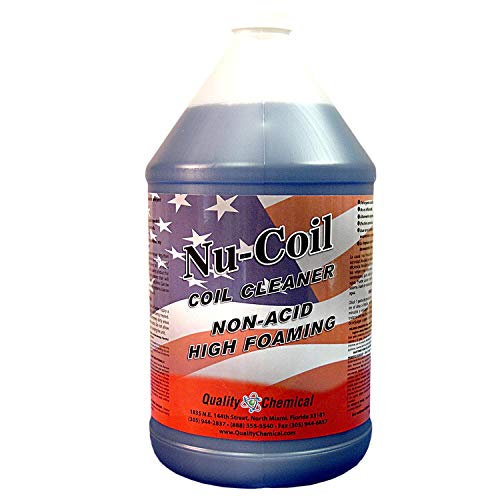
Don’t let the “foaming” label mislead you — this is a heavy alkaline concentrate that produces foam primarily when agitated. The real strength is its ability to dissolve crusted-on dirt, pollen, and mildew on condenser coils that sit outside year-round.
Users who applied this undiluted on severely dirty a-frame coils reported dramatic before-and-after results with just 10 minutes of dwell time. The formula is biodegradable and non-toxic once diluted, making it safe for pets and gardens near the outdoor unit.
One caveat: the high alkalinity means you need chemical gloves and eye protection, especially if using it concentrated. Several reviewers noted little to no visible foaming when mixed per the bottle directions, but the cleaning performance remained strong regardless.
Why it’s great
- Extremely effective on heavy, baked-on grime
- Concentrated — one gallon makes many batches
- Safe on all metal types when properly diluted
Good to know
- Requires PPE — alkaline formula can irritate skin
- Foaming action may be inconsistent per user reports
3. QwikProducts Foaming Coil Cleaner

This ready-to-use aerosol spray is the perfect entry point for homeowners who want a quick maintenance clean without mixing chemicals or buying a sprayer. The no-rinse self-rinsing foam expands on contact and lifts light-to-moderate dust and grease from window AC units and refrigerator coils.
Reviewers love the convenience — spray it on, let the foam do the work, and walk away. The pleasant lemon scent neutralizes the musty odor that often comes from neglected evaporator coils, making it ideal for indoor use in tight spaces.
It won’t replace a concentrated gallon for heavy commercial-grade buildup, but for seasonal DIY cleaning on a single condenser unit or a mini-split, the can size is perfectly matched to the job. Multiple users reported restored cooling on window units that hadn’t been cleaned in years.
Why it’s great
- No mixing, measuring, or sprayer required
- Self-rinsing formula leaves no residue
- Fresh scent that neutralizes coil odors
Good to know
- Small can size — best for one or two cleanings
- Not strong enough for heavy grease or years of neglect
4. RectorSeal Foam-A-Coil 82632 Coil Cleaner

RectorSeal’s Foam-A-Coil is engineered specifically for the tradesman who needs a non-acid solution safe for microchannel coils — the delicate flat-tube coils found on modern high-efficiency AC units. The surfactant-aided foam clings vertically and lifts tars, grease, and dirt without etching metal.
HVAC contractors report that it’s effective on both condenser and evaporator coils, and the bio-friendly formulation means you can rinse it onto grass without environmental concern. The one-gallon bottle, when loaded into a pump sprayer and mixed with warm water, produces a thick foam that holds in place even on windy days.
Where it falls short is consistency: some users received bottles that leaked in transit or produced very little foam. However, for those who got a good batch, the cleaning results were described as “like new” with no harsh chemical smell during or after application.
Why it’s great
- Designed for delicate microchannel coils
- Bio-friendly and non-flammable formula
- Foam clings to vertical surfaces for long dwell
Good to know
- Bottle may lack safety seal — check packaging
- Foaming action varies with water temperature
5. Nu-Calgon 416808 Evaporator Power, 1-Gallon

This is the same trusted Nu-Calgon formula but packaged specifically for evaporator coils and their associated drainage systems. It excels at eliminating the musty “dirty shoe” smell that comes from mold and mildew buildup in mini-split blower wheels and drain pans.
One notable use case came from a homeowner whose Fujitsu heat pump displayed error code 10-1 — a clogged cage indicator. After mixing 3:1 water to formula and applying two passes with a water rinse, the cage and fins looked brand new and the error code cleared permanently.
The solution feels and behaves like a detergent-alcohol blend, which allows it to penetrate tight fin valleys without leaving sticky residue. It’s notably low-odor, making it comfortable for indoor use even in occupied rooms, and the gallon jug provides ample solution for multiple seasons of maintenance.
Why it’s great
- Eliminates mold-related odors from evaporators
- Clears clogged drain pans and blower wheels
- Very low chemical scent during use
Good to know
- Not a foaming cleaner — applies as liquid
- May require gentle brushing for heavy lint buildup
FAQ
Can I use any coil cleaner on microchannel coils?
How often should I clean my HVAC coils?
Do I need to rinse after using a no-rinse cleaner?
Final Thoughts: The Verdict
For most users, the best coil cleaner winner is the Nu-Calgon 4168-08 Evap Pow’r because it combines professional-grade cleaning power with a safe no-rinse formula that won’t harm your drain pan or aluminum fins. If you need a foam that clings to vertical condenser coils, grab the RectorSeal Foam-A-Coil. And for quick DIY maintenance without the mess, nothing beats the QwikProducts Foaming Coil Cleaner.

Mo Maruf
I created WellFizz to bridge the gap between vague wellness advice and actionable solutions. My mission is simple: to decode the research and give you practical tools you can actually use.
Beyond the data, I am a passionate traveler. I believe that stepping away from the screen to explore new environments is essential for mental clarity and physical vitality.