Our readers keep the lights on and my smoothie glass nicely filled. As an Amazon Associate, I earn from qualifying purchases.
A dog that figures out how to open a cabinet can probably solve a flat slide puzzle in ten seconds. Cognitive dog toys flip the usual chew-and-abandon pattern into a brain workout: your dog thinks through a problem, nudges a piece, and earns a treat by working for it. That mental engagement helps hyperactive puppies burn off energy and gives senior dogs a gentle challenge without joint strain.
I’m Mohammad Maruf — the co-founder and writer behind WellFizz. This guide is built by comparing the manufacturers’ published specifications and the patterns across verified customer reviews, so you get each pick’s real strengths and trade-offs instead of marketing spin.
The best cognitive dog toys come in many forms — puzzle boards, snuffle mats, treat-dispensing chew toys. Read on to find the pick that matches your dog’s energy level and learning style.
How To Choose The Best Cognitive Dog Toys
A cognitive toy only works if it fits your dog’s size, chewing force, and how quickly it learns. Three things to check before you buy.
Match the difficulty level to your dog’s learning pace
A beginner puzzle needs one or two simple moves — like sliding a lid to expose a treat. An advanced dog that already breezes through flat boards needs a multi-step challenge, like spinning compartments or hidden pockets, to stay interested. A toy that is too hard frustrates; one that is too easy bores.
Prioritize durable, non-toxic materials for daily use
Look for natural rubber, food-grade ABS plastic (a tough, safe plastic), or BPA-free (bisphenol A-free) materials — especially if your dog uses the toy for meals every day. Aggressive chewers need stronger construction, like rubber reinforced with nylon. Gentle players enjoy plush-based puzzles. Never leave any toy with a dog that can tear and swallow pieces.
Consider treat-pocket design for slow feeding
The best cognitive toys double as slow feeders so your dog eats meals over several minutes instead of gulping in 30 seconds. Check that treat holes are big enough for kibble but small enough that food does not fall out instantly. Holes smaller than a pea are nearly unusable for dry treats and only work as a chew toy.
Quick Comparison
On smaller screens, swipe sideways to see the full table.
| Model | Category | Best For | Key Spec | Amazon |
|---|---|---|---|---|
| KADTC Dog Puzzle Toy | Advanced Puzzle | Smart dogs needing a multi-level challenge | 3 difficulty levels, 4 play modes, spin-to-release | Amazon |
| Outward Hound Hide-A-Squirrel | Plush Puzzle | Gentle players who love hide-and-seek | 6 squeaky squirrels, plush trunk 12.25″ long | Amazon |
| CECE PAW Carrot Farm | Snuffle Mat | Sniffing, foraging, and treat-hiding play | 12 squeaky carrots with 24 treat pockets | Amazon |
| Brightkins Pizza Party | Beginner Puzzle | First-time puzzle dogs and fast eaters | 12 compartments, 9.96″ round, BPA-free plastic | Amazon |
| Pceotllar Indestructible Chew Toy | Budget-Friendly | Aggressive chewers needing a tough, treat-dispensing core | Natural rubber & nylon, beef flavor, 6″ long | Amazon |
In‑Depth Reviews
1. KADTC Dog Puzzle Toy
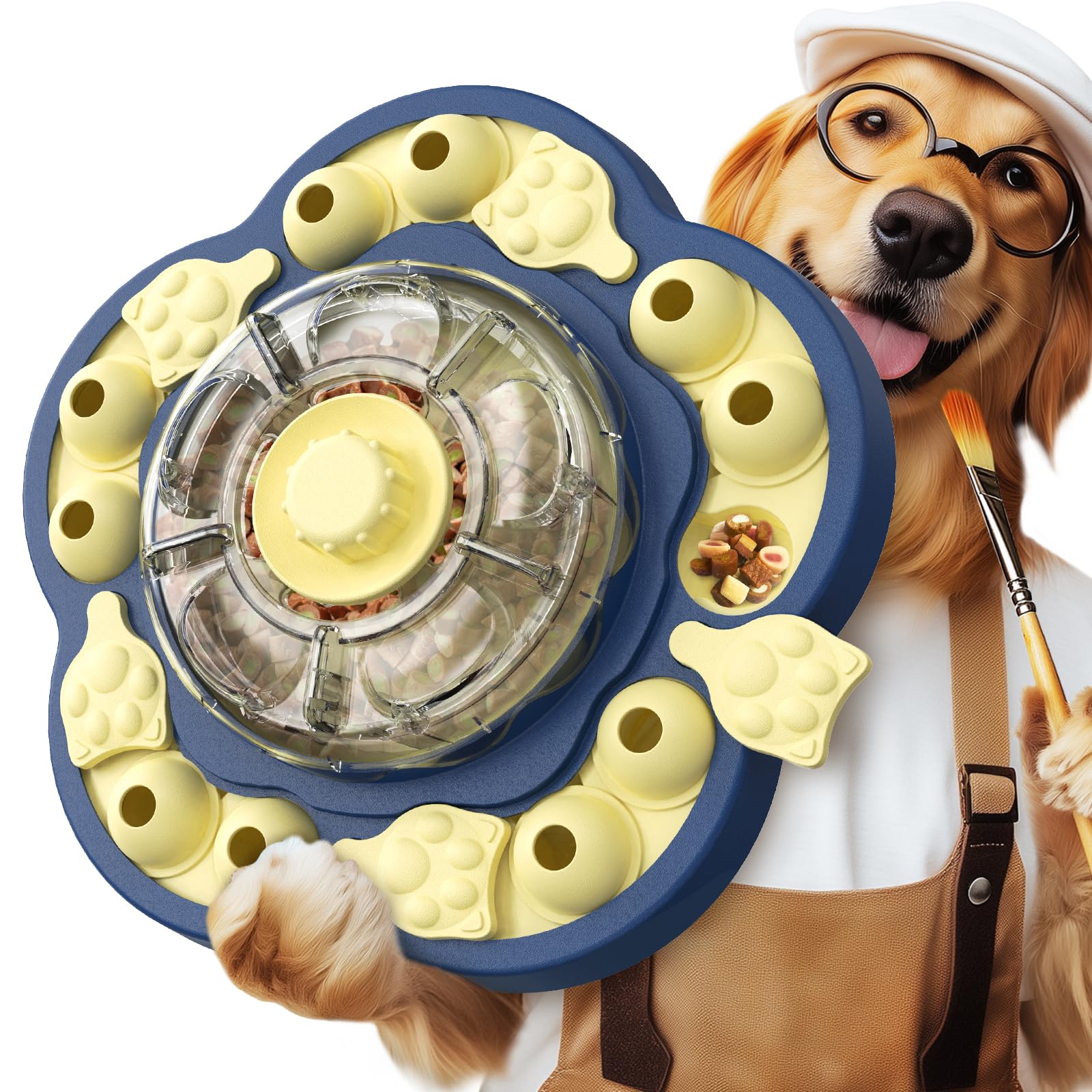
The KADTC earns the top spot because it is the only puzzle here that adjusts to your dog’s skill — it offers 3 separate difficulty levels and 4 play modes using a vertical spin-to-release mechanism, so a curious dog that solves flat boards in minutes still has a reason to come back. If you have a smart, high-energy breed, this is the upgrade over simpler boards.
At 12.99 inches wide and 3.15 inches tall, this sunflower-shaped feeder holds kibble up to 0.67 inches in size inside clear food pods. Your dog spins the center to drop treats into lower compartments, then slides and sniffs to get the reward — turning a 30-second bowl scarf into a 6-to-7 minute mental workout. Buyers report their dogs go from inhaling a meal to solving it for minutes on each level. The ABS plastic (acrylonitrile butadiene styrene) is food-grade and formulated without BPA (bisphenol A), PVC (polyvinyl chloride), or phthalates, making it safe for daily feeding.
Forceful pets can occasionally dislodge the moving parts that cover the treats, creating a potential chewing hazard — so supervise the first few sessions. This is the best overall pick for owners who want one toy that challenges, slows feeding, and stays interesting for months.
Why it’s great
- Three levels of difficulty keep smart dogs engaged long-term.
- Spin-to-release mechanism provides real mental stimulation, not a simple slide.
- Works as a slow feeder — dogs take 6-7 minutes to eat a meal on level two.
Good to know
- Moving parts can be dislodged by forceful chewers, so monitor play.
- Best for dogs 10 pounds and up due to the puzzle height.
2. Outward Hound Hide-A-Squirrel Dog Toy

Unlike the KADTC’s treat-dispensing puzzle, the Hide-A-Squirrel engages pure prey drive: your dog uses its nose to root out 6 squeaky squirrels from a plush tree trunk, a hide-and-seek game that is entirely different from a treat board. Each squirrel has its own squeaker, giving instant audio feedback that keeps dogs motivated to keep hunting.
The XL trunk measures 12.25 inches long by 7 inches wide. Owners mention that the squirrels themselves are surprisingly durable — one reviewer noted that the “log and squirrels still hold up after a year with minor repairs.” However, the plush trunk material is the weak point: determined chewers can shred the tree quickly, while the squirrels survive much longer. This toy suits gentle players — small breeds, seniors, or puppies — who like to nudge and tug rather than shred. Avoid it if your dog is a heavy chewer who destroys soft toys in minutes.
Choose this over the KADTC if your dog’s favorite game is “find the hidden object” and you want a soft toy that doubles as an interactive puzzle — just be ready to replace the tree trunk if you have a chewer.
Where it shines
- Engages natural hunting instincts — dogs love digging the squeaky squirrels out.
- Squirrels hold up remarkably well; one owner got a year out of them.
- X-Large size fits small and medium mouths well.
Worth noting
- Plush tree trunk can be destroyed quickly by aggressive chewers.
- Squirrels lose their tails and some fur over time.
3. CECE PAW Dog Enrichment Puzzle
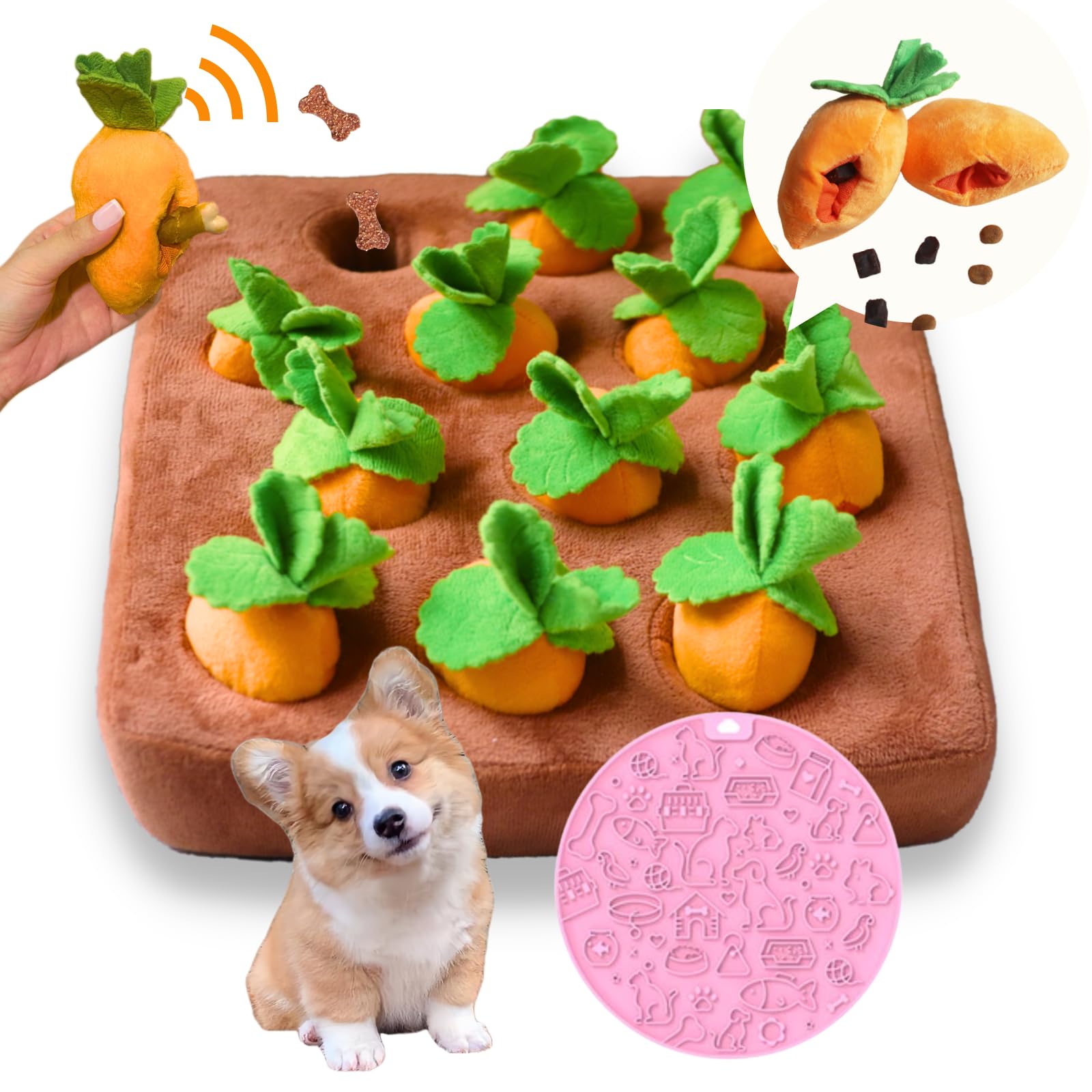
When your dog has already demolished every squeaky toy in the house and still has energy to burn, the Cece Paw Dog Enrichment Puzzle turns that restless drive into a calm, sniffing game — your dog noses through a realistic carrot patch, pulls squeaky carrots out of the mat, and discovers hidden treats inside each one. It is ideal for owners who want a low-noise, focused activity that tires a dog out mentally rather than physically.
Each of the 12 carrots has a hidden treat pocket (24 treat pockets total when you include the sponge mat holes), and the snug Velcro bottoms let you adjust the difficulty. The mat is 13 inches square. Customers note a single 5-to-10 minute play session leads to a nap — one buyer mentioned “cute toy, provides enrichment, 5-10 min play leads to nap.” The included lick mat is a bonus for spreading peanut butter or yogurt.
The standout detail is that the treat pockets are deep but accessible — unlike many puzzle toys, the holes are big enough for small treats without getting stuck, but narrow enough that your dog must sniff and dig to find the reward. This makes it a perfect middle-ground toy for energetic dogs that need calm focus before a nap. If your dog is an aggressive chewer that tears fabric, skip this and go for the tougher Brightkins or KADTC instead.
What stands out
- Dual-layer hiding system (inside carrots plus mat pockets) keeps dogs searching.
- Deep treat pockets prevent tearing while still being accessible to small mouths.
- Comes with an extra lick mat for added enrichment.
The trade-offs
- Holes in the sponge mat can be too narrow for some dogs’ claws.
- Primarily a snuffle activity — not for aggressive chewers.
4. Brightkins Pizza Party! Treat Puzzle
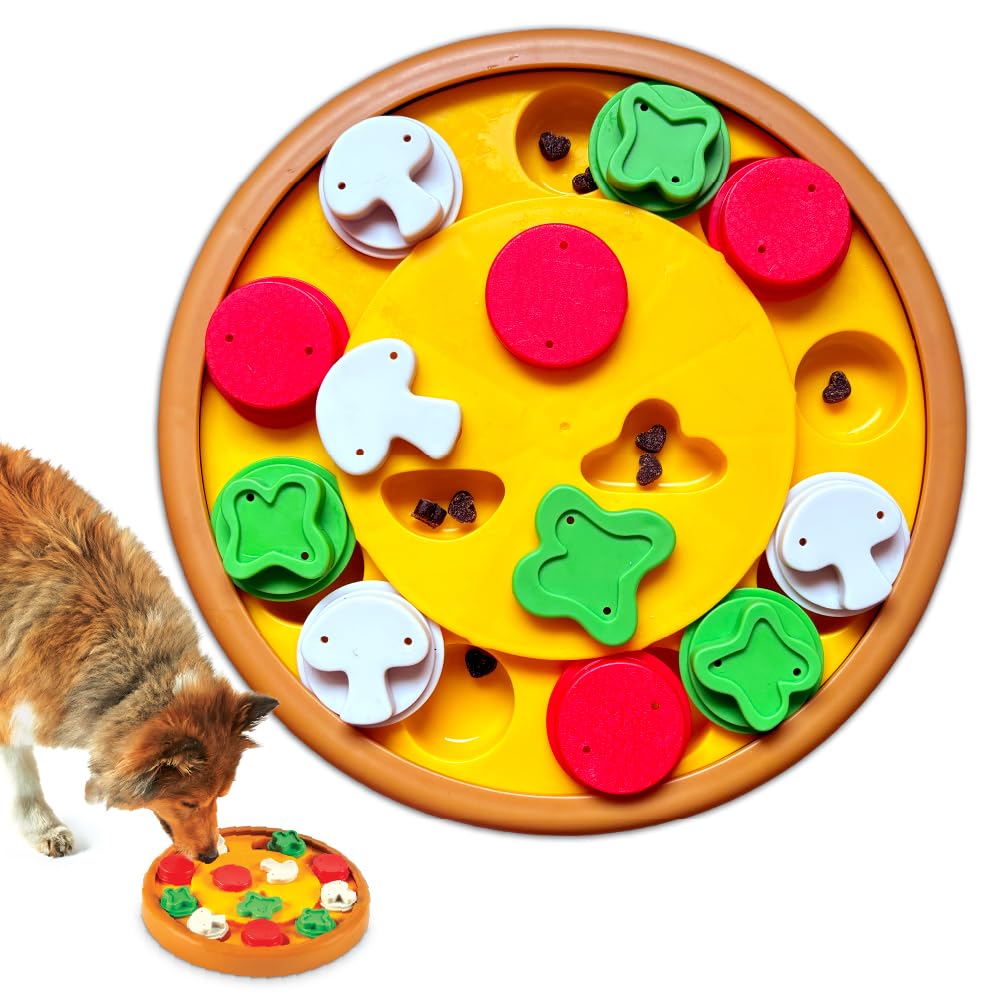
The single number that matters most in this category is the 12 treat compartments — and the Brightkins Pizza Party! Treat Puzzle scores perfectly on that front, offering more hiding spots than many plastic puzzle boards at a lower price. It also comes with a guide written by a certified professional dog trainer (CPDT-KA), making this the best choice for first-time puzzle owners who want a step-by-step introduction.
Measuring 9.96 inches round and made from BPA-free plastic, the compartments hold dry kibble or small training treats. All the “pizza toppings” slide freely in both directions with no locking mechanism. Buyers love that it is “easy to load and easy to clean” — a real convenience for daily use. It also doubles as a slow feeder, encouraging fast eaters to pace themselves and avoid upset stomachs.
The catch is that it is a beginner puzzle: most dogs figure out the sliding motion in a few sessions, meaning it lacks the long-term replay value of a multi-level puzzle like the KADTC. For the price, this is excellent for puppies, senior dogs, or any dog that has never used an interactive toy before — delivering strong price-to-value for its intended audience.
The upsides
- Comes with a dog-trainer-written guide for proper introduction.
- Simple slide mechanism is easy for beginners but offers enough resistance to be a fun challenge.
- BPA-free plastic is safe and easy to clean by hand.
Keep in mind
- Some lid bumps were reported uneven, with minor quality inconsistency.
- Fast learners can solve it quickly — less replay value for advanced dogs.
5. Pceotllar Indestructible Dog Chew Toys

At this budget-friendly price, you get a dual-material toy that combines a natural rubber body with a tough nylon core and an integrated beef flavor that attracts dogs to keep chewing. The rotatable squares slowly drop food as your dog twists the toy — adding a puzzle element to what is really a heavy-duty chew.
The downside is the treat pocket size: the holes are so small (smaller than a pea) that most commercial treats and kibble simply will not fit without jamming. Buyers repeatedly confirm that “the holes are too small to fit any treats” — so the puzzle function is severely limited compared to the KADTC or Brightkins. It is really a chew toy with a slow-feeder gimmick on the side, not a true cognitive puzzle. However, one dedicated owner got “a solid year out of our first before we had to replace,” which is impressive for a toy that costs this little.
This is perfect for owners of aggressive chewers who want the cheapest way to add some treat-dispensing function to a daily chew session — just know you will need to use peanut butter, yogurt, or soft paste rather than standard kibble. If your main goal is a true puzzle that your dog solves with its brain, not its jaws, pick the KADTC instead.
Why we’d pick it
- Extremely durable — reviewers point out a full year of heavy chewing before replacement.
- Attractive beef flavor keeps dogs engaged immediately.
- Very affordable entry point for a chew-and-dispense combo.
A few caveats
- Treat holes are too small for standard kibble — paste or soft food only.
- When the rubber eventually breaks, it creates a fairly large chunk of waste.
Understanding the Specs
Difficulty Level & Replay Value
A one-level slide puzzle works for beginners but gets solved in minutes. Look for toys with 2-3 difficulty levels or multiple play modes (like the KADTC sunflower that switches from easy spin to advanced snuffle) so your dog does not lose interest after a few sessions. Vertical or compartment-based designs tend to offer more long-term engagement than flat boards.
Treat Pocket Size & Slow Feeding Function
The diameter of the treat hole determines whether your dog can actually use the toy for feeding or just chewing. A hole smaller than a pea means standard kibble will not fit — you then rely on soft food like peanut butter. Look for holes at least 0.5 inches wide if you plan to use dry kibble for daily slow feeding. More pockets (12 to 24) mean longer mealtime engagement.
Material Safety & Durability
BPA-free, food-grade ABS plastic, or natural rubber are the safest choices because your dog mouths the toy directly. For aggressive chewers, rubber reinforced with nylon (as seen in the Pceotllar) survives far longer than plush or basic plastic. Plush toys like the Hide-A-Squirrel are best for gentle players — heavy chewers should avoid them unless closely supervised.
Size & Indoor Usability
A puzzle that is too small frustrates large dogs; one that is too large intimidates small breeds. The best cognitive dog toys for small dogs stay under 12 inches long and weigh under 1 pound. For all dogs, check the weight — a heavy plastic puzzle is loud on wood or tile floors, while a mat-style toy stays quiet and can be used in crates or on carpet.
FAQ
Can a cognitive dog toy replace a daily walk or training session?
How do I teach my dog to use a puzzle toy if they seem confused?
Are puzzle toys safe for puppies under six months?
Will a puzzle toy actually help with separation anxiety or destructive behavior?
How often should I clean a treat-dispensing puzzle?
Final Thoughts: The Verdict
For most dogs, the best cognitive dog toys winner is the KADTC Dog Puzzle Toy because it offers real multi-level challenge that stays interesting for smart dogs while doubling as a slow feeder for daily meals. If you want a gentle hide-and-seek toy that triggers your dog’s natural prey drive, grab the Outward Hound Hide-A-Squirrel. And for budget-conscious owners who need a tough chew toy with a treat-dispensing twist, the Pceotllar Indestructible Chew Toy delivers impressive durability for the price.

Mo Maruf
I created WellFizz to bridge the gap between vague wellness advice and actionable solutions. My mission is simple: to decode the research and give you practical tools you can actually use.
Beyond the data, I am a passionate traveler. I believe that stepping away from the screen to explore new environments is essential for mental clarity and physical vitality.