Our readers keep the lights on and my smoothie glass nicely filled. As an Amazon Associate, I earn from qualifying purchases.
Burnt, dusty, or flat — even the best store-bought coffee loses its soul days after the bag is sealed. Green coffee beans, on the other hand, stay vibrant for up to two years, waiting for you to unlock their flavor. A coffee roaster transforms those unassuming green seeds into a batch of fragrant, crackling beans that taste like the origin itself.
I’m Mohammad Maruf — the founder and writer behind WellFizz. I’ve spent hundreds of hours researching air vs. drum roasting, batch size trade-offs, smoke management, and how build quality affects consistency across more than 50 roaster models.
Whether you roast once a week or every morning, the right machine changes everything. This guide reveals which best coffee roaster fits your kitchen, your budget, and your preferred roast profile.
How To Choose The Best Coffee Roaster
Home coffee roasters fall into two camps: fluid bed (hot air) and drum. Fluid bed machines use convection to tumble beans, producing clean, bright flavors with fast roast cycles. Drum roasters use a rotating metal cylinder with direct or gas heat, offering deeper body and more control over development time. Your choice depends on batch size, preferred roast level, and where you plan to roast.
Batch Size and Capacity
Entry-level roasters handle 100–300g per batch; premium models go up to 500g or 1 lb. Larger capacity means fewer batches per week, but longer roast times can reduce consistency. For a household of two, 120–200g per batch is often ideal. For weekly meal-preppers, a 300–500g drum machine saves significant labor.
Temperature Control and Roast Profiling
The ability to adjust heat and airflow mid-roast separates basic machines from serious tools. Machines with step-less power settings and independent fan control let you stretch the drying phase, accelerate Maillard reaction, or drop the temperature for a slow caramelization. Digital displays with real-time temperature feedback make reproducibility possible.
Smoke and Chaff Management
Roasting generates smoke and chaff (the papery skin that flakes off beans). If you plan to roast indoors, look for an integrated chaff collector and a smoke filter or venting system. Fluid bed roasters generally produce more airborne chaff, while drum machines confine it inside the drum. Outdoor roasting eliminates the smoke concern entirely.
Quick Comparison
On smaller screens, swipe sideways to see the full table.
| Model | Category | Best For | Key Spec | Amazon |
|---|---|---|---|---|
| Fresh Roast SR800 | Fluid Bed | Best Overall | 226g batch, digital control | Amazon |
| MAGO MAGA Roma Pro | Fluid Bed | Smart Auto Profiles | 300g capacity, auto/manual modes | Amazon |
| Fresh Roast SR540 Bundle | Fluid Bed | Complete Starter Kit | 120g batch, extension tube included | Amazon |
| Precision Coffee Roaster PKF-500 | Drum | 1 lb Batch with Smoke Filter | 1 lb capacity, smoke filter | Amazon |
| Fresh Roast SR540 | Fluid Bed | Compact & Reliable | 120g batch, 9 power levels | Amazon |
| DYVEE KAKA-G400 | Gas Drum | Outdoor Propane Roasting | 300–400g capacity, quartz drum | Amazon |
| ANGELLOONG Upgrade | Drum | Mid-Range Value | 750g capacity, 1200W | Amazon |
| JIAWANSHUN Upgraded | Drum | Entry Level Budget | 500g capacity, 1200W | Amazon |
| GIVEROO 500g | Drum | Budget-Friendly Runner Up | 500g capacity, 800W | Amazon |
In‑Depth Reviews
1. Fresh Roast SR800
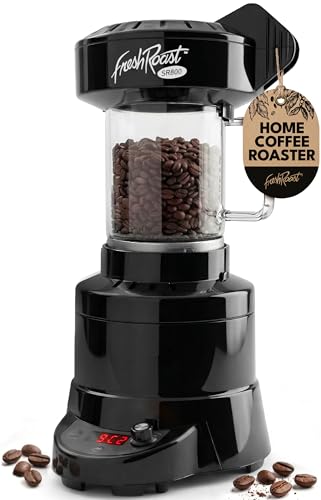
The SR800 is the sweet spot in home roasting: a fluid bed machine that roasts up to 226g per batch in under 10 minutes. Its independent heat and fan controls let you shape the roast curve precisely, from a gentle drying phase to a fast first crack. The digital display shows real-time temperature, and the push-knob interface, while a bit quirky, gives you full manual authority.
Users consistently report even roasts and excellent repeatability once you dial in your profile. The glass roasting chamber lets you watch the beans dance — no guessing when first crack finishes. The chaff collector works well, but roasting indoors still produces noticeable smoke, so positioning near a range hood or roasting outside is recommended.
The 1200W heating element is powerful enough for most climates, though some users in cold weather (below 60°F) note it struggles to reach high temperatures quickly. Built-in temperature readings can be slightly off; using an external infrared thermometer gives more accurate drop-temperature control. The included chaff collector doubles as a cooling tray in a pinch.
Why it’s great
- Excellent roast uniformity from fluid bed agitation
- Independent heat and fan control for custom profiles
- Fast 8–10 minute roast cycle
Good to know
- Built-in thermometer may be inaccurate; best with IR gun
- Produces significant smoke; needs ventilation or outdoor use
- Single multi-function knob can be unintuitive at first
2. MAGO MAGA Roma Pro
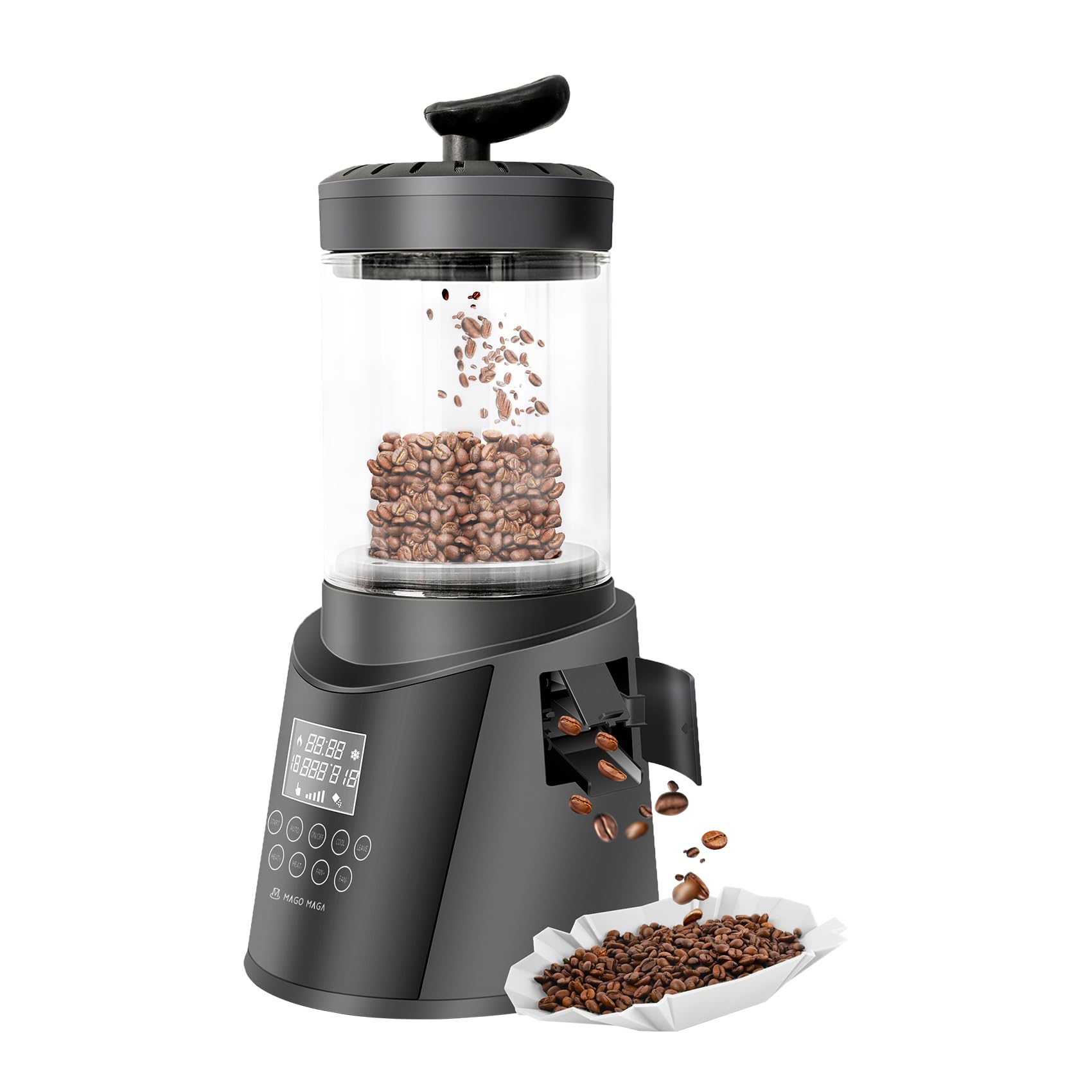
The Roma Pro brings a modern, semi-automatic approach to home roasting with a user-friendly digital display and both automatic and manual modes. Its 300g capacity (about ¾ lb) is generous for a fluid bed machine, and the double-layer glass window offers clear visibility of the roast progression. The auto mode is reliable for most standard green beans, while manual mode gives experienced roasters access to full temperature and time control.
An efficient chaff collector and upgraded version 1.5 bean bin door switch improve reliability. Users report consistent roasts with even color development, especially when sticking to the recommended 250g batch size. The auto-cooling cycle locks in flavor quickly. That said, the 120V model roasts a bit slower than higher-voltage versions, and some users experienced heating element failure after 50 lbs of use, though customer service responded quickly with replacements.
The compact footprint (6″ x 8.3″ x 18.5″) fits neatly on a countertop, and the removable glass parts make cleaning straightforward. This is one of the better options for beginners who want a guided roasting experience without sacrificing the ability to eventually go manual.
Why it’s great
- Auto and manual modes suit all skill levels
- Large 300g batch for a fluid bed roaster
- Double-layer glass window for clear visibility
Good to know
- 120V model roasts slower than expected
- Heating element longevity is inconsistent past 50 lbs
- Auto profiles may underperform with decaf beans
3. Fresh Roast SR540 Bundle
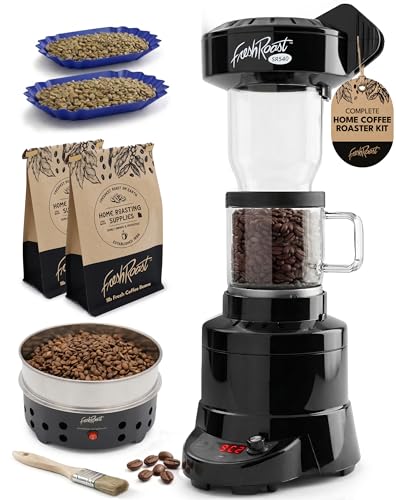
This bundle packages the reliable SR540 fluid bed roaster with a glass extension tube, a dedicated bean cooler, green coffee beans, sample trays, and a chaff brush — everything a newcomer needs to start roasting immediately. The SR540 itself roasts up to 120g per batch (about 4 scoops) in 5–6 minutes, making it ideal for espresso drinkers who roast every 2–3 days.
The glass extension tube improves heat retention and bean movement, significantly boosting consistency for larger batches. The included bean cooler stops the roast quickly, preserving development. Users report that the extension tube is essential for getting even results with batches over 90g. The standalone unit’s compact size and simple digital controls (fan 1–9, heat 1–9, time in 0.1-minute increments) make it approachable for beginners.
Some users find the extension tube unwieldy and prone to tipping, and the gaskets require occasional adjustment. The chaff collector works well but adds weight. For those who roast multiple batches back-to-back, the included cooler saves significant time over air-cooling in a colander.
Why it’s great
- Complete starter kit with cooler, tubes, and sample beans
- Glass extension tube improves roast consistency
- Fast 5–6 minute roasts for small batches
Good to know
- Extension tube can tip over easily during use
- Gaskets need periodic adjustment for proper seal
- Limited to 120g max batch size
4. Precision Coffee Roaster PKF-500
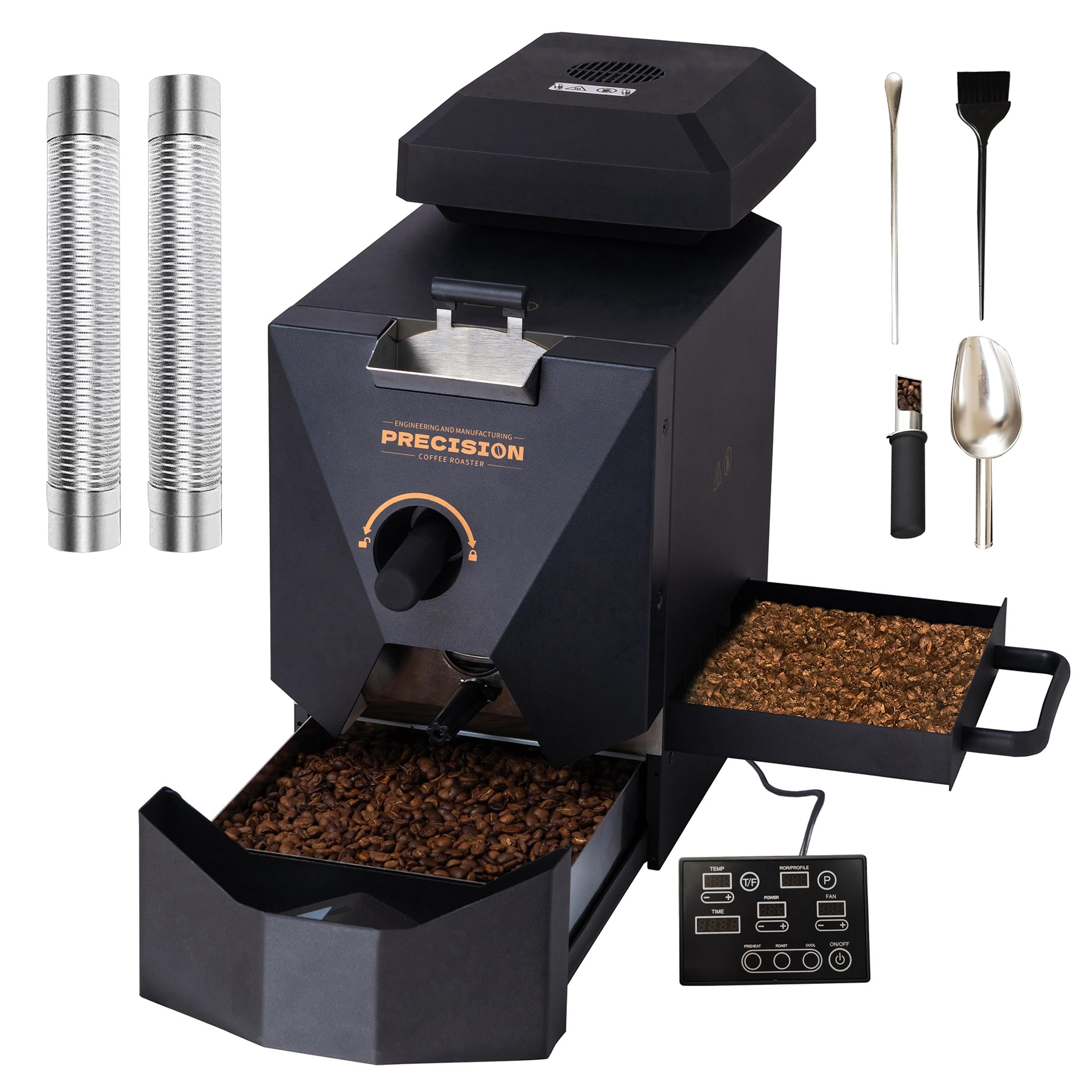
The PKF-500 stands out for its generous 1 lb capacity and integrated smoke filter with dual chimney tubes — a rare combination in home roasters. This drum machine offers automatic, assisted, and manual modes, giving you flexibility depending on your experience level. The stainless steel body feels robust, and the touchscreen interface, though not perfectly responsive, provides access to multiple pre-set roast profiles.
Users who have roasted over 50 lbs report good consistency when the machine is watched and manually stopped at the desired level. The smoke filter genuinely reduces indoor odor, making this one of the few roasters suitable for indoor use with proper ventilation. The observation window and sample spoon allow you to pull beans mid-roast to check color and development.
Reliability is the main concern here: some users experienced moisture leaking into the circuit board, causing loss of control mid-roast. Running a cool-down cycle between batches helps, but the touchscreen responsiveness frustrates some. Tech support responsiveness varies. For those willing to manage these quirks, the capacity and smoke management are unmatched in this class.
Why it’s great
- 1 lb batch size reduces roasting frequency
- Integrated smoke filter and vent pipes for indoor use
- Multiple pre-set profiles with manual override
Good to know
- Touchscreen can be unresponsive and labels hard to read
- Moisture from exhaust can damage circuit board
- Tech support response times are inconsistent
5. Fresh Roast SR540
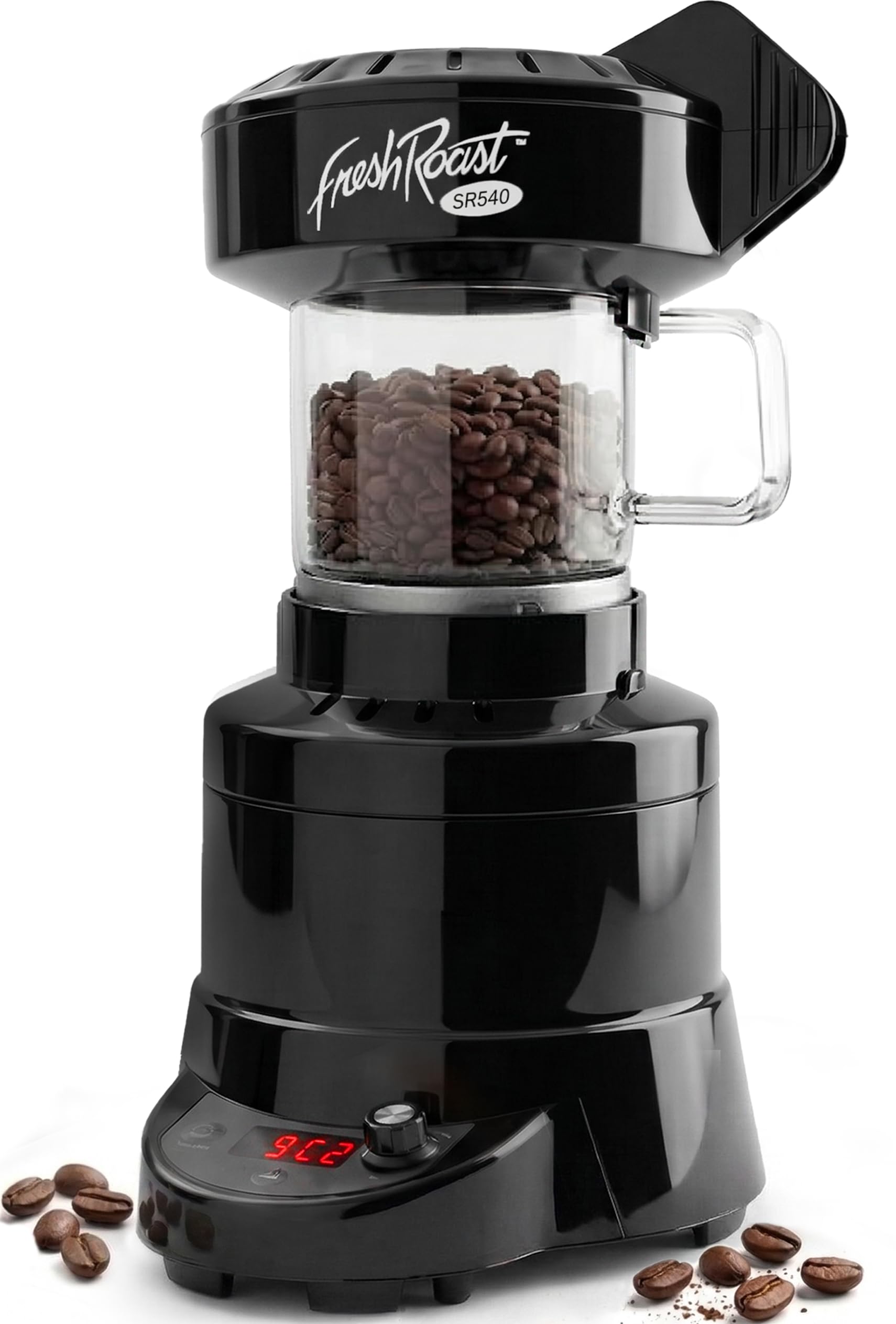
The standalone SR540 is the workhorse of the Fresh Roast line — a simple, rugged fluid bed machine with nine power levels and a chaff basket. It roasts up to 120g in about 7–10 minutes, and its analog controls (heat, fan, and timer knobs) are intuitive even for first-timers. Many users report hundreds of batches over several years with consistent results.
The glass roasting chamber is easy to clean, and the chaff collector captures most debris, though some chaff escapes during the early drying phase. Roasting under a range hood or outside keeps smoke manageable. Users who upgraded from the SR540 to the SR800 note that the smaller machine is more forgiving for learning roast profiles, and the fan is strong enough to agitate beans evenly even at lower batch sizes.
The analog knob can become wonky after extended use, but the manufacturer has a reputation for sending free replacement parts even after the warranty period. The SR540 is a proven entry point that holds its value — many owners keep it as a backup after upgrading.
Why it’s great
- Proven durability with hundreds of batches reported
- Intuitive analog controls — easy for beginners
- Good manufacturer support and replacement parts
Good to know
- Analog knob can become imprecise over time
- Max batch size is only 120g
- Lacks digital programmability for repeatable profiles
6. DYVEE KAKA-G400

The KAKA-G400 is a gas-powered drum roaster designed for outdoor use over a propane burner. Its quartz glass drum lets you watch beans tumble and change color in real time — the most transparent view of any roaster here. The stainless steel frame and wooden handle give it a premium feel, and the 12V motor is safe and quiet.
Capacity maxes out at 400g, with the sweet spot around 250–300g for even roasts. Users report roasting 30+ lbs through the machine with consistent results. The glass drum develops a brown patina over time, which is normal and doesn’t affect performance. Chaff management is straightforward: it escapes through slots in the drum, so roasting outdoors is essential to avoid mess.
Assembly is simple, but the included thermometer is slow to respond and its mount is clumsy. Small beans can get stuck in the metal tubes and burn, creating smoke. The glass drum can break if dropped, so careful handling is required. For those committed to outdoor roasting, this is one of the best value drum machines available.
Why it’s great
- Transparent quartz glass drum for full visibility
- Gas-powered — no voltage limitations
- Solid stainless steel construction with wooden handle
Good to know
- Requires propane burner — not electric
- Small beans can get stuck and burn in drum slots
- Included thermometer is slow and poorly mounted
7. ANGELLOONG Upgrade

The ANGELLOONG Upgrade is a drum roaster with a large 750g capacity and 1200W heating element. Its adjustable temperature range (100–240°C) and 0–60 minute timer give you plenty of control. The honeycomb non-stick interior ensures even heat distribution and makes cleaning relatively easy — a damp cloth wipes away most residue.
The transparent lid with four ventilation holes provides good visibility during the roast, and the standing handle keeps the lid stable when removed. Users who roast 300g batches report that the machine can produce city roasts with good development in about 25 minutes. The agitator arm rotates slowly, which some users find gentler on beans than faster-spinning drum designs.
Reliability is the weak point. Several users report the machine lasting 1–2 years with regular use, and the heating element can fail abruptly — there’s no user-service path. The fixed agitator arm may need bending to prevent occasional jams with small beans. For the price, it offers good capacity and decent consistency, but don’t expect it to last a decade.
Why it’s great
- Large 750g batch capacity for bulk roasting
- Honeycomb non-stick interior for even heat and easy cleaning
- Adjustable temp and timer for versatile profiles
Good to know
- Heating element may fail after 1–2 years
- Agitator arm can jam with small beans
- No user-serviceable parts for component failures
8. JIAWANSHUN Upgraded

This compact drum roaster from JIAWANSHUN packs a 500g capacity (recommended 300–500g) and 1200W of power into a footprint of just 13 x 13 inches. It offers 0–240°C temperature adjustment and a built-in timer, making it accessible for beginners who want to experiment with different roast levels. The transparent glass lid with ventilation holes lets you track color changes without opening the machine.
The automatic stirrer rotates beans during roasting, but several users note that the stirring arms can catch small or defective beans, causing the mechanism to jam or reverse. Pre-sorting beans — removing broken or undersized ones — is essential for reliable operation. The honeycomb non-stick interior cleans easily with a damp cloth. Some owners report using the machine for three batches before noticing wear on the stirring components.
Build quality is mixed: the plastic body feels less substantial than metal alternatives, and there are reports of the heating coil crimp failing after 8 months. However, at this entry-level price point, users generally find it a worthwhile tool for learning the basics of drum roasting. The machine also roasts nuts and popcorn, adding versatility.
Why it’s great
- Affordable entry point into drum roasting
- 500g batch with 0–240°C temperature control
- Transparent lid for monitoring roast progression
Good to know
- Stirring arms can jam with small or defective beans
- Heating coil durability is questionable past 8 months
- Plastic body feels less robust than metal roasters
9. GIVEROO 500g

The GIVEROO 500g is a budget-friendly drum roaster that offers the same 500g capacity as the JIAWANSHUN but with a slightly different design philosophy. Its automatic auger system keeps beans moving continuously, and the 45-degree scope design aims for more uniform roasting. The recommended batch size is 400–500g — smaller batches risk uneven results.
Users who roasted about 200 lbs over 3.5 years with the first unit frame the longevity fairly: the machine is inexpensive enough to treat as a consumable. The straight-sided pan provides more surface area than curved competitors, which some small growers prefer for even heat distribution. The stirring arms are straight rather than curved, which some users find sturdier.
On the downside, the ceramic part of the spinning arm can shatter after just a few uses, and the company offers no product support for replacement parts. The agitator arm also pinches beans mid-roast, potentially jamming the machine. If you’re willing to accept a short lifespan (some users report as little as 3–4 uses before failure), it’s the most affordable way to experiment with 500g drum roasting.
Why it’s great
- Lowest cost option for 500g drum roasting
- Straight-sided pan for even heat distribution
- Automatic auger system for continuous bean movement
Good to know
- Stirring arm ceramic part can shatter after few uses
- No company support for replacement parts
- Agitator pinches beans and may jam mid-roast
FAQ
Can I roast indoors with a fluid bed roaster?
How long do green coffee beans stay fresh?
What is first crack and second crack in coffee roasting?
How much coffee can I roast per week for a household of two?
Final Thoughts: The Verdict
For most users, the best coffee roaster winner is the Fresh Roast SR800 because it balances batch size, control, and reliability in a proven fluid bed platform. If you want automatic profiles and a generous 300g capacity, grab the MAGO MAGA Roma Pro. And for outdoor propane drum roasting with the fullest visibility, nothing beats the DYVEE KAKA-G400.

Mo Maruf
I created WellFizz to bridge the gap between vague wellness advice and actionable solutions. My mission is simple: to decode the research and give you practical tools you can actually use.
Beyond the data, I am a passionate traveler. I believe that stepping away from the screen to explore new environments is essential for mental clarity and physical vitality.