Our readers keep the lights on and my smoothie glass nicely filled. As an Amazon Associate, I earn from qualifying purchases.
A coffee maker for business isn’t a countertop appliance — it’s a productivity asset that either keeps your team caffeinated or becomes a bottleneck that slows the whole morning down. The difference between a home-grade drip brewer and a correctly specced commercial unit is measured not in bells and whistles but in gallons per hour, tank volume, and the ability to survive back-to-back brew cycles without losing temperature or breaking a seal. This guide breaks down the nine models that actually hold up under real workplace demand.
I’m Mohammad Maruf — the founder and writer behind WellFizz. I spent hundreds of hours parsing commercial brew specs, reading verified buyer accounts, and weighing thermal retention data against tank capacity to separate the machines that are built for a breakroom from the ones that will let your team down by the third pot.
Whether you’re outfitting a small office, a bustling church kitchen, or a large event hall, finding the right coffee maker for business requires understanding brew speed, carafe design, and heating element durability — three factors that consumer-grade machines rarely get right.
How To Choose The Best Coffee Maker For Business
A business coffee maker is defined by three non-negotiable elements: brew speed, thermal endurance, and total output capacity. Consumer machines often cite cup count but lack the heating element wattage to sustain high-volume cycles. Before you buy, consider the flow rate: a machine that claims 100 cups but takes two hours to finish isn’t a business tool — it’s a liability. Look for a minimum brew time of one cup per minute for any model over 50 cups. For smaller offices (10–30 people), a dual-warmer drip machine with a 12-cup carafe and a fast heat-up time (under 10 minutes) will handle peak demand. For breakrooms serving 50+ people, a pour-over urn with a 3.8-gallon-per-hour rating is the baseline.
Tank Material and Thermal Retention
The internal water tank is the engine. Stainless steel tanks hold temperature more consistently than aluminum and resist mineral scale buildup longer. A machine with a dual heater system — one to boil and one to hold — prevents the common problem of the first pot being hot and the third being lukewarm. Boil-dry protection is a mandatory safety feature: if the tank runs empty, the unit should shut off automatically rather than melting its own casing.
Filtration and Grounds Management
Commercial filters are typically gold-tone mesh or paper. Mesh filters reduce recurring costs and produce cleaner flavor, but they require regular rinsing to avoid oil buildup. Paper filters are disposable and catch fine sediment better, which matters if your team prefers a lighter roast. The grounds basket should lock firmly into place: a loose basket is the leading cause of coffee grounds ending up in the water reservoir, which kills flavor consistency and clogs the dispenser valve.
Certification and Compliance
NSF International certification is the gold standard for food-service equipment. An NSF-listed machine has passed construction, material, and cleanability tests that a standard consumer appliance hasn’t. ETL or Intertek listing also indicates third-party safety testing. If your business is subject to health inspections, a certified unit may be a requirement, not a preference. Home-grade machines that lack these certifications often use internal wiring and plastics that can degrade under continuous daily heat exposure.
Quick Comparison
On smaller screens, swipe sideways to see the full table.
| Model | Category | Best For | Key Spec | Amazon |
|---|---|---|---|---|
| BUNN 13300.0003 | Pour-Over | High-volume breakrooms | 3.8 gallons per hour | Amazon |
| BUNN 13300.0001 | Pour-Over | Small offices, durable build | 3.8 gallons per hour | Amazon |
| SYBO SF-CB-2GA | Drip Dual Warmer | Mid-size office, dual carafe | 2 x 12-cup carafes | Amazon |
| Proctor Silex 45100R | Commercial Urn | Large events, church functions | 100 cups, NSF listed | Amazon |
| Keurig K-Elite | Single-Serve | Diverse drink preferences | 75 oz water reservoir | Amazon |
| Keurig K-Classic | Single-Serve | Quick single cups on demand | 48 oz water reservoir | Amazon |
| Cuisinart DCC-3200 | Mid-Range Drip | Small to mid office (budget) | 14 cups, adjustable temp | Amazon |
| Kenmore 12-Cup | Mid-Range Drip | Value-conscious breakroom | 12 cups, bold brew mode | Amazon |
| Homecraft 100-Cup Urn | Large Event Urn | Budget large gatherings | 100 cups, dripless faucet | Amazon |
In‑Depth Reviews
1. BUNN VP17-3 (13300.0003)

The BUNN VP17-3 Low Profile Pourover is the benchmark for serious office coffee service. With a 3.8-gallon-per-hour output and three independently controlled lower warmers, this machine lets you keep decaf and regular flowing simultaneously without swapping carafes. The pour-over design eliminates plumbing entirely — anyone can pour in cold water and get hot coffee in about three minutes because the internal tank keeps water at brewing temperature 24/7. The low-profile body means even shorter team members can pour without reaching, a thoughtful ergonomic detail for busy kitchens.
Longevity is where the VP17-3 separates itself. Verified owners report 12 to 15 years of daily church and office use before any electrical service is needed. The stainless steel tank resists scale better than aluminum, and the SplashGard funnel keeps hot liquid away from the hand during pour-in. Paper filters catch fine sediment, producing a clean cup every time. Note that decanters are not included, so factor that into your total setup cost. The unit has no auto shutoff, which means it’s always on — you can pair it with an outlet timer to save energy overnight.
The machine requires a consistently fine grind and proper tamping to avoid under-extraction. If your team prefers a darker roast, the fast thermal transfer of the BUNN system actually produces a brighter flavor profile — some roasters may need adjustment. For any breakroom that serves more than 50 cups daily, this is the machine that will still be brewing a decade from now.
Why it’s great
- 3.8 gallons per hour handles peak morning demand
- Three warmers let you serve different blends simultaneously
- Low-profile design fits under standard cabinets
- 15-year-plus lifespan reported by real users
Good to know
- Decanters not included
- No auto shutoff; requires outlet timer for energy savings
- Always-on internal tank draws standby power
2. BUNN VP17-1SS (13300.0001)

The single-warmer version of the BUNN commercial pourover is the same powerhouse engine in a more compact footprint. It still delivers 3.8 gallons per hour and the same 3-minute brew cycle thanks to the always-hot stainless steel internal tank. The single warmer makes it ideal for offices that need one strong, consistent pot at a time — think a small law firm, a dental practice, or a back-office suite where volume is high but variety is not required.
The machine is notably plastic-free in its water path, which appeals to buyers concerned about chemical leaching from heated plastic components. The optional stainless steel funnel and filter basket upgrades eliminate the last plastic parts. The unit ships with a paper filter starter kit and a standard decanter, but many users eventually switch to a thermal carafe to keep coffee hot without a burner. BUNN’s commercial-grade heating element recovers almost instantly, so back-to-back brews are consistently hot — not a gradual temperature drop like home-grade machines.
The main limitation is the lack of a programmable on/off switch. Without an auto shutoff, the unit is always drawing power to maintain tank temperature. A simple smart plug timer solves this, but it’s an extra step. The height (17.3 inches) can be tight under some cabinets, so measure your space before purchasing. For a mid-size team that values durability over features, this is the workhorse that keeps delivering.
Why it’s great
- Zero plastic in the water path
- Fast 3-minute brew from cold pour
- Build quality that lasts beyond a decade
- Optional thermal carafe upgrade available
Good to know
- Single warmer limits simultaneous service
- Always-on system needs a timer for off-hours
- Height may not fit under low cabinets
3. SYBO SF-CB-2GA

The SYBO SF-CB-2GA is a fully ETL- and Intertek-certified commercial drip machine designed for offices that need two simultaneous pots. The dual warming plates let you brew a fresh 12-cup pot while the previous pot stays hot, eliminating the classic office coffee problem: “the first pot is cold by the time you get a second cup.” The multi-stream shower head saturates grounds evenly, producing consistent extraction across the full brew basket. Users in busy offices and restaurants consistently praise the flavor quality and the speed — a full 12-cup cycle finishes in under 10 minutes.
The stainless steel construction and proprietary drip-free carafe spout are standouts. The lid design arcs the pour and wicks residual coffee back into the pot, which keeps countertops clean and eliminates the sticky mess that plagues many glass carafes. The flat-bottom filter basket is compatible with standard commercial paper filters and also works well with reusable gold-tone filters for reduced ongoing costs. SYBO backs the unit with three decades of stainless steel manufacturing experience, and customer service responsiveness is frequently mentioned positively in reviews — a rare quality for machines in this price tier.
Some users report that the filter hole size can be restrictive, slowing brew speed slightly on very fine grinds. A few isolated complaints mention the unit tripping GCFI outlets, which may indicate an electrical grounding sensitivity in certain installations. Overall, for a mid-size business that serves 30 to 60 cups per morning, the dual-warmer format is a practical upgrade from single-carafe machines.
Why it’s great
- Dual warmers keep two carafes hot simultaneously
- Drip-free spout design prevents counter mess
- ETL/Intertek certified for commercial safety
- Quick 12-cup brew in under 10 minutes
Good to know
- Filter hole can slow brew with fine grinds
- May trip GCFI outlets in some installations
- 30-day return policy may feel short for commercial use
4. Proctor Silex Commercial 45100R
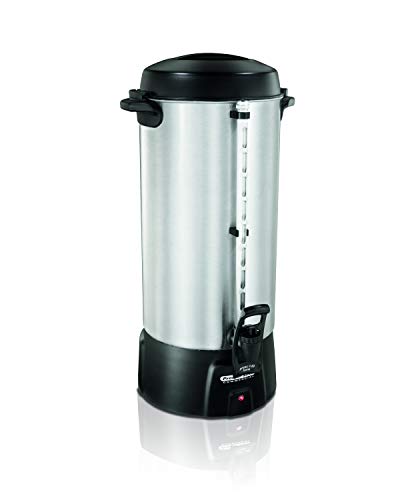
The Proctor Silex 45100R is a commercially rated, NSF-listed 100-cup aluminum urn built for serious volume. Its dual heater system is the key engineering feature: a central heater brings the water to boil for brewing, then shuts off automatically, leaving a gentle warming element to hold the coffee at serving temperature without overcooking it. This prevents the burned, bitter taste that happens when cheap urns keep the main heater running all day. The one-handed dispensing faucet fills cups quickly, and the twist-and-lock lid stays secure even if the urn is accidentally knocked over — a real safety feature for crowded event spaces.
Brew speed is roughly one cup per minute, so a full 100-cup batch takes about an hour. That’s standard for this class, but it means you need to plan ahead for peak service times. The water/coffee level window gives you a clear visual reading, and the removable uptube simplifies cleanup. The brushed aluminum exterior is lighter than stainless steel equivalents (about 6.5 pounds), which makes the urn easier to transport between rooms or to off-site events. Users report consistent results for church functions, wedding receptions, and even 1,000-person fair booths where multiple urns were used in parallel.
The plastic grounds basket is a weak point. Over time — especially with frequent use — the basket can warp, allowing coffee grounds to slip into the water reservoir. Some users have reported defective units that overflow or leak from the spout during first use. The six-month warranty feels short for a commercial appliance, and customer service responsiveness is inconsistent. Still, for a budget-friendly NSF-certified option, the output-to-price ratio is hard to beat.
Why it’s great
- NSF certified for health-inspected commercial kitchens
- Dual heater prevents burned coffee taste
- Lightweight brushed aluminum for easy transport
- Twist-and-lock lid for spill safety
Good to know
- Plastic grounds basket can warp over time
- Brews 100 cups in about one hour
- Mixed reviews on build consistency; some units defective
5. Keurig K-Elite

The Keurig K-Elite is the premium single-serve option for a business where individual drink preferences vary widely. The 75-ounce water reservoir is the largest in its class, allowing for about 9 to 10 brews before a refill — critical for a busy breakroom where refilling a tiny tank every few cups would slow the morning flow. Brew sizes range from 4 to 12 ounces, with a dedicated iced coffee setting that brews hot over ice for a full-flavored cold cup. The strong brew button extends the steeping cycle for a more intense extraction, which satisfies the dark-roast crowd without requiring a separate machine.
Temperature control is a genuine business feature. You can adjust the brew temperature by a few degrees, which matters if your team includes specialty coffee drinkers who find standard Keurig output too cool. The hot water on-demand button works for instant oatmeal, tea, or soup — expanding the machine’s utility beyond just coffee. The quiet brew technology is noticeable: at 10 PM in a shared office, the machine won’t sound like a construction site. The programmable auto-off and maintenance reminder keep the unit running reliably over months of daily use.
The K-Elite’s durability is a step up from budget Keurig models, but it is still a consumer-grade machine at its core. Multiple users report units lasting about two years before developing internal leaks or breaker issues. The internal assembly is hard to descale thoroughly without disassembly, and scale buildup can trigger mid-brew shutdowns. For a small office (under 15 people) that values variety and speed over volume, this is the strongest single-serve choice. For higher volume, you’ll want a drip or pour-over alongside it.
Why it’s great
- 75 oz tank minimizes mid-morning refills
- Adjustable temperature and strong brew mode
- Iced coffee and hot water dispenser functions
- Compact footprint for tight counter space
Good to know
- Internal assembly is difficult to descale
- Reported lifespan around 2 years with daily use
- Not designed for high-volume continuous brewing
6. Keurig K-Classic

The Keurig K-Classic strips away the curves and extra modes in favor of a straightforward, three-button interface that any employee can operate without training. The 48-ounce removable water reservoir supports about six to seven consecutive brews before needing a refill, which is adequate for a breakroom with 10 to 15 daily users. The auto-off feature is programmed to shut down after two hours of inactivity, saving energy when the office clears out for meetings or end-of-day. The machine includes a charcoal water filter and a starter pack of four K-Cup pods, so it’s ready to brew out of the box.
The simplicity is the K-Classic’s strongest asset for a business context. There’s no strength selector, no temperature control, no iced setting — just 6, 8, or 10 ounces. This reduces confusion and maintenance calls. The water reservoir detaches completely, making refills easier than fixed-tank designs. Users consistently report three to five years of daily use with no mechanical failures, which is better than average for the Keurig family. The quiet operation also gets frequent praise: the brew cycle is noticeably less noisy than earlier generations.
The trade-off for simplicity is lower maximum output. The K-Classic cannot brew into a travel mug taller than about 7.25 inches even with the drip tray removed. The first cup out of a cold machine is sometimes noticeably cooler than subsequent cups, which can be an issue for the early-morning employee who hits the machine before anyone else has used it. For a budget-friendly, no-fuss single-serve option in a small business setting, the K-Classic is a proven performer that doesn’t try to do too much.
Why it’s great
- Simple three-button operation, zero learning curve
- Removable 48 oz reservoir for easy refilling
- Programmable auto-off saves energy after 2 hours
- Quieter brew cycle than older Keurig models
Good to know
- No temperature or strength adjustment
- First cup can be cooler than subsequent brews
- Cannot fit very tall travel mugs
7. Cuisinart DCC-3200

The Cuisinart DCC-3200 is a 14-cup programmable drip machine that sits at the intersection of home convenience and light-commercial practicality. The PerfecTemp feature lets you adjust the hot plate temperature to keep coffee hot without scalding it — a rare control on drip machines at this level. The brew strength selector (regular or bold) lets you customize the extraction time for lighter or darker roasts without changing your grind. With a gold-tone commercial-style permanent filter included, ongoing costs are near zero once you buy the machine.
For a small office (under 20 people), the DCC-3200 offers real advantages. The 1-4 cup setting reduces brew time and ground coffee waste when you’re only making a partial pot. The programmable timer means coffee is ready when the first employee arrives. The carafe spout design is the main point of contention: when the pot is full, the spout tends to dribble down the side instead of pouring cleanly. Several users note that the narrow water opening makes filling difficult without a funnel, which can lead to spills on the base unit. The glass carafe itself is thin and prone to chipping if handled roughly.
Durability is decent but not commercial-grade. Owners report a lifespan of 2 to 4 years with daily use before the pump or heating element fails. The keep-warm mode can overcook coffee if left on for extended periods — using an insulated carafe instead of the glass pot and hot plate is a common workaround. For a budget-friendly entry into office brewing that still delivers hot, adjustable coffee, the DCC-3200 is a solid mid-range pick.
Why it’s great
- Adjustable hot plate temperature prevents burnt coffee
- 14-cup capacity suits small to mid offices
- Bold brew mode for stronger extraction
- Gold-tone permanent filter reduces waste
Good to know
- Spout leaks when pouring from a full carafe
- Narrow water opening makes refilling messy
- Lifespan of 2–4 years with daily use
8. Kenmore 12-Cup Drip

The Kenmore 12-Cup Programmable Coffee Maker brings the features you’d expect from a mid-range home brewer into a package that works well for a small business on a tight budget. The 12-cup capacity (1.8 liters) fits standard breakroom demand for about 10 to 15 people. The bold flavor brewing button works by slowing the water flow to steep the grounds longer, which produces a noticeably richer cup than the regular cycle. The built-in charcoal water filter removes chlorine and off-flavors from tap water, which is a genuine upgrade over cheaper models that assume you’ll use filtered water separately.
The pause-and-serve function stops the brew flow for up to 20 seconds when you remove the carafe — a practical feature in a busy office where someone always needs a cup before the cycle ends. The gold-tone reusable filter is included, which saves the recurring cost of paper filters. The dishwasher-safe carafe makes cleanup easier than many units that require hand-washing. Several users report that the machine brews better coffee than their previous Cuisinart, with hotter temperatures and more consistent extraction.
Reliability is the main concern. A significant minority of users report units that stop heating water after a few months, or tanks that are difficult to remove for cleaning. The three audible beeps at the end of a brew cycle and at auto shut-off cannot be disabled, which can be annoying in a quiet office early in the morning. The exterior finish is stainless steel, but the plastic components in the water path may degrade over time with hard water. For the price, the feature set is generous, but the build quality is entry-level.
Why it’s great
- Bold brew mode produces noticeably stronger coffee
- Charcoal water filter improves tap-water taste
- Pause-and-serve for mid-brew pouring
- Included gold-tone reusable filter saves on supplies
Good to know
- Loud beeps at brew end cannot be muted
- Some units fail or malfunction within months
- Plastic tank components may degrade with hard water
9. Homecraft 100-Cup Coffee Urn

The Homecraft 100-Cup Coffee Urn is the entry-level choice for large gatherings where budget is the primary constraint and serving temperature is more important than nuance. The quick-brewing system claims one cup per minute, which means a full 100-cup batch takes slightly over an hour — in line with other urns in this class. The dripless faucet operates with a light push for single cups or a sustained press for filling carafes, and it keeps the serving area clean compared to spigot-style dispensers that drip between pours. The keep-warm function automatically holds coffee at serving temperature for hours, which is essential for events where service spans a long morning or afternoon.
The internal water level is indicated by an external sight window rather than interior markings, which is a common design compromise at this price point. You’ll need to use the external gauge to measure your fill, which is less precise than etched tank walls. The plastic grounds basket is functional but can warp over time, particularly if the urn is used frequently for high-volume events. When the basket warps, grounds can slip past the filter and end up in the water reservoir, producing gritty coffee. The 6.5-pound weight in stainless steel makes it surprisingly portable — one person can carry it from storage to serving station.
The short six-month warranty and reports of units failing within that window are the biggest drawbacks. Some customers received defective units that never heated properly, and customer service replacement policies are inconsistent. For a church kitchen that uses it once a week, the risk is manageable. For a daily-use commercial kitchen, the build quality gap between this and an NSF-listed unit like the Proctor Silex becomes apparent quickly. This urn is best thought of as a backup or occasional-use machine rather than a primary daily brewer.
Why it’s great
- 100-cup capacity at a very accessible price point
- Dripless faucet keeps serving area clean
- Keep-warm function maintains temperature for hours
- Light enough for one person to carry
Good to know
- Plastic grounds basket warps over time, causing grinds in coffee
- External water gauge less precise than internal markings
- Short warranty and inconsistent QC on units
FAQ
Can I use a home drip machine in a small office with 15 people?
How many cups can a 100-cup urn actually serve in a business setting?
What does NSF certification mean for a business coffee maker?
Is a pour-over coffee maker better than an urn for office use?
How often should I descale a commercial coffee brewer?
Final Thoughts: The Verdict
For most businesses, the coffee maker for business winner is the BUNN VP17-3 because its 3.8-gallon-per-hour output, three-warmer configuration, and decade-plus lifespan make it the most cost-efficient long-term investment for any office serving more than 30 cups daily. If you want dual-carafe flexibility for a mid-size team, grab the SYBO SF-CB-2GA. And for high-volume single-serve variety in a small office, nothing beats the Keurig K-Elite with its 75-ounce tank and adjustable brewing parameters.

Mo Maruf
I created WellFizz to bridge the gap between vague wellness advice and actionable solutions. My mission is simple: to decode the research and give you practical tools you can actually use.
Beyond the data, I am a passionate traveler. I believe that stepping away from the screen to explore new environments is essential for mental clarity and physical vitality.