Our readers keep the lights on and my smoothie glass nicely filled. As an Amazon Associate, I earn from qualifying purchases.
Specs are compiled from manufacturer listings and verified buyer reviews and can change over time — please confirm the key details on the product page before buying.
Your cafe machine needs to pull shot after shot in the morning rush without heat loss, and let your baristas work fast — one weak link and the whole line stalls. This guide walks you through four commercial-grade espresso machines built for that reality, with honest trade-offs you need to know before you buy.
I’m Mohammad Maruf — the founder and writer behind WellFizz. This guide is built by comparing the manufacturers’ published specifications and the patterns across verified customer reviews, so you get each pick’s real strengths and trade-offs instead of marketing spin.
A heat-exchanger boiler (a single boiler that heats brew water and steam separately at the same time), a 3-liter water tank, and a semi-automatic workflow separate the true workhorses from the kitchen toys. If you are outfitting a busy counter, these are the details that make or break your service — that is exactly what this guide to the coffee machine for cafe is designed to uncover.
Our Picks at a Glance

How To Choose The Best Coffee Machine For Cafe
A cafe espresso machine is different from a home model — it must keep up with back-to-back orders without overheating or slowing down. Focus on these four areas to get the right one.
Boiler System: Heat Exchanger vs Dual Boiler
A heat-exchanger boiler lets you brew espresso and steam milk at the same time without waiting for the temperature to stabilize. That is critical when you have three drinks on the ticket. Dual-boiler machines are also excellent, but they often cost more and take up more space. For most mid-volume cafes, a heat-exchanger setup (like the ones in this guide) gives you the speed you need without the premium price of a two-boiler rig.
Water Tank Capacity and Direct Plumbing
The bigger the reservoir, the fewer times someone has to stop and refill mid-service. A 2.5-liter tank (like on the Rocket Appartamento) might work for a low-volume counter, but a 3-liter tank (like on the Nuova Simonelli Oscar II) saves a trip during a busy morning. Many commercial machines also accept a direct water line — that way you never refill at all.
Build Quality and Weight
A heavy stainless-steel frame absorbs vibration and keeps the machine planted when you lock in the portafilter. The Diletta Bello weighs 50 pounds — that is a significant anchor. Lighter machines (the Nuova Simonelli Oscar II weighs 13.01 pounds) are easier to move for cleaning but may shift around on the counter during hard use.
Serviceability and Parts Availability
When a part fails — and in a high-volume cafe, parts will fail — you need to fix it fast. Machines with an E61 brew group (Diletta Bello, Rocket Appartamento) use a widely shared standard, so replacement gaskets, screens, and springs are easy to find from any espresso parts supplier. Proprietary systems may mean longer downtime while you wait for a specific part from the manufacturer.
Quick Comparison
| Model | Best For | Boiler Type | Water Capacity | Weight | Amazon |
|---|---|---|---|---|---|
| Nuova Simonelli Oscar II★ Best Overall | Light-to-mid volume; easy setup | Heat Exchanger | 3 liters | 13.01 lbs | Amazon |
| Diletta Bello | High volume; serious barista control | Heat Exchanger (E61) | 3 liters | 50 lbs | Amazon |
| Rocket Espresso Appartamento TCA | Premium build; adjustable brew pressure | Heat Exchanger (E61) | 2.5 liters | 48.5 lbs | Amazon |
| Jura X8 Platinum | Super-automatic; one-touch drinks | Thermoblock | 167.3 fl oz | N/A | Amazon |
In‑Depth Reviews
1. Nuova Simonelli Oscar II Espresso Machine
Our pick — over 4★ from 60+ verified ratings; the strongest balance of quality and price.
A semi-automatic that packs a 3-liter tank into a 13-pound frame for light counters.
If your cafe has limited counter space or you need a machine that one person can lift for cleaning, the Oscar II is the lightest pick here at 13.01 pounds — that is 37 pounds lighter than the Diletta Bello. Yet it still holds a 3-liter water tank, matching the Bello’s capacity. You get a heat-exchanger system, so pulling shots and steaming milk happens simultaneously, just like on the heavier machines.
Reviewers call it “great value and delicious coffee — super easy to use!” and note it works well for office and small cafe setups. You can also hook it directly to a water source to skip the reservoir entirely. The included tamper, portafilter, milk frother, and shot baskets mean you have everything to start pulling shots from the start. However, one buyer mentioned a serious issue: “after 2 weeks, machine stopped producing coffee (steam wand still worked).” That is a risk if you depend on it for daily service.
Compared to the Rocket and Diletta, the Oscar II lacks an E61 brew group, so parts are less standardized. But for a low-volume cafe or a pop-up where weight and size matter most, this machine is a smart, affordable place to start.
Reasons to Choose It
- 3-liter reservoir — tied for the largest available here
- Weighs only 13.01 pounds for easy repositioning
- Can connect directly to a water line
Potential Dealbreakers
- Shoppers say the machine stops pulling shots after a couple of weeks
- Not an E61 group — replacement parts are less universal
- Thin packaging reported; risk of damage in transit
Great for small spaces: If you have a light-volume cafe, a small counter, and want a machine you can hook to a water line, the Oscar II offers excellent value and capacity.
Not for high volume: The reliability risk from multiple reports means it is better as a backup or for low-traffic spots.
2. Diletta Bello Espresso Machine | Heat Exchanger | E61 | Manual Control | 3 Liter | Made In Italy | (Stainless Steel)

A 50-pound Italian workhorse built for baristas who want total manual control.
Your barista can pull a shot and steam milk at the same time with no waiting, thanks to the heat-exchanger system. Capacity is the first thing you notice here: the Diletta Bello carries a 3-liter boiler, serving 20% more water than the Rocket Appartamento’s 2.5-liter tank — that means fewer refills between rushes. It is also handcrafted in Milan, Italy, with a stainless-steel frame and boiler.
Buyers report the fast warm-up — under 10 minutes — and consistent shots from the anti-channeling screen (a filter that prevents water from finding a single path through the coffee puck). But there are trade-offs. Owners mention the machine “leaks water from base after 2 months (filter replaced, recurred).” The single-shot portafilter also tends to leak hot coffee from the group head face. At 50 pounds, you need a sturdy counter and a strong back to move it for service — it is 37 pounds heavier than the Nuova Simonelli Oscar II’s 13.01 pounds.
The Eco Mode (a 60-minute timer) helps save energy during slow periods. For a cafe where volume is high and a barista is behind the machine dialing in each shot, this is the one that gives you the most control and the most water on tap.
Why It Earns the Top Spot
- Fast warm-up under 10 minutes
- 3-liter boiler — largest capacity tied in this list
- E61 brew group with widely available parts
What to Watch For
- Customers note persistent water leaks from the base
- Weighs 50 pounds — hard to move
- Long warm-up (30 min) reported by some for proper pressure
Best for high-volume counters: If a trained barista will operate the machine and you need the biggest water tank available here, the Diletta Bello delivers the manual control and durability your cafe demands.
If reliability is your top priority: The water-leak reports from buyers are a real concern for a primary machine — the Oscar II is lighter and easier to service if downtime is not an option.
3. Rocket Espresso Appartamento TCA Espresso Machine (Black/Copper)
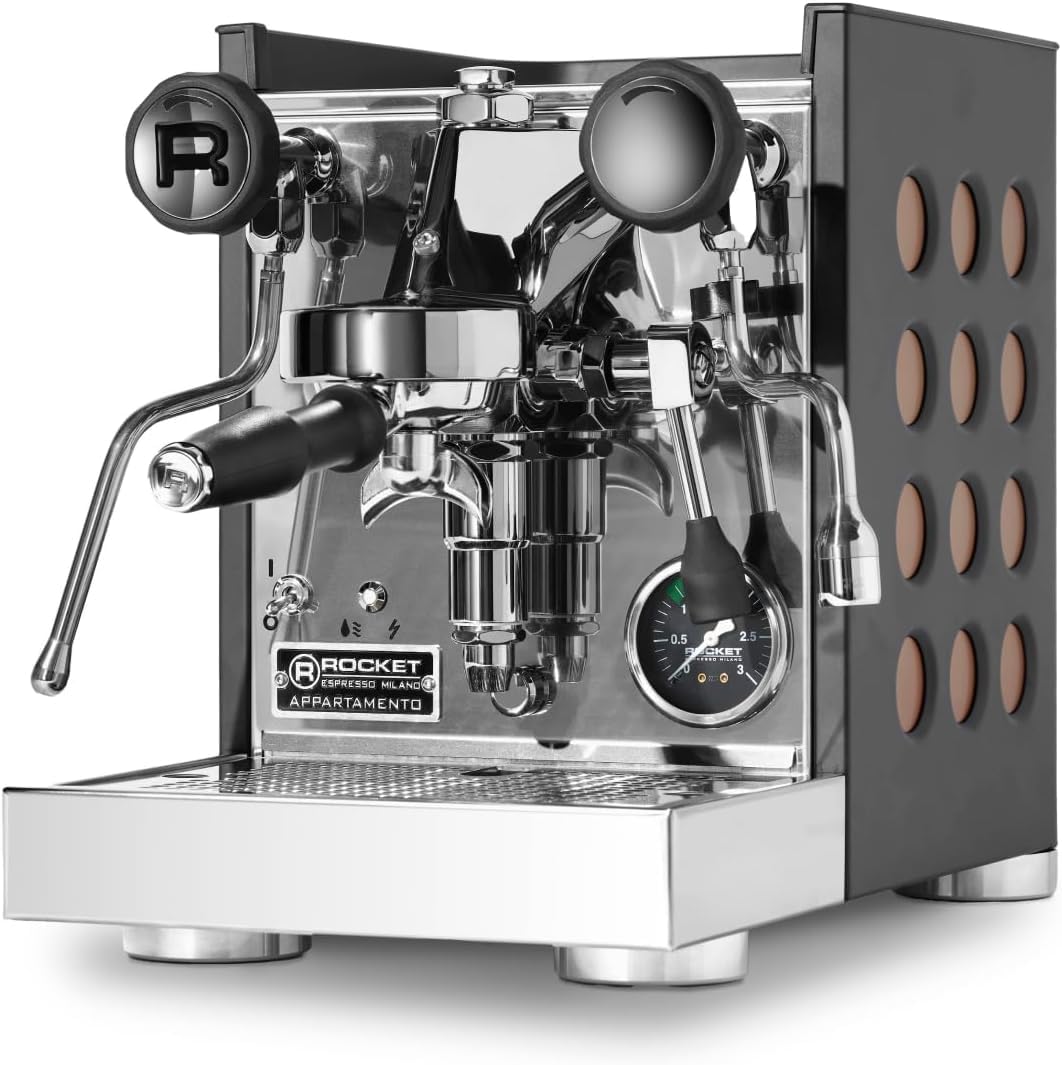
Redesigned from the ground up with hybrid PID temperature control for precision shots.
You get a ground-up redesign — a fresh case, frame, brew group, and control board compared to the original Appartamento. Its standout feature is a unique hybrid PID design (a digital controller that keeps water temperature steady for every shot) that lets you adjust brew temperature by selecting from four boiler pressures (0.9 to 1.2 bars) without extra screens or buttons. That flexibility means you can dial in different beans, from light roasts that need higher pressure to dark roasts that need less.
Unlike the Diletta Bello’s 3-liter capacity, the Rocket holds 2.5 liters — a 20% smaller tank — which means you will refill more often during a busy stretch. Reviewers praise the “powerful heat exchange boiler that delivers consistent espresso with rich crema” and the durable commercial-grade build. But one reviewer noted a serious failure: “after ~40 shots/day for 2 weeks, machine fails: shoots excess water, severely under-extracts.” At 48.5 pounds, it is heavy but still 1.5 pounds lighter than the Bello, so moving it is barely easier.
The optional 30-minute eco-mode saves energy, and the new RGB indicator light tells you water level and heating status at a glance. If you prize temperature control and the look of black/copper on your counter, this machine delivers — but the quality reports from cafe-level use are a real concern.
Temperature tweaker: The four-pressure PID adjustment is a rare feature at this price point — great for cafes that rotate beans often.
The hard truth: Multiple reviewers point out failure within two weeks of heavy use, with water overflow and under-extraction, making this a risky choice for a primary machine.
Best for specialty cafes: If you need adjustable brew pressure and love the E61 design, and your volume is moderate, the Appartamento TCA is a beautiful, capable machine.
skip it if: You cannot afford downtime — the failure reports from high-volume use are too frequent to ignore for a busy operation.
4. Jura X8 Platinum Automatic Espresso & Cappuccino Machine with Touch Screen

A fully automatic behemoth with a 167.3-ounce tank for catering-level volume without a barista.
The Jura X8 is the only super-automatic on this list — you fill the 17.6-ounce bean container, press a touchscreen button, and the machine grinds, tamps, brews, and froths milk by itself. Its water tank holds 167.3 fluid ounces, which is dramatically larger than any other machine here (more than 5 times the 3 liters of the Diletta Bello). It also features a Pulse Extraction Process (P.E.P.) — a method that pulses water through the coffee in short bursts rather than a steady stream — for balanced extraction in a shorter time, and an AromaG3 grinder for consistent grind quality.
Buyers report it is “built for heavy use” and that it “makes all the most popular drinks and does them well.” One office buyer reported “the flavor is 100x better than starshit or dunkin.” But the milk system is where this machine falls apart for cafe use. Multiple owners mention a persistent failure: “milk/foam system fails; loud noise, no milk dispensed, never made consistent flat white or cappuccino despite cleaning.” That is a major problem for a cafe that serves milk drinks all day.
Unlike the semi-automatic machines above, there is no barista to tweak pressure or shot time — the machine does it all. That is great if you do not have skilled staff, but if the milk system fails, you lose your entire milk-drink menu until it is repaired. The Jura X8 is massive too: at 18.5″ x 14.7″ x 18″, it is 16% larger dimensionally than the Nuova Simonelli Oscar II’s 16″ x 12″ x 16″.
What Makes It Unique
- Super-automatic — no barista skill required
- Enormous 167.3 fl oz water tank for fewer refills
- Pulse Extraction Process (P.E.P.) for balanced extraction
Critical Weaknesses
- Milk system failures reported by multiple buyers — never makes consistent cappuccino or flat white
- Very large footprint (18.5″ x 14.7″ x 18″)
- Proprietary parts and service network required for repairs
Best for high-volume offices or self-serve counters: If you want one-touch drinks with no barista training and a huge water tank, the X8 delivers convenience.
pass on it if you serve milk drinks: The milk system is the weakest link — a cafe that relies on cappuccinos and lattes cannot risk this failure pattern.
Understanding the Specs
Heat-Exchanger Boiler
This is a single boiler that uses the heating water to also heat a separate loop for steam. It means you can brew a shot and steam milk at the same time — no waiting for the boiler to reheat between tasks. That is the single most important feature for a cafe machine because the ticket printer does not pause between orders.
E61 Brew Group
The E61 is a standard design for commercial espresso machines, originally developed by Faema in 1961. It uses a large group head that stays at a stable temperature and has a pre-infusion chamber that gradually wets the coffee puck before full pressure hits. The big advantage for cafes: parts like gaskets, shower screens, and springs are interchangeable across many brands, so you can fix a leaking group head without waiting weeks for a specific part.
FAQ
Can I use a home espresso machine in a cafe?
What is the difference between a heat exchanger and a dual-boiler machine for a cafe?
How much water tank capacity do I need for a cafe?
Will an E61 group head machine fit on my counter?
How do I clean and maintain a commercial espresso machine?
Is a super-automatic or semi-automatic better for a cafe?
What does the Pulse Extraction Process (P.E.P.) do on the Jura machine?
What is the typical lifespan of a commercial espresso machine?
Do I need to plumb my cafe machine to a water line?
Why do some customers note leaking group heads on these machines?
Final Thoughts: The Verdict
For most buyers, the best coffee machine for cafe is the Diletta Bello because it combines the largest 3-liter water tank with an E61 heat-exchanger design for fast, simultaneous brewing and steaming — while keeping full manual control for a skilled barista. If you want automatic convenience with a huge water tank, grab the Jura X8 Platinum. And for a light-volume or pop-up cafe where weight and simplicity matter, the Nuova Simonelli Oscar II offers a 3-liter tank in a compact 13-pound frame.
How We Picked
We do not accept paid placement. Every pick is matched to a real buyer and a real use-case; we do not hands-on test units.
Sources & Methodology
Specifications: manufacturer listings and product documentation. Review insights: verified customer reviews, as of July 2026. Pricing: not shown on this page (it changes often); check the current price via the retailer link.
As an Amazon Associate, WellFizz earns from qualifying purchases. This does not affect which products we feature.
Related Guides

Mo Maruf
I created WellFizz to bridge the gap between vague wellness advice and actionable solutions. My mission is simple: to decode the research and give you practical tools you can actually use.
Beyond the data, I am a passionate traveler. I believe that stepping away from the screen to explore new environments is essential for mental clarity and physical vitality.