Our readers keep the lights on and my smoothie glass nicely filled. As an Amazon Associate, I earn from qualifying purchases.
The grinder you choose decides whether your morning coffee tastes like a café pour-over or a bitter afterthought. A decent burr grinder is the single biggest upgrade you can make to your home setup — it gives you consistent particle sizes so every brew extracts evenly, unlocking flavors you simply cannot get from a blade grinder that pulverizes beans into uneven dust.
I’m Mohammad Maruf — the co-founder and writer behind WellFizz. This guide is built by comparing the manufacturers’ published specifications and the patterns across verified customer reviews, so you get each pick’s real strengths and trade-offs instead of marketing spin.
Whether you pull espresso or pour a slow drip, finding the right coffee grinder under 500 means balancing grind range, consistency, build quality, and workflow — and these seven models cover every serious budget.
How To Choose The Best Coffee Grinder Under 500
A great coffee grinder under needs to do three things well: produce consistently sized grounds, give you enough adjustment range to dial in any brew method, and keep your workflow clean and fast. The buying decision starts with choosing between burr shape, dosing style, and power source — here is what each decision actually means for your cup.
Conical vs. Flat Burrs
Conical burrs (a cone-shaped grinding surface inside a ring) run at lower speeds, generate less heat, and tend to preserve the delicate oils in the bean. That makes them ideal for espresso because they produce a rounded, forgiving flavor profile. Flat burrs (two flat metal discs facing each other) grind faster and create more uniform particle sizes, which gives you a cleaner, brighter taste for pour-over and filter coffee — but they also cost more and often make more noise.
Number of Grind Settings vs. Stepless Adjustment
A machine with 48 or 75 preset click-stops lets you repeat the same setting every time without guesswork — you turn the dial, it clicks into place. Stepless adjustment (common on hand grinders) gives you infinite control between any two click positions, which matters most for espresso where a tiny fraction of a millimeter can turn a perfect shot into a choked mess. For drip, French press, or cold brew, 31 to 48 well-spaced settings are plenty.
Single-Dose vs. Hopper-Based Workflow
Single-dose grinders (you weigh out beans and pour them into the chute for each brew) waste almost zero coffee and let you switch beans between every cup — ideal if you drink light roast in the morning and decaf at night. Hopper-based grinders hold a larger stash (up to 10.6 ounces) so you can grind several cups without refilling, but they require you to purge a few grams between bean changes, which adds up over time.
Quick Comparison
On smaller screens, swipe sideways to see the full table.
| Model | Category | Best For | Key Spec | Amazon |
|---|---|---|---|---|
| AMZCHEF Single Dose (75 settings) | Mid-Range | Single-dose espresso & pour-over | 75 grind settings / 40mm conical burr | Amazon |
| Fellow Ode Gen 2 | Premium | Pour-over & filter coffee | 64mm flat burr / 31 grind settings | Amazon |
| AMZCHEF Conical Burr (48 settings) | Mid-Range | Large-batch daily grinding | 10.6 oz hopper / anti-static | Amazon |
| Viesimple Gen 4 | Premium | Ultra-quiet single-dose espresso | 48mm conical burr / <50 dB noise | Amazon |
| 1Zpresso K-Ultra | Premium | Travel & manual espresso | 20-micron clicks / magnetic catch cup | Amazon |
| SHARDOR Conical Burr | Mid-Range | Entry-level espresso | 51 settings / precision timer 2.0 | Amazon |
| KINGrinder K6 | Mid-Range | Affordable manual espresso | 16 microns/click / full metal build | Amazon |
In‑Depth Reviews
1. AMZCHEF Single Dose Coffee Grinder – 75 Settings
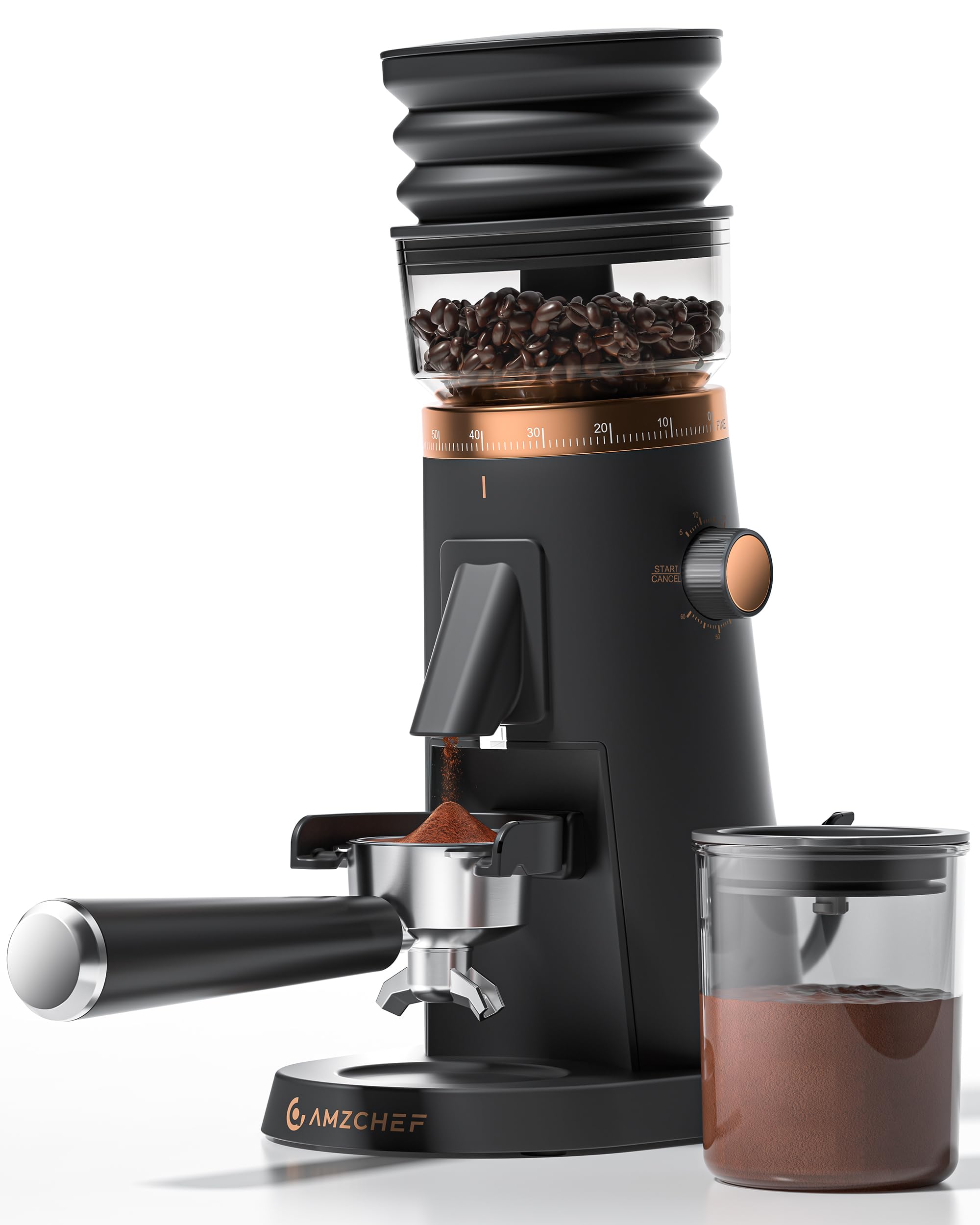
75 grind settings — more than double the 31 on the Fellow Ode Gen 2 — make the AMZCHEF single-dose model the top pick for espresso drinkers who need fine-tuned control without spending over $500. Its 40mm conical burr runs quietly at 60–75 dB (a soft conversational hum), so it won’t wake anyone during a 5 AM brew.
The magnetic outlet and included knock tool keep retention below 0.2 g (buyers report their replacement unit held just 0.2 g at setting 3), meaning almost every gram you grind makes it into your basket rather than getting trapped inside the chute. The 120 g vacuum-sealed container keeps beans fresh and doubles as a storage jar, and the built-in LED light illuminates the grinding chamber so you can see exactly what is happening.
The catch: the first unit one reviewer received stuck below setting 10, though a replacement worked fine at setting 3. For its combination of extreme adjustability, near-zero waste, and a 60-second timed grind mode, this is the single most versatile grinder in the under-$500 bracket. Verdict: if you brew espresso and pour-over on the same counter, start here.
Why it’s great
- 75 stepless click settings cover espresso through cold brew
- Magnetic spout and knock tool keep retention below 0.2 g
- Quiet DC motor (60–75 dB) with timed grinding
Good to know
- Occasional quality control on initial units (stuck dial below setting 10)
- Plastic body feels less premium than all-metal rivals
2. Fellow Ode Gen 2 64mm Flat Burr Coffee Grinder

The Fellow Ode Gen 2 focuses on one thing and does it better than anything else here: brewed coffee. It does not grind for espresso, so if you pull shots this is not the machine for you. But for pour-over, French press, and cold brew, its 64 mm stainless steel flat burrs (two-to-three times larger than the 40–48 mm conical burrs on other picks) produce the cleanest, most uniform particle distribution in the lineup — giving you a sweeter, more balanced cup with less bitterness.
Owners mention it grinds 17 g of coffee in about 10 seconds — nearly half the time of a typical electric grinder — and the anti-static ionizer keeps stray grounds off your counter if you wipe the chute every 60 cycles. At 9.92 lbs, it is the heaviest grinder here, which adds stability but also takes up serious counter real estate (9.41 x 4.13 x 9.78 inches).
If your kitchen is dedicated to pour-over and filter brewing, choose this over the AMZCHEF Single Dose. You lose espresso capability entirely, but you gain a nearly silent grinding experience and the kind of flavor clarity that rival Baratza Encore users call a “massive upgrade in usability.” The flat burr particle uniformity is the standout spec here — 64 mm of precision that other burrs under 50 mm simply cannot match.
Where it shines
- 64mm flat burrs produce unmatched particle uniformity for filter coffee
- Very quiet operation with anti-static mess control
- Fast grind speed (~10 seconds for 17 g)
Worth noting
- Does not grind fine enough for espresso
- Occasional jams if the hopper is overloaded
3. AMZCHEF Conical Burr Coffee Grinder, 48 Settings

You brew for two or more people every morning, switch between espresso and drip throughout the day, and do not want to weigh out beans for every single brew. The UV-blocking tinted hopper also keeps beans fresher than a clear plastic bin would.
Customers note the motor ran for 110 seconds without overheating — a solid stress-test result that suggests this grinder is built for back-to-back brewing sessions. The anti-static technology and rubberized cup keep the counter nearly mess-free, and the 48 settings range from fine enough for a Breville espresso machine to coarse enough for a French press. The smart touchscreen controls let you set grind time in 0.5-second increments up to 40 seconds.
The standout spec is the 10.6 oz capacity — the largest hopper in this roundup.
What stands out
- 10.6 oz hopper — largest capacity in the under- bracket
- Motor runs 110 seconds without overheating (verified by buyers)
- 48 settings cover espresso through French press
The trade-offs
- Touchscreen fingerprint magnet
- Occasional dial issue on first units
4. Viesimple Gen 4 Single Dose Burr Coffee Grinder
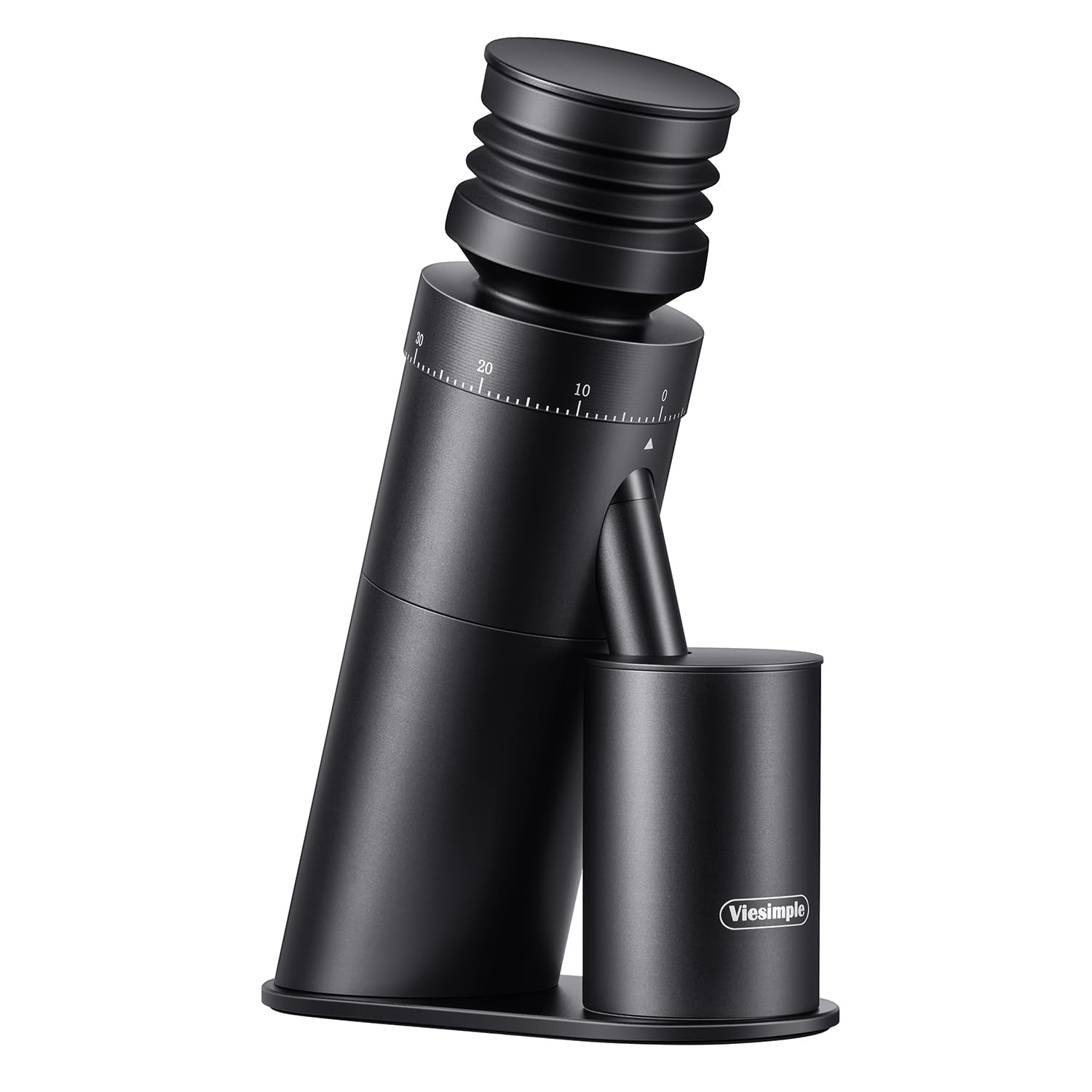
The single number that matters most in this category is noise, and the Viesimple Gen 4 scores below 50 dB — quieter than a library conversation — making it the only electric grinder here that you can use while someone sleeps in the next room. Its low-RPM DC motor runs slow and cool, preserving the oils in the bean and producing less heat degradation than higher-speed alternatives.
What you trade for that silence is capacity: at 30 g, the chamber is small, so this is strictly a single-dose machine. Reviewers point out the magnetic dosing cup and bellows system reduce retention to near zero, and the anti-clogging patent (a smooth powder channel refined over three previous generations) ensures grounds exit completely without building up inside. The build quality is all-aluminum with a 2-year warranty, which gives it a reassuring heft (2.52 kg) despite the compact 6 x 3 x 9 inch footprint.
For home baristas who need espresso-fine grinding but cannot stand the racket, the Viesimple Gen 4 delivers price-to-performance that reviewers call “amazing real espresso” at a fraction of the cost of high-end competitors — a price-to-value read that makes the quiet motor the one spec justifying its position if noise is your primary frustration.
The upsides
- Below 50 dB — barely audible during operation
- Low-RPM DC motor preserves bean flavor
- Anti-clogging channel with near-zero retention
Keep in mind
- Small 30 g bean chamber — not for large batches
- Grind setting markers may misalign on some units
5. 1Zpresso K-Ultra Manual Coffee Grinder

What you actually get at this lower price is all-aluminum construction, factory-calibrated to minimize burr wobble and rated to grind 100–200 kg of beans over its lifetime. At 1.5 lbs (3.9 lbs lighter than the SHARDOR), it is the lightest premium option here and fits into its included travel case for café-quality coffee on camping trips or weekend getaways.
The external adjustment dial delivers over 100 clicks at 20 microns per click — finer resolution than the KINGrinder K6’s 16 microns per click — so you can dial in espresso with surgical precision. Shoppers say 15 g grinds in roughly 10 seconds, and the magnetic catch cup snaps securely into place holding 35–40 g. The foldable handle pushes and twists to tuck away, preventing the grinder from tipping over in a drawer or backpack.
The honest limit is that it charges a premium over the KINGrinder K6, and the internal beam design can trap 0.2–0.5 g of beans unless you tap it aggressively. If you value portable precision and plan to brew everywhere from your kitchen to a campsite, the K-Ultra is perfect for the budget buyer who wants the best manual grinder on adjustability and build consistency.
Why we’d pick it
- 100+ clicks at 20-micron resolution for dialing in any brew
- All-metal construction rated for 100–200 kg of use
- Foldable handle and travel case for portability
A few caveats
- Internal design can trap 0.2–0.5 g of grounds
- Higher price than comparable manual grinders
6. SHARDOR Conical Burr Espresso Coffee Grinder

If you are stepping up from a blade grinder to your first burr grinder for espresso, the SHARDOR gives you the most forgiving learning curve. Its 51 settings range from the finest espresso powder to coarse French press, and the Precision Timer 2.0 lets you adjust grind time in 0.1-second increments up to 60 seconds — so you can dose by time rather than guesswork. At 6.2 lbs, it is also the heaviest entry-level grinder here, which keeps it planted on the counter while you work the portafilter cradle.
Buyers consistently praise it after 1.5 years of use, noting “fresh coffee taste, consistent grind, multiple settings, clean design” with “no spill issues.” The included dosing ring and portafilter cradle let you grind directly into the basket, which speeds up an already fast workflow. The anti-static coating reduces mess, though some users report minor static cling with the ground coffee chamber.
This is a gentle caution about its one weakness: if you grind more than two cups daily, the small hopper becomes a chore. For a solo espresso drinker making one or two shots per session, it is the most affordable gateway to real burr consistency.
Strong points
- 51 settings with 0.1-second timer precision for repeatable dosing
- Portafilter cradle for direct grinding — saves time
- Stable, durable build reported after 1.5 years of use
Before you buy
- Small 1.4 oz hopper requires frequent refilling
- Portafilter holder can sag under heavy portafilters
7. KINGrinder K6 Manual Hand Coffee Grinder
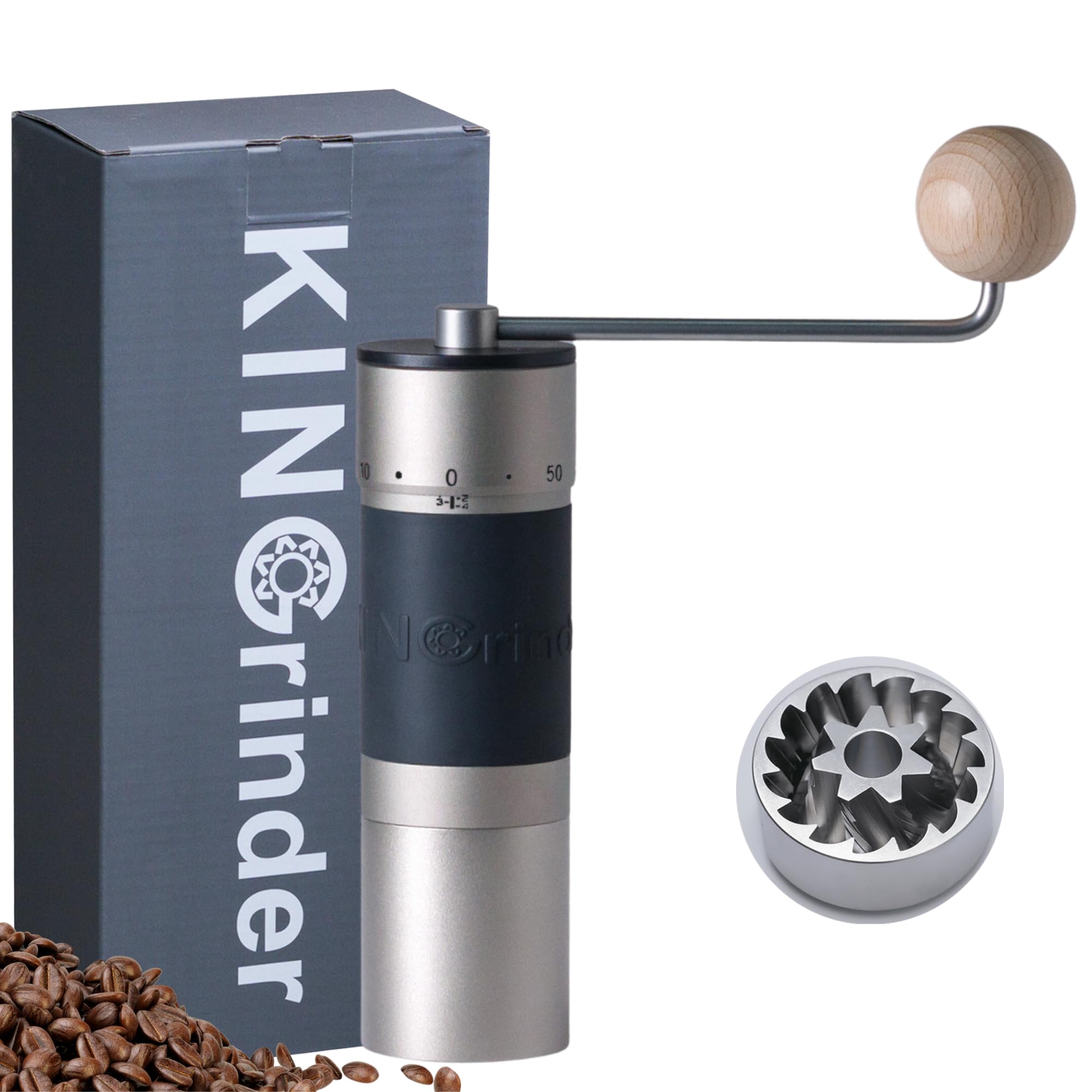
The KINGrinder K6 proves you do not need to spend triple to get espresso-capable grind quality. At roughly half the price of the 1Zpresso K-Ultra, it delivers 16 microns per click — finer than most electric grinders at this price — meaning you can dial in an espresso shot with real precision. The external adjustment nut gives 60 clicks per rotation up to 4 full rotations, so you have 240 total click positions. It is made entirely of aluminum and stainless steel, weighing 1.6 lbs, and buyers describe the build as “indestructible.”
What you give up is convenience: this is a manual grinder, so you will spend around 45 seconds cranking for a 10–20 g dose — about three to four times slower than the electric AMZCHEF or Fellow models. Buyers also report that the screw-on catch cup can jam if over-tightened. But for that effort, you get “zero retention, perfect dose control” and espresso quality that buyers report rivals grinders costing three times as much.
This is the exact budget buyer it is perfect for: someone who wants espresso at home, does not mind a short manual workflow, and wants to spend the lowest possible entry fee for real burr consistency. The 16-micron step size out-resolves many electric grinders and makes this the best value-for-dollar in the entire lineup.
What we like
- 16 microns per click — finer adjustment than many electric grinders
- Full aluminum/stainless steel construction feels indestructible
- Zero retention for precise single-dose control
The downsides
- Manual cranking takes ~45 seconds per dose
- Screw-on catch cup can jam if overtightened
Understanding the Specs
Burr Size & Material
Larger burrs (measured in millimeters) grind faster and produce more uniform particles. 64 mm flat burrs like those in the Fellow Ode Gen 2 create a cleaner, brighter flavor than 40 mm conical burrs, but they also run louder and cost more. Conical burrs preserve coffee oils better because they rotate slower and generate less heat. For most home brewers, a 40–48 mm conical burr is plenty; only go larger if filter coffee clarity is your top priority.
Number of Grind Settings
This tells you how many distinct grind sizes you can select — 31, 48, 51, or 75. More settings give you finer control between, say, fine drip and medium fine drip, which matters most for espresso. If you only brew drip and French press, 31 well-spaced settings are perfectly adequate. Stepless grinders (the KINGrinder K6 and 1Zpresso K-Ultra) offer infinite adjustment because they have no fixed clicks.
Retention (Single Dose vs. Hopper)
Retention is the amount of ground coffee that stays trapped inside the grinder after each use, usually measured in grams. Single-dose grinders aim for under 0.5 g retention so you do not waste coffee or mix old grounds with fresh beans. Hopper-based grinders (like the AMZCHEF 48-setting model) typically retain 1–3 g unless they have anti-static technology and knockers built in. For home users switching beans daily, look for grinders with magnetic spouts, bellows, or knock tools.
Noise Level
Measured in decibels (dB), grinder noise ranges from under 50 dB (a quiet room) to over 80 dB (a vacuum cleaner). Low-RPM DC motors, like the one in the Viesimple Gen 4, operate around 40–50 dB and are ideal for early-morning or apartment brewing. Standard AC motors typically run at 60–80 dB. If noise is a concern, prioritize grinders that specifically advertise “quiet DC motor” or “low noise” on the spec sheet.
FAQ
What is the difference between conical and flat burrs for coffee grinding?
How many grind settings do I actually need for home brewing?
What does “single dose” mean and should I buy one?
Final Thoughts: The Verdict
For most buyers, the coffee grinder under 500 winner is the AMZCHEF Single Dose (75 settings) because it combines the widest grind range with near-zero retention and a quiet DC motor — all for a mid-range price that leaves room for other gear. If you want the purest pour-over and filter coffee, grab the Fellow Ode Gen 2 for its 64 mm flat burrs and unmatched particle uniformity. And for the ultimate budget entry into espresso, the KINGrinder K6 delivers real burr consistency at a fraction of the price of any electric alternative.

Mo Maruf
I created WellFizz to bridge the gap between vague wellness advice and actionable solutions. My mission is simple: to decode the research and give you practical tools you can actually use.
Beyond the data, I am a passionate traveler. I believe that stepping away from the screen to explore new environments is essential for mental clarity and physical vitality.