If you are tired of stale, pre-ground coffee that loses its flavor before it hits your mug, a burr grinder (a grinder that uses two interlocking rings to crush beans evenly) changes everything. The right grinder gives you fresh, consistent grounds every morning for a noticeably better cup, without needing to spend a small fortune. The real trick is knowing which settings and build quality matter most so you do not end up with a noisy, messy machine that sits in the back of a cupboard.
I’m Mohammad Maruf — the co-founder and writer behind WellFizz. This guide is built by comparing the manufacturers’ published specifications and the patterns across verified customer reviews, so you get each pick’s real strengths and trade-offs instead of marketing spin.
Every grinder here delivers consistent grounds with a burr mechanism — not a whirling blade — and stays under a reasonable budget. This is your plain‑English guide to finding the absolute coffee grinder under $100 for your daily brew, whether you make espresso, French press, or pour‑over.
How To Choose The Best Coffee Grinder Under $100
Choosing your first burr grinder can feel like stepping into a secret club with its own language. Here are the three core decisions that separate a great daily driver from a frustrating mistake.
Burr Type: Conical vs. Flat
Nearly every grinder in this price range uses conical burrs (two cone-shaped metal rings that crush beans between them). Conical burrs run slower and quieter than flat burrs, produce less heat — which protects the bean oils — and are easier to clean. Flat burrs are rare under $100 and tend to be louder and messier.
Grind Settings: How Many Do You Actually Need?
Espresso demands very fine adjustments — a gap of just 0.05mm (a hair’s width) can make or break your shot. A grinder with 40 or more settings gives you the control to dial in for espresso, pour-over, drip, and French press. If you only drink drip coffee, 15 well-spaced settings might be enough. Count the settings, not the marketing claims.
Manual vs. Electric: The Real Trade-Off
Manual grinders are quieter, cheaper, and portable — the top manual here weighs just 0.46 kg and holds 60g of beans. The catch is you use arm power, which takes about a minute per cup. Electric models are faster and require no effort, but they are heavier, take up counter space, and typically cost more for the same grind quality.
Quick Comparison
On smaller screens, swipe sideways to see the full table.
| Model | Category | Best For | Key Spec | Amazon |
|---|---|---|---|---|
| CEVING 60g Manual | Manual | Portability & large batches | 60g capacity, 40 settings | Amazon |
| OXO Brew Compact | Electric | Quiet operation & compact size | 50g capacity, 15+29 settings | Amazon |
| TIMEMORE Chestnut C2S | Manual | Build quality & precision | 38mm burr, ~36 settings | Amazon |
| SHARDOR Conical Burr | Electric | Espresso & timed dosing | 51 settings, 0.1s timer | Amazon |
| AMZCHEF 48 Setting | Electric | Large hopper & anti-static | 10.6 oz hopper, touchscreen | Amazon |
| Tuni G1 | Electric | Espresso with low retention | 48 settings, 450 RPM | Amazon |
| AMZCHEF Espresso Grinder | Electric | Espresso & portafilter grinding | 48 settings, 100g container | Amazon |
In‑Depth Reviews
1. OXO Brew Compact Conical Burr Coffee Grinder

The OXO Brew Compact wins the top spot because it delivers consistent grounds from a quiet machine that takes up very little counter space — it measures just 3.75 inches wide by 10.75 inches tall, which is about half the width of most electric models. Buyers report it produces a “quiet low growl” that is much easier to live with than louder, more expensive grinders.
Its stainless steel conical burrs give you 15 distinct settings plus 29 micro-adjustments, so you can go from fine enough for pour-over to coarse for French press. The hopper holds up to 50 grams of beans — enough for about 6 cups of coffee — and the upper and lower burrs pop out for easy cleaning with a brush. Reviewers consistently say it creates “minimal mess” compared to the SHARDOR, which can scatter grounds.
The honest trade-off: it is the heaviest grinder here at 1.87 kilograms, which is 4.1x heavier than the CEVING manual grinder, so you will not want to move it around much. For a quiet, compact, reliable electric burr grinder that fits under a cabinet and gives you real control, this is the one to buy.
Why it’s great
- Quietest electric burr grinder in this class
- Removable burrs make cleaning straightforward
- Compact footprint fits under low cabinets
Good to know
- Some static and counter mess, though less than previous grinders
- Heavy at 1.87 kg; not portable
2. CEVING 60g Large Capacity Manual Coffee Grinder
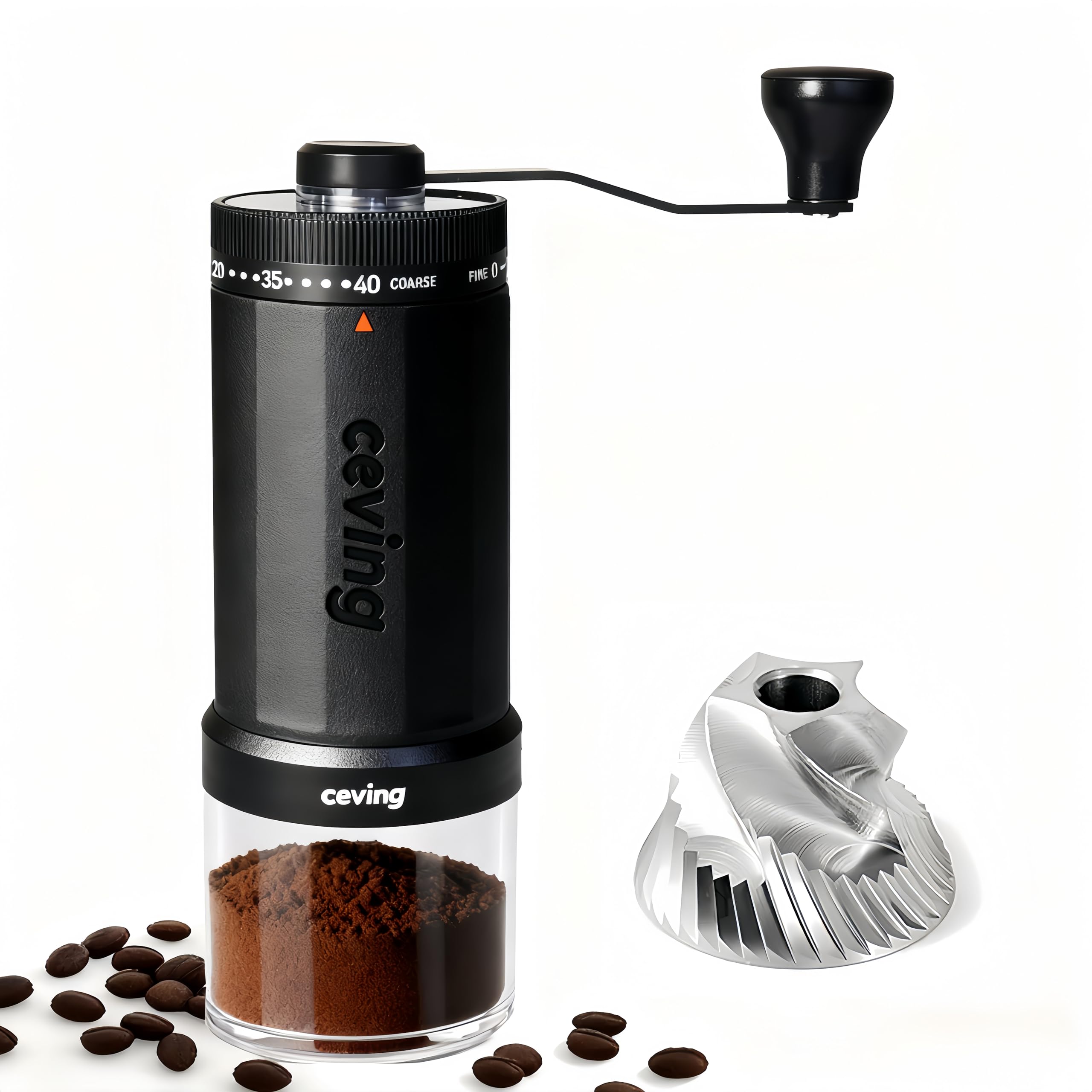
If the OXO Brew is too heavy to move around, the CEVING manual grinder weighs just 0.46 kilograms — a massive 4.1x lighter — and holds 60 grams of beans, which is 20% more capacity than the OXO’s 50-gram hopper. This means you can grind enough for a full French press or a big morning brew without refilling, all in a package that fits in a backpack.
Its 40 external grind settings let you switch from espresso-fine to coarse French press by turning a click ring on the outside — no hidden screws or tools needed. Owners mention it is a “compact, quiet hand grinder” that is “great for 1-2 cups (AeroPress)” and produces “consistent grounds” with a stainless steel burr that feels sturdy.
The downside is that you are turning a handle by hand, which takes about a minute per cup, and some customers note the lid and handle can wobble if you are not careful. Choose this if you want the largest capacity per grind, the lightest weight for travel, and do not mind a little morning arm exercise.
Where it shines
- Massive 60g capacity in a 0.46 kg body
- 40 external settings require no disassembly to change
- Quiet enough for early mornings without waking anyone
Worth noting
- Manual grinding takes time and effort
- Some static cling; spritz beans with water to fix
3. TIMEMORE Chestnut C2S Manual Coffee Grinder

If you plan to grind coffee every single day for years and want something that will not break, the TIMEMORE C2S is built from full metal — the entire body is stainless steel, solving the cracked-plastic-top problem its predecessor had. Its 38mm CNC-machined conical burr (a burr shaped by computer-controlled cutting for precision) runs on double bearings for a smooth, wobble-free handle spin that buyers describe as a “perfect manual grinder: adjustable, smooth, consistent grind.”
The grinder offers about 36 grind levels controlled by a threaded nut on the shaft: turn clockwise for finer, counter-clockwise for coarser. It holds approximately 25 grams of beans, which is enough for one solid pour-over or two espresso shots. Reviewers point out grinding a cup takes “less than 1 min” and is “quicker than electric” when you factor in setup. The compact body, at 52mm wide, is easy to grip even for smaller hands.
The trade-off: changing the grind size frequently is fiddly because the adjustment nut requires you to turn it many rotations. If you stick to one grind setting most days, this is a lifetime grinder that outperforms its price.
What stands out
- All-metal unibody construction feels indestructible
- Double bearings make the handle spin effortlessly
- Uniform grind with minimal fine powder
The trade-offs
- Adjusting grind size requires many rotations
- 25g capacity means refilling for large batches
4. SHARDOR Conical Burr Espresso Coffee Grinder

The single number that matters most for espresso is grind precision — and the SHARDOR offers 51 settings with a timer you can adjust in 0.1-second increments, so you can dial in exactly the right dose for your espresso machine. Its 40mm stainless steel conical burr runs slow to keep heat low, protecting delicate bean oils.
One limitation you accept for that precision is size: at 13.5 inches tall and 7.4 inches wide, it takes up more counter space than the OXO (a 2.0x width gap versus the OXO’s 3.75-inch footprint). It also weighs 6.15 pounds, so it is not something you will move around. Shoppers say that after 1.5 years of use it is “durable” with “consistent results” and that “freshly ground beans improve flavor/aroma.”
If you own an espresso machine like a Breville Bambino and want an entry-level electric grinder that delivers consistent, mess-free shots without spending hundreds, this is the most affordable path that actually works — a price-to-value read that justifies its countertop footprint.
The upsides
- 51 grind settings cover espresso to French press
- 0.1-second timer for precise dosing
- Anti-static tech keeps the counter clean
Keep in mind
- Larger footprint than compact electric models
- Portafilter holder can sag, requiring manual support
5. AMZCHEF Conical Burr Coffee Grinder (48 Settings)

What you actually get at this lower price is a 10.6-ounce bean hopper — the largest capacity in this list — plus a UV-blocking tint that keeps your beans fresher over time. The built-in trap-door design means you can remove the hopper to refill or clean without spilling beans everywhere, which is a smart detail that cheaper grinders skip.
What you give up compared to the more espresso-focused picks like the SHARDOR is that the timer maxes out at 40 seconds in 0.5-second steps, rather than the 0.1-second precision of the SHARDOR. For drip coffee, pour-over, and French press users this is completely fine. Reviewers praise the “uniform grind” and note the anti-static design means “no mess, no static” — one reviewer noted after using a grinder that was “super messy,” this one is clean by comparison.
This is the perfect pick if you brew multiple pots a day, want to load up beans once and forget about refilling, and prefer a touchscreen interface over knobs — making it the exact budget buyer it is perfect for.
Why we’d pick it
- Massive 10.6 oz hopper for fewer refills
- UV-blocking tint preserves bean freshness
- Anti-static reduces mess dramatically
A few caveats
- 0.5-second timer is less precise for espresso
- One report of a dial issue that was resolved quickly
6. Tuni G1 Conical Burr Coffee Grinder
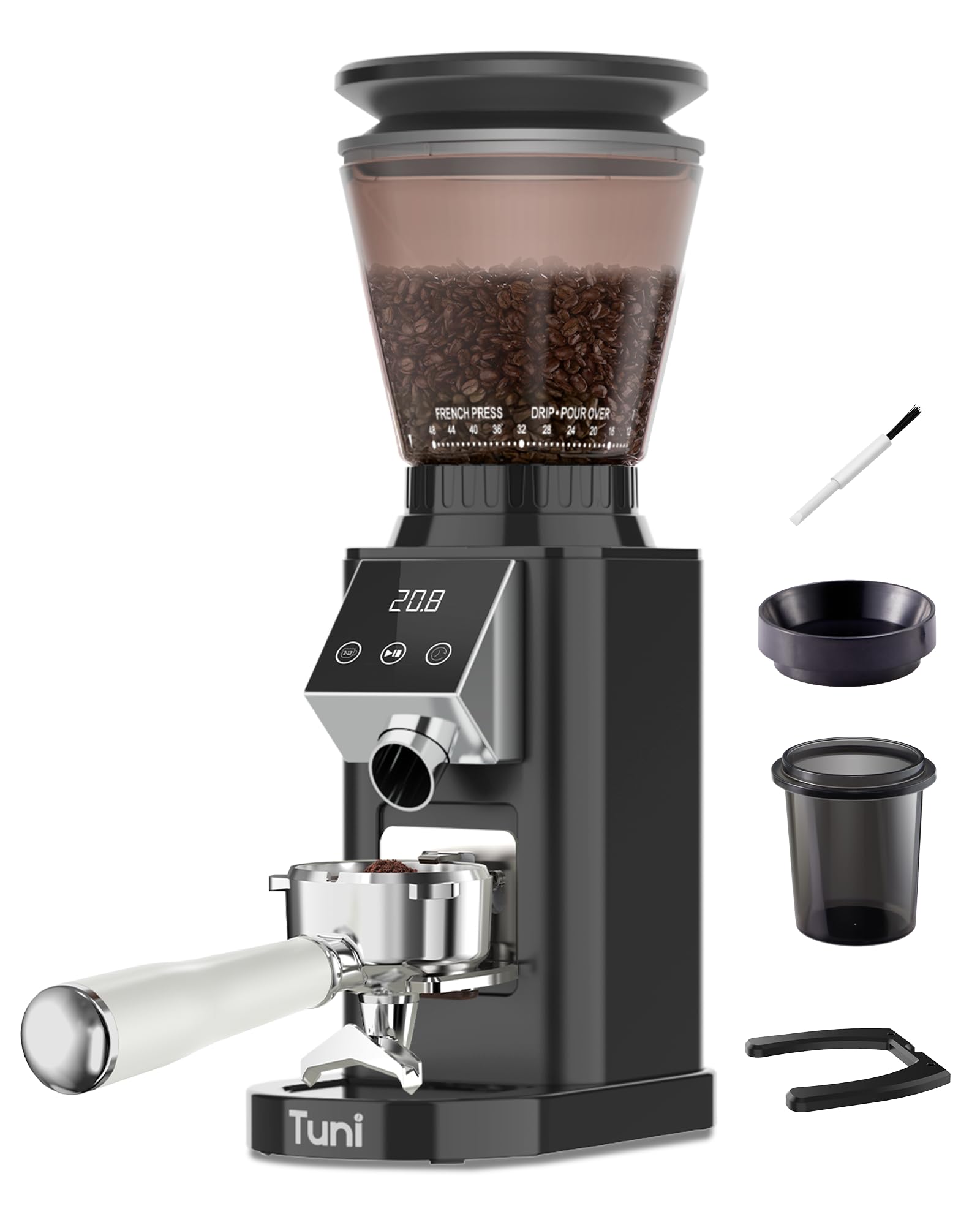
The Tuni G1 is built for the espresso enthusiast who hates wasted beans. Its patented 40mm conical burr system runs at a low 450 RPM, which minimizes heat and static, and buyers report retention (the amount of ground coffee stuck inside) is just 0.1 to 0.2 grams — meaning almost every bean you put in ends up in your cup or portafilter.
That low-retention design is paired with 48 grind settings, a precision timer in 0.5-second increments, and a detachable portafilter holder that fits 51-58mm baskets. The 8.8-ounce bean hopper is generous, and it includes a bellows blower to push out any remaining grounds. Owners mention it “punches way above its price” and is “quiet enough for 23s daily use.” One buyer mentioned that light roasts may require a DIY shim (included in the Noir version) to dial in fine enough for espresso.
The honest limit is that its long-term durability is still unproven since it is a newer model, but the build quality feels solid and the metal body resists smudges. For an electric grinder that wastes almost nothing, this is a standout.
Strong points
- Ultra-low retention (0.1-0.2g) saves your beans
- 450 RPM low-speed grind reduces heat and noise
- Includes bellows, shims, and portafilter holder
Before you buy
- Light roasts may need a shim for fine espresso
- Long-term durability is still being tested by users
7. AMZCHEF Coffee Grinder (Espresso Design)
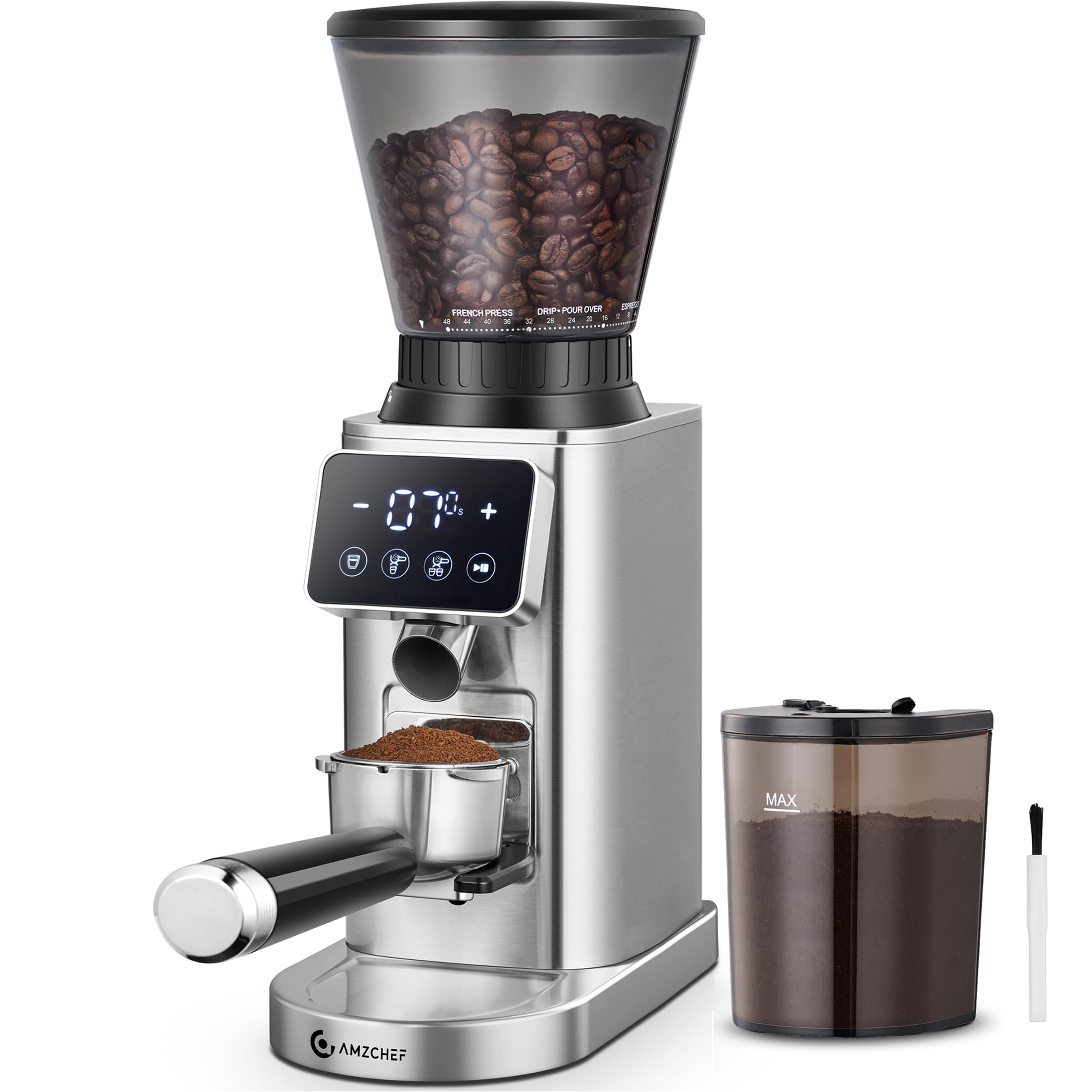
At the premium end of this field, the AMZCHEF espresso-focused grinder gives you the same 48 settings and 40mm burr as its sibling (the AMZCHEF 48 Setting model), but adds a dedicated portafilter holder with pads compatible with 50mm baskets, plus a 100-gram photophobic (light-blocking) ground coffee container. This means you can grind directly into your espresso machine’s portafilter with less mess.
Its low grinding speed of 450 RPM keeps heat and static down, and the LED touchscreen lets you switch between grinding by cup count, time, or single/double espresso dose. Customers note that after 8 months of use it is “easy to clean and use” and “setting 10” is their go-to for best espresso. One reviewer who previously owned a grinder said this one causes “no static” and delivers an “even grind every time.”
The one reason to choose this over the standard AMZCHEF model: you primarily make espresso and want the portafilter cradle for hands-free grinding. If you cycle between brewing methods, the sibling model’s larger hopper might serve you better at a slightly lower cost.
What we like
- Dedicated portafilter cradle for mess-free espresso grinding
- 100g light-blocking container keeps grounds fresh
- Quiet operation with low static and heat buildup
The downsides
- Does not save last setting; must scroll each time
- Portafilter holder can be loose on the mount
Understanding the Specs
Conical Burr
This is the grinding mechanism — two cone-shaped metal rings with teeth that crush beans into uniform particles. Unlike a blade grinder (which chops beans randomly), a burr grinder gives you consistent grounds that extract evenly in your coffee maker. That consistency is the single biggest leap in coffee quality you can make.
Grind Settings
The number of adjustment levels between the finest and coarsest grind. More settings mean finer control. For espresso you need very fine steps (0.05mm per click or finer), while drip and French press need coarser settings. A 40- to 51-setting range covers all brew methods comfortably.
Anti-Static Technology
Static electricity makes fine coffee grounds stick to the container and your counter. Anti-static coatings or low-RPM motor speeds reduce this cling. Some grinders also recommend spritzing beans with a few drops of water before grinding as a simple fix.
Portafilter Cradle
A holder that lets you place your espresso machine’s portafilter (the metal basket that holds the grounds) directly under the grinder chute. It stops grounds from scattering and means you skip an extra transfer step. Most cradles fit standard 51-58mm portafilter sizes.
FAQ
How many grind settings do I really need for espresso?
Is a manual grinder better than an electric one under $100?
Why does my coffee grinder make such a mess with static?
Can I use a manual grinder for espresso?
Final Thoughts: The Verdict
If you want one dependable pick, the coffee grinder under $100 winner is the OXO Brew Compact because it combines quiet operation, real burr consistency, and a small footprint that fits any kitchen — all with minimal mess. If you want maximum capacity and portability, grab the CEVING 60g manual grinder. And for espresso-focused home baristas who need precise dosing, the SHARDOR delivers the finest control at a fair price.

Mo Maruf
I created WellFizz to bridge the gap between vague wellness advice and actionable solutions. My mission is simple: to decode the research and give you practical tools you can actually use.
Beyond the data, I am a passionate traveler. I believe that stepping away from the screen to explore new environments is essential for mental clarity and physical vitality.