Our readers keep the lights on and my smoothie glass nicely filled. As an Amazon Associate, I earn from qualifying purchases.
Specs are compiled from manufacturer listings and verified buyer reviews and can change over time — please confirm the key details on the product page before buying.
You get a thick, velvety foam and a silky body only if the grind is ultra-fine — finer than espresso, almost like dust. Most bags on the shelf are too coarse or too bitter. This guide cuts through the noise to the nine coffees that deliver the real thing, so you know exactly which bag to put in your cart.
I’m Mohammad Maruf — the founder and writer behind WellFizz. This guide is built by comparing the manufacturers’ published specifications and the patterns across verified customer reviews, so you get each pick’s real strengths and trade-offs instead of marketing spin.
Whether you are new to the ibrik (a small long-handled pot for boiling coffee) or a lifelong drinker, the right bag makes every ritual better. Our picks for the best coffee for turkish coffee are the ones that consistently deliver on grind fineness (how fine the powder is), roast balance, and that unmistakable foam.
Our Picks at a Glance

How To Choose The Best Coffee For Turkish Coffee
You want a cup with a thick foam cap and a silky body, with no bitterness. The decisions you make in the bag define that outcome, so here is what to look for.
Grind Fineness is Non-Negotiable
Turkish coffee needs a grind finer than any espresso machine uses. The particles should feel like talcum powder between your fingers. A coarser grind will not extract fully in the short boil time, and you will get a thin, watery result with no foam. Every product on this list is ground to that ultra-fine standard, but freshness affects how the grind performs — older coffee clumps and loses its ability to foam.
Roast Level and Bitterness
Most Turkish coffee is roasted medium to dark, but too dark gives a burned, acrid taste. The best roasts develop a deep aroma without tipping into charcoal. That 100% Arabica label (a bean type known for smoothness) usually means a smoother cup with less bitterness. Buyers consistently describe the top-rated roast as having no burned taste — a sign of careful heat control during roasting.
Cardamom or Plain
Cardamom is the classic addition, and its freshness changes everything. A stale cardamom blend tastes flat and dusty. The best cardamom-infused Turkish coffees use whole spice blended at grinding, so the aromatic oils survive shipment. If you prefer to control the amount, a plain ground Turkish coffee lets you add fresh cardamom pods yourself.
Quick Comparison
| Model | Best For | Grind Fineness | Roast Level | Total Weight | Amazon |
|---|---|---|---|---|---|
| Kurukahveci Mehmet Efendi (10-Pack)★ Best Overall | Best Overall | Ultra-fine | Medium | 35.2 oz | Amazon |
| Elite (3-Pack)Best Value | Value | Ultra-fine | Dark | 10.5 oz | Amazon |
| Kurukahveci Mehmet Efendi (17.6oz)Premium Pick | Premium Single Bag | Ultra-fine | Medium | 17.6 oz | Amazon |
| Selamlique Istanbul (Chocolate) | Unique Flavor | Ultra-fine | Dark | 4.4 oz | Amazon |
| Al Ameed Cardamom | Bright & Aromatic | Ultra-fine | Light & Dark blend | 8 oz | Amazon |
| Café Najjar | Lebanese Style | Ultra-fine | Dark | 15.87 oz | Amazon |
| Maatouk Cardamom | Classic Blend | Ultra-fine | Medium-Dark | 16 oz | Amazon |
| Elite Cardamom (3-Pack) | Pre-Mixed Spice | Ultra-fine | Dark | 10.5 oz | Amazon |
In‑Depth Reviews
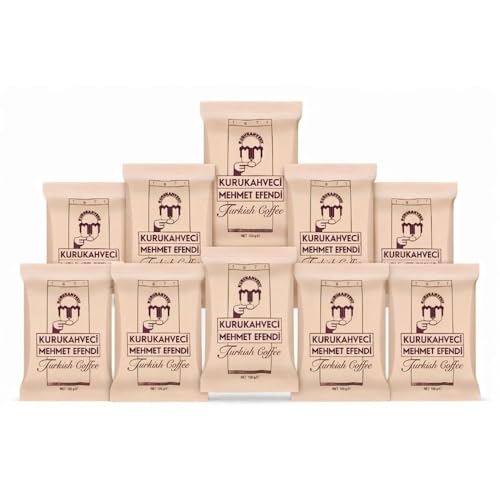
1. Kurukahveci Mehmet Efendi Turkish Coffee (10-Pack)
Our pick — over 4.5★ from 850+ verified ratings; the strongest balance of quality and price.
The 1871 original that owners treat as the reference standard for real Turkish coffee — the one that sets the bar for foam and flavor.
The coffee quality and taste are the two most-discussed aspects by a wide margin, and the consensus is clear: this is the benchmark. Made from 100% Arabica beans (a bean type prized for smoothness), ground to a talcum-fine powder (much finer than espresso), and roasted to a medium level that preserves the bean’s natural sweetness without any burned edge. It delivers exactly the rich aroma and velvety foam that the cezve ritual demands. At a full 35.2 ounces across the ten tins, it gives a large total volume — the 4.4-ounce Selamlique bag is smaller at 4.4 oz versus this 35.2 oz, making this a better value for daily drinkers.
The only real caveat is that the grind is so fine it will clog any standard coffee machine or French press. That is not a flaw — it means the coffee is correctly ground for its purpose. You need to boil it in an ibrik (a small pot for stovetop brewing) or small pot, let the mud settle, and never add milk. Buyers report that freshness is mixed: the tins seal well, but opened ones should be used quickly. As owners put it, once you dial in the method, “it’s amazing” and the “best Turkish coffee” going.
What wins people over
- Reference-level grind that produces a thick foam cap every time
- Medium roast avoids the burned taste of darker competitors like Café Najjar
- Generous 35.2 oz total keeps you stocked longer than the 4.4 oz Selamlique
The honest trade-off
- Requires the traditional ibrik method — no pouring into a drip machine
- Opened tins lose freshness faster than resealable bags
Reach for it if: you want the standard that defines the category — the one owners use to calibrate their grinders.
Think twice if: you need a coffee that works in a regular coffee pot or you prefer a cardamom-infused blend.
2. Elite Turkish Coffee (3-Pack)
The crowd-pleasing 3-pack that proves quality and competitive pricing can coexist — owners mention it has no burned taste.
The two most-discussed aspects are coffee quality and taste, and the strongest buyer sentiment is that “it doesn’t have a burned taste like other coffee” — a direct signal that the dark roast here is carefully controlled. At 10.5 ounces across three tins, it offers a mid-sized volume. The 3.36-ounce per-tin weight compares to the Al Ameed bag’s 8 oz, but the three-pack format makes it easy to keep one open and two sealed for freshness. Customers note using it not just in the traditional ibrik but also in a Keurig machine and as drip coffee, though purists will prefer the slow-boil method.
The mixed feedback on freshness is worth noting: some find it very fresh, while others say the batch they received was old. The grind quality also gets mixed marks — the ultra-fine texture is correct for Turkish coffee, but it can clump if the tin sits too long. Value for money, however, scores high across the board, making this a solid choice for anyone who wants to stock up without paying a premium.
Punch for the price: The three-tin format and clean roast make this the strongest bang-for-buck in the list. One caveat: Check the roast date on arrival — freshness is not guaranteed.
Grab it for: a daily drinker that will not break the bank and works in both a cezve and a drip pot.
Look elsewhere if: you want a single large bag or you need guaranteed fresh stock every time.
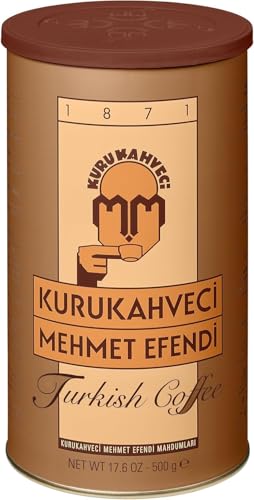
3. Kurukahveci Mehmet Efendi Turkish Coffee (17.6oz)
The same legendary roast as the 10-pack, sold in a single large bag for serious daily drinkers — buyers call the flavor “absolutely delicious.”
Flavor and coffee quality are the two aspects buyers mention most, and the feedback is overwhelmingly positive — buyers describe the smell as “so strong and delicious” and flavor as “absolutely delicious.” This is the same 100% Arabica, medium-roast, ultra-fine grind (finer than espresso) from Mehmet Efendi, but in a 17.6-ounce single bag rather than ten separate tins. It keeps the same talcum-fine grind that produces that signature thick foam, and it requires the same ibrik preparation. Buyers mention a very effective energy boost compared to other coffees, attributing it to the roast’s potency.
The difference from the 10-pack is format: one resealable bag versus ten tins. If you drink Turkish coffee every day, the single bag is more convenient and uses less shelf space. But once opened, the bag loses freshness faster than the sealed tins. That is the trade-off — buy this for the daily ritual, not for long-term storage.
The edge
- Same benchmark flavor in a compact 17.6-ounce bag
- Buyers describe it as the “best coffee I have ever had”
- Single format takes less pantry space than a 10-tin bundle
The catch
- Bag is less airtight than the tins once opened
- Requires the cezve — not compatible with drip machines
Best for: the home drinker who wants the gold standard Mehmet Efendi flavor without stacking ten tins.
Skip if: you prefer cardamom or you need portion-sealed tins for freshness.
4. Selamlique Istanbul Turkish Coffee (Chocolate)

The chocolate-infused dark roast that delivers a surprising pop at the bottom of the cup — not a subtle flavor.
This is not a subtle flavor — as reviewers point out, “it tastes smooth and delicious and at the end of your cup you get this pop of chocolate.” The 4.4-ounce bag is compact, and the dark roast base is ground ultra-fine (like talcum powder), making it suitable for the cezve. The chocolate flavor is distinct enough that some love it and others find it too far from traditional Turkish coffee. The flavor profile splits opinion, but for those who enjoy the twist, the experience is unique and memorable.
The trade-offs are real: the bag size is small compared to most competitors, and a few buyers found the flavor bitter and lingering. The cardamom-free profile means it works for people who want plain Turkish coffee with an added note. If you are a purist, this is not for you. If you want something different for an afternoon cup, the chocolate pop is genuinely fun.
Boldest flavor: The chocolate finish is the standout feature — you either love the pop or you do not. Watch for: a few batches arrive dented, so inspect the bag on delivery.
Try it if: you are curious about flavored Turkish coffee and want a dessert-like finish.
skip it if: you want a traditional clean Turkish coffee or you need a larger volume for daily drinking.
5. Al Ameed Gourmet Turkish Ground Coffee with Cardamom

The light-meets-dark roast blend with cardamom that takes a few tries to perfect — shoppers say it is “absolutely delicious” once dialed in.
Al Ameed uses a blend of 70% light and 30% dark roast 100% Arabica beans, a ratio that is unusual in Turkish coffee. The light-roast component gives a bright, less heavy cup than the typical all-dark Turkish coffee. The cardamom (a sweet-spicy seed) is present but not overpowering — buyers report it has “just the right amount of cardamom.” At 8 ounces, the bag sits between the small Selamlique and the larger Kurukahveci formats. The product dimensions are 2.25 x 3.5 x 5.5 inches, a compact footprint compared to the 8.66 x 6.69 x 3.94 inches of the Selamlique bag.
As owners mention: “it takes a few tries to get it to the strength you prefer, but once you do it’s amazing.” The light roast makes it harder to gauge extraction time — you might pull a weak cup on the first attempt. Once dialed in, though, the flavor is described as “absolutely delicious” and shows the cardamom clearly. The main downside is the per-ounce cost, which some call expensive.
Standout quality: The light-dark roast blend is unique and avoids the heavy bitterness of straight dark roasts. Be aware: You may waste a few scoops dialing in the brew strength.
Reach for it if: you want a brighter, less heavy Turkish coffee with cardamom that is not a dark roast.
Think twice if: you want a straightforward, no-fuss Turkish coffee that works on the first try.
6. Elite Turkish Coffee with Cardamom (3-Pack)
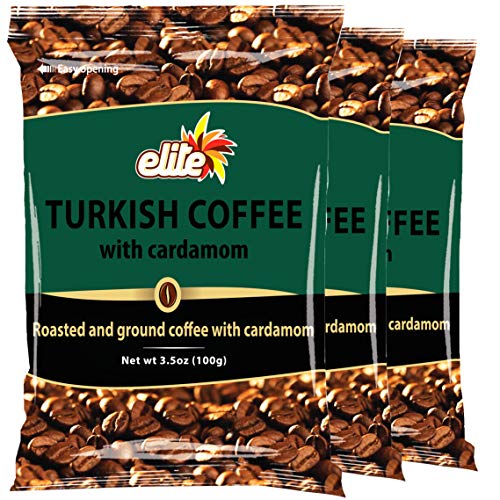
The cardamom blend that owners say has the perfect spice-to-coffee ratio, every time — no guesswork needed.
The quality and value-for-money are the top positive aspects here, and customers describe the cardamom balance as ideal — “the perfect ratio of cardamom to coffee” is a recurring observation. Like the plain Elite Turkish coffee, this is an ultra-fine (talcum-powder) dark roast, but with cardamom mixed in, so you get a consistent flavor in every cup without needing to add spice yourself. At 10.5 ounces across three tins, the volume is the same as the plain Elite 3-Pack. The 3.52-ounce weight per tin matches the single Elite tin, making this a cost-effective way to buy the cardamom version in bulk.
The taste is the most-discussed aspect, but it is mixed: while many call it excellent, a minority finds it terrible. The reason is likely that the cardamom flavor is strong, and not everyone likes that profile. Buyers who love it serve it in restaurants and say guests rave about it. The dark roast here is the same as the plain Elite, so if you found that clean, this will taste noticeably different due to the spice. Kosher for year-round use, excluding Passover.
Best cardamom blend: The spice ratio is consistently praised — no guesswork, just a reliable cup. Watch for: the cardamom flavor is pronounced, so if you prefer plain coffee, skip this one.
Get it for: a ready-to-brew cardamom Turkish coffee that does not require you to measure spices.
Pass if: you want plain coffee or you prefer controlling the cardamom yourself.
7. Maatouk Lebanese Coffee with Cardamom
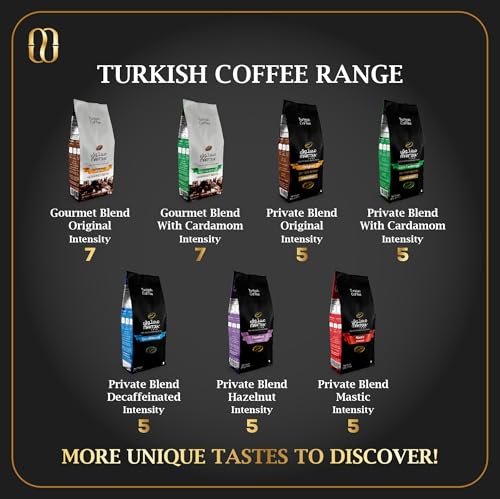
The Lebanese-style cardamom blend that owners say has a full, rich flavor you cannot quit — reviewers call it “full flavor” and “heavy on the flavor.”
Taste is the most-discussed aspect by a large margin, and positive reviews call it “full flavor” and “heavy on the flavor” — a sign of a bold cardamom (sweet-spicy seed) profile. Made from a blend of Brazilian and Arabica beans, this is an ultra-fine (talcum-powder) ground Turkish coffee that is meant for stovetop preparation in a traditional rake (a small pot). The cardamom is the defining feature, with buyers noting that it transforms the coffee from a daily drink to something special. The 16-ounce bag is generous — at 16 oz versus the 8-ounce Al Ameed bag — making this a solid option for regular brewing.
The negative feedback centers on freshness: a few buyers received stale bags with no detectable cardamom flavor. That is a risk with any large bag, so check the roast date if you can. The brew method is specific — this is not for a Mr. Coffee maker — and the cardamom makes it strong and slightly bitter in a way that is an acquired taste. If you love Lebanese coffee from restaurants, this delivers the same experience at home.
What standouts
- Bold, full flavor with prominent cardamom — owners call it “outstanding”
- 16-ounce bag is larger than most cardamom blends on the list
- Authentic Lebanese blend that recreates the restaurant experience
What to watch
- Freshness is inconsistent — some bags arrive stale with no cardamom aroma
- Strong and slightly bitter profile is an acquired taste, not for casual drinkers
Reach for it if: you already love Lebanese-style cardamom coffee and want a large bag for home.
pass on it if: freshness consistency is your top priority or you prefer plain Turkish coffee.
8. Café Najjar Turkish Coffee

The Lebanese-Turkish crossover that owners call the best coffee on the planet — or too acidic, depending on the batch.
The quality is the top positive aspect, and the strongest praise describes it as “the best coffee on the planet.” Made from 100% Arabica beans grown in Brazil and ground to an ultra-fine (talcum-powder) powder, this is a dark roast that follows the Lebanese tradition. The 15.87-ounce bag is vacuum-sealed at the factory, which helps preserve freshness. The product comes from Lebanon and is a well-known brand in Arabic coffee circles. Buyers recommend boiling four scoops and letting it settle before drinking, exactly like traditional Turkish preparation.
The taste is the most-discussed aspect, but it is the only one marked as mixed. Some find it “delicious” and “tastes wonderful” while others call it “too dark, acidic, and sour,” with the suspicion that those batches were old. That split suggests the roast is quite dark — borderline bitter — and that freshness is the deciding factor. If you buy a fresh batch, you get the top-tier experience; if you get an old one, it is drinkable but disappointing. The bag size is good for a trial run.
Best quality: When fresh, this is the coffee that fans swear by and repurchase regularly. Biggest risk: The taste is entirely batch-dependent — one bag can be perfect, the next too acidic.
Try it if: you are curious about Lebanese-style Turkish coffee and are willing to gamble on a fresh batch.
it’s not for you if: you need guaranteed consistency every time you open a new bag.
Understanding the Specs
Grind Fineness
The defining spec for Turkish coffee. The grind must be ultra-fine — finer than espresso (coffee extracted under pressure) — so the coffee extracts fully during the short boil in the cezve. A coarser grind will produce a thin, watery cup with minimal foam (creamy top layer). Every coffee on this list is ground to that standard, but the freshness of the grind matters: fresh ultra-fine coffee clumps less and produces a thicker foam cap than stale coffee that has been sitting on a shelf for months.
Roast Level
Most Turkish coffee uses a medium to dark roast. The roast determines the balance of body and bitterness. A medium roast (like the Kurukahveci Mehmet Efendi) preserves the bean’s natural sweetness and avoids the burned taste that comes from over-roasting. A dark roast (like the Elite or Café Najjar) gives a bolder, stronger flavor but can tip into bitter if the beans are pushed too far. The best roasts hit the point where the oils are developed but not charred.
Arabica vs. Blend
100% Arabica beans (a bean type known for smoothness) are the standard for premium Turkish coffee because they produce a smoother, less bitter cup than Robusta (a hardier, more bitter bean). The Al Ameed and Kurukahveci Mehmet Efendi are both 100% Arabica. Some blends, like the Maatouk, mix Brazilian and Arabica beans, which can add body but may also increase bitterness. For a pure, clean Turkish coffee experience, look for the 100% Arabica label.
Cardamom Freshness
Cardamom-infused Turkish coffee is a classic variation, but the spice loses its aromatic punch quickly. Fresh cardamom blends have a strong, sweet-spicy smell in the bag. Stale cardamom coffee smells flat and dusty. The Elite Cardamom blend gets consistent praise for its “perfect ratio of cardamom to coffee,” while the Maatouk has received mixed feedback on whether the cardamom is detectable at all — a sign that freshness matters more for spiced blends than for plain coffee.
FAQ
Can I use any ground coffee for Turkish coffee?
How do I brew Turkish coffee at home?
What is the difference between Turkish coffee and espresso?
How long does opened Turkish coffee last?
Can I use Turkish coffee in a regular coffee maker?
What is the difference between plain and cardamom Turkish coffee?
Is Turkish coffee stronger than regular coffee?
Why does my Turkish coffee taste bitter?
Which Turkish coffee is the most authentic?
How much coffee should I use per cup?
Final Thoughts: The Verdict
For most buyers, the coffee for turkish coffee winner is the Kurukahveci Mehmet Efendi 10-Pack because it delivers the definitive medium-roast flavor and thick foam that the ritual demands, backed by a century and a half of tradition. If you want a bright, cardamom-forward cup that takes a few tries to perfect, the Al Ameed Cardamom is a unique option. And for bulk daily drinking at the lowest per-ounce cost, the Elite 6-Pack is the one to reach for — just remember to use a glass mug, not paper.
How We Picked
We do not accept paid placement. Every pick is matched to a real buyer and a real use-case; we do not hands-on test units.
Sources & Methodology
Specifications: manufacturer listings and product documentation. Review insights: verified customer reviews, as of July 2026. Pricing: not shown on this page (it changes often); check the current price via the retailer link.
As an Amazon Associate, WellFizz earns from qualifying purchases. This does not affect which products we feature.
Related Guides

Mo Maruf
I created WellFizz to bridge the gap between vague wellness advice and actionable solutions. My mission is simple: to decode the research and give you practical tools you can actually use.
Beyond the data, I am a passionate traveler. I believe that stepping away from the screen to explore new environments is essential for mental clarity and physical vitality.