Our readers keep the lights on and my smoothie glass nicely filled. As an Amazon Associate, I earn from qualifying purchases.
Specs are compiled from manufacturer listings and verified buyer reviews and can change over time — please confirm the key details on the product page before buying.
Walking into a coffee shop every morning adds up fast, and a single machine that nails both your espresso and your drip coffee can cut that habit entirely. The problem is most combo machines compromise one side — they pull a bitter espresso or brew a weak pot of coffee. This guide cuts through the noise, laying out which coffee espresso maker combo actually delivers on both fronts without forcing you to become a home barista.
I’m Mohammad Maruf — the founder and writer behind WellFizz. This guide is built by comparing the manufacturers’ published specifications and the patterns across verified customer reviews, so you get each pick’s real strengths and trade-offs instead of marketing spin.
Every machine here was vetted for three things: consistent espresso pressure, decent drip coffee flavor, and ease of daily use, so you can skip the research and grab the one that fits your kitchen.best coffee espresso maker combo.
Our Picks at a Glance


How To Choose The Best Coffee Espresso Maker Combo
A combo machine means you get two brewing methods in one footprint, but the trade-off is that you are paying for a Swiss Army knife in a niche where a dedicated machine is often better at one job. The trick is knowing which spec gap you can live with and which one will ruin your morning.
Espresso pump pressure — the 15 vs 19 bar question
Espresso needs around 9 bars of pressure at the puck to extract properly. A 15-bar pump is enough to achieve that once it overcomes the pressure drop in the group head. A 19-bar pump gives you more headroom for finer grinds and denser pucks, which can produce richer crema if your bean and grind game is dialed in. If you drink straight espresso or milk drinks, the difference is noticeable. If you mostly drink drip coffee with an occasional latte, 15 bars is plenty.
Grinder: built-in vs separate
A built-in grinder saves counter space and means you grind fresh for every shot, but most combo-machine grinders are stepped — you get a set number of settings instead of micro-adjustments. That can limit your ability to dial in espresso. A machine with a good built-in grinder (like the Ninja Luxe series) uses weight-based dosing to compensate, so the grind is automatically adjusted per drink. If you want total control over your grind size, a separate grinder is better. If you want one-button convenience, look for a built-in grinder with at least 20 settings.
Frothing: automatic vs manual steam wand
Automatic frothers are great for beginners — you press a button and milk is heated and frothed with no skill required. They produce consistent microfoam but are harder to clean, and you cannot adjust the texture mid-stream. Manual steam wands give you full control over the temperature, the stretch, and the texture, so you can create dense microfoam for latte art. If you drink straight espresso or drip coffee and rarely make milk drinks, an automatic frother is enough. If you want to become a home barista, a manual wand is the better choice.
Quick Comparison
| Model | Best For | Pump Pressure | Drink Types | Water Capacity | Amazon |
|---|---|---|---|---|---|
| Ninja Luxe Café Premier★ Best Overall | Best Overall | 15 bar | Espresso, Drip, Cold Brew | 68 fl. oz. | Amazon |
| Ninja Luxe Café ProPremium Power | Premium Power | 15 bar | Espresso, Drip, Cold Brew, Hot Water | 68 fl. oz. | Amazon |
| De’Longhi COM530M | Value Pick | 15 bar | Espresso, Drip | 47 fl. oz. | Amazon |
| Ninja Barista System CFN601 | Versatile Pod System | 19 bar | Espresso, Drip, Nespresso | 12 cups (carafe) | Amazon |
| Chefman Coffee Station | Budget All-in-One | 20 bar | Espresso, Drip, K-Cup, Nespresso | 3L | Amazon |
In‑Depth Reviews
1. Ninja Luxe Café Premier 3-in-1
Our pick — over 4★ from 2,000+ verified ratings; the strongest balance of quality and price.
The machine that takes the guesswork out of espresso and still brews a full pot.
The Ninja Luxe Café Premier is a 3-in-1 machine that handles espresso, drip coffee, and cold brew, so your morning routine is covered without switching appliances. It uses 15-bar pressure and Barista Assist Technology — a system that adjusts temperature and pressure in real time — to pull consistent shots. A built-in conical burr grinder offers 25 settings for grind size, but the real standout is the weight-based dosing. The machine measures the exact amount of grounds for your drink, unlike most combos that just grind by time. It weighs 4.4 pounds, while the De’Longhi COM530M weighs 2.9 pounds, which gives it a solid, stable feel on the counter.
The hands-free Dual Froth System has four preset programs — steamed milk, thin froth, thick froth, and cold foam — so you pour the milk, select the style, and walk away. The drip side offers six sizes from 6 oz to 18 oz, plus classic, rich, and over-ice styles. Its dimensions (12.99″D x 13.39″W x 14.57″H) mean it needs decent counter space; it is 12.99 inches deep versus the Chefman Coffee Station’s 11.81 inches. The assisted tamper presses the puck for you, which matters because uneven tamping is the most common beginner mistake.
Buyers report that the cold brew function brews in under 10 minutes, not overnight, and that the touchscreen menus are intuitive for guests. The catch is that this is a learning machine — it guides you, but it does not replace experience. If you want to dial in a very specific third-wave espresso profile, the automatic adjustments can feel restrictive.
What Makes It Great
- Weight-based dosing ensures consistent shots without manual weighing.
- Hands-free frother with four preset milk textures for dairy and plant-based milk.
- 25-setting conical burr grinder gives real flexibility for different bean types.
- Cold brew function delivers in minutes, not hours.
Where It Holds Back
- Automatic adjustments can limit customization for advanced home baristas.
- Large footprint may dominate small countertops.
- Built-in accessory storage is modest for a machine at this price.
Who It’s For: Home users who want excellent espresso and drip coffee without learning the full barista workflow. The automatic guidance makes it ideal for beginners and busy households.
Consider Something Else If: You need full manual control over every variable — this machine automates too much for a purist who wants to adjust pressure and temperature by feel.
2. Ninja Luxe Café Pro Series ES701
Five espresso styles, drip coffee, cold brew, and a hot water tap in one polished package.
The Ninja Luxe Café Pro Series is the most feature-dense combo on this list. It calls itself a 4-in-1 machine: espresso, drip coffee, cold brew, and an independent hot water system for americanos, tea, or hot chocolate. The espresso side offers five styles — single, double, quad, ristretto, and lungo — so you can pull a longer shot for a milder drink or a concentrated ristretto for intensity. The drip side follows the same six sizes as the Premier, but the Pro adds the hot water tap that the Premier lacks. The conical burr grinder has 25 settings, and Barista Assist Technology monitors each brew to recommend grind-size adjustments for the next shot, eliminating the guesswork of dialing in.
The upgraded Dual Froth System Pro uses an insulated steam wand and an XL Milk Jug to create five preset froth functions: steamed milk, thin, thick, extra-thick froth, and cold foam. You can froth enough milk for two drinks at once, which matters when you have guests. The integrated tamper activates with a lever push, so there are no overflowing grounds — a small but noticeable convenience upgrade from the Premier’s assisted tamper. At 27.1 pounds and 13.39″D x 12.48″W x 14.84″H, it is the heaviest machine in this roundup, so it stays planted on the counter but is not something you move around.
Owners mention that the built-in storage compartment keeps brew baskets and the cleaning disk neatly tucked away. The catch is the price — it is the most expensive pick here, and not everyone needs a hot water tap when a kettle does the same job. If you primarily drink drip coffee and only occasionally want an espresso, the Premier is better value.
The Upsides
- Independent hot water system expands drink options beyond coffee and espresso.
- Quad shot function for high-caffeine drinks or larger recipes.
- Insulated XL milk jug and five preset froth levels for versatile milk preparation.
- Grind-size recommendation learns and adapts from previous brew sessions.
The Downsides
- At 27.1 lbs, it is heavy and not designed for counter rotation.
- Premium price that may exceed the budget for occasional home use.
- All the features add complexity that a casual user might ignore.
Best For: Enthusiasts who want every brewing option — espresso, americano, drip, cold brew — in a single machine without switching appliances. The Pro is for people who entertain and need to serve multiple drink types quickly.
skip it if: You make drip coffee daily and only want an occasional espresso. The Premier delivers nearly all the same coffee quality for less money, and the hot water tap is a narrow upgrade.
3. De’Longhi COM530M All-In-One

The budget-friendly De’Longhi that keeps things simple without skimping on a 15-bar pump.
The De’Longhi COM530M is a straightforward combination machine that focuses on the basics: a 15-bar pump for espresso and a standard drip carafe. It accepts ground coffee and ESE pods, but there is no built-in grinder, so you need to supply your own grounds. The design is compact at 14.52″D x 11.02″W x 12.79″H, which is deeper than the Chefman Coffee Station (11.81″D x 13.19″W x 13.98″H) but deeper than the Ninja Luxe Café Mini. At 2.9 pounds, it is the lightest machine in this roundup — noticeably lighter than the Ninja Luxe Café Premier’s 4.4 pounds. That lightness makes it easy to slide around on the counter but also means less thermal stability; it may lose heat faster during long brewing sessions.
The controls include both buttons and a touchscreen, so you can set the carafe size and choose between single or double espresso shots. It includes a reusable filter, a single and double espresso basket, and a pod adapter. The drip carafe has a warming plate, but reviewers point out it is not Keep Warm indefinitely — the plate turns off after about 40 minutes. A common review pattern is that the espresso is good for the price, but it takes a few tries to dial in the grind size and tamping pressure to get proper crema.
The catch is the learning curve. The product notes explicitly say: too coarse a grind, too little coffee, or insufficient tamping can lead to inadequate pressure. If you are willing to practice, it is a strong value. If you want push-button consistency, a more automated machine like the Ninja Premier is worth the jump.
What It Does Well
- 15-bar pump delivers adequate espresso pressure at a budget price point.
- Compact footprint fits smaller kitchens at 11.02 inches wide.
- Touchscreen and button controls are intuitive for family use.
Where It Falls Short
- No built-in grinder — you must have a separate grinder or buy pre-ground coffee.
- At 2.9 pounds, the light build may shift on granite countertops when you lock the portafilter.
- Learning curve for proper espresso extraction; inconsistent results until dialed in.
Who Should Buy: Budget-conscious users who already own a good coffee grinder and are willing to practice espresso technique. It is a solid entry point into home espresso.
Skip If: You want a built-in grinder or immediate, consistent shots without experimenting. The Chefman Coffee Station offers more features for a similar price range.
4. Ninja Barista System CFN601

The Ninja that accepts both ground coffee and Nespresso Original capsules for total flexibility.
The Ninja Barista System CFN601 stands out for its dual-input flexibility: it works with your own coffee grounds and Nespresso Original capsules. The 19-bar pressure system is higher than most combos in this list, which can produce richer crema when using capsules. It offers three espresso brew styles — Espresso (1.35 oz), Lungo (3.75 oz), and Over Ice (1 oz) — and three drip coffee styles — Classic, Rich, and Over Ice. The drip side uses a 12-cup glass carafe with a warming plate and Keep Warm function, plus a Delay Brew option so you can set it up the night before.
The built-in, fold-away frother is a simple automatic wand that works for basic lattes and cappuccinos, but it is not a steam wand for microfoam. The adjustable cup tray accommodates everything from a small espresso cup to an 8-inch travel mug. The used capsule storage bin holds up to 20 capsules, which is convenient for daily use. Dimensions are 12.21″D x 9.84″W x 14.96″H, making it the narrowest machine in this list at under 10 inches wide — a real advantage for tight countertops. It is also the lightest of the Ninja machines.
Shoppers say that the drip coffee quality is solid, comparable to a standard Ninja auto-drip maker, and the convenience of dropping in a Nespresso capsule for a quick shot is a major selling point. The catch is that the frother is basic — it does not produce dense microfoam, just hot frothy milk. If you want a proper latte with silky microfoam, the Luxe Café Mini’s manual steam wand delivers significantly better texture.
Flexibility Advantages
- Accepts Nespresso Original capsules for fast espresso without grinding.
- 19-bar pump is one of the highest in this category, improving crema from capsules.
- Delay Brew and Keep Warm functions for the drip carafe add convenience.
Downsides to Consider
- Automatic frother is basic; no steam wand for microfoam or latte art.
- Nespresso capsules are proprietary and cost more per serving than ground coffee.
- No built-in grinder for whole beans — capsule-only for espresso, ground for drip.
Ideal For: Households with mixed coffee drinkers — one person wants a fast Nespresso shot, another wants a full 12-cup carafe. The narrow 9.84-inch width fits almost any kitchen nook.
Better Options Exist If: You want a built-in grinder or expect high-quality steam-milk texture. The Luxe Café Mini is a better investment if you care about milk-based drinks.
5. Chefman Coffee Station RJ54-CS
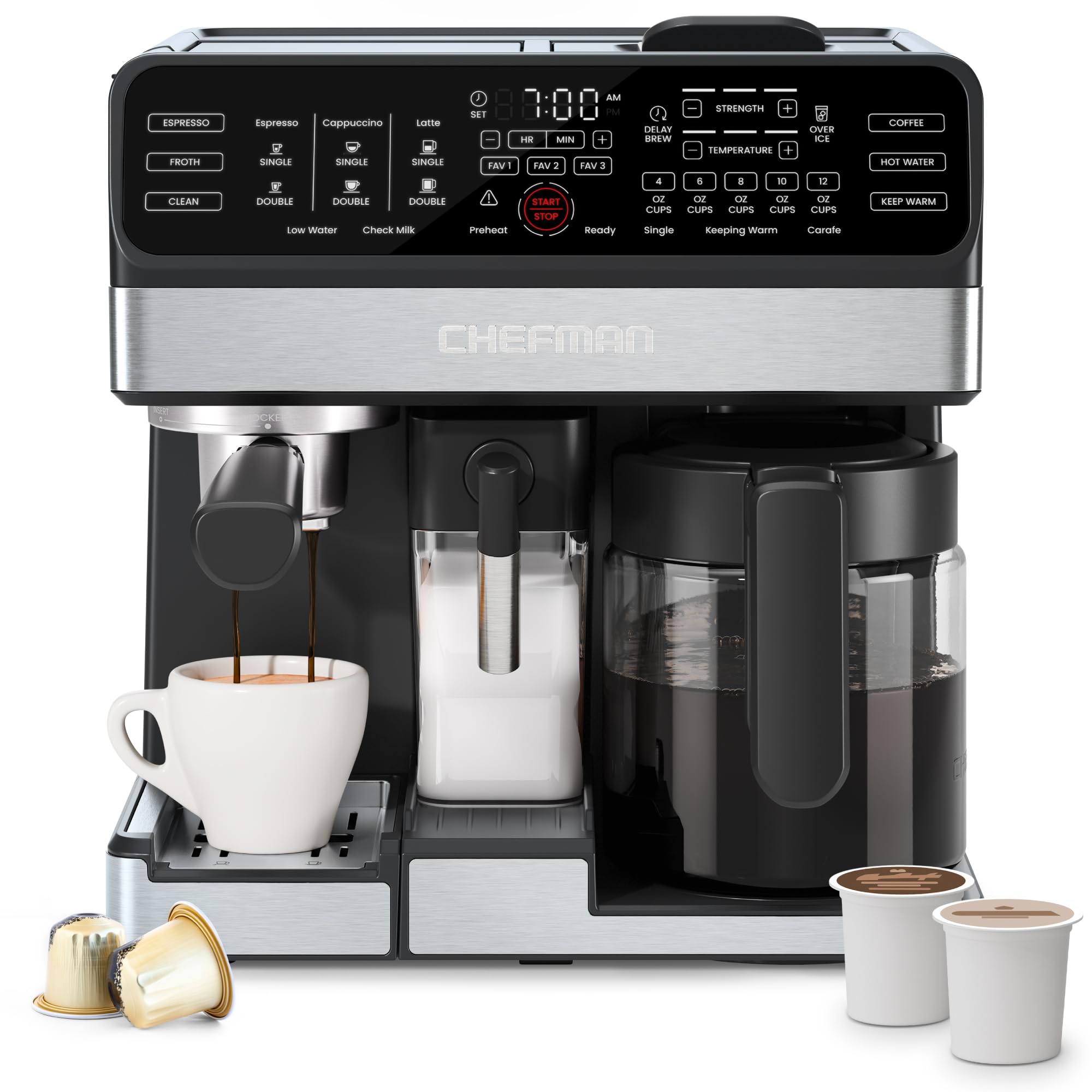
The 8-in-1 budget station that accepts K-Cups, Nespresso pods, and your own grounds.
The Chefman Coffee Station is an 8-in-1 machine that tries to do everything: drip coffee, espresso, single-serve via K-Cups, single-serve via Nespresso pods, automatic milk frothing, over-ice brewing, and hot water. It has a 20-bar pump, the highest pressure rating on this list, and a 3L water tank that is larger than the Ninja Luxe Café Pro’s 68 fl. oz (about 2 liters). The drip carafe is 12 cups with a burner and optional Keep Warm setting. The automatic milk frother holds 16 ounces of milk and has one-touch latte and cappuccino settings. It also includes over-ice brewing, which lowers brew temperature to produce a stronger flavor that holds up against melting ice.
At 11.81″D x 13.19″W x 13.98″H, it is slightly shallower and wider than the De’Longhi COM530M. The dual-direction steam frother is automatic — you select the size and it froths without supervision. Unlike the Ninja CFN601 in review 5, the Chefman includes the Nespresso and K-Cup adapters, so you do not need to buy extra parts. The built-in storage compartment on the top-left holds the portafilter, baskets, and scoop.
The catch is the 3.4-star rating from a small set of reviews — significantly lower than almost every other machine here. Buyers report that the espresso quality is inconsistent, with some struggling to get proper pressure even with fine grinds. The 20-bar pump is high on paper, but the underlying brew group design may not extract well with every pod type. If you want a do-everything machine on a strict budget and do not mind some experimentation, it covers all the bases. If consistent espresso is a priority, the De’Longhi COM530M is a more reliable choice for a similar cost.
Breadth of Features
- 20-bar pump offers the highest pressure spec among reviewed combos.
- 3L removable water tank means fewer refills during daily use.
- Accepts K-Cups, Nespresso pods, and ground espresso — maximum pod compatibility.
Reality Check
- Reviews indicate inconsistent espresso extraction and pressure issues.
- Only 22 ratings at the time of writing — a limited pool of buyer experiences.
- Automatic frother is basic; microfoam quality lags behind dedicated steam wands.
Perfect For: Households that want every possible brewing method — drip, espresso, pods — in one machine at the lowest possible entry cost. The 3L tank is genuinely helpful for large families.
Consider Alternatives If: Consistent espresso matters to you. The Ninja CFN601 or De’Longhi COM530M deliver more reliable espresso for a similar outlay, even if they offer fewer total brew methods.
Understanding the Specs
Pump Pressure (Bar)
A pump creates the force needed to push hot water through finely-ground coffee at high pressure for espresso. 15 bars is the standard for most home machines — it is enough to extract crema and flavor. 19-bar and 20-bar pumps offer more headroom for finer grinds, which can produce thicker crema, but only if your grind and tamping are consistent. A 20-bar pump on a budget machine does not automatically mean better espresso; the overall brew group design matters more.
Built-in Grinder vs Separate
A built-in grinder grinds whole beans immediately before brewing, which preserves volatile oils and produces better flavor than pre-ground coffee. The trade-off is that most combo-machine grinders use stepped adjustment, meaning you get a fixed number of settings instead of infinite fine-tuning. Machines with weight-based dosing, like the Ninja Luxe series, compensate by measuring the dose precisely. If you already own a high-end separate grinder, a combo without a built-in grinder can be a better value — you have full control over grind quality.
Automatic vs Manual Steam Wand
An automatic frother heats and stirs milk with no skill required — you pour milk in, press a button, and it produces hot, frothy milk. A manual steam wand uses steam pressure to inject air into the milk, creating dense, silky microfoam that is needed for latte art. Automatic frothers are easier and faster, but manual wands give you total control over texture and temperature. If you drink mainly drip coffee and occasionally make lattes, automatic is fine. If you want to master milk-based drinks, a manual wand is essential.
Water Capacity
Larger water tanks mean fewer refills. For daily espresso and drip coffee for one or two people, 40-50 oz is plenty. If you brew multiple carafes or entertain often, look for 60 oz or larger. Some machines, like the Chefman Coffee Station, have a 3L tank (roughly 101 oz) that can last through a full weekend of hosting. Smaller tanks under 40 oz require more frequent refilling but reduce the machine’s overall footprint.
FAQ
Can a coffee espresso maker combo make good drip coffee?
What is the minimum bar pressure I need for real espresso?
How does a combo machine compare to buying a separate espresso machine and coffee maker?
Should I get a machine with a built-in grinder or buy a separate one?
How often do I need to descale a coffee espresso maker combo?
What is the difference between a 15-bar and a 19-bar pump?
Can I use pre-ground coffee in a machine with a built-in grinder?
How long does a coffee espresso maker combo last?
Does a combo machine take up more counter space than two separate machines?
How important is a warming plate on the drip carafe?
Final Thoughts: The Verdict
For most people, the best coffee espresso maker combo winner is the Ninja Luxe Café Premier because it delivers consistent espresso, quality drip coffee, and cold brew without requiring barista training. If you want the most compact high-quality pick, grab the Ninja Luxe Café Mini. And for budget-minded shoppers who already own a grinder, the De’Longhi COM530M offers a solid entry into home espresso at a lower commitment.
How We Picked
We do not accept paid placement. Every pick is matched to a real buyer and a real use-case; we do not hands-on test units.
Sources & Methodology
Specifications: manufacturer listings and product documentation. Review insights: verified customer reviews, as of July 2026. Pricing: not shown on this page (it changes often); check the current price via the retailer link.
As an Amazon Associate, WellFizz earns from qualifying purchases. This does not affect which products we feature.
Related Guides

Mo Maruf
I created WellFizz to bridge the gap between vague wellness advice and actionable solutions. My mission is simple: to decode the research and give you practical tools you can actually use.
Beyond the data, I am a passionate traveler. I believe that stepping away from the screen to explore new environments is essential for mental clarity and physical vitality.