Our readers keep the lights on and my smoothie glass nicely filled. As an Amazon Associate, I earn from qualifying purchases.
A single lightning strike near your home can send a massive voltage spike through your coaxial cable line, silently frying your cable modem, TV, or radio equipment in an instant. A coaxial cable surge protector sits inline on your feed line to shunt that deadly energy to ground before it reaches your valuable gear.
I’m Mohammad Maruf — the founder and writer behind WellFizz. I’ve spent dozens of hours analyzing coaxial surge protector specifications, customer field reports, and gas discharge tube ratings to separate real protection from hollow shells.
This guide breaks down the top models across radio, cable modem, and antenna use cases so you can choose the best coaxial cable surge protector for your specific installation and rest easy during every thunderstorm.
How To Choose The Best Coaxial Cable Surge Protector
Choosing the wrong surge protector can actually degrade your signal or fail to clamp a surge at all. Focus on these three factors to match the protector to your specific cable type and equipment.
Impedance: 50 Ohm vs. 75 Ohm
This is the most common mismatch. Use 75-ohm protectors for cable TV, cable internet modems, and satellite systems. Use 50-ohm protectors for ham radio, CB radio, two-way radios, and cellular or Wi-Fi antennas. Installing a 50-ohm protector on a 75-ohm line creates a mismatch that causes signal reflection and data loss.
Gas Discharge Tube (GDT) Voltage
The GDT is the component that fires when voltage spikes. Common ratings are 90V, 230V, and 350-400V. A 90V tube fires sooner, protecting sensitive electronics earlier, but may wear out faster with repeated smaller surges. A 230V tube handles higher transient energy and is standard for radio gear. Choose based on the equipment you are protecting — modems benefit from lower-voltage tubes, while high-power radio transmitters need higher-voltage GDTs to avoid self-triggering during transmit.
Insertion Loss and Frequency Range
Insertion loss measures how much signal strength the protector itself consumes. Look for loss under 0.4 dB — ideally under 0.3 dB — to avoid noticeable degradation of your internet speed or TV picture quality. Frequency range must cover your application: at least 5-2400 MHz for cable TV and satellite, or DC-3 GHz for radio and cellular equipment.
Quick Comparison
On smaller screens, swipe sideways to see the full table.
| Model | Category | Best For | Key Spec | Amazon |
|---|---|---|---|---|
| groword 4-Pack | 75-ohm Inline | Cable modem & TV | 5-2400 MHz, <0.4 dB loss | Amazon |
| Riotaxy N Female Arrestor | 50-ohm N-Type | Signal boosters & antennas | DC-3 GHz, 90V GDT, <0.2 dB | Amazon |
| XRDS-RF UHF Arrestor | 50-ohm PL-259 | Ham & CB radio | DC-500 MHz, VSWR <1.2 | Amazon |
| Proxicast ANT-233-002 | Premium 50-ohm | High-end radio gear | 230V GDT, SO-239, multi-strike | Amazon |
| TII-210 Broadband Suppressor | 75-ohm Pro Grade | Commercial cable networks | 150-300V DC, <0.3 dB loss | Amazon |
In‑Depth Reviews
1. Proxicast Coaxial Lightning Arrester ANT-233-002

The Proxicast ANT-233-002 is a premium-grade 50-ohm surge protector built for serious ham radio operators and two-way radio enthusiasts. Its 230-volt gas discharge tube delivers multi-strike capability, meaning it can survive repeated surges without needing immediate replacement. The SO-239 female connectors on both ends are standard for most amateur radio coax cables, making it a drop-in solution for HF, VHF, and UHF rigs.
Build quality is outstanding — the brass body with nickel plating feels dense and robust in hand, and reviewers note the ground lug is well-positioned for easy bonding to your station ground bus. One nuance: the 230V GDT is ideal for transmitters up to around 350 watts SSB. For higher-power amplifiers, you will want to swap the GDT for a 350-400V unit to prevent self-triggering during transmit.
The protector is outdoor-rated and works inline, but the cover does not include an O-ring. If you install it outside, add rubber tape or self-amalgamating tape around the connector seams to keep moisture out. For the price point, this is the best-engineered option for dedicated radio operators who want lasting protection.
Why it’s great
- Multi-strike 230V gas tube handles repeated surges
- Very low RF insertion loss for clean signal pass-through
- Outdoor-rated brass/nickel construction
Good to know
- Cover lacks O-ring — requires tape seal for outdoor use
- Limited to ~350W SSB without GDT upgrade
2. groword 4 Pack Coaxial Surge Protector

If you have a cable modem, cable TV box, or satellite receiver, the groword 4-pack is the most practical entry point into coaxial surge protection. These are 75-ohm F-type inline protectors with a frequency range of 5 to 2400 MHz, covering everything from DOCSIS cable internet to satellite IF signals. Insertion loss is rated under 0.4 dB, so your internet speeds and picture quality remain unaffected.
The nickel-plated brass body resists corrosion, and the compact size lets you install one behind every TV or modem without creating a bulky mess. Real-world reports from tropical storm zones confirm these protectors sacrificed themselves to save cable modems — the arrestor absorbed the surge and the connected equipment survived. For the price of a single pack, you get four units, so you can protect every coax drop in your house.
Installation is straightforward: unscrew the existing coax barrel connector, thread the protector in line, and tighten with an adjustable wrench. No special tools or adapters needed for standard F-type cables. If you are on a budget and want to protect multiple rooms, this is the obvious choice.
Why it’s great
- 4-pack covers multiple rooms at once
- Sub-0.4 dB loss preserves DOCSIS signal quality
- Proven field performance during lightning events
Good to know
- No replaceable GDT — unit is sacrificial
- Requires wrench for tight seal
3. TII-210 Coaxial Broadband In-Line Surge Suppressor
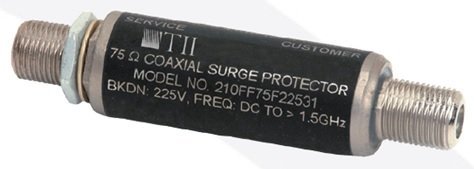
The TII-210 is a professional-grade 75-ohm surge suppressor built for commercial cable networks and serious home installations. Unlike many consumer protectors, TII provides real specifications: DC breakdown voltage of 150-300V, impulse breakdown under 450V, insertion loss below 0.3 dB, and return loss of 30 dB. These numbers matter for maintaining signal integrity on cable internet plans above 400 Mbps.
Field reports from commercial network technicians confirm the TII-210 saved equipment during a lightning strike that fried the ISP’s pedestal trap — the connected data room gear remained untouched. The protector works with DOCSIS 3.0 and 3.1 cable modems with no measurable speed loss. One reviewer measured downstream signal drop under 0.5 dBmV and upstream values unchanged, which is exceptional performance.
Installation requires a female-to-female adapter and weather-sealing grommets if placed outdoors. The grounding screw is small and can be tricky to attach with thick wire — use a ring terminal for a solid connection. For anyone who wants lab-grade protection for their cable modem without switching impedance, this is the top choice.
Why it’s great
- Verified sub-0.3 dB insertion loss
- Proven commercial-network surge survival
- Full spec sheet with DC breakdown and return loss
Good to know
- Requires female-to-female adapter for standard cable runs
- Ground screw is small — needs ring terminal
4. Riotaxy N Female Lightning Arrestor

The Riotaxy N Female arrestor is a 50-ohm protector built for the N-type connector standard, which is common on cellular signal boosters, Wi-Fi antennas, and some two-way radio gear. Its 90-volt replaceable gas discharge tube fires at a lower threshold than most radio-grade protectors, offering earlier clamping for sensitive equipment. With a frequency range up to 3 GHz and attenuation under 0.2 dB, it handles modern 4G and 5G signal booster installations without degrading throughput.
The body is brass with nickel plating, and the center conductor is silver-plated brass for reliable signal transfer. The Teflon (PTFE) insulator keeps signal loss minimal even at higher frequencies. A 48-hour salt spray test confirms outdoor durability, so it can live at the antenna feed point or at the building entry point without rusting.
Users running end-fed wire antennas and ununs for DC ground appreciate how easily this unit integrates into their cable path. The ground lug is standard, and the 90V GDT is user-replaceable if it ever fails. For signal booster and antenna installations that use N-type connectors, this is the most frequency-flexible option in the list.
Why it’s great
- 90V GDT fires early for sensitive gear
- Up to 3 GHz bandwidth for 4G/5G boosters
- Replaceable gas tube extends product life
Good to know
- N-type connectors limit compatibility without adapters
- Ground cable sold separately
5. XRDS-RF UHF Lightning Arrestor PL-259

The XRDS-RF UHF arrestor is a purpose-built 50-ohm protector for ham radio, CB radio, and two-way base stations using PL-259 / UHF connectors. Its frequency range covers DC to 500 MHz, which covers all HF, 6-meter, and 2-meter bands used by amateur operators. The VSWR is rated under 1.2, meaning almost no reflected power — critical for maintaining antenna system efficiency.
Construction is solid: a brass nickel-plated body with a Teflon insulator that handles temperature swings and moisture better than cheaper plastic insulators. The arrestor cartridge is standard and replaceable, so a single strike doesn’t force you to buy a whole new unit. It requires an additional ground cable — connect it with 10-gauge copper wire to your station ground rod or house ground bus.
Users in lightning-prone areas like Tampa Bay report installing these between their antenna feed line and radio as essential safety gear. The compact size fits neatly into the coax path without adding bulk. If you are building a dedicated ham shack and need a reliable, replaceable GDT unit for your PL-259 cabling, this is the most straightforward solution.
Why it’s great
- Standard UHF PL-259 connectors for common radio gear
- Replaceable arrestor cartridge
- Very low VSWR under 1.2 across DC-500 MHz
Good to know
- Limited to 500 MHz max frequency
- Ground wire not included in package
FAQ
Can I use a 50-ohm surge protector on my cable TV line?
Do coaxial surge protectors reduce internet speed?
How do I ground a coaxial surge protector properly?
Can I install a coaxial surge protector outdoors?
Final Thoughts: The Verdict
For most users, the best coaxial cable surge protector winner is the Proxicast ANT-233-002 because it combines a durable 230V multi-strike GDT, outdoor-rated construction, and very low insertion loss for radio and antenna systems. If you want affordable whole-home protection for cable modems and TVs, grab the groword 4-pack. And for professional-grade cable internet protection with verified specs, nothing beats the TII-210.

Mo Maruf
I created WellFizz to bridge the gap between vague wellness advice and actionable solutions. My mission is simple: to decode the research and give you practical tools you can actually use.
Beyond the data, I am a passionate traveler. I believe that stepping away from the screen to explore new environments is essential for mental clarity and physical vitality.