Our readers keep the lights on and my smoothie glass nicely filled. As an Amazon Associate, I earn from qualifying purchases.
Specs are compiled from manufacturer listings and verified buyer reviews and can change over time — please confirm the key details on the product page before buying.
If your CB radio sounds weak or staticky, the coax cable (the wire connecting your radio to your antenna) is the most likely culprit — more often than a bad radio or a broken antenna. The wrong coax bleeds your signal before it ever reaches the air, leaving you frustrated and unheard.
I’m Mohammad Maruf — the founder and writer behind WellFizz. This guide is built by comparing the manufacturers’ published specifications and the patterns across verified customer reviews, so you get each pick’s real strengths and trade-offs instead of marketing spin.
Whether you are running a base station, a mobile setup in your truck, or a portable ham shack, finding the right coax cable for cb means balancing signal loss, cable length, connector quality, and flexibility for your exact installation.
Our Picks at a Glance


How To Choose The Best Coax Cable For CB
Picking a coax cable means looking past the brand name and focusing on three things: the cable type (which controls signal loss), the connectors (which must be a perfect fit), and the length you need to reach from your radio to your antenna without extra slack.
Cable Type Matters Most
For CB and VHF radio use (around 27-150 MHz), the two main choices are RG58 and RG8x. RG58 is thinner and cheaper, but it loses signal faster over longer runs. RG8x has a thicker inner conductor (17AWG or even 16AWG) and lower loss per foot, making it better for runs over 18-20 feet or higher-power setups. For longer runs (60 feet or more), a low-loss cable like LMR400 or its equivalent (KMR400) is a smarter choice.
Connectors: PL259 is the Standard
Almost every CB radio, antenna, SWR meter, and dummy load uses a PL259 (UHF Male) connector. If you buy a cable with PL259 males on both ends, you can connect directly to your radio and antenna. If your antenna uses an SO239 (UHF Female) socket, a PL259-to-PL259 cable is a direct fit. Adapters (SMA, BNC, SO239) are useful if your setup mixes different connector types, but adding an adapter introduces a tiny amount of signal loss.
Length: Too Much is Bad
A longer coax cable always loses more signal than a shorter one. Buy only the length you need to connect your gear — an extra 10 feet of coiled cable inside your shack adds unnecessary loss. If your run is short (under 10 feet), a quality RG58 or RG8x works fine. For runs of 50 feet or more, step up to a low-loss cable to keep your signal strong.
Quick Comparison
| Model | Best For | Cable Type | Item Length | Connector Type | Amazon |
|---|---|---|---|---|---|
| Ham Radio YOTENKO RG58 49.2ft★ Best Overall | Versatile long kit | RG58 | 49.2 ft | PL259 Male + adapters | Amazon |
| MOOKEERF KMR400 25ftAlso Great | Low-loss base station | KMR400 (LMR400 eq.) | 25 ft | PL259 Male | Amazon |
| exgoofit RG8X 50ft | Long-run RG8x | RG8X | 50 ft | PL259 Male | Amazon |
| Ullnosoo RG8x 18ft | Waterproof mobile install | RG8X | 18 ft | UHF PL259 | Amazon |
| MOOKEERF RG8x 100ft | Large property / marine | RG8X (White) | 100 ft | PL259 Male | Amazon |
| YOTENKO RG8x Jumper 2ft 3-Pack | Short jumpers between gear | RG8X | 2 ft (3-pack) | PL259 Male | Amazon |
| SUPERBAT RG58 15ft Kit | Entry-level jumper kit | RG58 | 16.4 ft | PL259 + adapters | Amazon |
In‑Depth Reviews
1. Ham Radio Coax Cable 50 Ohm, RG58 49.2Ft + 4 Adapters
Our pick — over 4.5★ from 750+ verified ratings; the strongest balance of quality and price.
This 49.2-foot RG58 bundle adapts to almost any connector you own, making it incredibly flexible.
This is the Swiss Army knife of coax kits. You get a 49.2-foot RG58 cable with PL259 male on both ends, plus four adapters: UHF female SO239 to SMA male, SMA female, SO239, and BNC male. The adapter pack means you can connect your CB radio to an SWR meter with a UHF port, then to a VNA with an SMA connector, or to a dummy load with BNC — all from one cable. The Ham Radio kit includes a cable and four adapters, while the SUPERBAT kit includes a cable and three adapters.
The cable uses solid copper inner conductor with tinned copper braid and aluminum foil shielding. The heat shrink tube is 6cm (about 2.4 inches) long, which reviewers point out keeps the PL259 connectors secure even when the cable is bent or pulled. One buyer mentioned that the pre-terminated RG58 cable delivered a SWR of under 1.5 across multiple radios — meaning your antenna tune will be stable and your radio will not be stressed by reflected power.
The catch is that RG58 has more loss than RG8x over long runs. At 49.2 feet, some buyers noted “some loss,” so if you are running more than about 50 watts at VHF frequencies, you might want to step up to the RG8x options below.
Why this bundle stands out
- Comes with 4 adapters (SMA, BNC, SO239) for class-leading flexibility
- Long 6cm heat shrink at each connector prevents pull-off
- Under 1.5 SWR across multiple radios reported by buyers
Limitations
- RG58 is a step down from RG8x in signal loss at longer runs
- At 49.2 feet and 50+ watts, shoppers say noticeable loss
Grab this for a versatile shack: Ideal if you own multiple radios or test equipment with different connector types and need one cable that adapts to all of them.
Look elsewhere for high-power or VHF+: If you push more than 50 watts or operate above 50 MHz regularly, the RG8x options will serve you better with less signal loss.
2. MOOKEERF PL259 UHF Cable 25ft, KMR400
This cable’s low-loss KMR400 design keeps your signal strong over longer runs — ideal for a base station.
If you have a longer run from your radio to your antenna — say through a wall or up to a roof — this 25ft cable uses KMR400, which is equivalent to LMR400 and RG8u, to keep signal loss very low. At 450 MHz (a frequency used by some UHF radios), the loss is less than 0.85dB, and the SWR is ≤ 1.25. This means less than one decibel of your power is lost, and almost all of it reaches the antenna instead of reflecting back, so your radio stays safe and your signal stays clear.
The inner conductor uses copper-clad aluminum, and the outer layer is aluminum foil plus tinned copper braid for double shielding. The 2.2-inch adhesive-lined heat shrink tube at each connector is roughly twice as long as the 1.1-inch shrink on many other cables, which buyers report prevents the PL259 from pulling off during installation. Unlike the thinner RG8x jumper packs, this cable is designed to stay in one place; owners mention it is stiff, so it is best for a fixed base station rather than a setup you take apart frequently.
One reviewer using it for a 2-meter J-pole in a basement reported a flat 1.0 SWR on the 1-20-40 bands, calling it a “sleeper hit.” Another owner uses it to connect an amp to a meter and confirms it is compatible with all 50-ohm systems.
Why it leads
- Extremely low loss at UHF (under 0.85dB at 450MHz)
- Double-shielded with long adhesive heat shrink for weather sealing
- Equivalent to LMR400 at a better price point
The trade-off
- Very stiff cable, hard to bend into tight corners
- No adapter pack included; may need an SO239 adapter
Best for fixed setups: This is the pick for anyone who has a permanent base station or a run over 20 feet and wants the lowest signal loss possible from a pre-terminated cable.
skip it if you move gear often: The stiffness makes it a poor fit for a portable go-kit or a mobile radio you swap between vehicles.
3. MOOKEERF CB Coax Cable, 100ft RG8x, White Marine

With 100 feet of low-loss RG8x, it spans yards and towers while a white jacket blends in on boats.
When you need to run cable across a yard, up a tower, or on a boat, this 100ft white-jacket RG8x cable fills the gap that shorter cables cannot. The white PVC jacket is waterproof and flexible, designed specifically for marine environments where a black cable looks out of place. The inner conductor is solid copper, and the outer shield uses aluminum foil plus tinned copper braid; the maker claims more than 95% shield performance against EMI and RFI (electromagnetic and radio-frequency interference that can cause static).
Customers note that at 450 MHz the measured loss was 2.11dB — better than the advertised 2.25dB — and that the 2.2-inch heat shrink with adhesive inner wall seals the PL259 connectors well against moisture. One reviewer made over 250 contacts using 20W SDR over six months, reporting a 1.1 SWR on most bands. The catch is that the cable is stiff and prone to kinking, so it is not a good choice for a portable setup you wind and unwind frequently; one reviewer noted it has “memory” and recommends a flexible stranded-core RG8x for transient use.
At 100 feet, this cable stretches 82 feet farther than the Ullnosoo 18ft RG8x below, making it the clear choice for long-distance runs rather than close-quarters mobile installs.
Strengths
- Very long 100ft length for large installations
- White jacket suits marine and aesthetic-sensitive setups
- Measured loss beats the spec (2.11dB vs 2.25dB)
Caveats
- Stiff cable with memory; difficult to roll up for travel
- Overkill for a short CB radio-to-antenna run under 25 feet
Reach for this if you cover ground: Perfect for a base station on a large property, a marine VHF installation, or any fixed location where you need a clean white cable that handles a long outdoor run.
Not for the mobile ham shack: The stiffness and length make it impractical for a radio you move between vehicles or take on POTA trips.
4. exgoofit RG8X Coaxial Cable 50ft (15m)

A 16AWG center conductor, thicker than the standard 17AWG, gives this 50-foot RG8x cable lower resistance and a smart price.
While most RG8x cables use a 17AWG inner conductor, this exgoofit cable steps up to 16AWG made from 19 strands of 0.3mm tinned pure copper. A thicker conductor means lower resistance and less signal loss, which matters when you are running 50 feet of cable from a base station radio to an antenna. The double shielding (braid and foil) further protects the signal from interference.
The molded nickel-plated brass PL259 connectors have gold-plated center pins that resist corrosion. The PVC jacket is flexible enough for outdoor routing, and the cable is waterproof, so you can run it through a wall or along a roofline. At 1.6 pounds, this is the heavier RG8x option, which reflects the thicker conductor and more sturdy shielding. The Ullnosoo 18ft RG8x is much shorter at 18 feet, while this exgoofit cable is 50 feet, so if you need to span a longer distance without stepping up to LMR400, this exgoofit cable is the sensible mid-length choice.
Buyers describe it as “good quality coax for great price” and note the mold-to-connector design felt high-tech and sturdy. Owners say the connectors are quality-made and fit well, and most would buy another.
Value highlights
- Thicker 16AWG stranded copper center conductor for lower loss
- Gold-plated center pins resist corrosion
- 2-year warranty with individual cable testing
The one catch
- No adapter pack included (cable only)
Best value for 50-foot runs: If you need a mid-length RG8x cable with a conductor one gauge thicker than standard and do not want to pay LMR400 prices, this is your cable.
Not for ultra-long runs: At 50 feet, it works great for most base stations, but for 75+ feet you will still want the MOOKEERF KMR400 or 100-foot white RG8x.
5. Ullnosoo 18ft RG8x Coaxial Cable, Waterproof

An 18-foot RG8x built to handle the weather on a Jeep or truck — waterproof and vibration-resistant.
This cable is purpose-built for mobile installations where water and vibration are daily challenges. The RG8x cable has a solid pure copper inner conductor (17AWG) with double shielding, and the fully molded nickel-plated brass PL259 connectors are gold-plated on the center pins. The strong PVC jacket is waterproof, so you can route it through a firewall and out to a fender-mounted antenna without worrying about moisture getting into the braid.
At 18 feet, this is a shorter cable that suits a mobile CB in a Jeep Wrangler, pickup truck, or SUV where the antenna is on a roof mount or tailgate bracket. It is 0.38 kg (0.84 lb) — fairly light and easy to snake around interior panels. Buyers report good SWR readings after installation; one installer noted the coax worked very well with good SWR and recommended it. Another reviewer said the ends are soldered really well and the cable feels well made, though one person mentioned it felt a bit stiff (other buyers disagreed and called that complaint exaggerated).
Compared to the 2-foot jumpers below, this 18-foot cable is 16 feet longer — the right fit when you need to cross the length of a vehicle, not just patch between two pieces of equipment on the same desk.
What works
- Waterproof PVC jacket for outdoor vehicle use
- Solid copper inner conductor with double shielding
- Good SWR results reported by mobile CB installers
Keep in mind
- Some users find the cable a bit stiff for tight corners
- No adapter kit included
Designed for mobile rigs: If you are wiring a CB into a vehicle and need a weatherproof cable in the 15-20 foot range, this is the most practical ready-to-run option on the list.
Not for a base station: At only 18 feet, it is too short for most indoor runs from a desk to an attic or outdoor antenna.
6. RG8x Jumper Cable 2 ft 3-Pack, CB Coax
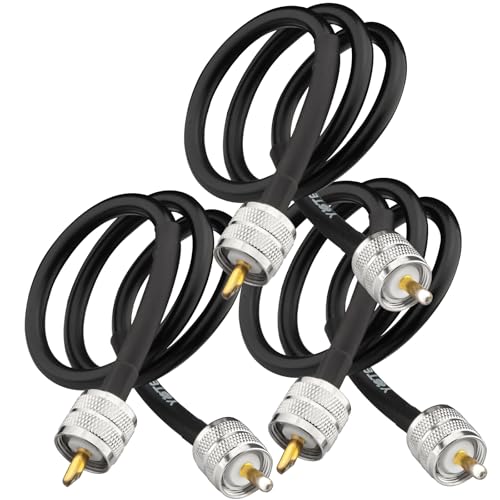
Three short RG8x jumpers for tidy connections between your radio, tuner, and meter — no wasted slack.
When your desk has a radio, an SWR meter, an antenna tuner, and a dummy load all within a foot or two of each other, a long coax cable is just wasted slack that clutters your workspace. This 3-pack gives you three 2-foot RG8x cables with PL259 male on both ends, purpose-built as patch cables between equipment. The cable is flexible enough to bend around tight corners without straining the connectors.
The RG8x braid uses 128 strands of 0.12mm aluminum wire for low loss — at 50 MHz the loss is only 0.44dB per cable, and the VSWR is ≤ 1.12. Each connector has 6cm of heat shrink to prevent the PL259 from pulling off. One buyer reports using these as jumpers on a 100-watt HF setup (radio to tuner to meter) and found they work well with decent quality fittings and nice flexibility. Another reviewer noted that while the cables work well, the packaging crammed all three into a small bag, so one arrived damaged; ordering a boxed shipment method may help.
Unlike the SUPERBAT kit below, these are pure RG8x cables with no adapter set, so they are specifically for gear that already has PL259 sockets.
Jumper strengths
- Very low loss at CB frequencies (0.44dB at 50MHz)
- Flexible enough for tight desk layouts
- Three cables cover a full radio-tuner-meter chain
Watch out for
- Packaging may damage cables in transit
- No adapters — not for gear with SMA or BNC ports
Ideal for a clean shack layout: If your equipment sits within a few feet and you want to eliminate long, coiled coax loops, these jumpers keep your setup tidy and your signal clean.
Not a main cable: At only 2 feet each, these are exclusively for interconnection between devices, not for the main radio-to-antenna run.
7. SUPERBAT CB Coax Cable UHF PL259 RG58 15ft + 3 Adapters

A simple 15-foot RG58 kit with adapters for a first-time CB setup — low risk and affordable.
If you are new to CB or ham radio and just need a basic cable to get your radio talking to your antenna and SWR meter, this SUPERBAT kit is a low-risk starting point. You get a 15-foot (16.4 feet actual) RG58 cable with PL259 male on both ends, plus three adapters: a UHF female-to-female SO239 coupler, an SMA male-to-UHF female bulkhead, and a BNC male-to-UHF female bulkhead. This cable is 16.4 feet long, compared to the 49.2-foot Ham Radio kit, and includes three adapters instead of four.
The 50-ohm RG58 cable is rated for over 1,000 mating cycles on the connectors. It works as a PL259-to-PL259 jumper or as an SMA/BNC-to-PL259 cable using the adapters. Owners mention the build quality seems good and it is a good value for the money; one ham radio operator specifically noted it “works fine for jumpers between radio, tuners and amplifier at 10 meter band and down.” Another reviewer simply called it a “good cable that solved my problem.”
The trade-off is that RG58 has more signal loss than RG8x, so for any run longer than a few feet or for high-power operation, you will notice it. But for a simple starter setup or for short jumper duty, it gets the job done affordably.
Starter perks
- Includes 3 useful adapters for versatile connectivity
- Build quality praised by buyers as good for the money
- Short length works well for desk or bench setups
The limits
- RG58 cable has higher loss than RG8x for longer runs
- At only 15 feet, not suitable for base station runs
For the newcomer or bench: A cheap, functional kit that lets a first-time CB owner connect their radio to an antenna or SWR meter without buying adapters separately.
Skip it for serious setups: If you run more than 50 watts, plan a permanent outdoor antenna, or want the lowest signal loss, pay more for an RG8x or KMR400 cable.
Understanding the Specs
RG58 vs RG8x vs KMR400 (LMR400)
The cable type tells you the thickness of the inner conductor and the amount of signal loss per foot. RG58 is the thinnest (around 20AWG center conductor) and loses the most signal — fine for short jumpers under 10 feet, but a bad choice for a 50-foot run. RG8x is thicker (17AWG to 16AWG) and is the standard for most CB base stations and mobile installs up to about 60-70 feet. KMR400 (equivalent to LMR400 and RG8u) is the thickest of the three, with very low loss at UHF frequencies, designed for runs of 25 feet or more where you cannot afford to lose power.
SWR (Standing Wave Ratio)
SWR measures how much of your radio’s power is reflected back from the antenna instead of being transmitted. A perfect match is 1.0:1. For CB work, an SWR under 1.5:1 is good, and under 1.2:1 is excellent. A high SWR (above 2.0:1) can damage your radio’s final amplifier. A well-made coax cable with proper connectors helps keep SWR low — one of the cables here was measured at 1.1 SWR across most bands. Always check your SWR after installing a new cable.
FAQ
Will any coax cable work with my CB radio?
What is the difference between RG58 and RG8x for CB?
Can I use a longer coax cable than I need?
How long does a CB coax cable last outdoors?
Do I need a special coax for a mobile CB in a vehicle?
What are jumper cables used for in a ham shack?
Can I cut a pre-terminated coax cable to a shorter length?
What does “50 ohm” mean for coax cable?
Final Thoughts: The Verdict
For most buyers, the best coax cable for cb is the MOOKEERF KMR400 25ft because it delivers the lowest signal loss in a ready-to-run package that suits a base station or a long mobile run. If you want the flexibility of a multi-adapter kit at a useful length, grab the Ham Radio RG58 49.2ft Kit. And for a budget-friendly mobile install that handles weather, the Ullnosoo 18ft RG8x is a practical choice that will not let you down.
How We Picked
We do not accept paid placement. Every pick is matched to a real buyer and a real use-case; we do not hands-on test units.
Sources & Methodology
Specifications: manufacturer listings and product documentation. Review insights: verified customer reviews, as of July 2026. Pricing: not shown on this page (it changes often); check the current price via the retailer link.
As an Amazon Associate, WellFizz earns from qualifying purchases. This does not affect which products we feature.
Related Guides

Mo Maruf
I created WellFizz to bridge the gap between vague wellness advice and actionable solutions. My mission is simple: to decode the research and give you practical tools you can actually use.
Beyond the data, I am a passionate traveler. I believe that stepping away from the screen to explore new environments is essential for mental clarity and physical vitality.