Our readers keep the lights on and my smoothie glass nicely filled. As an Amazon Associate, I earn from qualifying purchases.
Specs are compiled from manufacturer listings and verified buyer reviews and can change over time — please confirm the key details on the product page before buying.
Finding a reliable coating for your rubber roof can feel like a gamble — you want something that actually sticks to EPDM or TPO, stays flexible in the heat and cold, and doesn’t peel up after a single summer. This guide cuts through the confusion, breaks down the real specs that matter, and shows you exactly which formulas solve the common problems of blistering, cracking, and poor coverage so you can stop re-coating every season.
I’m Mohammad Maruf — the founder and writer behind WellFizz. This guide is built by comparing the manufacturers’ published specifications and the patterns across verified customer reviews, so you get each pick’s real strengths and trade-offs instead of marketing spin.
If you own an RV, travel trailer, or a flat-roofed structure covered in EPDM or TPO, the right coating for rubber roof saves you from messy leaks and costly water damage by forming a flexible, waterproof barrier that stays intact for years.
Our Picks at a Glance
How To Choose The Best Coating For Rubber Roof
The biggest mistake most people make is grabbing any white sealant thinking it will bond to EPDM rubber. It won’t — not without the right chemical prep. A good coating needs a primer (especially on EPDM) to create a surface the liquid rubber can grip. Here are the three things you must check before you buy.
Silicone vs. Acrylic — Which Base Is Right for Your Roof?
Silicone coatings are naturally UV-stable and stay flexible for years, but you cannot recoat them easily — new silicone won’t stick to old silicone without a special primer. Acrylic (elastomeric) coatings bond better to existing roof materials and can be recoated more simply, but they may chalk or erode faster under direct sunlight. Look at your climate: if you get scorching summers and want the sun’s heat bounced away, a silicone with high solar reflectance is stronger; if you plan to re-coat every few years, an acrylic formula gives you more flexibility.
Coverage Rate and Film Thickness — Don’t Just Count Gallons
A coating that claims to cover 50 square feet per gallon is not skimping — it is telling you the minimum film thickness needed for a waterproof seal. Spread a gallon too thin over a bigger area and you get a skim coat that cracks under the first freeze. The rule of thumb: apply heavy, allow 2–3 coats, and wait the full cure time (usually 24 to 48 hours) between coats. If a product says “1 gallon covers 50 sq ft,” respect that number — it is the floor, not the ceiling.
Surface Compatibility — EPDM, TPO, and Fiberglass All Play by Different Rules
EPDM rubber roofs require a primer before coating — no exceptions. TPO and fiberglass are friendlier but still benefit from a cleaner and primer for long-term adhesion. Check the product’s compatible material list. If it says “EPDM” but does not include a primer recommendation in the description, assume you need to buy a separate primer to avoid bubbling or delamination later. A kit that includes a dedicated EPDM primer, seam tape, and lap sealant is often the safest bet for first-time users.
Quick Comparison
| Model | Best For | Coverage | Base Material | Item Weight | Amazon |
|---|---|---|---|---|---|
| Xmntdo Polyurethane★ Best Overall | Budget-friendly fresh coat | 50 sq ft | Polyurethane | — | Amazon |
| Liquid Rubber 30 Ft KitAlso Great | Complete tear-off replacement | 30 ft RV (5G pail) | Water-Based (Zero VOC) | 40 Pounds | Amazon |
| BEEST Silicone 5 Gallon | Long-term solar reflection | 167 sq ft (2 coats) | Silicone | 50.4 Pounds | Amazon |
| BEEST Acrylic 1 Gallon | General re-coating (small rigs) | 50 sq ft | Acrylic Elastomeric | 10 Pounds | Amazon |
| Flex Seal Liquid | Spot repairs & small patches | — | Rubber | 11.3 Pounds | Amazon |
In‑Depth Reviews
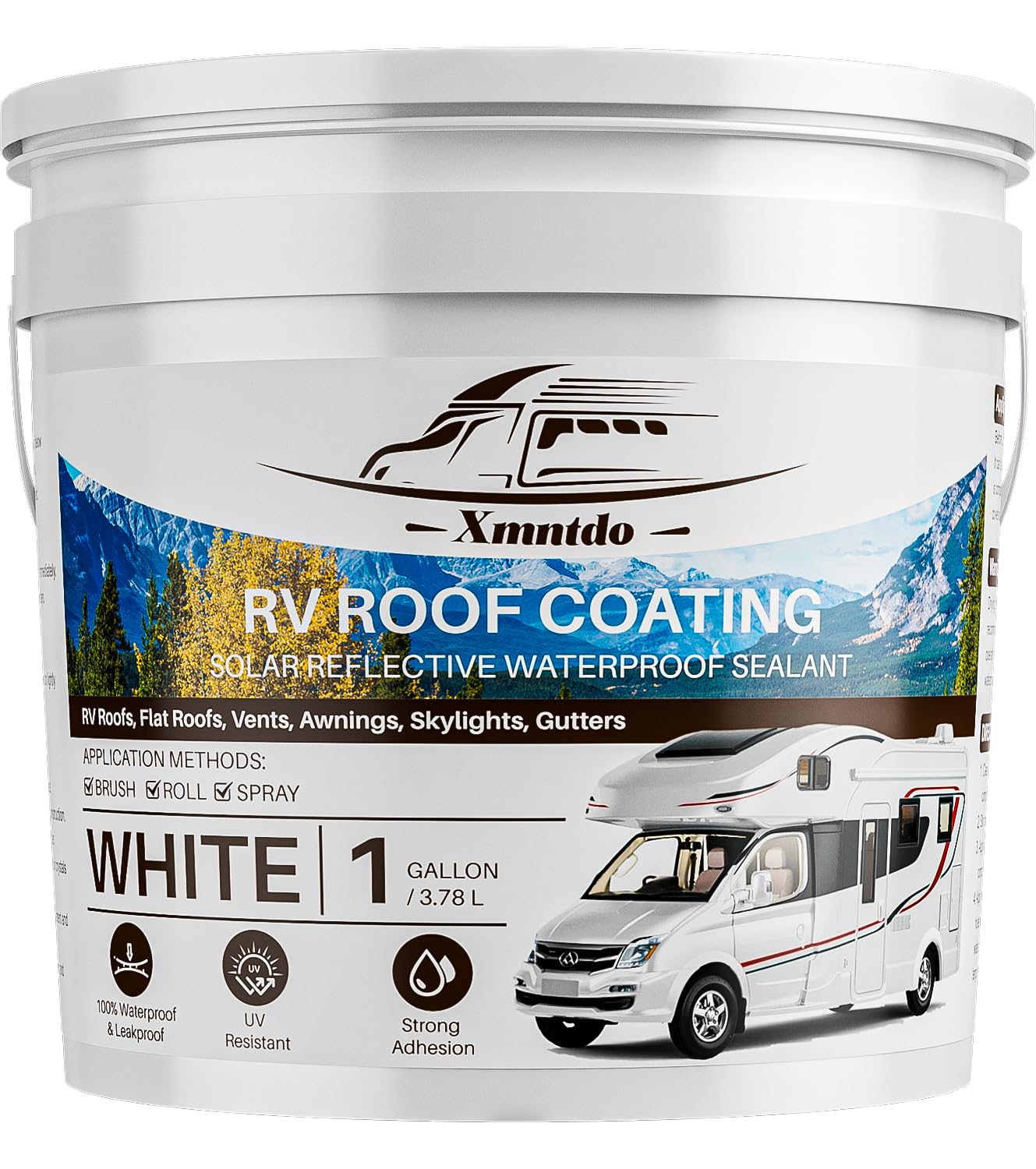
1. Xmntdo RV Roof Coating White 1 Gallon
Our pick — over 4★ from 750+ verified ratings; the strongest balance of quality and price.
An entry-level polyurethane coating that covers the basics without frills or a high price tag.
This white polyurethane formula is designed specifically for RV roofs and works with EPDM, TPO, fiberglass, and aluminum surfaces. It covers 50 sq ft per gallon, and the maker suggests applying a second coat after 24 hours for best waterproofing. The item dimensions are 8.3 x 7.3 x 8.4 inches, making it compact enough to store alongside your other RV supplies. It is a heat-reflective white coating that can reduce the surface temperature of your roof — the data says it “surpasses basic rubber roof repair kits” in heat reflection. The self-leveling formula means it flows into gaps without requiring a ton of brush work.
A practical detail: the recommended application temperature is above 50°F (10°C), including overnight temperatures, and full curing needs 24–48 hours depending on thickness and humidity. Buyers appreciate that it dries to the touch in 4–6 hours, letting you move around the roof more quickly on the second day. The catch is that it is a polyurethane base, not a true liquid rubber — it will be less flexible than a pure silicone or acrylic formulation, so on older roofs that flex heavily with temperature swings, you may see cracking over time. It pairs with an EPDM primer for rubber roofs, which is available separately.
Does the basics well
- Self-leveling formula reduces brush marks and fills small surface cracks automatically.
- White color provides solar reflectance to lower roof temperature and interior heat.
- Quick dry time of 4-6 hours to touch allows multi-coat work in a single weekend.
Know the limits
- Polyurethane base is less flexible than silicone or acrylic, risk of cracking on moving roofs.
- No primer or seam tape included — a separate EPDM primer is recommended for best adhesion.
- Only 768 ratings with 4.4 stars, so long-term durability is less proven than BEEST or Liquid Rubber.
Reach for it if: you need a low-cost white coating for a small, stable fiberglass or aluminum roof that does not flex much.
Pass if: you have a large EPDM rubber roof on a travel trailer that expands and contracts — the acrylic or silicone options will stretch better.
2. Liquid Rubber RV Roof Coating 30 Ft Leak Repair Kit
This 5-gallon kit delivers a fully sealed roof in a single weekend with zero guesswork.
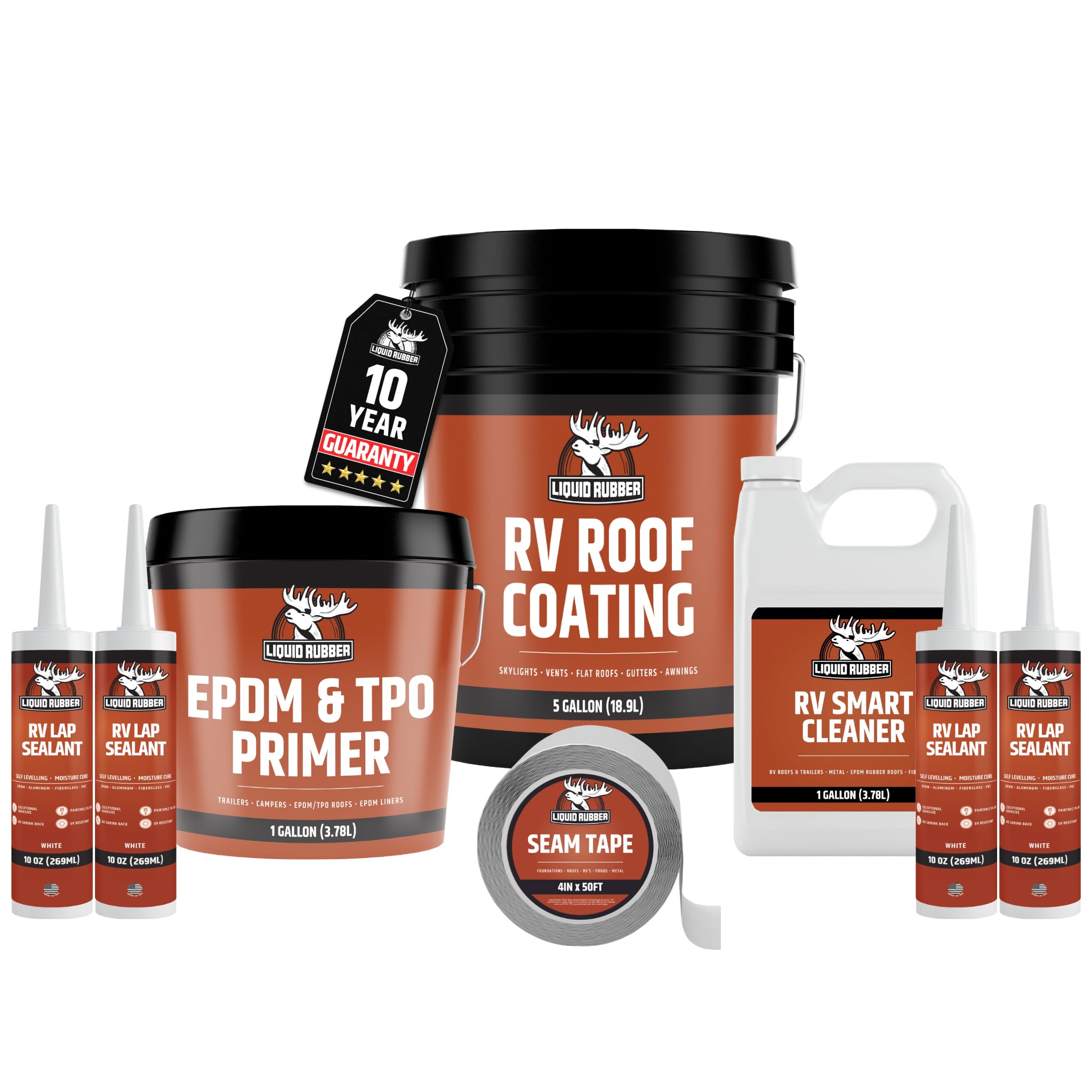
You get everything — the 5G pail of roof coating, a dedicated EPDM primer, four lap sealants, and seam tape — so you are not chasing separate products. That all-in-one system is the real draw here. The coating itself is a water-based (zero VOC) formula, meaning no strong solvent fumes inside your camper while it dries. You roll it on like paint: one gallon covers every 50 sq ft at the recommended thickness. That means the 5-gallon pail handles a full 30-foot RV per the data. The kit includes an EPDM primer that creates a proper bond on rubber surfaces, something many coatings skip entirely.
Buyers report the brilliant white finish noticeably lowers interior temperatures on sunny days thanks to the solar reflective properties, and the flexible seal handles the expansion and contraction of a moving RV without cracking. There is a 10-year durability claim behind this, but keep in mind the manufacturer only accepts full-kit returns — do not tear open the individual bottles expecting to send one back later. This is the strongest choice if you want one order, one method, and a roof that stays dry.
Why it works as a system
- Includes cleaner, EPDM primer, seam tape, and lap sealant — no separate purchases needed.
- Water-based with zero VOC so it is safe to use around people and pets and has less odor.
- Rated for 10 years of protection when applied as directed per the manufacturer.
Know before you buy
- Full kit returns only — you cannot return just the coating if you only use part of it.
- Application temperature must be between 50°F-90°F (10°C-32.2°C), limiting cold-weather work.
- Heavy at 40 pounds, so moving the pail up a ladder takes planning.
Grab it if: you want a complete, factory-like restoration kit that includes primer and seam tape for a low-maintenance EPDM application.
Think twice if: you only have a small patch or a 20-foot camper — a single gallon kit would be less waste and easier to handle.
3. BEEST RV Roof Coating Silicone White 5 Gallon
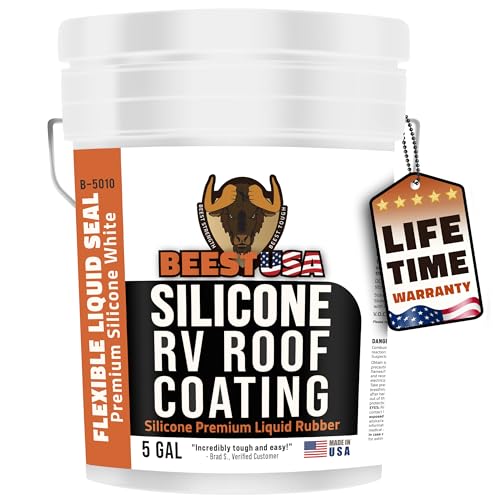
A self-leveling pure silicone formula that bounces off UV rays and stays flexible for years.
Unlike the acrylic version from the same brand, this one uses a silicone base. That matters because silicone is inherently UV resistant — it does not chalk or become brittle under constant sun, making it a better long-term bet for hot climates. It covers up to 167 sq ft with two coats, and you can brush, roll, or spray it on. At 50.4 pounds per 5-gallon pail (the Liquid Rubber kit weighs 40 pounds), it is heavier., but that weight is partly the denser solid content that builds the waterproof film. The data says it is self-leveling, so it flows into small cracks and gaps without you having to spread everything manually.
BEEST recommends using their own roof cleaner and multipurpose primer before application, and they specifically note that EPDM roofs MUST use a primer. A trade-off to consider: once you put a silicone coating down, recoating with another silicone layer later requires careful surface prep because silicone does not easily stick to cured silicone. Owners mention the initial cure is quick — 2 to 4 hours between coats — but you need the full 48 hours before the roof can handle rain or heavy dew. This is a high-end pick for owners who park their rigs in open sun and want the coating itself to do the heavy lifting on heat reflection.
Built for sun exposure
- Silicone base is naturally UV stable and resists degradation from constant sunlight.
- Self-leveling formula fills minor surface imperfections without extra work.
- Ultra low VOC and safe for indoor and outdoor use around pets and people.
Plan your prep
- EPDM roofs require a dedicated primer before application — do not skip it.
- Recoating silicone over old silicone is difficult without a special bonding primer.
- Heaviest in the lineup at 50.4 pounds, which can be awkward on a ladder.
Reach for this if: your RV sits in full sun all season and you need UV protection that outlasts acrylic formulations.
Look elsewhere if: you plan to re-coat every year or two — acrylic is easier to reapply over itself and costs less upfront.
4. BEEST RV Roof Coating White 1 Gallon

A mid-range acrylic that gets the job done without the heavy price tag of pure silicone.
If you do not need the five-gallon volume or the silicone chemistry of the larger BEEST, this single gallon of acrylic elastomeric coating is a sensible pick. It covers 50 sq ft and weighs just 10 pounds, while the 5-gallon silicone version weighs 50.4 pounds. That weight difference makes a huge difference when you are hauling a bucket up onto a ladder on your own. It bonds to EPDM, TPO, metal, aluminum, fiberglass, and PVC/vinyl surfaces — essentially every common roof and repair surface an RV owner would come across.
Apply the first coat, wait 4 hours, then apply a second coat. Full cure takes 48 hours at temperatures between 40°F-90°F, so you need a clear window in the forecast. Buyers like that it is solvent-free and ultra low VOC, meaning the smell is minimal and you can work in a ventilated space without a respirator. The trade-off is that acrylic is less inherently UV-stable than silicone, so in very high-sun regions you may see some chalking after a couple of years. For the price of a single gallon, though, it is a very accessible starting point for a DIYer who wants professional results without buying a whole kit.
Easy to handle
- Weighs only 10 pounds, making it manageable for one-person application on a roof.
- Compatible with a wide range of surfaces including EPDM, TPO, metal, and fiberglass.
- Ultra low VOC and solvent-free so it is safer for indoor use if needed.
Limitations to note
- Acrylic may chalk or erode faster in direct sun compared to a silicone-based coating.
- Only covers 50 sq ft per gallon, so a larger 30-foot RV would need the 5-gallon pail.
- EPDM roofs still require a separate primer — not included.
Start here if: you have a small camper, pop-up, or a section of roof that needs a fresh coat and you want a lightweight can you can handle alone.
Not your best bet if: your roof is over 150 sq ft or you live in a year-round high-UV area — you need the silicone version or the 5-gallon kit for volume and durability.
5. Flex Seal Liquid Rubber Coating Sealant 1 Gallon

A familiar household name that works best as a targeted patch rather than a full-roof coating.
Flex Seal Liquid is liquid rubber in a can — you brush, roll, dip, or pour it on, and it dries into a watertight, flexible membrane. At 11.3 pounds and a compact package measuring 7.75 x 6.5 x 6.5 inches, it is smaller than the BEEST 5-gallon pail (which is 12 x 12 x 15 inches). That makes it much easier to store in a cramped RV compartment or tool box. It is UV resistant and chemical resistant, and it prevents rust and corrosion on metal surfaces. The black color, however, absorbs heat instead of reflecting it, so it is not ideal for a full roof coating on a camper that bakes in the sun.
Customers note it is excellent for sealing around skylights, vent flanges, and seams where movement is likely. It bonds to rubber, so it works on EPDM patches. But there is no coverage rate listed in the data, and the material type is simply “rubber” without any indication it has the elastomeric or solar-reflective properties of dedicated roof coating products. Use it for spot repairs and edge sealing rather than expecting it to replace a full elastomeric roof coating.
Perfect for small jobs
- Compact 7.75 x 6.5 x 6.5 inch can stores easily in tight spaces.
- Flexible, waterproof membrane that stays sealed around moving joints.
- UV resistant and chemical resistant for harsh environments.
Not for full roofs
- Black color absorbs heat, so it is the wrong choice for a full sun-exposed roof coating.
- No coverage rate or film thickness provided — guesswork on how much to apply.
- Not formulated as a solar-reflective or elastomeric roof coating.
Best for: quick patch repairs around seams, vents, and small cracks where you need a flexible sealant in a small can.
skip it if: you want a full roof coating — you need a product with solar reflectance and a specific coverage rate.
Understanding the Specs
Solar Reflectance (Cool Roof Effect)
This is the spec that makes a white coating actually worth the effort. A coating with high solar reflectance bounces visible light and infrared heat away from your roof surface. That means the rubber below stays cooler, which slows UV degradation, and the inside of your RV or building does not heat up as fast. Look for white or “brilliant white” colors — dark coatings like black or grey absorb heat and make your air conditioner work harder. Every product here except Flex Seal is white for this reason.
Coverage Rate vs. Film Thickness
Coverage rates like “50 sq ft per gallon” exist because the manufacturer has calculated the minimum wet film thickness needed — spread it thinner, and the coat is too weak to seal. If you spread one gallon over 100 sq ft, you get half the recommended thickness. That causes pin-holing, blistering, and early failure. Always follow the stated coverage and plan for 2–3 coats. A pail that says “167 sq ft (2 coats)” is telling you the total square footage you can do with the whole pail at the proper thickness.
FAQ
Can I put a new coating over an old rubber roof coating?
Do I really need a primer for EPDM rubber roofs?
How long does a white coating last on an RV roof?
Can I use a black coating like Flex Seal on my whole roof?
How thick should each coat be when applying?
What temperature range is safe to apply these coatings?
Can I apply rubber roof coating over TPO or fiberglass?
What is the difference between a paint-on coating and a rolled roofing membrane?
Will one gallon be enough to coat my entire RV roof?
Can I apply these coatings in humid or rainy weather?
Final Thoughts: The Verdict
For the majority of shoppers, the coating for rubber roof winner is the Liquid Rubber 30 Ft Kit because it bundles the EPDM primer, seam tape, and lap sealant you actually need for a proper installation, removing all second-guessing about compatibility. If you want the highest solar reflectance and UV resistance for a sun-baked RV, grab the BEEST Silicone 5 Gallon for its self-leveling silicone chemistry. And for a budget-friendly refresh on a small fiberglass or metal roof, the standout is the Xmntdo Polyurethane 1 Gallon if you keep expectations realistic about long-term flexibility.
How We Picked
We do not accept paid placement. Every pick is matched to a real buyer and a real use-case; we do not hands-on test units.
Sources & Methodology
Specifications: manufacturer listings and product documentation. Review insights: verified customer reviews, as of July 2026. Pricing: not shown on this page (it changes often); check the current price via the retailer link.
As an Amazon Associate, WellFizz earns from qualifying purchases. This does not affect which products we feature.
Related Guides

Mo Maruf
I created WellFizz to bridge the gap between vague wellness advice and actionable solutions. My mission is simple: to decode the research and give you practical tools you can actually use.
Beyond the data, I am a passionate traveler. I believe that stepping away from the screen to explore new environments is essential for mental clarity and physical vitality.